
.webp)
Best Practices for AI Travel Lead Scoring


AI travel lead scoring helps travel businesses predict which leads are most likely to book trips and generate revenue. By analyzing data like browsing behavior, booking history, and engagement signals, it assigns scores to prioritize high-value leads. This approach enables sales teams to focus on serious prospects, improving booking rates and ad efficiency.
Key Steps for Success:
- Set Clear Goals: Define objectives like increasing booking rates or boosting trip value.
- Organize Data: Clean and standardize data from sources like CRMs and booking systems.
- Build Smart Forms: Use multi-step forms to collect relevant lead details like budgets, travel dates, and trip types.
- Train AI Models: Use historical data (6–12 months) to account for trends and seasonality.
- Integrate Scoring with Tools: Sync scores with CRMs and marketing platforms for real-time updates.
- Monitor Performance: Track metrics like conversion rates and booking values by score bands (e.g., hot, warm, cold).
- Refine Regularly: Update forms, retrain models, and adjust scoring logic based on results.
Using AI models tailored to the travel industry ensures businesses can act quickly on leads, especially during peak booking periods. This strategy not only improves efficiency but also helps capture higher-value bookings.
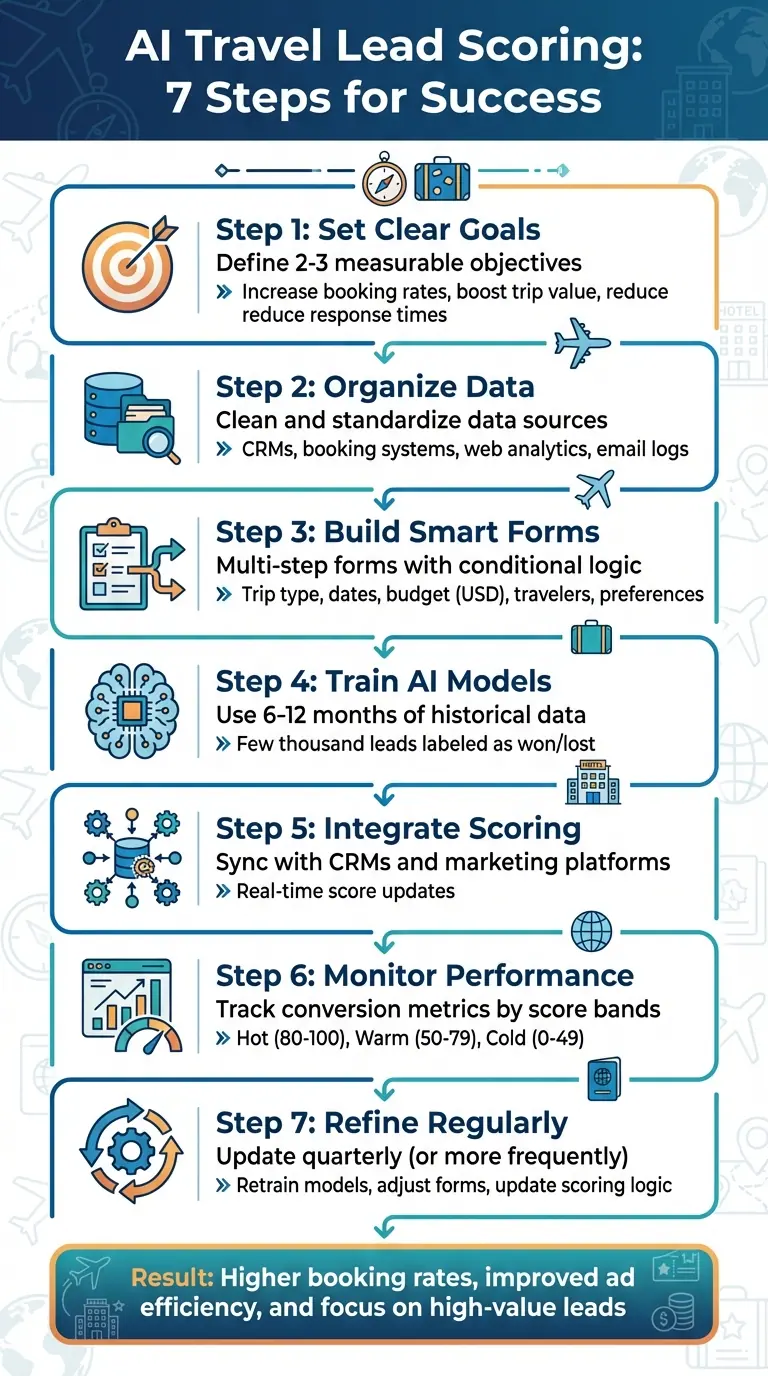
7-Step AI Travel Lead Scoring Implementation Process
Set Goals and Prepare Your Data
Start by setting clear objectives and organizing your data. Focus on 2–3 measurable goals, such as increasing booking conversions, boosting the average trip value (in USD), or reducing response times. These goals will directly influence how you define a "qualified travel lead." For instance, if your aim is to maximize revenue, a qualified lead might be someone planning a trip worth over $2,000, with confirmed travel dates, and strong engagement markers like repeated destination views or quote requests. Once your goals are set, define what constitutes a qualified lead to help your AI model prioritize effectively.
Define What Makes a Qualified Travel Lead
A qualified travel lead typically shows clear intent - like checking availability, initiating a quote, or abandoning a booking late in the process. Several factors can help you determine lead quality, including trip type (leisure, corporate, group, or MICE), minimum trip value in USD, travel dates and flexibility, number of travelers, and whether the contact is the decision-maker.
For example:
- A leisure lead might qualify if they have a round-trip planned within the next 90 days, a budget of at least $2,000, have viewed the same destination three or more times, and identify as the decision-maker.
- A corporate lead, on the other hand, might require a minimum estimated annual travel spend of $50,000+, a role like travel manager or procurement contact, and interest in negotiated contracts.
Review and Clean Your Data Sources
Gather data from first-party sources like your CRM, booking records, web analytics, email logs, chat transcripts, and form submissions. Before feeding this data into your AI model, ensure it’s clean and well-organized. Assign each lead a unique ID, merge duplicate entries, and standardize key fields like phone numbers and country formats. Consistently label outcomes (e.g., "won", "lost", "no show") for past opportunities, as missing or inconsistent labels can reduce model accuracy.
Also, ensure critical signals are complete - gaps in essential fields can hurt your results. For compliance with U.S. privacy standards, document consent sources (like form checkboxes or email opt-ins), respect unsubscribe and do-not-call preferences, and use role-based access controls in your CRM. Once your data is clean and standardized, you can confidently move forward to build forms that capture the most relevant lead details.
Build Forms That Capture the Right Lead Information
Your forms should collect essential details, such as:
- Trip type (leisure, corporate, group, etc.)
- Destination(s) and travel dates (formatted as MM/DD/YYYY)
- Budget in USD (e.g., "$2,000–$4,999")
- Number of travelers and room preferences
- Accommodation or flight preferences
- Purpose of travel
- Role of the contact (traveler, travel manager, decision-maker)
To improve completion rates, consider using multi-step forms with tools like Reform. These forms can reduce drop-offs while gathering all necessary information. Use hidden fields to automatically capture UTM parameters, campaign IDs, landing page URLs, and referral sources, giving your AI model additional context without overwhelming users. Features like lead enrichment, email validation, and spam prevention can further enhance data quality at the point of entry. Conditional logic can also streamline the process - for instance, only ask for "annual travel budget in USD" if "corporate travel" is selected. Real-time analytics on form performance will help you refine your questions, ensuring you only ask what’s necessary for scoring leads effectively.
To train your AI model, you’ll need a dataset of at least a few thousand historical leads, labeled as either won vs. lost or booked vs. abandoned. Include profile details, trip data, engagement signals, and revenue figures for successful deals. Ideally, gather 6–12 months of data to account for seasonal trends, such as summer vacations or holiday travel. This variety ensures your model won’t lean too heavily on a single segment. Clean data and well-designed forms are the foundation for accurate, dynamic lead scoring that evolves as travelers interact with your business.
Build Your AI Lead Scoring Model
Now that your data is clean and your forms are optimized, it’s time to create your AI lead scoring model. This model will help you generate actionable, real-time scores for travel leads, giving you a clearer sense of who’s ready to book and who might need more nurturing.
Choose Your Scoring Method and Timeframe
The first step is to pick a scoring method that aligns with your business model. Here are a few options:
- Predictive Scoring: Ideal if you have plenty of historical data. This method uses machine learning to predict booking likelihood based on past outcomes.
- Behavioral Scoring: Focuses on tracking real-time engagement signals like destination searches, quote requests, and page visits. It’s perfect for businesses where decisions happen quickly.
- Account-Based Scoring: Best for corporate or group travel, where you’re evaluating companies or organizations rather than individuals.
For many, starting with a hybrid model - combining rule-based and predictive approaches - works well. As your data matures, you can transition to a fully AI-driven system. Also, set a prediction window that fits your typical travel decision cycles. For example, a 30-day window might work for most trips, but for luxury or long-haul travel, you may need to extend it to 60 or 90 days. A clear timeframe ensures your AI focuses on leads actively planning trips instead of casual browsers.
Once your scoring method is in place, it’s time to add travel-specific data points.
Add Travel Industry Data Points
Your scoring model needs to be fed with relevant, travel-specific metrics to deliver accurate results. Here’s what to include:
- Engagement Signals: Track metrics like destination page views, time spent comparing options, fare alert sign-ups, and repeat visits.
- Trip Details: Include information such as destination, travel dates (use MM/DD/YYYY format), trip duration (in nights), and party size.
- Value Indicators: Capture data like budget ranges (e.g., "$2,000–$4,999"), preferred cabin class, room type, and interest in extras like tours or travel insurance.
Don’t forget to account for seasonality. For example, weigh signals from major U.S. travel periods like summer, Thanksgiving, Christmas, and spring break more heavily. Booking lead time is another key factor - someone checking availability within 14 days is more likely to book soon than someone planning 90+ days out. Finally, include relationship data like loyalty tier, past booking frequency, total spending history, and satisfaction scores. With this wealth of data, your AI can analyze thousands of behavioral signals to pinpoint which leads are ready to book and which need more attention.
The next step is to translate these insights into actionable score ranges and lead stages.
Set Up Score Ranges and Lead Stages
Use a simple 0–100 scale to categorize lead quality. For example:
- Hot Leads (80–100): These are ready for immediate follow-up.
- Warm Leads (50–79): Place these leads into targeted nurture campaigns with personalized destination content and time-sensitive offers.
- Cold Leads (0–49): Send occasional inspiration emails to keep these leads engaged.
Map these score ranges to different stages of the traveler journey. For instance:
- Research/Inspirational Stage: Leads here are browsing broadly, exploring destination guides, and gathering ideas.
- Planning/Consideration Stage: These leads are comparing dates and prices, reading reviews, or building wishlists.
- Booking Stage: At this point, leads are checking availability, entering traveler details, or requesting quotes.
- Pre-Arrival Stage: These leads have already booked and are engaging with itinerary details or add-ons.
Regularly review how leads in each score range are converting. If your "hot" leads aren’t converting as expected, revisit your data inputs or adjust the thresholds. This ongoing fine-tuning ensures your model stays accurate as traveler behavior and market trends shift over time.
Connect AI Scoring to Your Daily Operations
For your AI scoring model to make a real impact, it needs to seamlessly integrate with the tools your team already depends on - like your CRM, booking platform, and marketing automation systems. By embedding scores into these systems, you can turn data into meaningful actions that drive results.
Connect to Your CRM and Marketing Systems
Integrate your AI scoring model directly into the platforms your team uses daily. Sync the scoring engine with your travel CRM, booking software, and marketing tools. Add fields like "AI Lead Score", "Score Band", "Travel Segment", or "Predicted Trip Value (USD)" to your CRM so advisors can quickly reference key insights. Use a unique traveler ID across all systems to ensure that scores and updates flow accurately in near real time. This way, your team can act on fresh signals, such as fare searches or quote requests, without delay.
Establish a two-way data flow: your website, forms, and analytics feed behavioral data - like destination searches, cart values (in USD), and past spending - into the AI model. In turn, the model updates downstream systems with refreshed scores, segments, and actionable recommendations for advisors and marketers. Build CRM dashboards that highlight high-scoring leads and key activities, such as "Viewed New York–Paris fares 3+ times" or "Abandoned family package quote." This visibility helps your team focus on leads most likely to book soon, rather than wasting time on cold prospects. By connecting your lead data collection to daily operations, you create a system that drives smarter, faster decisions.
Set Up Automatic Lead Routing and Follow-Up
Put your AI scores to work by automating lead routing to the right teams. For example, if a lead's email domain and firmographics suggest corporate interest with a strong likelihood of booking, route it to your corporate sales team. If the data points to family vacations and school holidays, send it to your leisure specialists. You can define routing rules based on score bands and segments: high-scoring corporate leads (above 80) might go to a dedicated account executive, while mid-range leisure leads (scores between 50 and 79) could be assigned to a general advisor pool. Lower-scoring leads can remain in automated nurture campaigns.
For leads with a predicted trip value exceeding $5,000, prioritize them for follow-up within 15 minutes during U.S. business hours. Attach tailored follow-up playbooks to each score tier: high scores prompt immediate, personalized outreach (via phone or one-on-one email) with specific itinerary suggestions, while mid-range scores enter email or SMS journeys that align with their interests and budget. Low scores receive lighter, inspirational content to gradually build interest. Monitor metrics like open rates, clicks, and bookings by score band to fine-tune your outreach strategies, channels, and offers.
Match Your Forms to Your Scoring Model
Your forms should collect the exact data your AI model needs to generate accurate scores. Keep forms simple and progressive - start with essential fields, then use multi-step flows for high-intent visitors to reduce drop-offs. Tools like Reform make this process easier by enabling you to design multi-step travel inquiry forms. Gather predictive data early, such as destination, travel dates, and approximate budget, and save secondary questions - like preferred airlines or hotel ratings - for later steps.
Reform’s conditional routing lets you tailor questions to the type of lead. For instance, ask for a company name if the lead is corporate, or request children’s ages for leisure leads. Features like email validation, lead enrichment, and spam prevention improve data quality. Real-time analytics on form drop-off rates allow you to experiment with different designs and measure how they affect both conversion rates and scoring accuracy. By aligning your forms with your scoring model, you ensure that every piece of data collected feeds directly into actionable insights.
As Justin Jackson, Co-founder of Transistor.fm, shared: "Early user of Reform here! Loving the simplicity; I've already switched some things from Typeform to Reform."
sbb-itb-5f36581
Track Performance and Improve Your Model
Your AI scoring model needs to keep pace with the ever-changing travel landscape. Trends shift with the seasons, new destinations become popular, and traveler preferences evolve. To stay accurate, it's essential to monitor performance regularly and adjust based on real-world results.
Measure Results by Score Category
Divide your leads into score bands: 0–40 (cold), 41–70 (warm), and 71–100 (hot). Then, track key metrics within each group. These metrics should include:
- Booking conversion rate: The percentage of leads that eventually book a trip.
- Average booking value: The total spend in USD, covering flights, hotels, and extras.
- Time from inquiry to booking: How long it takes for a lead to convert.
High-score leads should show significantly higher conversion rates and revenue compared to lower bands. If the metrics look the same across all groups, your model might not be effectively distinguishing serious buyers from casual browsers.
To monitor this effectively, set up score-banded reports in your CRM or business intelligence tool. Refresh these reports daily, and analyze performance on a weekly or monthly basis. Use U.S. date formats (e.g., 01/31/2025) and segment results by key categories like leisure versus corporate travel, domestic versus international trips, or specific origin markets. This level of detail helps you determine if high-scoring leads are driving more bookings and revenue - or if your scoring logic needs adjustments. This analysis lays the groundwork for deeper accuracy testing.
Test Model Accuracy Regularly
To ensure your model is working as intended, compare predicted scores with actual bookings and revenue. Use hold-out validation sets and ongoing back-testing to measure performance. For example, if the top 25% of leads by score account for 70% of your revenue, your model is likely doing well. If not, it's worth investigating further.
Pay close attention to false positives and negatives - leads that were misclassified. Look for patterns in destinations, booking channels, or price ranges that might be causing errors. Additionally, check for unintended bias by analyzing performance across traveler segments, such as age, location, language, device type, or trip type (e.g., family, solo, corporate). For instance, if travelers from a specific region consistently receive lower scores despite similar booking rates, the model might be reflecting historical trends rather than current intent.
Since travel demand is influenced by seasons, events, and market conditions, check for model drift at least quarterly. During times of rapid change - like new route launches or post-crisis recovery - review your model more frequently. These insights will help you make timely updates to both your forms and scoring model.
Update Form Fields and Retrain Models
Building on earlier efforts to optimize forms, use performance data to refine your lead capture process. Identify which form fields are strongly linked to high scores and actual bookings. Key fields might include confirmed travel dates, budget range in USD, home airport, trip type, or loyalty program membership. If certain fields are rarely completed, often inaccurate, or show no correlation with bookings, consider simplifying or removing them to reduce friction. On the other hand, you can add fields that signal intent, like "Are your dates flexible?" or "How soon are you planning to book?" Test these changes with A/B experiments to ensure they improve data quality without hurting conversion rates.
Retrain your model every quarter as a baseline, and more frequently during seasonal shifts, new product launches, or market expansions. Use the most recent 6–12 months of data, giving more weight to recent trends to better reflect current traveler behavior. Keep a detailed log of training dates, data windows, feature changes, and performance metrics. Also, document any updates to forms, routing rules, or service level agreements so that your sales and marketing teams can interpret and use the scores effectively. This documentation is invaluable for troubleshooting, onboarding new team members, and maintaining compliance with internal policies.
Tools like Reform can simplify the process of testing and iterating on multi-step forms, conditional questions, and lead enrichment fields - without requiring engineering support. Leveraging advanced form features can help you collect cleaner, more accurate data, which in turn improves your model's performance. By combining flexible forms with a robust AI scoring system, you can continuously refine how you capture and interpret traveler signals, keeping your strategy sharp and effective.
Conclusion
AI-driven travel lead scoring equips travel brands with the tools to zero in on high-value prospects. By defining what makes a qualified lead, cleaning up data, building a scoring model, integrating it with your CRM, and continuously fine-tuning the process, businesses can achieve higher conversion rates, improve sales efficiency, and see a stronger return on investment.
The foundation of effective lead scoring is high-quality, structured data. Accurate form inputs enable AI to differentiate serious planners from casual browsers. Key details - like destination preferences, travel dates, budget in USD, group size, and trip purpose - help the AI prioritize leads effectively. On the flip side, inconsistent or incomplete data can derail the scoring process. Tools like Reform help travel businesses capture better data with user-friendly, multi-step forms. Features like conditional logic, real-time email validation, and lead enrichment ensure cleaner inputs. Plus, seamless integrations with CRM and marketing platforms mean that lead data flows directly into scoring and routing workflows, enhancing both the AI model’s performance and operational efficiency.
Switching from static rules to predictive models offers measurable benefits. Predictive scoring improves lead-to-booking ratios and makes ad spending more efficient by focusing outreach on segments most likely to convert. Tracking metrics like conversion rate, revenue per lead, and cost per booking by score category provides clear evidence of ROI. And here’s the good news: you don’t need perfect data or a massive budget to get started. Begin with a basic qualified lead profile, refine key form fields, and test a simple AI model alongside your current rules. As you see results, you can scale up.
In the competitive U.S. travel market, where demand fluctuates with seasons, AI helps agencies, tour operators, and hospitality brands stay ahead. By prioritizing leads based on both their likelihood to convert and their potential trip value, businesses can capture stronger traveler signals and secure more predictable revenue streams. Pairing optimized forms with advanced AI scoring isn’t just a strategy - it’s a game-changer.
FAQs
How does AI-powered lead scoring help boost travel booking conversions?
AI-driven lead scoring takes booking conversion rates to the next level by pinpointing and prioritizing the most promising leads through predictive analytics. By diving into customer behavior, preferences, and past interactions, AI assigns scores to leads, allowing travel businesses to zero in on those most likely to book.
This focused strategy doesn't just save time - it also opens the door to personalized marketing. Think tailored offers, customized follow-ups, and outreach that genuinely connects with potential customers. The payoff? A smoother sales process and a better chance of turning interested prospects into confirmed bookings.
What key data should be used to train an effective AI lead scoring model in the travel industry?
To build a strong AI lead scoring model for the travel industry, you need reliable, targeted data that mirrors customer habits and preferences. The most important data points to consider include:
- Demographics: Details like age, location, income range, and preferred travel styles.
- Behavioral patterns: Website activity, search queries, and booking history.
- Engagement insights: Metrics such as email open rates, clicks, and responses to campaigns.
- Purchase trends: Booking frequency, types of trips, and average spending amounts.
By integrating these data points, the model can better identify quality leads, focus on promising prospects, and enhance conversion rates. Regularly updating and cleaning the data is essential to keep predictions accurate and useful.
How often should AI lead scoring models be updated for accuracy in the travel industry?
AI lead scoring models in the travel industry need consistent updates to stay accurate and relevant. Ideally, these models should be reviewed and retrained every 3 to 6 months. The exact timing depends on factors like the amount of data you're working with and how quickly customer preferences or market trends shift.
It's also crucial to keep an eye on performance indicators such as model accuracy and lead conversion rates. If you see a noticeable decline in these metrics, it’s a clear signal to refresh your model sooner. Regular updates help ensure your lead scoring system remains effective at identifying and converting potential customers.
Related Blog Posts
Get new content delivered straight to your inbox

The Response
Updates on the Reform platform, insights on optimizing conversion rates, and tips to craft forms that convert.




Drive real results with form optimizations
Tested across hundreds of experiments, our strategies deliver a 215% lift in qualified leads for B2B and SaaS companies.
