
.webp)
Best Practices for Lead Nurturing Workflow Cadence



When it comes to lead nurturing, timing is everything. The frequency and timing of your outreach - your cadence - can determine whether a lead stays engaged or goes cold. Here's the key takeaway:
- 73% of B2B leads aren't ready to buy immediately, so nurturing them with the right cadence is crucial.
- Over-communicate, and you risk annoying your prospects. Wait too long, and they may forget your brand.
The solution? Use behavior-based strategies to adjust your cadence dynamically. For example:
- Leads showing high intent (e.g., visiting a pricing page) need faster follow-ups.
- Less engaged leads require slower, less frequent outreach.
Quick Tips:
- Start with 1–2 touches per week for early-stage leads.
- Use a 3-day interval for high engagement periods.
- Extend follow-ups over 17–21 days for balanced outreach.
- Incorporate multiple channels (email, LinkedIn, phone) to improve response rates by 63%.
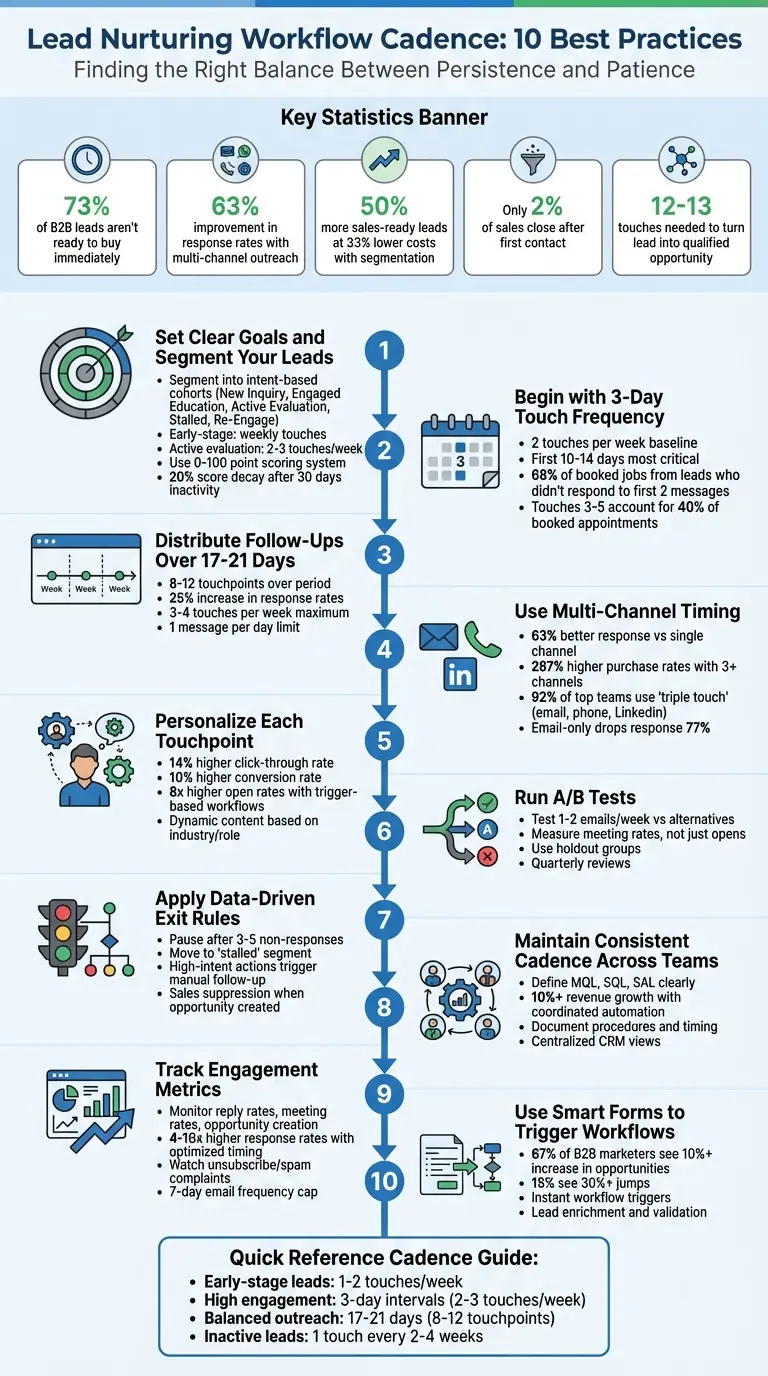
Lead Nurturing Workflow Cadence Framework: 10 Best Practices
The Perfect Sales Cadence for Inbound Lead Generation
sbb-itb-5f36581
1. Set Clear Goals and Segment Your Leads
To create an effective cadence, start by defining your goals and segmenting your leads based on their stage in the buying process and their intent. A one-size-fits-all approach won’t work - someone who just downloaded an eBook isn’t at the same stage as someone who filled out high-converting lead forms to compare pricing. Proper segmentation ensures every interaction feels relevant and timely.
Begin by organizing leads into intent-based cohorts that reflect their journey. For example, The Pedowitz Group suggests categories like New Inquiry, Engaged Education, Active Evaluation, Stalled, and Re-Engage. Each group should have a tailored rhythm - early-stage leads might receive weekly touches, while those in active evaluation could require 2–3 touches per week. This kind of segmentation not only makes campaigns more effective but also ensures your team can scale efforts without feeling overwhelmed.
Better Lead Engagement
Segmented campaigns are proven to work. They generate 50% more sales-ready leads at 33% lower costs. Personalized emails also perform better, boasting a 14% higher click-through rate and a 10% higher conversion rate. Trigger-based workflows take this a step further, achieving 8x higher open rates.
Adapting to Lead Behavior
To keep up with changing lead behavior, implement a dynamic, point-based scoring system. Use a scale from 0 to 100 to prioritize leads automatically. For example, award points for key actions like demo requests (+25) or being in a target industry (+15). At the same time, deduct points for disqualifiers like competitor domains (−20) or unsubscribes (−25).
To maintain accuracy, apply a 20% score decay if a lead is inactive for 30 days. This ensures your sales team focuses on high-intent leads rather than wasting time on cold prospects. Adjust your cadence based on engagement - slow it down for inactive leads and ramp it up when they show renewed interest.
Scaling for Teams and Campaigns
Scaling these strategies across teams requires clear rules. Establish Service Level Agreements (SLAs) between marketing and sales to define when a lead becomes a Marketing Qualified Lead (MQL). For instance, an MQL might need a score above 50 and a verified business email. This ensures high-priority leads get immediate attention while marketing continues nurturing others.
Set frequency guardrails to limit weekly touches and pause emails during active sales conversations. These boundaries prevent overlap, reduce fatigue, and keep campaigns running smoothly - even when multiple teams are working on different initiatives. The result is a scalable system that prioritizes quality without overwhelming your prospects.
2. Begin with a 3-Day Touch Frequency
A 3-day interval - about two touches per week - hits the sweet spot between staying relevant and avoiding inbox overload. This timing keeps your brand visible during the crucial first 10–14 days when leads are most engaged, without pushing them to unsubscribe. It also gives prospects time to process educational content while keeping your business in their decision-making orbit.
Effectiveness in Improving Lead Engagement
Research shows that persistence pays off. For example, touches 3 through 5 accounted for around 40% of total booked appointments in a study focused on local service leads. An Atlanta-based roofing company, audited by Automate the Journey in early 2026, discovered that 68% of its booked jobs came from leads who didn’t respond to the first two messages. By extending their follow-up sequence to seven touches over one week, they managed to lower their cost-per-booked-job by $40 in just 45 days. This strategy, led by Tim Hershberger and automated using GoHighLevel, highlights the value of consistent follow-ups.
"A good starting point for many B2B nurture sequences is 1–2 emails per week - enough to keep momentum, not enough to cause fatigue." - Unreal Digital Group
Flexibility in Adapting to Lead Behavior
While the 3-day rhythm works well as a baseline, it’s important to stay flexible. Use If/Then logic in your CRM to adjust timing based on lead behavior. For instance, if a lead clicks on a key link or visits your pricing page, shorten the delay to a 1-day interval to capitalize on their interest. On the flip side, if engagement wanes, stretch the delay to 5–7 days to avoid irritating disengaged prospects. Implement global limits to ensure no lead receives more than one touch per day or 3–4 marketing emails per week across all active campaigns. This prevents overlap and keeps communication channels running smoothly.
Scalability for Different Team or Campaign Sizes
Automation makes managing a 3-day cadence effortless, even for large-scale campaigns. Modern CRM tools can trigger workflows automatically as soon as a multi-step form is submitted, ensuring the first touch happens within 90 seconds - critical for maximizing response rates. This approach is a core component of a successful lead conversions playbook. To avoid overwhelming sales teams, set up automated rules to exit leads from the workflow once they book an appointment or respond. Additionally, coordinate with sales by pausing marketing efforts for 14 days once an opportunity is opened, avoiding mixed messages and maintaining a polished, professional approach.
3. Distribute Follow-Ups Over 17-21 Days
Extending your follow-up cadence to a 17-21 day period allows for a well-balanced approach to nurturing leads. This method combines persistence with respect for the prospect's decision-making timeline.
Effectiveness in Improving Lead Engagement
A follow-up cadence spread over 17-21 days provides enough time for 8–12 touchpoints without overwhelming your prospects. This aligns perfectly with the B2B sales cycle, where decisions often take time. In fact, sales teams using this structured approach have reported a 25% increase in response rates. The numbers don’t lie: only 2% of sales close after the first contact, and it typically takes 12–13 touches to turn a lead into a qualified opportunity. By pacing your follow-ups over three weeks, you build trust and demonstrate value without coming across as pushy.
"A 17-21-day cadence allows you the space to build trust and address prospect objections." - GrowLeads.io
Flexibility in Adapting to Lead Behavior
This cadence isn’t rigid - it’s designed to adapt based on how your leads respond. If a prospect shows interest, you can speed up your follow-ups to within 24 hours. On the flip side, if there’s no engagement after five attempts, you can slow things down to one touch every 2–4 weeks. To avoid overwhelming your audience, stick to 3–4 touches per week and limit communication to one message per day. Advanced tools even use a "fatigue score" to adjust message frequency, pausing contact for 14–30 days when necessary. This flexibility ensures you keep engaged leads interested while giving others the breathing room they may need.
Scalability for Different Team or Campaign Sizes
Scaling this approach across teams or campaigns requires careful coordination. Use global frequency caps and centralized tools to avoid overlapping touchpoints. For example, a "Last Marketing Send" timestamp in your CRM ensures that different departments aren’t bombarding the same lead. Streamline processes by pausing automated workflows as soon as a meeting is scheduled or an opportunity is created. Larger teams can even leverage AI tools to respond to lead inquiries within five minutes, freeing up sales reps to focus on high-priority conversations. Companies that excel in lead nurturing generate 50% more sales-ready leads at a 33% lower cost, and nurtured leads tend to make 47% larger purchases than those who aren’t nurtured.
"The win is not 'more email' - it's better timing, clear guardrails, and fewer wasted touches." - Jeff Pedowitz, CEO, The Pedowitz Group
This structured yet adaptable framework ensures your campaigns run efficiently, even at scale.
Integration with Existing Tools and Workflows
Modern CRMs like Salesforce, HubSpot, and Zoho make it easy to implement and automate a 17-21 day follow-up sequence. These platforms allow for personalization through dynamic tags and behavioral triggers. For example, tools like Reform can sync with form submissions to trigger workflows immediately, ensuring your follow-ups align with the cadence. Monitor engagement data regularly - if you notice drop-offs around Day 14, adjust your messaging or try switching communication channels. By integrating these tools, you can maintain a smooth, automated cadence that doesn’t require constant manual adjustments.
4. Use Multi-Channel Timing for Balanced Outreach
Relying on a single communication channel can limit your outreach success. Research shows that multi-channel strategies yield much better results - response rates improve by 63% compared to single-channel tactics, and using three or more channels can result in 287% higher purchase rates. On the flip side, email-only sequences see response rates drop by 77%, while call-only approaches fare even worse, with a 91% reduction in engagement. By incorporating multiple channels, you build on the behavior-based strategies discussed earlier, creating a more well-rounded outreach plan.
Effectiveness in Improving Lead Engagement
High-performing sales teams often rely on a "triple touch" strategy - combining email, phone calls or voicemails, and LinkedIn. This method increases the likelihood of a response, with 92% of top teams using this approach. The key isn't bombarding prospects with messages but connecting with them on platforms they actually use. Some leads may check LinkedIn daily but ignore emails, while others might prefer a phone call over a direct message. By diversifying your outreach, you reduce inbox fatigue and engage prospects through their preferred medium.
"Multi-channel nurturing isn't about blasting messages - it's about creating a seamless conversation." - Jill Konrath, Sales Leader
A balanced strategy ensures your brand stays visible without overwhelming your audience. For example, emails can deliver in-depth information, LinkedIn can establish credibility through personal interactions, and phone calls can add a human touch to follow-ups. Together, these channels create a cohesive strategy that reinforces your message.
Flexibility in Adapting to Lead Behavior
Just as timing should adjust to a lead's activity, your multi-channel approach should adapt as well. For high-intent leads, increase the frequency of outreach (2–3 touches per week). If engagement slows, reduce contact to once every 2–4 weeks, then ramp up again when new buying signals emerge. For instance, if a lead visits your pricing page, you could initiate a short, targeted outreach sequence across email, LinkedIn, and retargeting ads over the next 10–14 days. Similarly, if three email attempts go unanswered, try switching to a phone call or LinkedIn message instead of persisting with email.
Some advanced teams use "fatigue scoring" to monitor engagement across channels. When a lead’s interest drops below a certain threshold, outreach is paused to avoid wasting effort on unresponsive prospects. This keeps your communications relevant while maintaining visibility for leads still in the decision-making process.
Scalability for Different Team or Campaign Sizes
Scaling a multi-channel strategy requires careful planning and coordination. Start by setting clear Service Level Agreements (SLAs) between sales and marketing to ensure high-priority leads receive immediate follow-ups, while marketing continues automated nurturing for others. Use a centralized CRM to track activity across email, LinkedIn, and phone, avoiding duplication of efforts. For smaller teams, focus on mastering your existing channels before adding new ones, introducing one channel at a time to manage resources effectively.
Larger campaigns can benefit from automation. AI tools can handle time-consuming tasks like research and monitoring deal progress, freeing your team to concentrate on critical conversations. To maintain consistency, repurpose content across channels, ensuring your messaging aligns everywhere. Companies that integrate automation with personal interactions often see revenue growth exceeding 10% compared to those sticking to single-channel methods.
Ease of Integration with Existing Tools and Workflows
Modern CRMs like Salesforce, HubSpot, and Zoho simplify multi-channel outreach by automating sequences based on lead behavior, such as form submissions or website visits. For instance, tools like Reform can integrate with your CRM to trigger actions like a Day 1 welcome email, a Day 5 LinkedIn connection request, Day 14 retargeting ads, and a Day 25 phone call - all without manual intervention. This ensures your outreach runs smoothly and efficiently.
To further optimize results, AI-powered send-time optimization can predict the best times to contact each lead, boosting open rates by 35% to 50%. Additionally, allowing leads to set their own preferences for communication frequency and channels through a preference center can reduce unsubscribe rates and improve list health. By integrating these tools, you create a seamless, automated outreach strategy that adapts to your leads' behavior while keeping your team aligned.
5. Personalize Each Touchpoint While Automating Timing
Merge customized content with automated timing to deliver messages that feel personal and relevant - without requiring constant manual input.
Effectiveness in Improving Lead Engagement
Tailor your content to match each stage of the buyer's journey. For example, share educational resources during the awareness phase, provide case studies in the consideration phase, and offer ROI calculators or tools when leads are ready to make a decision. This approach increases engagement by ensuring the content speaks directly to their needs.
Personalization goes beyond just adding a name. Dynamic content adjusts in real time based on the lead's profile. For instance, manufacturing leads might be shown industry-specific case studies, while healthcare professionals receive compliance-focused materials. Similarly, C-level executives are more likely to respond to strategic, ROI-driven messaging, whereas middle managers might prefer content highlighting efficiency and team benefits. Combining personalized content with adaptive follow-ups keeps leads engaged and moves them further along the funnel.
Flexibility in Adapting to Lead Behavior
Behavioral triggers allow your workflows to adapt automatically based on a lead's actions. If someone attends a webinar or downloads a whitepaper, it signals increased interest and can prompt more frequent follow-ups. On the other hand, inactivity should trigger a slower cadence or even a re-engagement strategy.
Conditional logic can help refine this process. For instance, clicking on a specific link might trigger related content, while non-engagement routes the lead into a different sequence. High-intent actions, like visiting a pricing page or requesting a demo, may justify 2–3 follow-ups per week. Meanwhile, leads in earlier stages might only require one educational touchpoint per week. Adding a delay - such as waiting three days after a whitepaper download - gives the lead time to engage before the next follow-up. If they take further action during this time, the system can respond immediately.
Scalability for Different Team or Campaign Sizes
Scaling personalization is manageable with the right tools. Real-time segmentation, integrated with your CRM and analytics, can adjust messaging based on a lead's activity and stage in the buying process. To keep everything organized, use a central calendar and shared rules across your marketing teams. Features like frequency caps and global suppression rules prevent over-contacting leads or accidentally sending duplicate messages.
Ease of Integration with Existing Tools and Workflows
Modern CRMs and automation platforms, like Reform, make it easier to build personalized workflows. Using conditional logic, these tools can adjust messaging based on factors like industry, company size, or job title. Reform integrates seamlessly with your CRM, triggering workflows based on form submissions or lead behavior. Features like conditional routing and real-time analytics ensure that your timing stays both relevant and automated.
Additionally, preference centers and frequency controls allow leads to opt for "less frequent" communication rather than unsubscribing altogether. This respects their preferences while keeping them engaged. By aligning your tools and workflows, you can create a nurturing process that feels personal, yet runs on autopilot.
6. Run A/B Tests to Optimize Cadence
A/B testing takes the guesswork out of finding the right outreach rhythm by directly comparing different frequencies and timing strategies. The goal is to discover a cadence that keeps leads moving forward without overwhelming them.
Effectiveness in Improving Lead Engagement
Start by segmenting your leads based on their intent and lifecycle stage - like distinguishing between a "New Inquiry" and someone in "Active Evaluation". Once segmented, create a hypothesis to test. For example, you might begin with 1–2 emails per week and compare it to alternative approaches, such as one touchpoint weekly versus two.
Focus on the metrics that matter. Instead of just tracking opens or clicks, measure outcomes like meeting rates, opportunity creation, and how leads progress through stages.
"The best cadence is proven by outcomes: higher reply/meeting rate, improved stage progression, stable deliverability, and fewer 'no decision' stalls" - The Pedowitz Group
To measure the true impact of a specific cadence, use holdout groups within your segments. This method allows you to see how much lift in conversions is directly tied to your outreach approach.
Flexibility in Adapting to Lead Behavior
Different audiences respond to different strategies. For instance, C-suite executives might prefer fewer, high-value touchpoints every two weeks, while mid-level researchers could engage better with more frequent communications. Keep an eye on unsubscribe rates and spam complaints - these are clear signs that your cadence might be too aggressive. Including an option like "send me less often" can help you fine-tune frequency preferences for individual leads.
Scalability for Different Team or Campaign Sizes
Plan quarterly reviews to account for seasonal shifts and changes in audience behavior. If you're testing higher outreach frequencies, set automated frequency caps to avoid overwhelming leads during active sales discussions. Tools like Reform can help by providing real-time analytics and conditional routing, making it easier to execute and refine your A/B tests. Incorporate these insights into your broader workflow to keep improving your lead nurturing cadence over time.
7. Apply Data-Driven Exit Rules to Adjust Cadences
When it comes to fine-tuning your lead nurturing cadence, data-driven exit rules are a game changer. These rules allow you to automatically pause, slow down, or stop communication based on how a lead interacts with your outreach. The result? Messaging that feels more relevant and aligned with each lead's behavior.
Boosting Lead Engagement with Smarter Rules
A key rule to implement is the non-engagement threshold. For example, if a lead ignores three to five emails, they can be moved to a "stalled" segment. This prevents overloading your audience, reducing the risk of spam complaints or unsubscribes - clear indicators that your cadence may be too aggressive. On the flip side, high-intent actions, like clicking on a pricing link or requesting a demo, should trigger immediate manual follow-up rather than more automated emails. By analyzing these patterns, you can make smarter, more flexible adjustments to keep your strategy on point.
Adjusting Cadence Based on Lead Behavior
Different stages of the buyer journey call for different communication rhythms. For instance, early-stage leads might be contacted 1–2 times per week as they explore your offerings. But once they move into active evaluation, you can increase touchpoints to 2–3 times weekly. If a lead becomes "stalled", scale back to one touch every 2–4 weeks to maintain visibility without coming across as pushy. Additionally, sales suppression rules can pause marketing emails as soon as a sales opportunity is created. Tools like Reform's conditional routing and CRM integrations make it easier to implement these behavior-based adjustments, ensuring your cadence speeds up when interest is high and slows down when engagement drops.
8. Maintain Consistent Cadence Across Teams
When Marketing, SDRs, and Account Executives operate on misaligned schedules, it creates confusion and reduces conversion rates. To avoid this, everyone needs to agree on clear definitions for MQL (Marketing Qualified Lead), SQL (Sales Qualified Lead), and SAL (Sales Accepted Lead). These definitions should be documented, along with the processes for transitioning leads between teams. Without this clarity, prospects might get overwhelmed by both marketing emails and sales calls at the same time. Establishing these guidelines ensures smoother handoffs and lays the groundwork for effective SLAs (Service Level Agreements).
Effectiveness in Improving Lead Engagement
SLAs are critical for creating seamless transitions between teams. For instance, if a lead visits your pricing page or requests a demo, Sales should act immediately while Marketing provides supporting content. Suppression rules are key here - they prevent situations where a prospect gets a sales call and marketing email simultaneously. When automation and human outreach are well-coordinated, businesses can see over 10% revenue growth.
A "triple touch" cadence, which combines email, voicemail, and LinkedIn outreach, is used by 92% of successful sales development teams to maximize engagement.
"Companies excelling at lead nurturing generate 50% more sales-ready leads at a 33% lower cost!"
– Forrester Research
Scalability Across Teams and Campaigns
As organizations grow, manual coordination becomes harder to manage. With just 2% of sales happening on the first touch, every team member must stick to a consistent multi-touch rhythm. To scale effectively, document procedures and roles in detail. For example, create a guide that specifies timing (e.g., "wait two days, then call") and outlines how to transition between channels. Assigning clear responsibilities also helps: Marketing Ops can handle segmentation, RevOps can manage behavior triggers, and Sales Ops can oversee SLAs and suppression rules. This approach minimizes lead leakage and ensures prospects are engaged equally.
Integrating with Existing Tools and Workflows
Centralized CRM views make it easier for teams to stay aligned by providing a unified record of engagement history. Automated task assignments ensure follow-ups happen quickly, while shared task queues allow both Marketing and Sales to monitor engagement in real time. Tools like Reform, with its conditional routing and CRM integrations, make it simpler to set up behavior-based handoffs. This ensures your cadence adjusts dynamically - speeding up when interest spikes and slowing down when engagement drops. By integrating tools and workflows, you can deliver a smooth, timely experience for every lead.
9. Track Engagement Metrics to Refine Timing
Pay attention to outcome-focused metrics like reply rates, meeting rates, opportunity creation, and pipeline progression. These indicators help you determine if your timing is driving meaningful engagement or just cluttering inboxes. By analyzing this data, you can make smarter adjustments to your follow-ups and touchpoints.
Effectiveness in Improving Lead Engagement
The line between an effective and ineffective cadence often becomes clear through negative signals. For instance, spikes in unsubscribe rates or spam complaints indicate that your outreach frequency might be too aggressive. When these metrics rise, it’s a sign to pull back. On the flip side, high click-through rates and meeting creation rates suggest your timing is hitting the mark.
Connor Kraft, President of Nurture Machines, highlights the importance of tracking metrics:
"Tracking lead nurturing metrics is crucial for evaluating strategy effectiveness and making data-driven decisions".
When timing is optimized, lead nurturing emails can generate 4 to 10 times higher response rates compared to standalone email blasts.
Flexibility in Adapting to Lead Behavior
An adaptive cadence approach is key here. Behavioral triggers should take precedence over a rigid schedule. For example, if a lead visits your pricing page or downloads a resource, it’s the perfect moment to act - send a follow-up immediately while their interest is fresh. On the other hand, when engagement drops, it’s a signal to slow things down. Activate no-response protocols to pause or reduce frequency. To maintain list health, it’s also wise to set a 7-day cap on email frequency.
Ease of Integration with Existing Tools and Workflows
With tools like Reform, you can leverage real-time analytics and CRM integrations to unify tracking across channels. This means you’re not just monitoring email clicks - you’re also keeping tabs on form submissions, retargeting interactions, and webinar attendance. By consolidating all this engagement data in one place, you gain a comprehensive view of lead behavior. This unified perspective allows you to fine-tune your timing, ensuring every interaction happens at the most impactful moment.
10. Use Reform Forms to Trigger Accurate Workflow Cadence
Forms are the starting point for any effective lead nurturing process. Whether someone downloads a guide, signs up for a webinar, or requests a demo, that form submission should instantly set the right workflow in motion. Reform forms act as the key trigger for these automated workflows, letting you define specific criteria based on the exact action a lead takes. By identifying high intent at the moment of engagement, Reform ensures the workflow cadence matches where each lead is in their journey. This immediate action lays the groundwork for a cadence tailored to their behavior.
Effectiveness in Improving Lead Engagement
Lead nurturing pays off - 67% of B2B marketers report at least a 10% increase in sales opportunities, and 15% see jumps of 30% or more. The secret lies in capturing intent at the peak moment, like when someone actively requests information or takes a specific action. Leads nurtured with precision often result in larger purchases.
Reform takes it a step further with lead enrichment and email validation features. By ensuring clean, accurate data at the start of the workflow, Reform minimizes bounce rates and improves email deliverability.
Flexibility in Adapting to Lead Behavior
Once intent is captured, you can use the form data to refine your cadence. Segment leads based on their intent and use conditional routing to customize follow-up timing and communication. For example:
- A lead downloading a pricing guide might enter a faster cadence with 2–3 touchpoints per week.
- Someone downloading an awareness-level resource might receive 1–2 touchpoints weekly.
Behavior-based triggers can further adjust workflows. For instance, if a lead visits a pricing page after submitting a form, the cadence can automatically accelerate to match their heightened interest.
Ease of Integration with Existing Tools and Workflows
Reform integrates effortlessly with your CRM and marketing automation systems. Form submissions sync in real time, triggering the appropriate nurture sequence without the need for manual data entry. This ensures quick follow-up for high-intent leads, while ongoing marketing efforts provide additional support. Reform’s real-time analytics also help you identify which forms and fields generate the most qualified leads, allowing you to fine-tune your approach for even better results.
Conclusion
Crafting an effective lead nurturing cadence is all about finding the right mix of timing, personalization, and automation. These elements form the backbone of every step in your nurturing process.
One key strategy is using behavior-triggered actions. For instance, if a lead visits your pricing page or downloads a high-intent resource, it’s a good time to speed up outreach. On the flip side, if engagement slows down, reducing the frequency of contact can help avoid fatigue and protect email deliverability. Adjusting your cadence based on how leads interact ensures you maintain momentum without overwhelming them.
Segmenting your leads is another essential step. Early-stage prospects typically respond well to 1–2 touches per week focused on educational content. Meanwhile, leads actively evaluating your product or service can handle more frequent communication, as long as the messages remain relevant and timely.
To gauge how well your cadence is working, look beyond open rates. Metrics like reply rates, meeting bookings, opportunity creation, and stage progression provide a clearer picture of success. A/B testing different frequencies can also help you find the sweet spot - balancing conversions with maintaining deliverability.
Reform offers tools that streamline this adaptive approach. With features like conversion-focused forms and automated workflows, Reform ensures leads are engaged from the very first interaction. Instant form submissions trigger behavior-based workflows, delivering customized follow-ups at the right time. Additionally, real-time lead routing, enrichment, and validation provide high-quality data for precise segmentation and timely follow-ups.
FAQs
How do I pick the right cadence for each lead segment?
To find the right outreach cadence, match your frequency to the lead's level of engagement, buying signals, and where they are in their journey. Begin with 1–2 touches per week for leads in the early stages. For high-intent leads, step it up to 2–3 touches per week. On the other hand, if a lead shows little engagement, scale back to just one touch every 2–4 weeks. Keep an eye on engagement metrics and adjust as needed to stay relevant without coming across as pushy. The key is to balance persistence with personalization.
What behaviors should trigger faster follow-ups?
Faster follow-ups are essential when prospects demonstrate behaviors that indicate strong interest or intent. Actions like achieving high engagement scores, downloading resources, attending events, filling out forms, or updating their profiles to reflect a higher likelihood of purchase are clear signals. These behaviors suggest they're ready for more in-depth conversations, which could significantly improve conversion chances.
How do I prevent over-messaging across teams and channels?
To strike the right balance in lead nurturing, align your communication pace with the prospect's engagement and behavior. When intent is high, act quickly with more frequent touchpoints. As engagement decreases, slow your cadence to avoid overwhelming them. If new buying signals emerge, re-engage strategically.
Use tools like measurable gates, service-level agreements (SLAs), and automation to set intervals that match activity levels and audience segments. This approach ensures your communication stays consistent and tailored to each lead, reducing the risk of message fatigue while maintaining your email deliverability.
Related Blog Posts
Get new content delivered straight to your inbox

The Response
Updates on the Reform platform, insights on optimizing conversion rates, and tips to craft forms that convert.



Drive real results with form optimizations
Tested across hundreds of experiments, our strategies deliver a 215% lift in qualified leads for B2B and SaaS companies.
