

CCPA Contract Clauses for Leads Shared With Partners



Before a partner passes leads to another company, define what each recipient can do with the data - and put those limits in writing. Under the CCPA, actual data use determines the recipient’s role, not the “partner” label.
The contract and lead-transfer process should cover five controls:
- Roles: Identify each recipient and assess whether transfers count as a sale or sharing.
- Use limits: Name permitted purposes and address marketing, profiling, and model training.
- Downstream terms: Require written agreements that carry applicable restrictions to other processors.
- Consumer rights: Assign request owners and track responses across the chain. Honor sale/sharing opt-outs as soon as feasible, within 15 business days.
- Compliance checks: Set review rights, correction steps, and deletion or return terms. Test forms, integrations, and exports against those rules.
A signed contract does not replace privacy notices or opt-out rights. The data flow must follow both the agreement and the consumer’s choices.
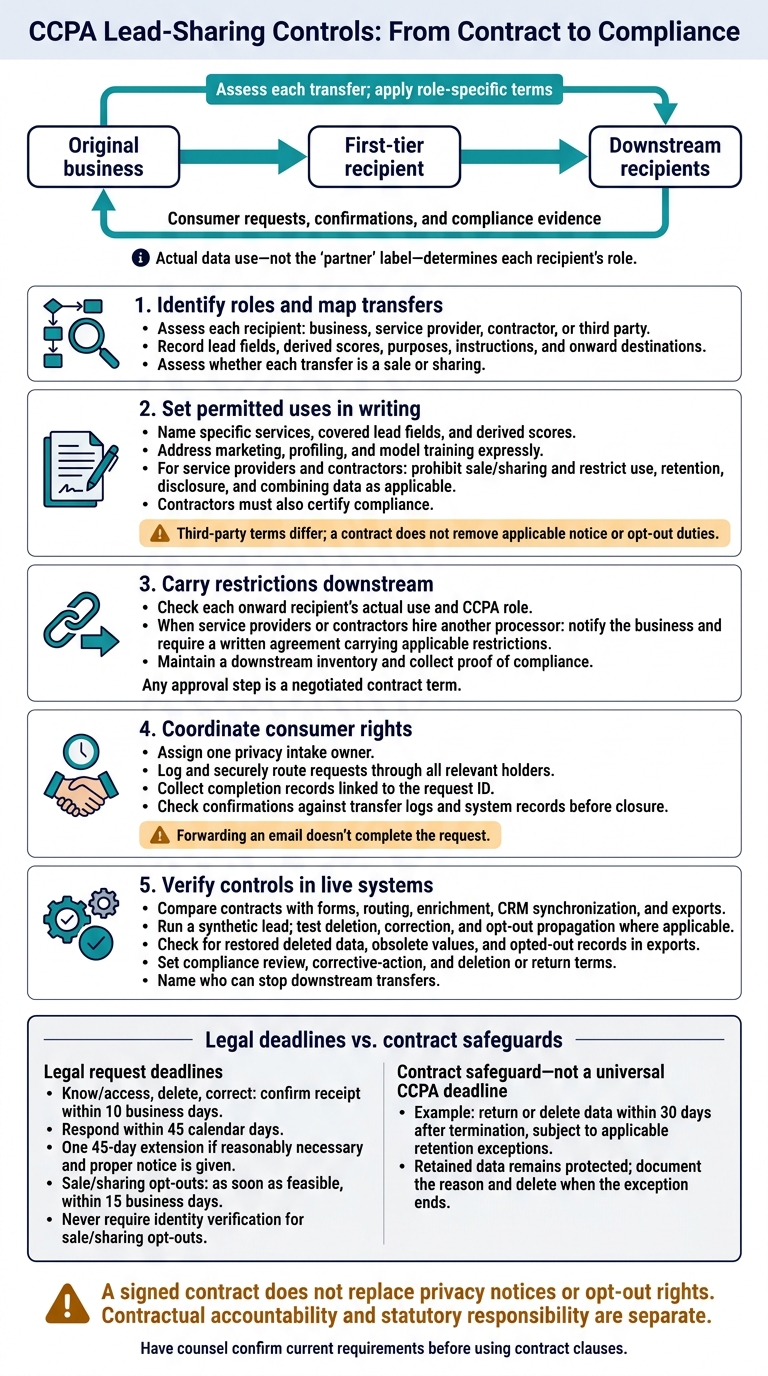
CCPA Lead-Sharing Controls: From Contract to Compliance
CCPA Vendor Rules: Service Providers vs. Third Parties | Third-Party Risk Management | SAFE
sbb-itb-5f36581
Identify Each Lead Recipient’s CCPA Role
Map the full lead chain before drafting contract clauses. Work contact data can still be personal information when it identifies a California resident. Assess each recipient separately, including downstream vendors your partner adds. Each recipient’s role determines which contract clauses it must accept.
Distinguish Businesses, Service Providers, Contractors, and Third Parties
Check downstream processors individually. Your partner’s label doesn’t determine their role.
| Recipient role | Permitted purpose | Required agreement | Secondary-use limits | Main risk |
|---|---|---|---|---|
| Business | Determines the purposes and means of processing | None | Autonomy within the law | Direct liability for notices and consumer rights |
| Service provider | Processes personal information only on the business’s behalf for limited business purposes | Written contract with specific use, retention, and disclosure limits | Secondary use prohibited | Becoming a third party through secondary use |
| Contractor | Performs services under specific restrictions | Written contract plus certification of compliance with restrictions | Use limited to contracted services | Use or disclosure outside the permitted scope |
| Third party | Any recipient that isn’t a service provider or contractor | Notice and opt-out mechanisms | May use data for its own purposes if opt-out rights are honored | Triggering sale/share opt-out and notice duties |
Cross-customer profiling, self-marketing, and model training can signal a role change. If a recipient uses lead data for its own purposes, check whether service-provider or contractor status still fits.
Map Lead Fields, Uses, and Transfer Paths
Keep a transfer register covering contact details, enrichment fields, and derived scores. Scores and predictions linked to a person count as personal information. For each transfer, record the recipient, the fields it receives, the processing purpose, who supplies the instructions, and every onward destination - including hosting providers and plug-ins.
Document training and product-improvement uses separately. If a recipient claims the data is deidentified, check that the contract and technical settings support that claim.
Draft CCPA Clauses for Each Recipient Role
Use California Civil Code sections 1798.100(d) and 1798.140, along with regulations 7051 and 7053, as the drafting baseline. Have counsel confirm the current requirements before using the clauses.
Match each recipient’s clauses to how it handles data downstream and the lead fields it actually receives.
Set Specific Purposes and Limits on Use
Use a contract schedule to name the parties, covered lead fields, derived scores, and specific services.
For service providers and contractors, restrict use to the listed business purposes. Prohibit sale and sharing, as well as retention, use, or disclosure outside the direct business relationship. Bar combining the data with other personal information unless the law allows it. Contractors must also certify compliance.
Third-party contracts still need the required protections, but not the service-provider-specific prohibitions. A third-party contract does not remove applicable sale/share notice or opt-out duties.
Illustrative clause: Recipient may process Lead Data only to perform the services identified in the service schedule. Recipient shall not sell or share Lead Data, use it outside those services or the direct business relationship, or combine it with other personal information except as expressly permitted by applicable CCPA provisions.
Drafting note: Define the permitted services narrowly. Address model training expressly rather than leaving it inside a broad permitted-use clause.
Back those limits with oversight and rights to require corrective action.
Require Privacy Protection, Oversight, and Corrective Action
Require the recipient to provide CCPA-level privacy protection and notify the business if it can no longer comply. The contract should allow reasonable checks on compliance and prompt correction of data use that the contract does not permit. Spell out security controls, notice windows, recordkeeping, audit frequency, costs, and confidentiality.
Use a tiered review: SOC 2 Type II first, on-site review if issues arise.
Define Request Support and End-of-Service Duties
Require the recipient to help with access, deletion, and correction requests. For service providers, this support should include deleting personal information from logs, databases, and backups. Third parties must meet their own applicable duties - not just forward requests.
At termination, require the return or deletion of Lead Data, including derived scores, logs, and caches, unless law or security requires retention. Set a firm deadline, such as 30 days, as a contract safeguard - not a universal CCPA deadline. Retained data must remain subject to the contract. Require the recipient to document why it is keeping that data and delete it when the exception ends.
Control Onward Transfers of Lead Data
When a partner sends leads to another recipient, the contract must carry the same CCPA limits through every downstream relationship.
Authorize Downstream Processing and Pass On Restrictions
Before a partner sends leads to another vendor, check whether that vendor’s use follows the original instructions. If it does, include service-provider or contractor restrictions in the downstream contract. If the recipient uses the data for its own marketing, profiling, or model training, reassess its CCPA role. Also check whether the transfer counts as a sale or sharing that requires opt-out rights and opt-out preference signals. A contract does not override CCPA notice or opt-out duties.
When a service provider or contractor hires another processor to handle lead data, require notice to the business and a written downstream agreement that passes along the applicable CCPA restrictions. The agreement must address permitted purposes, retention, and further disclosure. Keep an inventory of downstream recipients, especially when using lead generation websites to source data.
Then assign responsibility for monitoring the chain, documenting compliance, and escalating failures.
Assign Responsibility for Downstream Compliance
Make the first recipient responsible for downstream contracts and proof of compliance. Require immediate reporting of unauthorized lead disclosures or noncompliance, along with coordinated correction, deletion, or return when needed. Use the matrix below to assign responsibilities. Treat any approval step as a negotiated contract term.
| Control | First-tier recipient | Downstream lead processor |
|---|---|---|
| Authorization | Notify the business before hiring another processor. | Begin processing only under the required written agreement. |
| Permitted use | Limit lead use to the contracted purpose. | Follow the contracted purpose. |
| Onward disclosure | Pass applicable restrictions into downstream contracts. | Apply restrictions to further transfers of form submissions. |
| Requests | Coordinate and track requests across the partner chain. | Report request completion or applicable exceptions. |
| Deletion | Track deletion, return, and permitted retention across the chain. | Delete or return covered data; document permitted retention. |
| Monitoring | Collect proof of downstream compliance. | Supply records for reasonable compliance checks. |
| Incident escalation | Immediately report failures and coordinate corrective action. | Immediately report unauthorized lead disclosures or noncompliance. |
Contractual accountability and statutory responsibility are separate. Making the first recipient responsible for downstream contracts does not remove the original business’s own notice and opt-out obligations.
Contracts with marketing, analytics, and measurement partners must also limit data use and disclosure.
Manage Consumer Requests and Check Compliance
Route Consumer Requests and Track Partner Action
Assign one privacy intake owner for requests received through the designated portal, email, phone, and opt-out preference signals, including Global Privacy Control. Log the request ID, receipt time, request type, identifiers needed to find the lead, likely holders, owner, deadlines, verification status, and final disposition. Verify identity when required for know, delete, and correct requests. Never require identity verification for sale or sharing opt-outs. Link each opt-out signal to the consumer or browser/device as the law requires. Use the log to trace every downstream holder before the deadline.
Keep legal deadlines separate from contract SLAs throughout the partner chain. Confirm access, deletion, and correction requests within 10 business days and respond within 45 calendar days. One 45-day extension is allowed if reasonably necessary and proper notice is given. Honor sale/sharing opt-outs as soon as feasible and within 15 business days.
Once logged, send the request through the full partner chain. Forwarding an email doesn't complete the request. Use an approved secure channel to route it to the first-tier recipient and any relevant downstream recipients. Preserve the original request and audit trail. Specify who needs notice for each request, which exceptions apply, and who collects downstream confirmations. Require a completion record linked to the request ID - not extra personal data. Before closing the ticket, check confirmations against transfer logs and system records.
Match each request type to the recipient's required actions and completion record.
| Request type | Request owner | First-tier recipient | Downstream recipient | Required action | Completion record | Escalation trigger |
|---|---|---|---|---|---|---|
| Know/access | Privacy operations | Return matching lead records and disclosures | Search copies, enrichment, CRM, and campaign records | Collect responsive data and sources | Search log, response package, exception rationale | Missing records, conflicting results, or missed internal deadline |
| Delete | Privacy operations with legal review | Delete the lead or isolate it under a documented exception | Delete or instruct approved subprocessors; confirm completion | Stop use and remove eligible copies | Deletion timestamp, systems checked, exception record | Retention claim, backup issue, or unapproved downstream holder |
| Correct | Data-quality owner | Correct fields and notify relevant systems | Correct copies and suppress obsolete values | Propagate correction | Field-change record and partner confirmation | Conflicting sources or failed synchronization |
| Opt out of sale/sharing | Privacy or consent owner | Apply suppression and stop qualifying disclosures | Apply suppression before further transfers | Stop sale/sharing and future exports | Signal/request timestamp, suppression status, recipient acknowledgments | Continued transfer, unmatched identity, or failed signal propagation |
| Limit sensitive information, where applicable | Privacy operations | Restrict use to permitted purposes | Apply equivalent downstream restrictions | Stop nonpermitted use; confirm controls | Restricted-processing flag and partner attestation | Sensitive data remains in unrestricted workflow |
Check Contracts Against Forms, Integrations, and Exports
After mapping request routing, check that the contract matches the live form and integration flow.
Use a checklist before signing, then repeat the check quarterly or based on risk. Compare the approved data-flow diagram and live exports against recipient names and roles, fields, purposes, retention periods, transfer classifications, required agreements and downstream terms, notices and choices, security controls, monitoring and audit rights, termination duties, deletion or return duties, and request-routing contacts.
In Reform, compare conditional routing, enrichment, and CRM settings with the approved data-flow diagram. Block or review any field, recipient, purpose, or integration the contract doesn't cover.
Run a synthetic lead through submission, routing, enrichment, CRM synchronization, and export. Test deletion, correction, and opt-out propagation where applicable. Check whether later synchronization restores deleted data or obsolete values.
Track on-time completion, downstream confirmation time, unapproved recipients, and opted-out records in exports. Escalate immediately for an onward transfer made without permission, continued sale or sharing after an opt-out, inability to identify data locations, a false completion report, security incidents, or repeated missed service levels.
Conclusion: Put Lead-Sharing Contract Controls Into Practice
Require approval before sending leads - not afterward. Each recipient’s role should determine the contract terms, allowed uses, onward-transfer limits, consumer-request support, and completion records. Carry those obligations into every downstream contract.
Assign clear responsibilities: legal approves roles and enforces contracts, marketing operations manages downstream lead-transfer paths, and privacy coordinates consumer requests. Name who can stop downstream transfers when a partner uses data outside its allowed purpose or fails to support a request.
Use this short launch checklist:
- Confirm the final contract matches each recipient’s role.
- Approve specific uses and downstream recipients, and require written downstream restrictions.
- Assign owners to unresolved request-routing gaps and retention exceptions.
- Record owner approvals and who has stop-work authority.
FAQs
Is sharing leads a CCPA sale if no money changes hands?
Yes. Sharing leads can count as a sale under the CCPA if personal information goes to a third party in exchange for nonmonetary valuable consideration. If a vendor uses that information for its own purposes - such as building profiles across clients or improving its models - the transfer may qualify as a sale or sharing.
A transfer falls into neither category only when both the contract and the vendor’s actual practices strictly limit use to providing a specific service.
What if my lead partner refuses to identify downstream recipients?
A refusal creates a serious compliance risk. Under the CCPA and CPRA, limited visibility into the data chain may lead to transfers being classified as a sale or share, triggering opt-out and notice obligations.
Require contracts to mandate prompt notice when subprocessors are engaged and apply the same privacy restrictions to every subcontractor. Reserve your rights to audit and terminate the relationship if transparency requirements aren’t met.
Does a deletion request require stopping AI training on my leads?
Yes. Under the CCPA and CPRA, vendors must honor applicable deletion requests, subject to legal exceptions. Vendors also cannot use the consumer’s personal information beyond authorized services, including for AI model training or improvement.
Your agreements should explicitly prohibit vendors from using lead data to develop or improve generalized AI models. They should also require vendors to delete that data from their systems and stop processing it - including for model training - when they receive an applicable deletion request.
Related Blog Posts
Get new content delivered straight to your inbox

The Response
Updates on the Reform platform, insights on optimizing conversion rates, and tips to craft forms that convert.


Drive real results with form optimizations
Tested across hundreds of experiments, our strategies deliver a 215% lift in qualified leads for B2B and SaaS companies.
