
.webp)
5 EU-U.S. DPF Changes That Affect Lead Capture


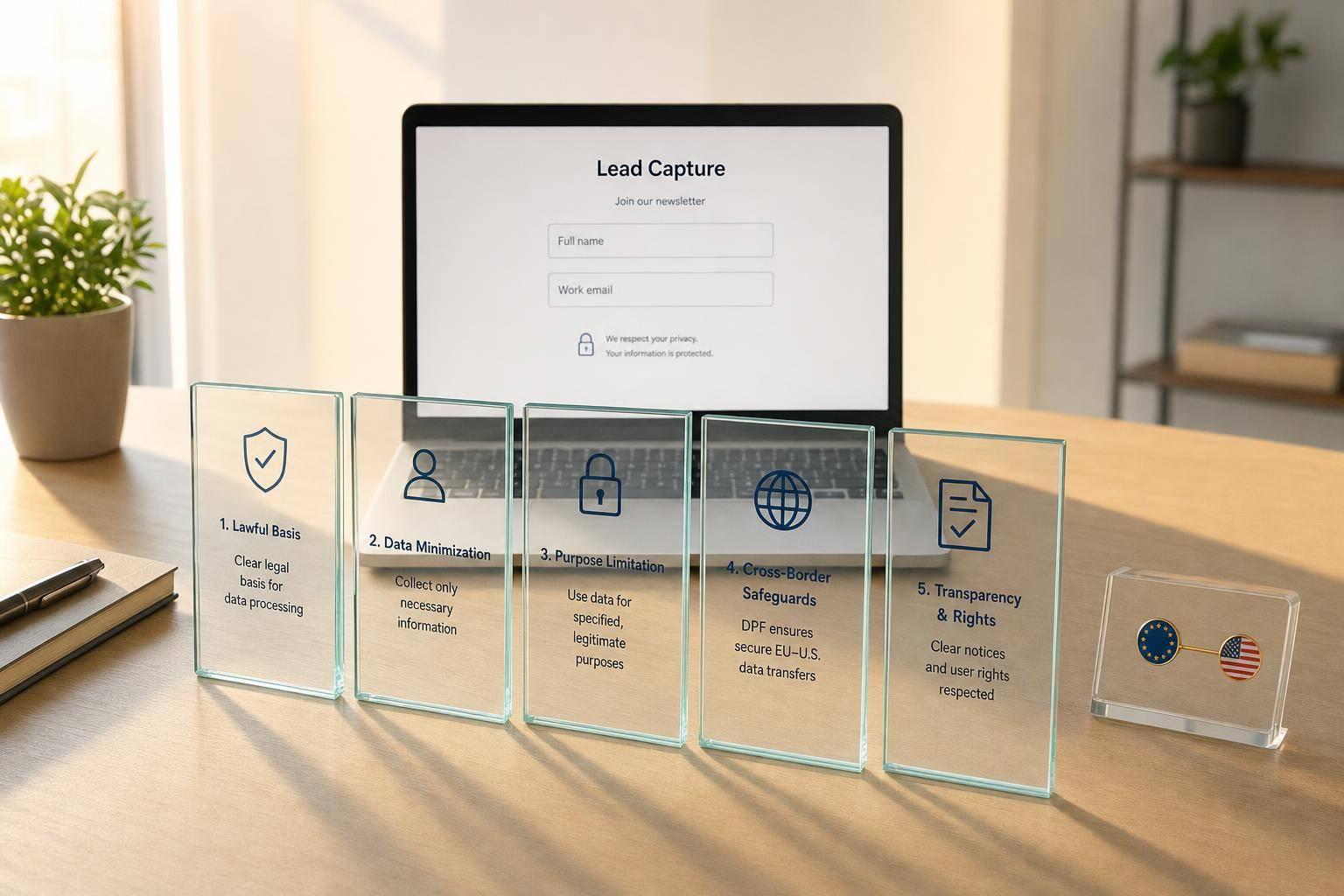
If you collect EU leads in the U.S., the transfer path is still open as of 09/28/2026 - but your risk did not go away.
I’d sum it up like this: the DPF still works for certified U.S. vendors, the September 3, 2025 court ruling did not break it, and teams still need backup paperwork, vendor checks, and GDPR controls across forms, analytics, enrichment, CRM, and email.
Here’s the short version:
- DPF is still usable for EU-to-U.S. data transfers to certified vendors.
- The 09/03/2025 General Court ruling kept it in place, but an appeal is still pending.
- GDPR still applies in full after the data reaches your systems.
- Annual vendor recertification matters because a lapsed listing can block new transfers.
- U.S. oversight issues in 2026 mean you should keep SCCs and an updated TIA ready.
- UK and Swiss data need separate coverage, not just EU DPF status.
- Your biggest exposure is daily workflow, not just the transfer itself.
What changed? The transfer step is simpler for DPF-certified vendors.
What did not change? You still need lawful basis, clear notice, opt-outs, retention limits, and clean vendor records.
A fast way to think about it: if your stack touches EU lead data in 5 places - forms, enrichment, analytics, CRM, and email - each one still needs review.
| Area | What I’d check now | Why it matters |
|---|---|---|
| Forms | Notice, lawful basis, fields collected | This is where collection risk starts, so it's vital to design the perfect landing page form |
| Enrichment | Vendor status, subprocessor chain | Third-party sharing adds risk fast |
| Analytics | Purpose limits, disclosed use | Secondary use can create GDPR issues |
| CRM | Retention, access, deletion workflow | Data sits here the longest |
| Opt-out, suppression, vendor basis | Marketing use gets scrutiny fast |
So the plain-English takeaway is simple: DPF reduces transfer friction, but it does not reduce your compliance workload. The article below is about where that pressure now shows up and what lead teams should keep on file.
The EU-US Data Privacy Framework is here: a practical guide for businesses trading internationally
sbb-itb-5f36581
Why Lead Capture Teams Need to Watch the DPF
When an EU visitor fills out a form, that data rarely stays in one place. It usually moves from the form into analytics, enrichment tools, a CRM, and email platforms. And with each handoff, there may be a cross-border transfer. So every tool in your stack becomes part of the compliance picture.
That’s why lead capture teams need to keep an eye on DPF changes. DPF certification can make data transfers simpler, but it does not take away your GDPR duties as the controller.
The transfer itself may be covered by the framework. But collection, notice, retention, and follow-up? Those still sit with you.
Your business remains the data controller. So before you collect a lead’s data, you need a valid legal basis in place, whether that’s consent or legitimate interest. You’re also on the hook for your privacy notice, how long you keep the data, and whether your email follow-up matches the purpose the data was collected for.
Here’s how that breaks down across a standard lead capture stack:
| Lead Capture Layer | Your Remaining Duty as Controller |
|---|---|
| Forms / Intake | Establish lawful basis (consent or legitimate interest) |
| Analytics | Enforce purpose limitation - no incompatible secondary use |
| Enrichment | Verify opt-out mechanisms for third-party data disclosure |
| Marketing Automation | Provide clear notice and direct marketing opt-outs |
| CRM / Storage | Apply retention schedules and data integrity controls |
There’s one more thing to watch: DPF certification doesn’t last forever. Vendors have to recertify every year. If a vendor lets that certification lapse, you need to move to another transfer mechanism, such as SCCs.
That’s why vendor verification is the first DPF checkpoint for lead capture teams.
1. Stricter DPF Vendor Verification for Lead Capture Tools
Once you know a certification can lapse, check every tool in your stack before any EU lead data moves. DPF certification applies at the vendor level, not the company level. So every tool tied to lead capture - your form builder, CRM, analytics platform, enrichment service, and email system - needs to appear on the official list at dataprivacyframework.gov.
For each vendor, look at three things:
- The certification status should be Active
- The certification should cover non-HR data
- The vendor should fall under FTC or DOT enforcement jurisdiction
Some industries, including banking and insurance, don't qualify. So a long certification directory doesn't mean much if your vendor is missing or its status has lapsed. Check again on a set schedule, and keep a compliance calendar with renewal dates for every vendor that touches EU lead data.
Don't stop with the main vendor. Under the onward-transfer accountability principle, your vendor also needs contracts with its own subprocessors - including something like a cloud host sitting behind a CRM - that require the same level of data protection. That chain runs from vendor to subprocessors to lead data across your forms, analytics, enrichment, CRM, and email tools. A certified email platform can still create risk if its subprocessors aren't covered.
Keep SCCs ready as a fallback if a vendor loses certification or if a transfer path falls outside DPF coverage. And this review can't be a one-time task. After launch, certifications, subprocessors, and transfer conditions can change.
2. What to Do After the DPF's First Periodic Review
The October 2024 DPF review kept the framework in place, but it also pointed to one issue that still matters: the need for a fully working PCLOB. Once you've confirmed a vendor's status, the next move is simple on paper but easy to miss in practice. You need to refresh the records, notices, and fallback contract language tied to that data transfer.
For any lead capture team handling EU data, three documents need attention right away:
- ROPA (Art. 30): List each U.S. tool that processes EU leads in your Article 30 ROPA, and record the DPF adequacy decision as the transfer basis.
- Privacy Notice: Update your privacy notice to state DPF participation and the DPRC redress path for EU individuals.
- Vendor DPA / TIA: Check that vendor contracts refer to DPF coverage and include a ready-to-use Transfer Impact Assessment updated with Executive Order 14086 proportionality findings. That way, if a form builder, enrichment service, or email platform shifts its transfer path without warning, you're not starting from scratch.
You should also keep SCCs on hand as a fallback for any transfer path that slips outside DPF coverage.
Here’s the short version of what needs updating:
| Document | What to Update |
|---|---|
| Privacy Notice | Name DPF participation and DPRC redress path |
| ROPA (Art. 30) | Record DPF adequacy as the transfer basis |
| Vendor DPA / TIA | Refer to DPF; add SCCs as fallback; update TIA with EO 14086 findings |
One more point: UK and Swiss lead data still need separate opt-ins. DPF participation by itself does not cover those transfers. That line matters, especially once you get into the next layer of the stack: transfer resilience under U.S. oversight pressure.
3. The September 3, 2025 General Court Ruling Left the DPF Intact
The September 3, 2025 ruling left the DPF in place as a usable transfer basis for EU lead data. In plain English: if you work with DPF-certified U.S. vendors, you can still send data to them without relying on SCCs as your main path.
That matters. It means those vendors are still usable today.
But let's not kid ourselves: this does not wipe away transfer risk.
An appeal is still pending - Case C-703/25 P - so the DPF remains usable, but it isn't risk-free. The smart move isn't to change transfer bases right now. It's to have a backup plan sitting on the bench, ready to go.
Keep these items current across your stack:
- SCCs
- An updated TIA
- Current DPF verification
And don't limit that prep to one tool. It should cover your form, CRM, enrichment, analytics, and email vendors.
So yes, the ruling gives the transfer basis more stability. At the same time, oversight pressure still shapes how long that stability may hold.
4. 2026 U.S. Oversight Uncertainty Raises Transfer Resilience Requirements
The court ruling may still stand, but that doesn't mean EU lead-data transfers are on solid ground. The staying power of the DPF rests on two things: court support and U.S. oversight. Right now, that second piece is weaker. In January 2025, three PCLOB members were dismissed, which removed the board's quorum. Then, in July 2026, the Supreme Court's ruling in Trump v. Slaughter weakened the independence that helped support the European Commission's adequacy decision.
This isn't just a policy issue sitting in the background. It touches the tools that handle EU leads every day: forms, CRM platforms, enrichment tools, analytics, and email systems.
The Norwegian Data Protection Authority put it bluntly:
"Companies should prepare an exit strategy in case the adequacy decision is revoked, as there may be no transition period." - Norwegian Data Protection Authority
That warning matters. If there is no transition period, you can't afford to build a fallback plan later. It needs to be ready now. That means checking whether your TIA still reflects the current transfer path, keeping SCCs ready to use, tightening onward-transfer terms, and mapping out a fast switch to EU-hosted systems.
| Lead System | 2026 Transfer Risk Factor | Resilience Measure |
|---|---|---|
| Forms & Analytics | Expanded U.S. intelligence-access exposure | Update the TIA to assess "electronic communication service provider" status. |
| CRM Syncs | Weaker regulatory independence | Implement SCCs as a parallel legal basis to the DPF. |
| Enrichment Tools | Subprocessor transfer risk | Execute data processing addenda with equivalent DPF principles. |
| Email Follow-up | Immediate revocation risk | Document a 48-hour transition plan to EU-hosted alternatives. |
If your form provider, including Reform, relies on DPF certification, keep SCC fallback language in place and maintain a documented cutover plan.
Those checks matter most where DPF principles meet the everyday mechanics of lead capture.
5. DPF Principles Now Apply Directly to Forms, Enrichment, Analytics, and Email
DPF duties reach into every part of lead capture that touches EU data. It’s not just about getting data across borders. It’s also about how each step in the funnel explains, limits, and protects that data once it enters your system.
| Funnel Layer | Relevant DPF Principle | Required Change |
|---|---|---|
| Forms | Notice and Choice | Disclose DPF participation before collection and offer a direct-marketing opt-out. |
| Enrichment | Onward Transfer | Use certified vendors bound by equivalent safeguards. |
| Analytics | Data Integrity and Purpose Limitation | Collect only purpose-relevant data; keep it accurate and current. |
| CRM Syncs | Security and Access | Protect data, support access and deletion requests, and document the workflow. |
| Email Follow-up | Choice | Include a clear opt-out in every marketing email. |
The real test isn’t just whether the transfer is covered. It’s whether each channel handles EU lead data the right way: with proper disclosure, clear limits, and solid protection.
Multi-step forms are often the first place things go wrong. Under the DPF, your form must disclose - before or at the time of collection - that you take part in the DPF, what data you collect, why you collect it, and which third-party categories, such as enrichment or analytics vendors, receive it. If that notice shows up late, or stays buried in a policy page no one sees, that’s a problem.
Onward-transfer accountability also doesn’t stop at the initial handoff. Your processors must provide protection equal to the DPF. That duty runs through your enrichment vendors, CRM syncs, and analytics tools - not just the transfer itself. Put simply, if your stack passes EU lead data from tool to tool, each handoff needs the same level of care.
You’ll also want to record the DPF adequacy decision in your ROPA and document your recourse and request-handling workflows. Those records back up the systems you use to collect and route leads, not just a separate compliance file sitting in a folder.
If you use Reform for forms, enrichment, or analytics, check its DPF status on dataprivacyframework.gov and keep a dated record of that check on file.
Vendor Due-Diligence Checklist
Use this checklist before any EU lead enters your expertly optimized forms, enrichment tools, CRM, analytics stack, or email systems.
Start with the vendor’s exact legal entity name on DataPrivacyFramework.gov. Make sure the status is Current. If the listing shows Expired or Withdrawn, you can’t rely on DPF for new transfers. Also check that the listing applies to the exact service handling your lead data. For lead capture, confirm the certification includes non-HR data. If you work with UK or Swiss data, verify UK Extension or Swiss-U.S. DPF coverage on its own.
Next, ask each vendor for its subprocessor list and review it for missing details. Log the review date and save the exact version of the list you checked. Then use that same review method for every tool that touches lead data.
| Checklist Item | What to Verify |
|---|---|
| DPF Participant Status | "Current" on DataPrivacyFramework.gov for the exact legal entity |
| Certification Scope | Covers the specific tool or service you're using |
| Data Category | Non-HR data (commercial/lead data) is explicitly included |
| Geographic Coverage | UK Extension or Swiss-U.S. DPF if applicable |
| Onward Transfer Contracts | Subprocessors are bound to DPF-equivalent protections |
| Complaint Mechanism | Independent recourse body is identified in the privacy policy |
| FTC or DOT jurisdiction | Vendor falls under FTC or DOT enforcement authority |
DPF Timeline for Lead Capture Planning
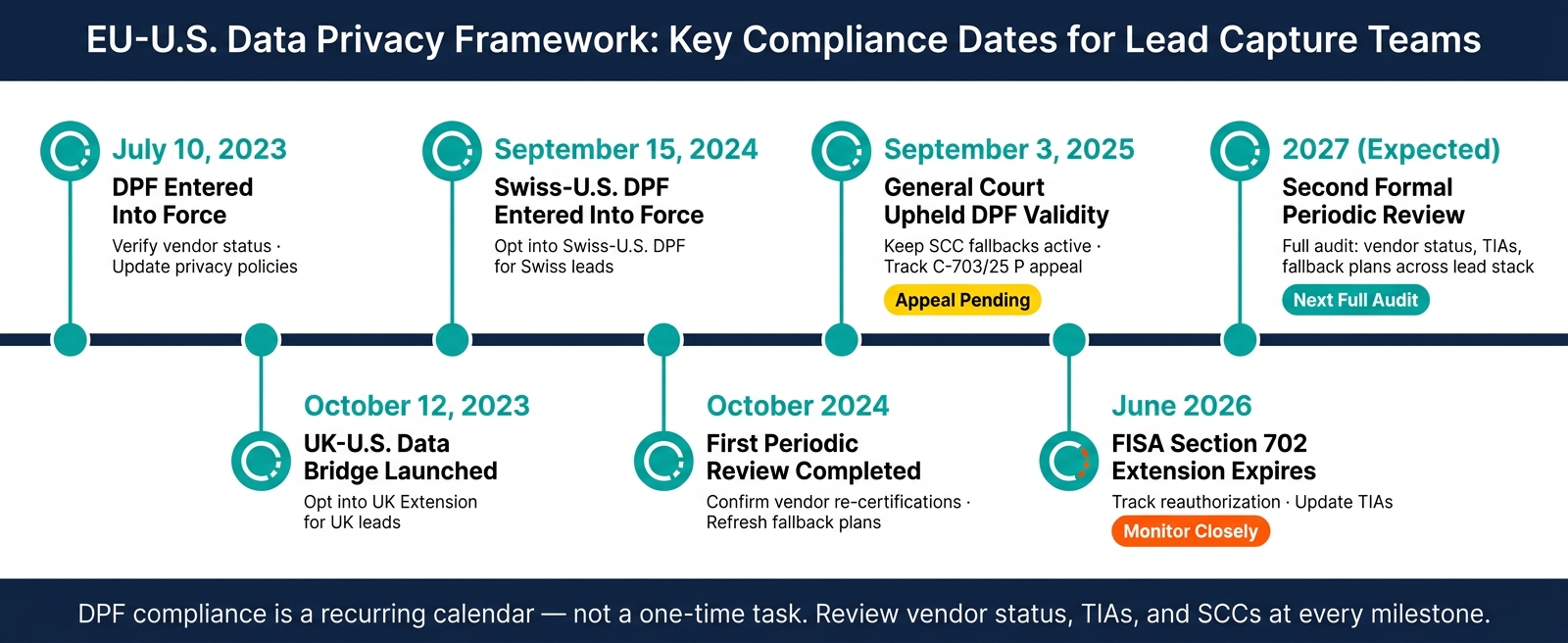
EU-U.S. Data Privacy Framework: Key Dates for Lead Capture Teams (2023–2027)
Think of the DPF as a recurring compliance calendar, not a set-it-and-forget-it task. That means building regular check-ins for vendor reviews, notice changes, and backup transfer checks into your workflow.
Each date on the timeline should tie back to the parts of your lead capture setup that move data around every day, like forms, enrichment, analytics, CRM, and email.
| Date | Milestone | What Lead Capture Teams Should Do |
|---|---|---|
| July 10, 2023 | DPF entered into force | Verify vendor status and update privacy policies. |
| October 12, 2023 | UK-U.S. Data Bridge launched | Opt into the UK Extension for UK leads. |
| September 15, 2024 | Swiss-U.S. DPF entered into force | Opt into the Swiss-U.S. DPF for Swiss leads. |
| October 2024 | First periodic review completed | Confirm vendor re-certifications and refresh fallback plans. |
| September 3, 2025 | General Court upheld the DPF's validity | Keep SCC fallbacks active and track the appeal. |
| June 2026 | FISA Section 702 extension expires | Track reauthorization and update TIAs. |
| 2027 (expected) | Second formal periodic review | Audit lead capture workflows and vendor status. |
Treat 2027 as your next full audit point. In plain English, that's the moment to recheck vendor status, TIAs, and fallback plans across your lead stack.
"The Framework is subject to annual joint reviews by EU and US authorities. Businesses should implement an internal compliance calendar to track these reviews." - Daniel J. Gershman, Esq., Falcon Rappaport & Berkman LLP
Use these dates to keep vendor checks, TIAs, and transfer backups current.
What the September 3, 2025 Court Ruling Changes and What It Does Not
For lead capture teams, the day-to-day impact is much simpler than the court ruling itself.
On September 3, 2025, the General Court upheld the EU-U.S. Data Privacy Framework. That means DPF-certified U.S. vendors can still be used for EU lead transfers. If your forms, CRM, enrichment, analytics, or email stack depends on U.S. tools, that matters. At the same time, it’s still smart to keep SCCs on hand as a backup.
Here’s the plain-English version of what changed and what stayed the same for lead capture teams:
| Area | What Changed After September 3, 2025 | What Did Not Change |
|---|---|---|
| Transfer Mechanism | DPF-certified vendors remain a valid transfer path for forms, CRM, enrichment, analytics, and email tools. | SCCs and BCRs remain necessary for any U.S. vendor that is not DPF-certified. |
| Documentation | No per-transfer TIA for DPF-certified vendors; still record the transfer in the ROPA. | Teams still need to confirm that the certification covers the relevant data type, such as non-HR marketing leads. |
| Vendor Due Diligence | Verification is simpler because teams can rely on the official DPF list. | You still need to confirm that the certification covers the relevant data type, such as non-HR marketing leads. |
| Transparency | Referring to the DPF in privacy notices is now safe from immediate annulment. | Notices still need to be clear and provided at the point of data collection. |
| Core GDPR Principles | The ruling did not change GDPR duties. | The ruling did not change GDPR duties. |
The big takeaway is simple: the ruling cuts down transfer friction, but it does not cut down GDPR duties. So yes, things got easier on the transfer side. But your team still needs to handle notice, records, vendor checks, and lawful processing with care.
That stability also still leans on U.S. oversight, which is the next risk to watch.
Risk Matrix for Lead Capture Systems
After vendor checks and fallback planning, the next step is to rank the systems most likely to fail first. That shows where DPF changes hit the funnel itself, not just the transfer layer. It turns legal risk into plain system impact.
| Lead Capture Function | Scenario A: Vendor DPF Lapse | Scenario B: DPF Invalidation (CJEU) | Scenario C: Non-Compliant Subprocessor |
|---|---|---|---|
| Form Intake | Critical. New EU leads can’t be transferred to that tool’s U.S. systems. | Critical. Immediate halt is needed unless SCCs are already in place. | Low, unless a sub-host processes or stores the form data. |
| Enrichment Syncs | High. Data added by a non-certified vendor can’t be used. | High. All U.S.-based enrichment syncs need SCCs and a current TIA. | Critical. This is the most exposed area, since enrichment depends on a subprocessor chain. |
| Analytics Identifiers | Medium. Tracking pixels may keep running, but they face audit risk. | Critical. Automated tracking often has no SCC fallback. | Medium. Risk depends on where the analytics data goes. |
| CRM Routing | High. Routing EU leads to a U.S.-based CRM becomes a GDPR violation right away. | Critical. Core sales operations for EU leads are paralyzed. | Medium. Risk rises if a new subprocessor handles lead distribution. |
| Email Follow-up | High. Automated outreach from U.S. platforms loses its legal basis. | High. This needs an immediate switch to SCC-based processing. | Low. This is usually handled by the primary vendor. |
Here’s the pattern: lapse risk hits intake first, invalidation risk hits CRM and analytics first, and subprocessor risk hits enrichment first. Any system without a backup transfer path - such as pre-signed SCCs - should be treated as Critical right now.
Use this ranking to decide which tools need fallback coverage first.
How DPF Principles Apply Across the Lead Funnel
Use the risk matrix like a workflow map. Each transfer risk turns into a form, enrichment, CRM, or email control issue. And DPF rules show up at every step of lead handling.
Here’s how each funnel stage lines up with its main DPF control:
| Funnel Stage | Relevant DPF Principle | Operational Control |
|---|---|---|
| Lead Forms | Notice & Data Minimization | Show a clear privacy notice at the point of entry and collect only the fields you actually need. |
| Enrichment | Data Integrity & Onward Transfer | Verify enrichment vendors are DPF-certified or bound by equivalent safeguards, and document retention limits. |
| Analytics | Notice | Disclose the categories of third-party analytics providers in your privacy notice. |
| Email Follow-up | Choice | Use automated unsubscribe and suppression controls that honor opt-outs immediately. |
| Downstream Transfer / CRM | Accountability for Onward Transfer | Route data only to third parties disclosed in your notice; use data processing addenda and keep source and consent timestamps for every lead record. |
At the form stage, the rule is simple: creating high-converting lead forms requires showing a clear privacy notice before someone hits submit and asking only for fields you can defend. If you don’t need a field, remove it.
For enrichment and analytics, focus on downstream sharing and record hygiene. Keep enriched data accurate, current, and time-limited. And make sure your notice tells people which categories of analytics vendors are involved.
At the CRM and email layer, onward-transfer accountability comes down to controls that actually work. Keep the source and consent timestamp for each lead record. Make sure suppression lists and unsubscribe controls are enforced in real time.
Use this map to review each vendor and workflow in the checklist below.
Conclusion
The DPF can still serve as a basis for transfers in late 2026, but that only holds up when every tool and workflow that touches a lead stays compliant. This is mostly about day-to-day execution. Your forms, enrichment tools, analytics, CRM routing, and email follow-up need to work under the same set of controls.
So the next move is pretty straightforward: audit every tool that handles EU leads. Before you add any form, enrichment, analytics, CRM, or email tool, check the vendor’s certification status. Then make sure your privacy notice matches the stack you’re actually using.
Once you’ve mapped the stack, shift to transfer backup planning. Keep SCCs and an up-to-date TIA ready as fallback coverage for high-volume lead flows, especially while the C-703/25 P appeal is pending.
That backup plan only works if you keep it current. Review DPF status during each vendor renewal and after every periodic review. Earlier frameworks have failed before, so contingency planning is just standard practice. In day-to-day terms, the safest lead capture programs rely on verified DPF vendors, documented fallbacks, and a standing review cadence.
FAQs
Do I still need SCCs if my vendors are DPF-certified?
Not strictly. If a vendor is currently certified under the EU-U.S. Data Privacy Framework (DPF), you don't need SCCs for that transfer.
That said, plenty of organizations still keep SCCs in place as a fallback. The DPF is still facing legal challenges, and the rules could shift. Using both gives teams a backup plan and helps them avoid a last-minute scramble to update transfer terms later.
How often should I verify a vendor’s DPF status?
Check a vendor’s Data Privacy Framework status on the official U.S. Department of Commerce website before any data transfers. That way, you can confirm the vendor is currently listed at the time the transfer starts.
Then review that status on a regular basis. Pay extra attention if the vendor changes its data practices, goes through a corporate change, or if you begin collecting new types of personal data. It also helps to keep an internal compliance calendar so you can track annual re-certifications and keep up with legal changes.
What changes for UK and Swiss lead data?
The EU-U.S. Data Privacy Framework (DPF) does not automatically apply to UK or Swiss data transfers. Each one has its own add-on.
For the UK, the UK-U.S. Data Bridge has been in effect since October 2023. For Switzerland, an adequacy decision took effect on September 15, 2024.
There’s one more step that matters: U.S. companies with active DPF certifications must specifically opt in through the ITA portal for each of these arrangements.
Related Blog Posts
Get new content delivered straight to your inbox

The Response
Updates on the Reform platform, insights on optimizing conversion rates, and tips to craft forms that convert.



Drive real results with form optimizations
Tested across hundreds of experiments, our strategies deliver a 215% lift in qualified leads for B2B and SaaS companies.
