
.webp)
Email Follow-Up Timing: What Works Best


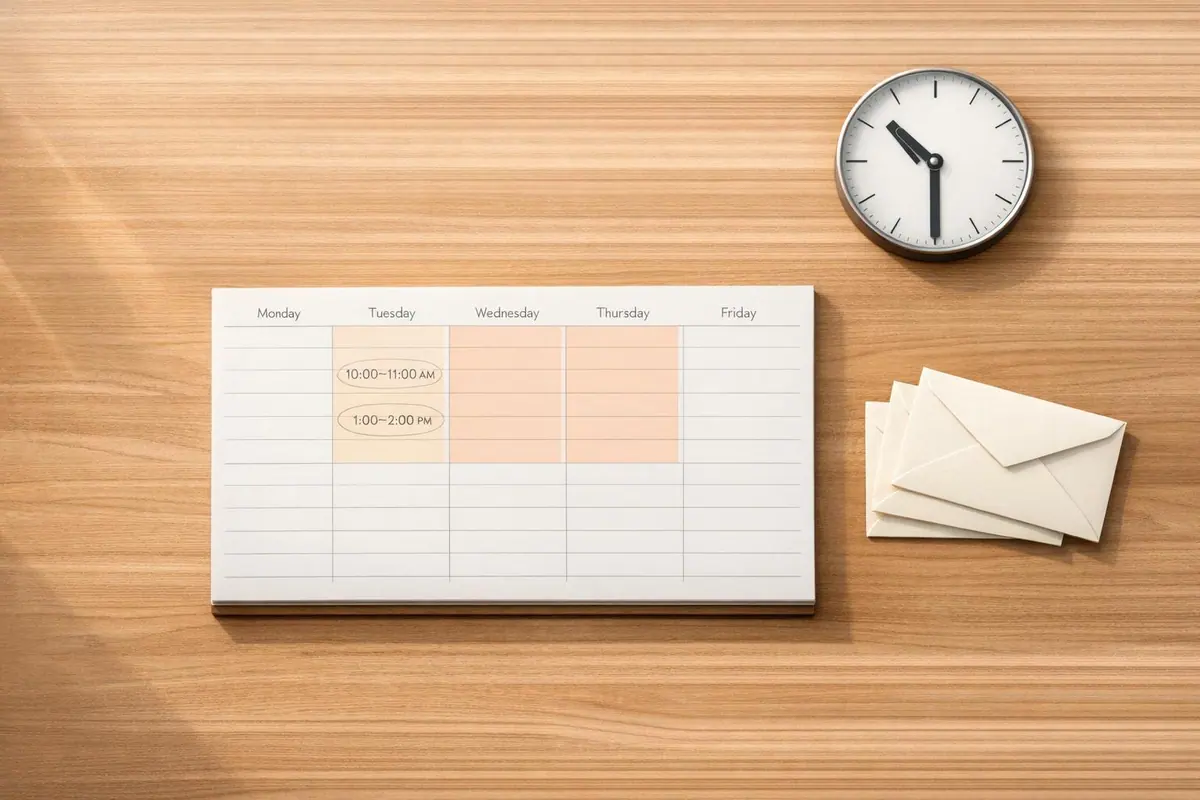
Timing matters. When you send follow-up emails, the right timing can significantly increase open and reply rates. Here's what works best:
- Best days: Tuesday, Wednesday, and Thursday outperform other days for engagement. Tuesday leads with a 42% open rate and 3.8% reply rate.
- Best times: 10–11 AM is the sweet spot, with a 44% open rate and 3.9% reply rate. Afternoons, especially 1–2 PM, are also effective.
- Follow-up intervals: Start with a 2–3 day gap before the first follow-up, then space out subsequent emails (e.g., Days 3, 7, 14, and 28).
- How many follow-ups: Stick to 2–3 follow-ups. The first follow-up alone accounts for 38% of responses.
Research shows persistence pays off - 80% of sales require at least five follow-ups, often requiring effective lead qualification to prioritize the right prospects, but nearly half of professionals stop after just one. Automating sequences with tools like Reform can help you stay consistent and optimize timing for better results.
The Right Cold Email Follow-up Strategy that Has Not Reached Out to You Yet!
sbb-itb-5f36581
Best Days to Send Follow-Up Emails
Best Days and Times to Send Follow-Up Emails: Open and Reply Rate Statistics
What the Data Shows About Each Day
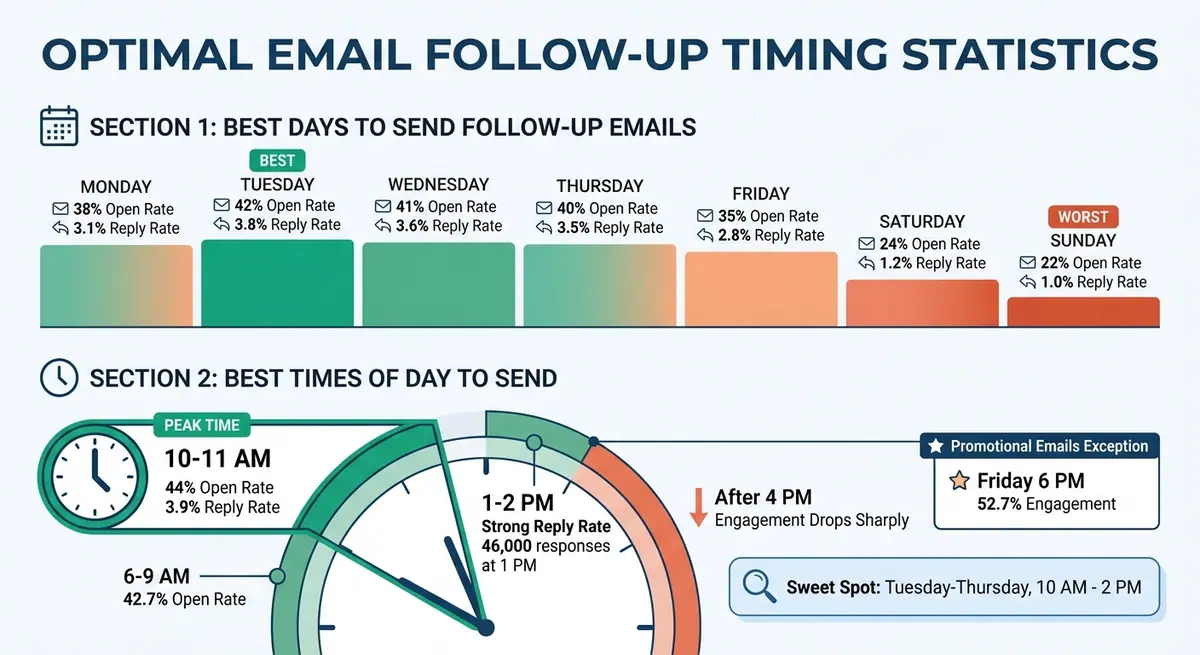
When it comes to follow-up emails, the middle of the week reigns supreme. Tuesday, Wednesday, and Thursday consistently deliver higher open and reply rates. Among these, Tuesday takes the crown, boasting a 42% open rate and a 3.8% reply rate. Not far behind, Wednesday sees a 41% open rate and 3.6% reply rate, while Thursday maintains strong engagement with a 40% open rate and 3.5% reply rate.
On the flip side, Monday struggles with a 38% open rate and 3.1% reply rate, largely due to the email backlog from the weekend. As the week winds down, Friday sees engagement dip further to a 35% open rate and 2.8% reply rate, as many people start shifting their focus to the weekend. Unsurprisingly, weekend performance is the weakest. Saturday records a 24% open rate with just a 1.2% reply rate, and Sunday trails behind with a 22% open rate and a mere 1.0% reply rate.
Here’s a quick breakdown of these stats:
| Day | Open Rate | Reply Rate | Key Insight |
|---|---|---|---|
| Tuesday | 42% | 3.8% | Best day; recipients are focused. |
| Wednesday | 41% | 3.6% | Strong engagement; mid-week focus. |
| Thursday | 40% | 3.5% | Recipients are wrapping up tasks. |
| Monday | 38% | 3.1% | Overloaded inboxes from the weekend. |
| Friday | 35% | 2.8% | Attention shifts to weekend plans. |
| Saturday | 24% | 1.2% | Minimal professional engagement. |
| Sunday | 22% | 1.0% | Lowest activity; weekend downtime. |
Why Tuesday Through Thursday Gets Better Results
Email campaigns sent on Tuesdays through Thursdays thrive because they align with the natural rhythm of the workweek. By Tuesday, most professionals have worked through the Monday email surge and are back in a productive groove.
"Tuesdays consistently rank as the top day for email opens and click-through rates. People are settled into their work week, past the Monday rush, and looking to make progress." - Rebump
Mid-week emails also benefit from a recipient’s focus on completing tasks before the weekend. Following up on a Tuesday can set the stage for additional touchpoints later in the week, like Wednesday or Thursday, when engagement remains high. This strategic timing capitalizes on the momentum of a busy and productive workweek.
Best Times of Day to Send Follow-Up Emails
10 AM: The Morning Peak Time
The 10–11 AM window consistently shows strong results, with a 44% open rate and a 3.9% reply rate. By this time, most professionals have tackled their most pressing tasks and are more likely to check and respond to emails.
"The 10-11 AM slot in the recipient's local timezone is the clear winner at 44% open rate and 3.9% reply rate." - WarmySender
Emails sent earlier in the morning, between 6–9 AM, also perform well. In fact, 40% of workers are already scanning their inboxes by 6 AM, contributing to a 42.7% open rate during this timeframe. However, timing matters across time zones - sending at 10 AM EST, for example, might hit West Coast recipients at 7 AM PST, which could be too early for some.
Afternoon and Evening Options
Once the morning rush is over, the afternoon provides another chance to capture attention.
At 1 PM, follow-up emails see a surge in replies, with an average of 46,000 responses as recipients settle back into work after lunch.
"Based on our data, the best time for sending emails is 1 PM." - Jenny Keohane, Yesware
The 1–2 PM window is ideal for targeting recipients who are clearing out less urgent tasks, offering a second opportunity if your morning email went unanswered. However, engagement tends to drop sharply after 4 PM.
An interesting exception is Friday at 6 PM, when promotional emails achieve a surprising 52.7% engagement rate as people wind down for the weekend. For the best results with follow-ups, aim to send emails between 9 AM and 2 PM to maximize your chances of catching recipients at their most responsive times.
How Many Follow-Ups to Send and When
The Right Number of Follow-Ups
The sweet spot for follow-ups is 2–3 messages, much like how optimizing lead forms focuses on quality over quantity. While some teams stretch their sequences to seven or more emails, research shows that response rates tend to level off after the third or fourth follow-up. Beyond that, additional emails - like the 5th, 6th, or 7th - contribute only a small fraction of total responses.
"The 5th, 6th or 7th follow-up email brings you merely a fraction of the total percentage, so the people who go for quantity don't seem to have a better reply rate." - Margaret Sikora, CEO, Woodpecker.co
The first follow-up often delivers the biggest boost in responses. But there’s a fine line - overdoing it can backfire. For example, sending a 4th follow-up (the 5th email in a sequence) can triple spam complaints and unsubscribe rates.
Once you’ve settled on the number of follow-ups, the next step is to figure out the timing.
Time Intervals Between Follow-Ups
Start with a 2–3 day gap before your first follow-up. This initial pause is critical - a 3-day interval can generate 31% more replies compared to shorter gaps. If someone is going to respond, there’s a 90% chance they’ll do so within the first two days after receiving your email.
After the first follow-up, gradually extend the intervals. A well-balanced schedule - such as sending emails on Day 1, Day 3, Day 7, Day 14, and Day 28 - yields a 7.1% total reply rate while keeping spam complaints to just 0.2%. On the other hand, sending daily follow-ups results in a lower 4.1% reply rate but a much higher 1.8% spam complaint rate, which can hurt your sender reputation.
| Email Position | % of Total Replies | Total Replies |
|---|---|---|
| Email 1 (Initial) | 32% | 32% |
| Email 2 (Follow-up #1) | 38% | 70% |
| Email 3 (Follow-up #2) | 16% | 86% |
| Email 4 (Follow-up #3) | 9% | 95% |
| Email 5 (Breakup) | 4% | 99% |
(Source: WarmySender Analysis of 8.3M emails)
The numbers tell a clear story: 70% of replies come from your initial email and the first follow-up. By the time you’ve sent a third follow-up, you’ve captured 86% of all potential responses.
Using Reform to Automate Follow-Up Timing
Setting Up Automated Follow-Up Sequences
Reform takes the guesswork out of follow-up timing by automating sequences based on proven strategies. With its CRM integrations, Reform syncs form submissions directly with your CRM and email platforms, triggering follow-ups according to research-backed schedules. This approach has been shown to achieve a 7.1% reply rate. The process works smoothly with real-time analytics, allowing you to fine-tune your strategy as you go.
The system uses dynamic, behavior-based triggers to ensure follow-ups are sent at the right time. For instance, if a lead downloads a resource on a Tuesday afternoon, Reform can schedule the first follow-up for 10:00 AM on Friday, hitting the optimal engagement window three days later. Additionally, exit rules stop the sequence once a lead converts, ensuring no unnecessary emails are sent.
Reform’s Email Automation feature adds a personal touch to your outreach. Using Liquid templates, you can pull data from form submissions directly into your email subject lines and body text. This creates highly tailored follow-ups that resonate with your leads.
Tracking Performance with Real-Time Analytics
Automation is only part of the equation - tracking and refining your approach is just as important. Reform’s real-time analytics let you monitor performance and test different strategies. For example, you can run A/B tests to compare the effectiveness of a 2-day follow-up gap versus a 3-day gap, helping you identify the timing that drives the most engagement.
The platform also tracks incomplete submissions and form abandonment, giving you a clear view of where leads drop off. This insight allows you to adjust your timing and messaging to better capture their attention.
Reform’s analytics enable segmentation based on lead behavior and quality. For example, high-intent leads who complete multi-step forms might receive faster follow-ups, while lower-priority leads are contacted less frequently. This tailored approach not only improves reply rates but also reduces spam complaints. Balanced intervals, for instance, keep complaints as low as 0.2%, compared to 1.8% for overly frequent follow-ups.
Conclusion
Timing and persistence play a major role in successful follow-ups. Research shows that while 80% of sales need at least five follow-up attempts to close, 44% of salespeople stop after just one try - missing out on the 38% of positive responses that often come from the first follow-up alone.
The ideal follow-up strategy involves sending emails mid-week at carefully planned intervals, such as Days 1, 3, 7, 14, and 28. This method achieves a 7.1% reply rate while keeping spam complaints as low as 0.2%. The key? Each follow-up must add fresh value to the conversation.
"Timing and relevance beat volume every time." - SDR Team Lead (via Prospeo)
Automation makes this process smoother and more efficient. Reform, for example, automates follow-up sequences with proven timing patterns. Its CRM integrations ensure follow-ups are sent at the right times, while real-time analytics help track results and fine-tune strategies. Features like lead segmentation, A/B testing for timing, and personalized messaging based on form data make it easier to connect with prospects meaningfully. This not only supports the research but also boosts conversion rates.
When prospects go silent, it’s rarely a flat-out rejection. Instead, it’s a signal to stay persistent and use a data-driven approach to turn that silence into engagement.
FAQs
Does this timing change for different time zones?
When it comes to follow-up emails, timing is everything. To maximize engagement, it's crucial to consider the recipient's local time zone. Research shows that scheduling emails between 9:00 AM and 11:00 AM in their time zone consistently results in higher response rates, no matter where they are located. This window aligns with the start of the workday for many, making it an ideal time to catch their attention.
What should I write in each follow-up to add value?
To make your follow-ups meaningful, aim to provide something new - whether it’s fresh information, helpful insights, or practical solutions. Avoid sending messages that simply “check in.” Instead, share timely industry updates, compelling success stories, or personalized offers that directly address their needs. Every follow-up should have a clear purpose: tackle objections, underscore benefits, or introduce value. This way, your messages stay engaging and drive the conversation forward.
When should I stop following up and move on?
Limit your follow-ups to 4-5 touchpoints over a span of 8 to 12 weeks. Make each interaction count by offering something valuable, whether it’s new insights, helpful resources, or relevant updates. Too many follow-ups can feel intrusive and might even lead to spam complaints. Prioritize meaningful communication over sheer frequency to keep your audience engaged without overloading them.
Related Blog Posts
Get new content delivered straight to your inbox

The Response
Updates on the Reform platform, insights on optimizing conversion rates, and tips to craft forms that convert.


Drive real results with form optimizations
Tested across hundreds of experiments, our strategies deliver a 215% lift in qualified leads for B2B and SaaS companies.
