

India vs Kenya: Data Rules for SaaS Forms


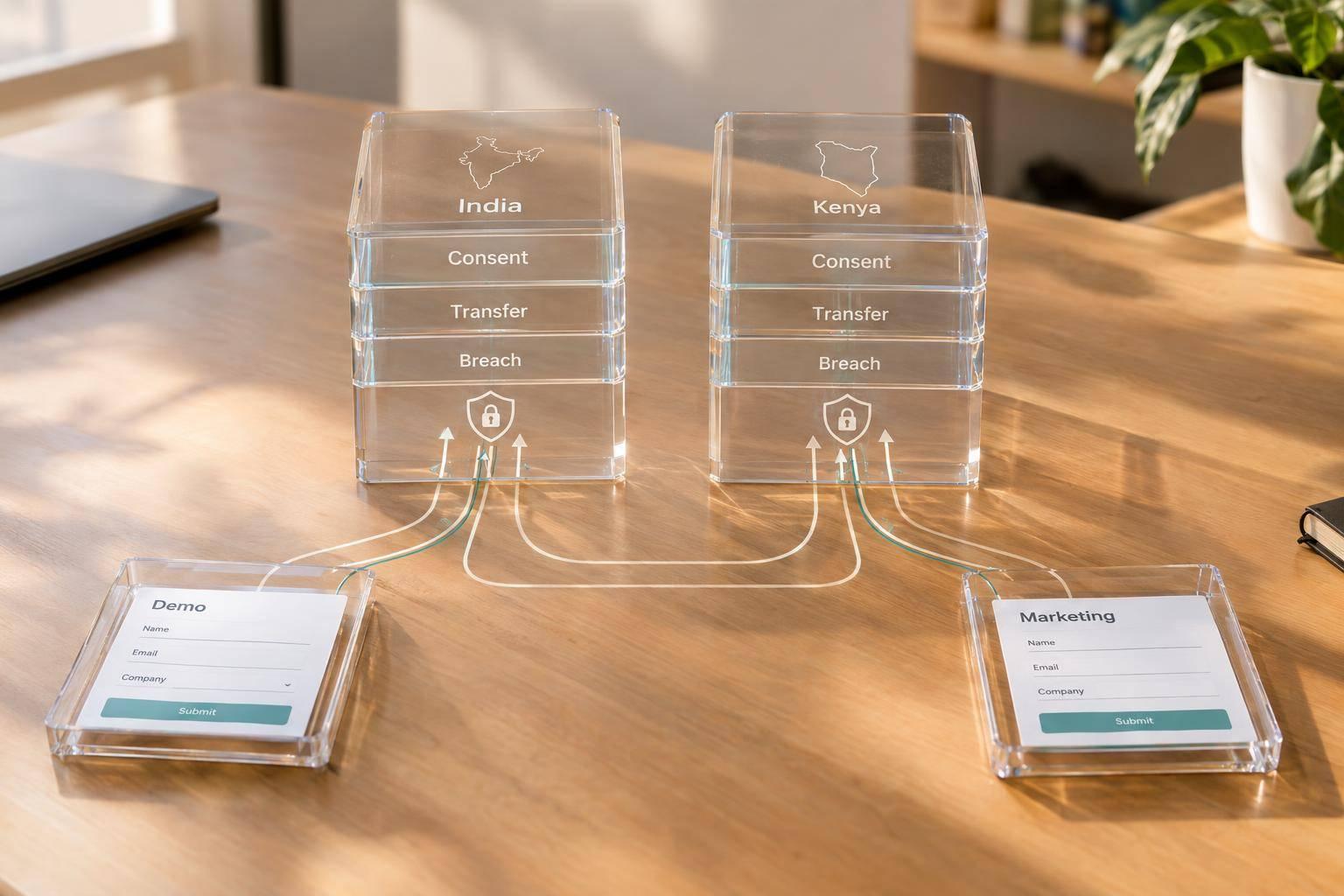
My starting point: separate demo requests from marketing consent, then map where every form submission goes. As of November 1, 2026, Kenya’s data protection duties are already in force; India’s core DPDP duties are scheduled to take effect on May 13, 2027.
I’d compare both markets across consent, notices, business roles, registration, security, rights requests, sensitive and children’s data, transfers, hosting, and launch costs. The form is only the start: your CRM, email tools, analytics, and vendors need checks too.
Quick Comparison
| Launch check | India | Kenya |
|---|---|---|
| Timing | Prepare for phased DPDP deadlines | Meet current requirements |
| Consent and notices | Build notices, separate marketing choices, and consent records | Set lawful grounds, notices, and marketing consent |
| Registration | No general DPDP business registration | Assess ODPC registration rules and exemptions |
| Security and rights | Prepare safeguards, deletion, and request workflows | Maintain safeguards and rights-request handling |
| Breach response | Prepare user and Board notification workflows | Plan for the applicable 72-hour ODPC deadline |
| Transfers and hosting | Check destination restrictions and sector rules | Confirm transfer grounds and any applicable local-storage duties |
| Sensitive and children’s data | Check parental consent and other applicable laws | Check added safeguards and parental consent |
| Launch work and costs | Budget for controls and applicable added duties | Budget for registration, controls, and any required risk assessment |
<u>I’d approve launch only after assigning owners and testing vendor support</u> for consent records, withdrawal, deletion, and incident handoffs - not just reviewing a privacy policy.
India vs Kenya: Consent, Notices, and Data Duties
Consent Choices and Records
A demo request is not marketing consent. Keep demo follow-up separate from newsletters and promotional campaigns. India’s core DPDP duties take effect on May 13, 2027. Kenya’s duties are already in force.
| Issue | India | Kenya | Practical action |
|---|---|---|---|
| Lawful grounds | Use consent or a limited specified use for demo follow-up. | Treat demo follow-up as a pre-contract step or a legitimate interest, where applicable. | Keep demo follow-up separate from marketing. |
| Notices | Explain what data you collect and why in an itemized notice, with the required language options. Using multi-step forms vs static ones can help organize these notices without cluttering the UI. | State the form’s purposes and relevant rights. | Place the notice beside the form fields, before submission. |
| Consent evidence | Keep the consent wording, form version, timestamp, and checked box or equivalent positive action. | Direct marketing requires explicit, informed consent. | Log a separate marketing choice with an unchecked box. |
| Withdrawal | Make withdrawal as easy as giving consent. | Provide marketing opt-outs. | Stop marketing across the form, CRM, and email tools. |
| Rights requests | Build workflows for DPDP rights before the duties take effect. | Access, correction, and deletion rights apply. | Assign someone to find records across the form, CRM, and email tools. |
| Retention | Set up deletion workflows before the duties take effect. | Storage limitation applies. | Set retention periods by purpose. Don’t keep every lead indefinitely. |
These collection rules also shape how you handle security, vendors, and rights requests.
Security, Registration, and Rights Requests
Once consent flows are in place, check who must register, who must secure the data, and who handles rights requests.
India has no general DPDP registration requirement for SaaS businesses. The government designates Significant Data Fiduciary status. Kenya has registration criteria and exemptions, but small size does not automatically exempt your business.
| Duty | India | Kenya | Practical control |
|---|---|---|---|
| Security and processor oversight | Put reasonable security safeguards and processor arrangements in place before the duties take effect. | Technical and organizational safeguards apply to controllers and processors. | Review access controls, vendor contracts, and incident cooperation. |
| Registration and added oversight | Designated Significant Data Fiduciaries have added duties, including an India-resident DPO and independent auditor. | Check ODPC registration criteria and exemptions for both controller and processor roles. | Record your assessment. Don’t assume your provider’s registration covers your business. |
| Rights and deletion | Build workflows before the duties take effect. | Build workflows for access, correction, and deletion requests. | Assign a request owner and verify completion across the form, CRM, and email tools. |
| Breach response | Build workflows to notify affected users and the Board. | Applicable breaches must be reported to the ODPC within 72 hours. | Require prompt processor escalation so you have time to meet the reporting deadline. |
That 72-hour window makes vendor escalation part of launch planning - not something to sort out after a breach.
Kenya’s marketing rules also carry enforcement risk. The ODPC has taken action over unsolicited messages sent without verified consent. Treat this as evidence of its enforcement focus, not as a substitute for meeting the rest of the statutory duties.
Sensitive Data and Children’s Data
Collect only the fields you need to qualify the lead. Using a multi-step lead gen template helps balance data collection with user experience. Don’t ask for sensitive or child-related data unless the lead flow needs it. Kenya has statutory sensitive personal data categories. Restrict transfers by field and destination, sending data only where the law allows. India’s DPDP Act does not define a separate sensitive-data category, but duties under other applicable laws still apply.
Lead forms may collect age or parent-contact data, so review children’s data separately. Kenya requires age verification and parental or guardian consent; an age gate alone may not be enough. India’s forthcoming framework requires verifiable parental consent. Next: transfer limits and hosting choices.
sbb-itb-5f36581
Kenya Data Privacy Law Explained: A Quick Guide to the Data Protection Act
India vs Kenya: Data Transfers and Hosting

SaaS Form Data Flow: Map Every Transfer
Once you’ve defined your form fields, map where each one goes.
Transfer Rules and Required Records
Transfer rules and hosting rules are separate checks. Before choosing hosting, check current government notifications, effective dates, and sector rules. A vendor’s “compliant hosting” claim isn’t enough. Check each destination separately.
| Issue | India | Kenya |
|---|---|---|
| Transfer framework | Transfers are allowed unless the government restricts a destination. | Transfers require an allowed path, such as adequacy, appropriate safeguards, necessity, or explicit informed consent. |
| Conditions to check | Confirm the destination and any sector rule before enabling the transfer. | Check your allowed transfer path. A contract or business need alone doesn’t automatically make the transfer lawful. |
| Field-level export | Identify which form fields leave the country and block any field without an allowed transfer path. | Identify which form fields leave the country and block any field without an allowed transfer path. |
| Local hosting | Confirm whether the data is classified as critical data before choosing infrastructure. | At least one copy of personal data must be stored in Kenya. Processing of strategic interest may also require local servers or a local copy. |
Keep evidence for each transfer route: the contract, destination assessment, safeguard documents, any adequacy decision, and the consent record if you rely on consent.
Map Data Flows Across Integrations
For SaaS forms, transfer risk usually starts after submission. Map the full submission path - not just the form’s hosting region. Include form storage, CRM syncs, email alerts, analytics, enrichment, backups, subprocessors, and remote support access. Ask each provider where these activities happen and whether data can pass to other recipients. Local hosting doesn’t keep every integration local.
Keep a transfer register that records the destination, data category, purpose, recipient, retention period, transfer ground, and onward transfers. Link each entry to its contract and supporting evidence. Before enabling an integration, confirm how it handles the data you send. Recheck the register whenever a provider changes subprocessors, backup locations, or support arrangements.
India vs Kenya: Startup Costs and Launch Preparation
Budget by processing activity, not country. In India, Significant Data Fiduciary status and sector rules shape SaaS form launch costs. In Kenya, turnover, headcount, and mandatory-sector rules drive those costs. Your purpose and business role also affect the workload, so split launch preparation into legal, product, engineering, and support workstreams.
| Pre-launch workstream | India | Kenya |
|---|---|---|
| Registration assessment | Check sector licensing and whether the business could qualify as a Significant Data Fiduciary. SDF status is not a general registration requirement for every SaaS business. | Check turnover, employee count, and mandatory-sector rules. Registration is required above KES 5 million in annual turnover or more than 10 employees. Some sectors must register regardless of size. |
| Legal documents | Finalize notices, consent text, withdrawal flows, and processor contracts. | Finalize privacy notices, processor contracts, transfer documentation, and rights procedures. |
| Engineering changes | Build consent logs, withdrawal and deletion flows, and security controls. | Build rights handling and breach escalation. Confirm that one serving copy can be stored in Kenya, and plan any DPIA for high-risk processing at least 60 days before launch. |
| Monitoring setup | Track commencement dates, sector rules, and designation triggers. | Track registration renewal, processing changes, and legal updates. |
| Customer support | Assign owners for correction, erasure, withdrawal, and incident escalation. | Set up rights-request handling and controller–processor incident handoffs. |
Give each workstream a named owner before the form goes live.
Assign Compliance Tasks Before Launch
Legal should decide which rules apply and what could block launch. Product should define collection choices, engineering should build the controls, and support should handle intake and escalation.
In India, legal should track the timeline for each applicable notice, consent, withdrawal, deletion, and security requirement. In Kenya, legal should settle registration, contracts, transfer grounds, rights procedures, and breach responsibilities before approving collection.
Incident handling needs a named owner and a backup. Kenya requires controllers to notify the ODPC within 72 hours and processors to notify the controller within 48 hours. Engineering and support should test that handoff before launch.
Configure Reform and Verify Vendor Support
Once owners are assigned, check that the form tool supports the required flows.
Use Reform to implement compliance - not prove it. Multi-step forms can put notices beside the relevant collection step. Conditional routing can limit questions to what each lead needs to answer. Keep optional marketing choices separate from the request itself.
Before approval, ask Reform to confirm consent-record exports, access controls, retention settings, deletion support, hosting locations, subprocessors, contract terms, and incident commitments. Test whether withdrawal and deletion requests reach connected systems, and document any manual work needed. Approve launch only after checking these capabilities, including exports, deletion workflows, and incident support.
Conclusion: Choose a Market and Check Launch Readiness
Once you’ve mapped consent, transfers, and vendor controls, choose the market your current setup can support.
Choose the market you can document today, not the one that looks easier on paper. India’s DPDP duties take effect in phases. Kenya’s regime is already in effect, with ODPC registration rules, documented accountability duties, and cross-border transfer rules.
The same controls need different evidence in each market.
| Entry plan | Evidence needed before approval |
|---|---|
| India-first | A dated assessment of DPDP duties currently in force, consent architecture that meets current obligations, and a timeline for duties that take effect later. |
| Kenya-first | An ODPC registration certificate where required, a local copy of required data, transfer safeguards, a 72-hour breach response plan, and a completed DPIA for any high-risk processing. |
| Simultaneous | Unified consent records, mapped vendor data flows, cross-border transfer safeguards, local-hosting mapping where needed, and vendor support for both markets’ requirements. |
Document every required control and attach supporting evidence before approval.
Get local legal review before collecting sensitive or children’s data, entering restricted sectors, or enabling higher-risk integrations.
FAQs
Do these rules apply if my SaaS business is based abroad?
Yes. Kenya’s Data Protection Act applies to data controllers and processors based outside Kenya that handle personal data belonging to individuals in Kenya. If your business also serves individuals in India, you must follow applicable local privacy laws, including the Digital Personal Data Protection (DPDP) Act and government restrictions on cross-border data transfers.
Being based abroad does not exempt your business from obligations related to consent, data security, or individuals’ data rights in either country.
Can I use one lead form for both India and Kenya?
Using the same lead form for India and Kenya is risky because each country has different data rules. Kenya requires cross-border transfers to have an adequacy decision, appropriate safeguards, or explicit consent that identifies the recipient and risks. Certain data deemed important to national interests must also be stored in Kenya.
India’s DPDP Act sets its own requirements for data processing and international transfers. Keep country-specific compliance documentation and storage practices for both India and Kenya.
Do I need fresh consent for existing leads?
Yes - if your SaaS lead forms rely on consent, you generally need new, specific, informed, and unambiguous consent for each purpose. People must also be able to withdraw it.
India’s DPDP framework requires consent to be freely given and unconditional. Bundled or unclear consent doesn’t meet that standard. Kenya requires freely given, specific, informed, and express consent. Both require notice before processing.
Related Blog Posts
Get new content delivered straight to your inbox

The Response
Updates on the Reform platform, insights on optimizing conversion rates, and tips to craft forms that convert.


Drive real results with form optimizations
Tested across hundreds of experiments, our strategies deliver a 215% lift in qualified leads for B2B and SaaS companies.
