
.webp)
How to Align Email Campaigns with Sales Funnels


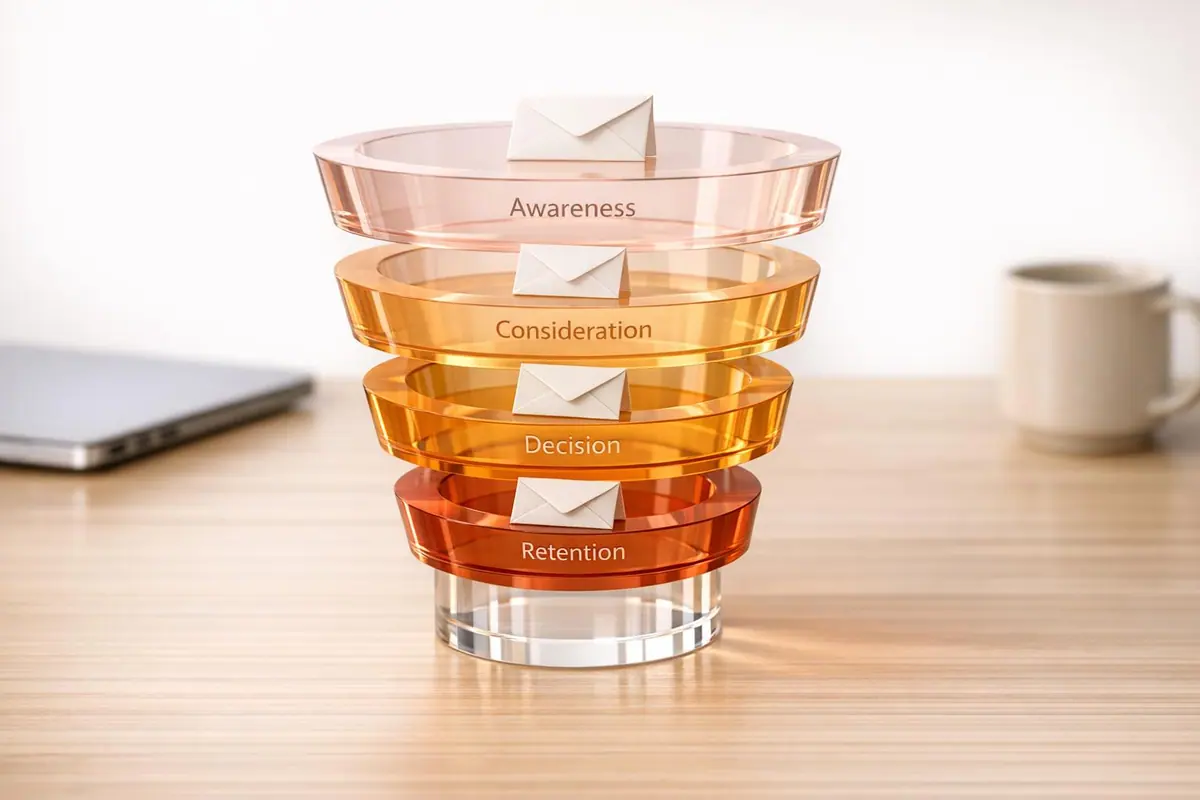
Email campaigns can drive up to $44 for every $1 spent - but only if they're aligned with the sales funnel. Here's the deal: prospects move through four stages - Awareness, Consideration, Decision, and Retention. Each stage reflects a different mindset, and your emails need to match their needs at every step.
- Awareness: Educate with blogs, guides, or welcome emails. Avoid sales pitches.
- Consideration: Show value with case studies, comparisons, or webinars.
- Decision: Push conversions with discounts, trials, or urgency-driven offers.
- Retention: Build loyalty with follow-ups, check-ins, and rewards.
Automation makes this easier by segmenting leads with high-converting lead capture forms based on behavior and sending tailored emails. For example, a lead visiting your pricing page gets a targeted email with a trial offer. Companies using this approach see 39% better open rates and up to 760% more revenue from segmentation.
Want to make this work? Focus on understanding where your audience is in the funnel and deliver the right message at the right time. Email marketing isn't just about sending messages - it's about guiding your audience toward action.
How to Make Email Sales Funnels that Make Money
sbb-itb-5f36581
Understanding the Sales Funnel Stages
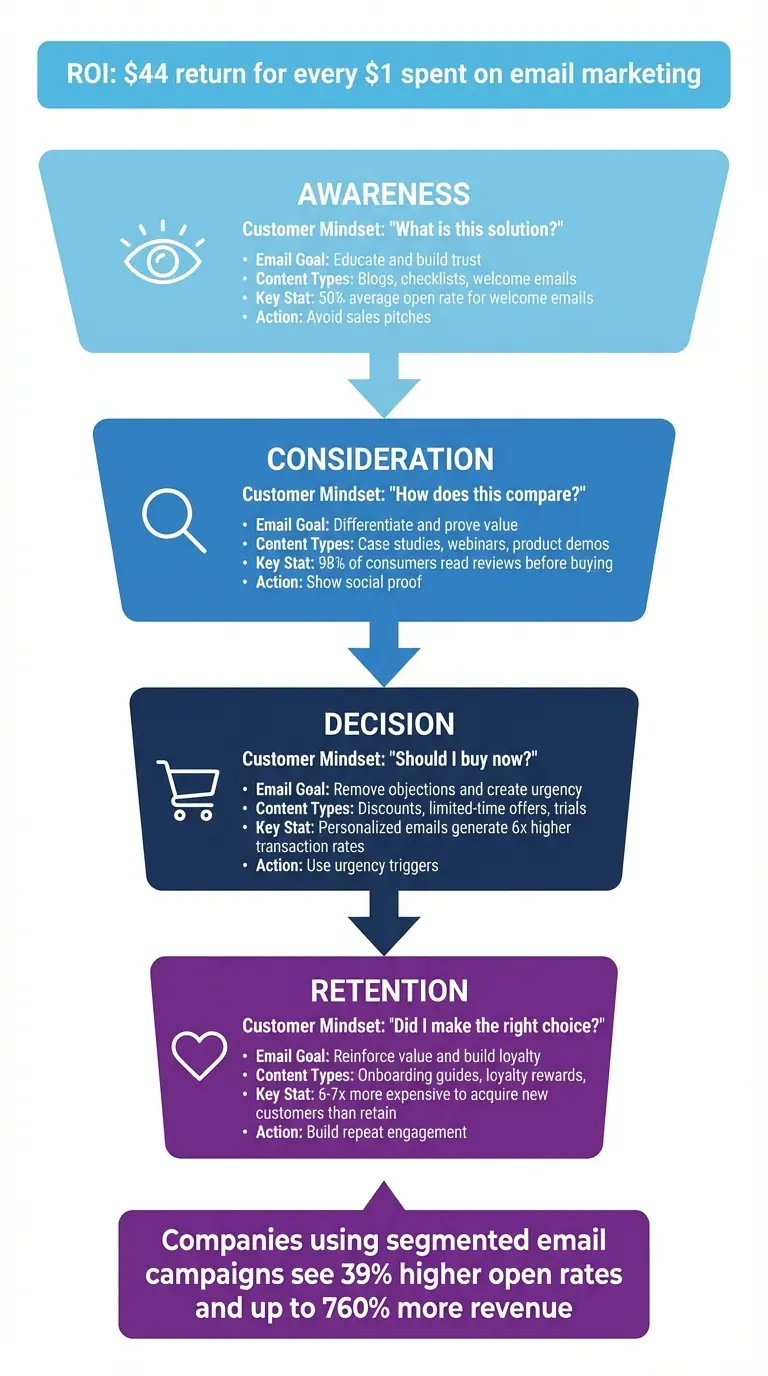
Email Campaign Strategy for Each Sales Funnel Stage
The sales funnel outlines the psychological steps buyers take before they make a purchase. Each stage reflects a different mindset, starting from the moment someone first hears about your brand to when they become a loyal customer. By understanding these stages, you can deliver the right message at the right time, instead of treating all leads the same and risking losing them.
The 4 Stages of the Sales Funnel
Awareness is where it all begins. At this stage, a prospect recognizes they have a problem and comes across your brand as a possible solution. They’re asking questions like, "What is this? Can it help me?". They’re not ready to buy yet - they’re just exploring. Interestingly, welcome emails during this phase have an average open rate of 50%, making it a great time to establish trust without pushing for a sale.
Consideration, often called the Interest stage, is when leads start comparing you to competitors. They’re thinking, "This could work, but how does it stack up?". This is when they dive deeper - reading reviews, checking out case studies, and watching demos. In fact, 98% of consumers read reviews before buying a product for the first time, showing how vital this phase is for building credibility.
Decision is the moment of conversion. The prospect is ready to buy but might need a final push - like a discount, a trial extension, or a clear call-to-action. At this stage, they’re asking, "Should I buy this now?". Creating urgency and addressing any lingering doubts is crucial here.
Retention focuses on what happens after the sale. Since it’s 6 to 7 times more expensive to acquire a new customer than to keep an existing one, this stage is all about turning first-time buyers into repeat customers. Post-purchase emails, loyalty rewards, and check-ins can help reinforce the value of their decision.
How Email Campaigns Support Lead Nurturing
Email campaigns are effective because they deliver personalized content based on where a lead is in the funnel. For example, someone in the Awareness stage needs educational content like blog posts or guides - not a sales pitch. In the Consideration stage, they’ll look for case studies or testimonials that prove your value. Meanwhile, Decision-stage leads respond well to time-sensitive offers that create urgency.
"The real strength of email funnels comes from their organized structure. Every message plays a specific role – it educates, engages, or persuades based on where recipients are in the funnel." – CampaignHQ
This structured approach works. Companies that segment their email lists by funnel stages see 39% higher open rates. And in 2024, automated emails accounted for only 2% of total email volume but drove 37% of sales. Behavioral signals, like visits to pricing pages or downloads of specific content, help identify where a lead is in the funnel. From there, you can send emails tailored to their current questions and concerns.
| Funnel Stage | Customer Mindset | Email Goal | Typical Content |
|---|---|---|---|
| Awareness | "What is this solution?" | Educate and build trust | Blogs, checklists, welcome emails |
| Consideration | "How does this compare?" | Differentiate and prove value | Case studies, webinars, product demos |
| Decision | "Should I buy now?" | Remove objections and create urgency | Discounts, limited-time offers |
| Retention | "Did I make the right choice?" | Reinforce value and build loyalty | Onboarding guides, loyalty rewards |
Next, we’ll dive into how automation makes these email strategies even more effective.
Creating Email Campaigns for Each Funnel Stage
Awareness Stage: Building Initial Engagement
At the awareness stage, your main objective is to educate and build trust without pushing for a sale. Leads are often in the early stages of research, so aggressive tactics can backfire. Instead, focus on offering value through welcome emails and high-converting lead forms for resources like checklists, templates, or email courses.
Welcome emails are a powerful tool, boasting open rates close to 50%, far higher than the 19.49% industry average. Use this as an opportunity to introduce your brand, deliver the promised resource, and outline what subscribers can expect in future emails. For instance, if a lead downloads a resource, follow up a few days later with an email that highlights your expertise - without diving into a sales pitch.
Lead magnets, such as actionable templates or tools, can drive impressive conversion rates of 30% to 40%. A good example is HubSpot's editorial calendar template, which keeps users engaged without pushing a product. Avoid direct sales-driven CTAs like "Buy Now." Instead, guide readers to useful blog posts or other resources that build credibility.
"The companies that win at awareness are the ones that give away their best insights freely." – Sequenzy
Since 58% of people check their email first thing in the morning, making a strong initial impression is essential. Automated emails triggered by user actions - like downloading a resource - often outperform generic, scheduled campaigns. Once you've captured their interest, the next step is to nurture these leads and guide them toward deeper consideration.
Consideration Stage: Nurturing Leads with Helpful Content
In the consideration stage, leads are evaluating options and asking, "Why should I choose you?" This is where educational content, social proof, and addressing objections come into play. Nurtured leads tend to make purchases that are 47% larger than those who aren't nurtured, making this stage a worthwhile investment.
Stick to the 80/20 rule: ensure 80% of your emails provide helpful, educational content, while only 20% focus on sales. Share case studies that highlight success stories, comparison guides that showcase your value, and tools like ROI calculators to demonstrate financial benefits. For B2B buyers - who typically review over seven pieces of content before contacting sales - behavior-based email triggers can deliver the right message at the right time.
"A good nurture campaign focuses on one thing at a time. To take away one concept or one next step. Avoid long emails with multiple CTAs that obscure the desired next step." – Con Cirillo, Head of Lifecycle Marketing at Funnel
Segmentation can be a game-changer, driving up to a 760% increase in revenue compared to non-segmented campaigns. Use self-segmentation emails to let subscribers indicate their preferences, which allows you to deliver tailored messaging and more relevant content. For B2B audiences, tailoring emails to different roles - like sending ROI calculators to CFOs and technical guides to evaluators - can significantly boost engagement. Since 73% of B2B leads aren't ready to buy immediately, patience and consistent value delivery are essential.
Decision Stage: Converting Leads with Targeted Offers
At the decision stage, leads are close to making a choice. Your job is to guide them toward conversion with well-timed, personalized offers. While it often takes at least five touchpoints to close a sale, 44% of salespeople stop after just one follow-up. To avoid this, use behavioral triggers to send targeted emails when leads stall, such as after visiting your pricing page or during a trial.
If trial engagement drops, consider offering an extension to keep the momentum going. For leads nearing the end of a trial, send ROI-focused emails that highlight the cost of their current challenges compared to the benefits your product provides.
Urgency can also be a powerful motivator. Use genuine deadlines, countdown timers, or limited-time offers to encourage immediate action. Remind prospects of what they stand to lose - like access to critical features or time-saving benefits - if they don't act. Personalized emails, which can generate six times higher transaction rates than generic ones, are key. Keep your messages concise with clear CTAs like "Buy Now", "Schedule a Demo", or "Upgrade Today." Even a simple, direct email asking, "Have time to talk?" can build trust. Reinforce your message with social proof, like testimonials or case studies, to solidify your credibility.
Retention Stage: Building Loyalty and Repeat Engagement
When a lead converts, the relationship doesn’t end - it evolves. Post-purchase emails are essential for turning first-time buyers into repeat customers. Asking for reviews or testimonials can be highly effective, as 98% of consumers read reviews before making a purchase. Satisfied customers who share their positive experiences can become advocates for your brand.
Email marketing remains one of the most cost-effective strategies, delivering an average ROI of $44 for every $1 spent. By staying in touch after the sale, you can encourage repeat purchases, increase customer lifetime value, and build a loyal customer base that supports your long-term success.
Using Automation to Align Email Campaigns with Sales Funnels
Manually segmenting email lists can become overwhelming as your audience grows. Automation steps in to connect form submissions with targeted email sequences, ensuring leads receive tailored messages that align with their position in the sales funnel. Here’s how you can gather and use detailed lead data effectively through automation.
Capturing Detailed Lead Data with Multi-Step Forms
Multi-step forms are a powerful way to collect zero-party data - information that users willingly share about their preferences and intentions. By splitting longer forms into smaller, digestible sections (usually 3–5 fields per step), you can reduce mental strain and lower the chances of users abandoning the form altogether [20,21]. Psychological principles like the Zeigarnik Effect and Commitment Bias play a role here, boosting conversion rates by as much as 300% and improving completion rates from 10% to 53% [19,23].
"Multi-step forms aren't magic; they're applied psychology. They work because they understand how the brain processes information and makes choices." – Sadia Humaira, Bit Form
Start with simple, low-pressure questions like, "What is your goal?" and save contact details for the final step. This approach takes advantage of commitment bias, making users more likely to complete the form. Adding a progress bar can also ease anxiety by tapping into the endowed progress effect, giving users a sense of accomplishment as they move through the steps [20,23].
Real-world examples highlight the impact of this strategy. RANAVAT saw a 294% increase in conversions and gained over 3,000 new email subscribers by using a personalized multi-step form quiz. Similarly, CrazyBulk reported a 141% boost in conversion rates (7% for quiz-takers compared to 2.9% overall) after implementing a guided-selling multi-step form.
Using Conditional Routing for Precise Targeting
Conditional routing ensures leads are sent to the most relevant email sequences based on their form responses, allowing you to pre-segment your audience before they even enter your CRM [21,22]. With conditional logic, users only see questions that apply to them, skipping irrelevant ones [20,22]. For instance, a CFO might be routed to emails focused on ROI, while a technical evaluator could receive detailed product specs. This level of personalization engages leads from the very first interaction.
Reform’s conditional routing feature and powerful form templates make it easy to set up these rules without requiring any coding. Leads are automatically assigned to specific email workflows based on their answers, ensuring they start their journey in the right part of the funnel. From there, these workflows can be integrated with your marketing and CRM systems for a seamless transition.
Connecting Reform with Marketing and CRM Systems
To create a smooth, conversion-driven strategy, it’s essential to connect your automated processes with your broader sales funnel. Reform integrates effortlessly with platforms like HubSpot, Salesforce, Zapier, ConvertKit, and Google Sheets, automating the lead-to-email process [20,22].
When a lead completes a multi-step form, their responses are instantly synced to your CRM, complete with tags and segmentation. This triggers the appropriate email sequence without requiring manual input. For example, a lead in the consideration stage might receive case studies and comparison guides, while someone in the decision stage could get trial offers or limited-time discounts.
Reform also offers real-time analytics and tracks abandoned submissions, helping you identify where users drop off. Recovery emails can then be sent to re-engage those leads. This closed-loop system ensures that no lead is left behind, steadily guiding prospects toward conversion.
Conclusion
When emails are aligned with the sales funnel and paired with automation, the results speak for themselves.
Tailoring email campaigns to each stage of the sales funnel helps turn cold prospects into loyal customers. By sending the right message at the right time, you can build trust during the awareness stage, address concerns during the consideration phase, and create urgency when leads are ready to make a purchase. Email marketing continues to deliver impressive returns, with an ROI ranging from $38 to $44 for every $1 spent.
Automation takes this strategy further by simplifying processes like capturing preferences and routing leads through multi-step forms. This approach makes lead nurturing more effective and can significantly improve conversion rates.
Reform plays a key role in streamlining these efforts by seamlessly connecting form submissions to your CRM and marketing tools. Its features, such as conditional routing and real-time analytics, ensure that leads are guided smoothly through the funnel without requiring constant manual intervention.
"The goal of your email funnel is to move people from their stage of awareness to the point of sale." – Benyamin Elias
FAQs
How do I know a lead’s funnel stage?
To pinpoint where a lead is in the sales funnel, focus on their actions and level of engagement. Here's how you can break it down:
- Awareness stage: They’re consuming educational content like blog posts, guides, or videos to learn more about a problem or topic.
- Consideration stage: They’re interacting with resources designed to build trust, such as case studies, webinars, or product comparisons.
- Decision stage: They’re showing intent by responding to offers like demos, consultations, or free trials.
By combining lead scoring techniques with smart data collection, you can fine-tune this process and confidently assign leads to the right stage in their journey through the funnel.
What emails should I automate first?
Start by automating emails for the awareness and interest stages of your sales funnel. At this point, focus on sending educational content, introductory messages, and clear value propositions. These emails are essential for nurturing leads and building trust early on.
You should also create nurturing emails that align with where your leads are in their journey. These targeted messages keep prospects engaged and help qualify them, guiding them toward the consideration and decision stages. Done right, these foundational emails can boost engagement and improve conversion rates.
How often should I email each stage?
Email frequency usually falls between 1 to 4 emails per month, varying based on where leads are in the sales funnel and their level of engagement. For instance, during the consideration and decision stages, sending emails more often can help nudge leads toward taking action. On the other hand, during the awareness stage, fewer emails packed with useful information tend to work better. Striking the right balance - around 2 to 4 emails per month per stage - keeps your audience engaged without feeling bombarded.
Related Blog Posts
Get new content delivered straight to your inbox

The Response
Updates on the Reform platform, insights on optimizing conversion rates, and tips to craft forms that convert.

Drive real results with form optimizations
Tested across hundreds of experiments, our strategies deliver a 215% lift in qualified leads for B2B and SaaS companies.
