
.webp)
Feature Engineering in Predictive Analytics: Key Steps



Feature engineering is the process of transforming raw data into meaningful inputs for predictive models. It’s a critical step in developing systems like lead scoring models, which help sales teams prioritize high-potential leads. Here’s a quick breakdown of the key steps covered in the article:
- Define Goals: Start by identifying the business problem and setting clear predictive goals. Analyze past customer data to find patterns that predict success.
- Identify Data Sources: Combine explicit data (e.g., company size, job title) with implicit data (e.g., website visits, email clicks) to capture intent.
- Perform Exploratory Data Analysis (EDA): Analyze your data to uncover patterns, correlations, and missing values. Document findings for consistency.
- Clean Data: Address missing values, remove irrelevant information, and filter out noise to improve data quality.
- Create Features: Generate new, derived features (e.g., ratios, flags) using domain knowledge to enhance predictive power.
- Transform & Encode: Prepare data for machine learning by transforming distributions and encoding categorical variables.
- Scale & Normalize: Standardize or normalize features to ensure fair contributions to the model, especially for distance-based algorithms.
- Select Features: Focus on the most impactful features using importance metrics or dimensionality reduction techniques.
- Validate & Iterate: Test features with cross-validation and refine them based on model performance and changing trends.
These steps ensure your model is built on high-quality, actionable data, leading to better predictions and more effective decision-making.
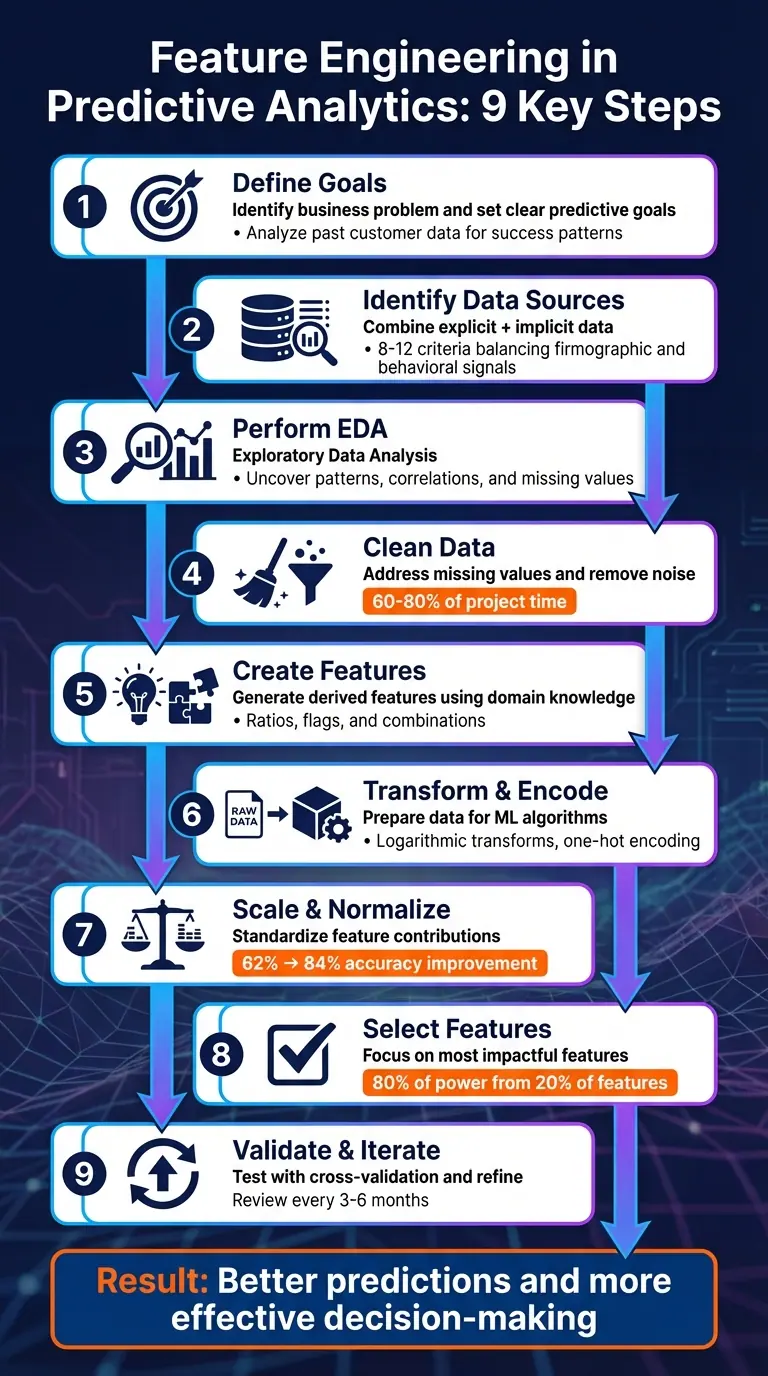
9-Step Feature Engineering Process for Predictive Analytics
Feature Engineering for AI: Transforming Raw Data into Predictions
sbb-itb-5f36581
Step 1: Understand Your Business Problem and Data
Before diving into feature engineering, it's essential to define what success looks like for your predictive model. Vishnu Kumar D S explains:
Understanding the problem allows you to anticipate the types of features that could help.
Without this clarity, you risk creating features that don't contribute to predicting conversions. A clear understanding of your goals ensures you can set measurable objectives and align your data with your business needs.
This step is especially important for identifying high-intent prospects versus less promising leads. IBM highlights:
Feature engineering is context-dependent. It requires substantial data analysis and domain knowledge.
For instance, if a senior decision-maker at a large company visits your pricing page, it might indicate strong buying intent. However, the same action from someone without decision-making authority may not hold the same weight.
Define Your Predictive Goal
Start by analyzing the last 50–100 customers who converted. Look for patterns in the data that reveal predictors of closed deals. Focus on real-world data - examine trends in job titles, company sizes, industries, and behaviors that consistently occur before purchases.
Sales teams can provide valuable input about what drives revenue. For example, you might find that attending a webinar is a stronger predictor of conversions than downloading a whitepaper.
Once you’ve identified these patterns, set a clear target metric tied to measurable business outcomes. This metric will guide your feature engineering decisions moving forward.
Identify Key Data Sources
With your predictive goal in place, the next step is to pinpoint the most relevant data sources. Use a combination of domain expertise and data analysis to identify the signals that matter most. Your data sources should be aligned to capture both explicit and implicit indicators of intent.
For effective lead scoring, combine explicit data - like firmographic and demographic details (e.g., company revenue, employee count, industry, job function, and seniority level) - with implicit data that tracks behavior. Behavioral signals might include website visits, engagement with pricing pages, content downloads, email interactions, or product trial activity. As Orbitforms.ai notes:
What leads do typically predicts conversion better than who they are.
Aim to define 8–12 criteria, balancing explicit and implicit data categories. Review your data collection methods - such as forms, landing page forms, and email tracking - and identify any gaps in your scoring criteria. To avoid overwhelming prospects with long forms, use progressive profiling to gather explicit data over multiple interactions, ensuring high-quality data without sacrificing user experience.
Step 2: Perform Exploratory Data Analysis (EDA)
Once you've identified your data sources, it's time to dive into Exploratory Data Analysis (EDA). This step helps uncover the structure, quality, and hidden patterns within your dataset. As statistician John Tukey famously said:
Unless the detective finds clues, judge or jury has nothing to consider. Unless exploratory data analysis uncovers indicators, there is like nothing for confirmatory data analysis to consider.
For example, in April 2023, Associate Data Scientist Akash Sharma conducted an EDA on a lead scoring dataset from an education company. This dataset contained 9,240 rows and 37 columns. By examining categorical conversion ratios, Sharma discovered that while "Unemployed" leads made up the largest group, "Working Professionals" had a much higher conversion ratio of 91.64%. Additionally, the analysis revealed that "SMS Sent" was the most effective "Last Activity", with a conversion ratio of 62.91%.
A complete EDA should deliver three essential outputs: a data dictionary outlining units and ranges, a quality report that identifies missing data and outliers, and a decision on modeling readiness. Be sure to document all transformations for consistency, as these insights will directly inform feature creation in the next stages.
Analyze Data Distributions
Start by examining data distributions using tools like box plots to detect outliers and histograms to assess skewness. Check the balance of your target variable and flag any missing data. For categorical fields, treat non-selections as null values. Even if your overall missing rate is low (e.g., 0.9%), specific features may have higher levels of missingness that require focused imputation.
Pay attention to features that might duplicate information, such as "Education" and "Education.num", to avoid multicollinearity. Also, ensure that no features include data from after the prediction point, such as timestamps that occur post-conversion. Including such data can artificially boost model performance during training but will fail in real-world applications.
Identify Correlations
Building on your distribution analysis, investigate relationships between variables to refine your feature set. Calculate conversion ratios for categories within features like "Lead Origin" or "Lead Source" to identify the most effective channels. For instance, some channels may show conversion rates exceeding 90%, indicating strong predictive value.
Use visual tools like heatmaps and box plots to explore correlations. To reduce noise, group low-frequency categories under "Others". This approach simplifies your dataset and enhances model performance. By the end of this process, you should have a clear understanding of which variables are critical for predicting conversions and which ones offer little value. This clarity will guide the feature engineering process, ensuring your work is data-driven and impactful.
Step 3: Clean and Prepare Raw Data
After gathering insights from your exploratory data analysis (EDA), it's time to clean and organize your raw data. This step is critical, often taking up 60% to 80% of your project time. Poor data quality has been linked to an 85% failure rate in AI projects. As Ori Sagi, Customer Engagement Manager at Pecan AI, aptly says:
Your model is only as smart as the data behind it.
Data cleaning primarily involves addressing missing values and removing irrelevant or noisy information. These tasks are crucial because even minor oversights can drastically affect your model’s performance. For instance, in a Kaggle competition, improper data cleaning led to data leakage, dropping a model's AUC score from 0.99 to 0.59 - a stark reminder of the importance of careful preparation.
Handle Missing Data
When dealing with missing data, the approach depends on the extent and type of the gaps:
- If less than 10% of your data is missing, simply removing those rows is often sufficient.
- For larger gaps, use imputation methods tailored to your data:
- Numerical features: Replace missing values with the mean for normally distributed data or the median when outliers are present.
- Categorical features: Fill missing values with the mode (most frequent category).
- Time-series data: Apply "forward-fill" to propagate the last known value forward.
Advanced techniques like iterative imputation (e.g., Bayesian Ridge or Random Forest) or K-Nearest Neighbors (KNN) imputation can also be effective. Some algorithms, such as HistGradientBoostingRegressor, even handle missing values natively, sometimes outperforming traditional imputation methods.
Additionally, consider creating binary "is_missing" indicators for features with significant missingness. These flags can provide predictive insights - for example, the absence of salary information might correlate with higher-income individuals. Always remember to fit imputation transformers on your training set and apply them to your test set to avoid data leakage.
Once missing values are addressed, focus on identifying and removing data that could distort your model's predictions.
Remove Irrelevant or Noisy Data
Irrelevant or noisy data can skew your model's outcomes, so it’s crucial to filter it out:
- Negative scoring: Exclude data that fails to improve accuracy, such as personal email domains (e.g., Gmail, Yahoo), generic job titles like "student" or "consultant", or companies below a certain size threshold.
- Stale data: Use score decay to account for outdated information. For example, subtract 5–10 points for every month of inactivity to prioritize recent signals.
- Low-variance features: Apply variance threshold filtering to remove features with minimal variability, as they add little predictive value.
To refine your process further, monitor your sales acceptance rate. If high-scoring leads are frequently rejected by sales, it may signal irrelevant data or flawed scoring criteria. Regularly conduct outlier analysis to identify leads that deviate from expected outcomes - such as high-scoring leads that don’t convert or low-scoring leads that do. This can help uncover hidden issues or overlooked predictive features.
Lastly, establish score boundaries to manage extremes. For example, set a maximum score of 100 and a minimum score of 0 or -20 to prevent noisy data from skewing results excessively. These steps will help ensure your data is clean, relevant, and ready for the next phase of your project.
Step 4: Create Derived Features
Once your data is clean, the next step is to create derived features - transforming raw inputs into more meaningful data points. These features help uncover patterns that raw data alone might miss, leading to better model performance. For example, in a time-in-transit project with 10 million records, feature engineering boosted on-time delivery rates from 48% to 56%.
Combine Existing Data Fields
By combining columns through operations like ratios, sums, or differences, you can reveal relationships hidden in the raw data. Instead of treating each data point separately, derived features expose non-linear patterns.
Take real estate analytics, for instance. Instead of keeping "Year Built" and "Year Sold" as separate fields, calculate a new feature like "House Age" (Year Sold minus Year Built). This derived feature often correlates more strongly with price than the original data points. Similarly, for lead scoring, creating an "Income-to-Age Ratio" can highlight trends that income or age alone might not capture. These types of features bring out signals that directly improve predictive models.
A great example is Progressive Insurance's Snapshot program. By focusing on behavioral data - like actual driving habits - instead of demographic data, they identified safer drivers with greater accuracy. This approach led to $700 million in driver discounts and $2 billion in premiums within a year. Their top-tier leads, identified through these features, converted 3.5 times more effectively than average leads.
Incorporate Domain Knowledge
Your industry expertise is invaluable when deciding which features to create. Start with indicator variables - binary features that flag key events or behaviors. For example, in a lead scoring model, you might create a "high-intent" flag for users who visit both a pricing page and a competitor comparison page within 48 hours. This single feature encapsulates a complex behavior that signals readiness to buy.
Another way to apply domain knowledge is by grouping sparse categories. If you have categorical data with low-frequency classes, like "Wood Siding" and "Wood Shingle", combining them into a broader "Wood" category reduces noise and helps prevent overfitting. A practical rule is to merge categories until each has at least 50 observations.
In early 2026, the Carson Group showcased the power of feature engineering by achieving 96% accuracy in predicting lead conversions. By transforming raw data on impressions, clicks, and conversions into actionable features, they reduced wasted effort on low-quality leads by 80%. As House of MarTech aptly put it:
Machine learning finds patterns you'd never think to look for.
When designing derived features, aim for simplicity and interpretability. Features that are easy to explain build trust with stakeholders, aid debugging, and ensure compliance with regulations. Using a virtual feature store can streamline the process of managing and serving these features across models. By generating a wide range of potential features and allowing algorithms with feature selection capabilities to identify the most effective ones, you set the stage for successful model training.
Step 5: Transform and Encode Features
Once you've created derived features, the next step is to prepare them for machine learning models. This involves transforming and encoding features into numerical formats that models can process effectively.
Apply Logarithmic or Polynomial Transformations
Some features, like income, website traffic, or transaction amounts, often have a long-tail distribution. Most values cluster at the low end, with a few outliers stretching far to the right. A logarithmic transformation can compress these extreme values, making the distribution more bell-shaped (Gaussian-like), which many algorithms handle better. To decide if this is necessary, examine your data's distribution using histograms or boxplots. If the data is right-skewed, applying a log transformation is a common fix. Keep in mind, though, you can't take the log of zero or negative values without adding an offset first.
For non-linear relationships, polynomial transformations can help. Raising features to a power (e.g., squaring them) allows linear models to capture curved patterns, such as the diminishing returns of salary increases with additional experience. However, high-degree polynomials can lead to overfitting, so use them cautiously. Alternatively, the Box-Cox transformation is a flexible method that automatically finds the best power to stabilize variance and normalize the data.
If you're using distance-based models like K-Nearest Neighbors or Support Vector Machines, standardizing features after transformation is crucial. This ensures that features with different scales don't dominate the model. Once numerical features are properly transformed, the next step is encoding categorical data into numerical forms.
Encode Categorical Variables
After transforming numerical features, categorical variables must be converted into numerical representations. The choice of encoding method depends on whether the categories have a natural order.
- One-hot encoding: This method creates a binary column for each category. For example, a "Color" feature (e.g., Red, Blue, Green) is converted into separate binary columns. It's ideal for nominal data (categories without an inherent ranking). However, if the feature has high cardinality (e.g., zip codes with hundreds of unique values), this can lead to a bloated dataset. To manage this, group rare categories into an "infrequent" bucket if they appear in less than 5% of records.
- Ordinal encoding: This technique is suitable for ranked categories, like education levels (e.g., High School < Bachelor's < Master's < Doctorate). It assigns integers that preserve the order (e.g., High School = 1, Bachelor's = 2). Using domain knowledge to map these values can help the model learn more effectively. Be careful not to apply ordinal encoding to nominal data, as this can create misleading relationships.
- Target encoding: For high-cardinality features, target encoding can be a powerful option. It replaces each category with its mean target value, maintaining predictive power with fewer dimensions. For instance, you could replace zip codes with their average conversion rates. To avoid overfitting - especially for categories with few observations - apply smoothing (e.g., setting smooth="auto" in scikit-learn).
| Encoding Method | Best For | Key Advantage | Watch Out For |
|---|---|---|---|
| One-Hot | Nominal data, low cardinality | Treats categories independently | Can cause dimensionality explosion with many categories |
| Ordinal | Ranked categories | Preserves meaningful order | Implies order if used on nominal data |
| Target | High-cardinality nominal data | Links directly to the target with fewer dimensions | Risk of data leakage without proper validation |
| Frequency | High cardinality | Efficient, no extra dimensions | Loses category-specific details |
In scikit-learn, parameters like handle_unknown="ignore" can help prevent errors when new categories appear during production.
"Coming with features is difficult, time consuming, requires expert knowledge. Applied Machine learning is basically feature engineering".
Always fit transformations and encoders on your training data and apply the same parameters to your test data. With features transformed and encoded, you're ready to move on to scaling and normalizing them in the next steps.
Step 6: Handle Feature Scaling and Normalization
Once you've transformed and encoded your data, the next step is scaling. Scaling ensures that all features contribute fairly to your model's performance. Without it, features with larger ranges - like salary ($30,000–$200,000) - can overshadow smaller-range features, such as years of experience (0–40). For example, in a February 2026 case study on predicting employee attrition with K-Nearest Neighbors, a $50,000 salary difference was mistakenly treated as equal to 50,000 years of experience. After applying standardization, the model's accuracy jumped from 62% to 84%.
"Feature scaling is not just a nice-to-have. For many algorithms, it's the difference between a model that works and one that doesn't." - Sebastian Raschka, Machine Learning Researcher
Scale Features for Consistency
The method you choose for scaling depends on your data's distribution and the algorithm you're using:
- Standardization (Z-score normalization): Centers data around a mean of 0 and a standard deviation of 1 using the formula (X – μ) / σ. This method works well for normally distributed data and is less affected by outliers.
- Min-Max Scaling: Rescales features to a range of 0–1 using (X – X_min) / (X_max – X_min). It's ideal for neural networks but can be sensitive to outliers.
- Robust Scaling: Uses the median and interquartile range (IQR) instead of the mean and standard deviation. This method is better suited for datasets with significant outliers.
- Max Abs Scaling: Scales data by dividing by the maximum absolute value of each feature. It’s particularly useful for sparse datasets, as it preserves sparsity.
Tree-based models like Random Forest and XGBoost don't require scaling because they split data based on feature values rather than distances.
Important Tip: Always fit your scaler on the training data only, then apply the same parameters to both the training and test sets. Fitting the scaler on the entire dataset before splitting can leak information from the test set into the training process, leading to overly optimistic performance estimates.
Once features are scaled, you can move on to normalization for algorithms that rely on distance measurements.
Normalize Data for Distance-Based Models
Normalization becomes crucial when working with algorithms that use distance calculations. Models like K-Nearest Neighbors, K-Means, and Support Vector Machines are highly sensitive to feature magnitudes. Without normalization, one feature might dominate the distance calculations, overshadowing others.
A great example comes from a June 2020 study using the Wine Recognition Dataset. Researcher Giorgos Myrianthous showed that applying StandardScaler before running Principal Component Analysis (PCA) and training a Gaussian Naive Bayes model improved test accuracy from 81% to 98%. This was because features like Proline (with values in the thousands) no longer overpowered features like Hue (with values near 1.0).
For businesses, these improvements can have a direct impact. Companies using predictive lead scoring, for instance, have reported a 28% boost in conversion rates and a 25% reduction in sales cycles.
Finally, keep in mind that you should not scale categorical variables, especially those that are one-hot encoded. These variables are already confined to a range of 0 to 1 and do not require further adjustment.
Step 7: Select Relevant Features
Once you’ve scaled and normalized your features, the next step is to zero in on the ones that truly drive your model's performance. Not all features are created equal - about 80% of a model’s predictive power often comes from just 20% of the features. By identifying and keeping the most impactful ones, you can save on computation time and reduce the risk of overfitting.
The goal here is to focus on features that strongly correlate with your target variable while removing those that add little to no predictive value. This process generally involves two approaches: using feature importance metrics and applying dimensionality reduction techniques.
Use Feature Importance Metrics
Feature importance metrics help pinpoint which variables have the biggest influence on your model’s predictions. The exact method you choose will depend on the type of model you’re working with:
- Tree-Based Models: Algorithms like Random Forest and XGBoost come with built-in importance scores. For example, Gini Importance measures how much a feature reduces impurity at each decision tree split. In a lead scoring model, "time spent on pricing page" might have a significantly higher Gini Gain compared to "browser type", making it a more critical feature.
- Permutation-Based Importance: This model-agnostic approach works by shuffling a feature’s values and measuring the resulting drop in accuracy. If randomizing a feature like "company size" causes accuracy to fall from 87% to 74%, it’s clear that the feature is essential.
- Linear Models: For linear and logistic regression, the absolute size of the coefficients can indicate feature importance. For instance, if "demo request submitted" has a coefficient of 2.4 while "newsletter subscriber" has 0.3, the former is far more influential in driving predictions.
Once you’ve identified features with little or no importance, remove them and validate your model using cross-validation. This ensures you’re not compromising predictive accuracy while simplifying your model.
Apply Dimensionality Reduction
If feature importance metrics don’t slim down your dataset enough, dimensionality reduction techniques can help. These methods condense your data into fewer, more meaningful dimensions, which is especially useful when working with large feature sets.
One popular technique is Principal Component Analysis (PCA). PCA transforms correlated variables into a new set of uncorrelated components that capture the most variance in your data.
"PCA attempts to 'compress' the information in your data into fewer dimensions, and the most 'informative' dimensions are retained." - CodeSignal Learn
Typically, PCA results in only a 1% to 15% loss of variability in the data. However, it’s crucial to standardize your data first, as PCA is sensitive to the scale of the input features.
For classification tasks like lead scoring, Linear Discriminant Analysis (LDA) can sometimes be a better choice than PCA. LDA is a supervised method that focuses on maximizing class separability. If your data is sparse - such as when many features are binary flags with mostly zero values - Truncated Singular Value Decomposition (SVD) can be a more efficient alternative.
Keep in mind that while dimensionality reduction can improve performance and speed, it may also reduce interpretability. The new components are mathematical combinations of original features, which can make it harder to explain why a particular lead scored the way it did.
Step 8: Validate and Iterate on Features
Feature engineering is a process that requires constant refinement. The final step in this journey is to validate your features and iterate based on their performance. Even after selecting and scaling features, testing their impact on your model is essential. This step ensures your features aren't just theoretically sound but also practical in driving actionable insights. The best predictive models are built through a cycle of testing and improvement, not a one-time effort.
Test Features Using Cross-Validation
Cross-validation is the go-to method for evaluating how well your features work. One of the most popular techniques is K-fold cross-validation, where the dataset is split into k equal parts (folds). The model is then trained and validated k times, each time using a different combination of folds. This approach provides a more reliable performance estimate than a single train/test split, especially for smaller datasets.
For lead scoring models, ROC AUC (Receiver Operating Characteristic Area Under the Curve) is a particularly effective metric. It evaluates how well the model distinguishes between positive and negative leads. For example, a lead scoring model using Logistic Regression achieved a 0.817 ROC AUC on a validation set in 2026, meaning it correctly predicted outcomes 81.7% of the time when comparing random positive and negative examples. Alongside AUC, keep an eye on precision (how many leads marked as "converted" actually converted) and recall (how many converted leads the model detected). These metrics help balance lead quality with lead volume.
When performing cross-validation, calculate the mean and standard deviation across all folds. If you notice a high standard deviation, it suggests that your features might not be stable - they could work well on some subsets of data but fail on others. This is a sign that you may need to revisit your feature engineering process.
Once cross-validation confirms that your features are stable, shift your focus to refining them based on how the model performs in real-world scenarios.
Iterate Based on Model Performance
Real-world performance is where the true test of your features lies. Pay close attention to metrics like precision and recall - any significant drops could indicate that features are losing their effectiveness. If lead scores are clustering too narrowly, it might be time to refine your features.
In February 2026, a financial technology startup transitioned from a rules-based system to a predictive lead scoring model. By leveraging pattern recognition to identify high-potential leads, they boosted win rates from 20% to 30% and saw a 215% increase in conversions over six months. Similarly, Carson Group achieved 96% accuracy in predicting lead conversions using raw impression and click data, cutting down wasted effort on low-quality leads by 80%.
Features can degrade over time - typically within 3–6 months - due to changes in market conditions or buyer behavior. To counter this, establish a retraining schedule. Review your model's impact and adjust features at least once a month to stay ahead of seasonal trends and market shifts. Regularly incorporate new conversion data, either weekly or monthly, to address feature performance decay. Keep an eye on early indicators like lead response time and MQL-to-SQL conversion rates during the first 1–8 weeks to catch potential issues before they escalate.
"The tech didn't replace human intuition - it amplified it by filtering out noise." - House of MarTech
For a robust evaluation, use a three-way data split: training (to build the model), validation (to fine-tune features and hyperparameters), and test (for an unbiased final assessment). Avoid using the test set to tweak features - once you do, it becomes "contaminated" and no longer provides an accurate measure of real-world performance.
Conclusion
Feature engineering acts as the bridge between raw data and actionable business results. This checklist offers a clear framework to create a predictive system that guides your sales team toward high-conversion leads.
Taking these steps can lead to measurable success. For instance, Salesforce's Einstein Lead Scoring analyzes over 100 signals per lead, making sales teams 1.3 times more likely to exceed their quotas. Similarly, Lenovo transformed its lead scoring process in 2022 by adopting Adobe Marketo Engage across North America, EMEA, and Asia-Pacific. This shift replaced fragmented manual methods and enabled quicker responses to high-intent leads.
"Focus on platforms that allow for 'explainable AI,' meaning the AI model provides transparency on how it derives lead scores. This transparency helps build trust in the system." - Marc Perramond, VP Product, Demandbase
To truly optimize your lead scoring process, ensure that your features align with your Ideal Customer Profile and highlight the behaviors that drive conversions. Misalignment could result in an overly complex system that fails to consistently identify top leads.
It's also essential to revisit and refine your features regularly based on real-world performance. Market trends shift, buyer behaviors evolve, and features can lose their effectiveness - often within 3–6 months. Plan quarterly calibration meetings between sales and marketing teams to adjust feature weights and ensure your model stays effective. The time and effort you put into refining these features will lead to better conversion rates and a more efficient sales process.
FAQs
How do I avoid data leakage during feature engineering?
To avoid data leakage, it's critical to build features using only the data available at the time of prediction. Here are some key practices to follow:
- Split data early: Divide your dataset into training, validation, and test sets before starting any feature engineering. This ensures that information from one set doesn’t unintentionally influence another.
- Exclude target-related or future data: Avoid using features that are directly tied to the target variable or rely on information from the future, as this can distort your model's predictions.
- Preprocess separately: Apply preprocessing steps like scaling or encoding independently for each dataset split. This prevents information from the full dataset from leaking into the training process.
By following these steps, you can ensure your model delivers reliable performance metrics and is better equipped to handle unseen data.
Which encoding method should I use for high-cardinality categories?
When dealing with high-cardinality categories, techniques like target encoding or embedding can be game-changers. These methods handle large feature sets more effectively compared to traditional approaches like one-hot or dummy encoding, which often become inefficient and resource-intensive as the number of categories grows. By using these advanced methods, you can keep your model scalable without sacrificing performance.
How often should I refresh features and retrain a lead scoring model?
To keep your lead scoring model accurate and relevant, it's important to update its features and retrain it on a regular basis. This should typically happen whenever fresh data is available or if you see a drop in performance. These regular updates help ensure your predictions align with the latest trends and data patterns.
Related Blog Posts
Get new content delivered straight to your inbox

The Response
Updates on the Reform platform, insights on optimizing conversion rates, and tips to craft forms that convert.




Drive real results with form optimizations
Tested across hundreds of experiments, our strategies deliver a 215% lift in qualified leads for B2B and SaaS companies.
