
.webp)
Real-Time Threat Detection Using Behavioral Insights



Cyberattacks are evolving, and static defenses like CAPTCHAs or IP blocklists are no longer effective against sophisticated social engineering tactics. Modern attackers use AI to mimic human behavior, making it harder to detect threats. Behavioral analysis offers a smarter way to protect online forms by analyzing how users interact, identifying patterns that reveal suspicious activity in real time.
Why This Matters:
- Traditional defenses fail: Bots and AI tools bypass CAPTCHAs and filters with ease.
- Social engineering is rising: 60% of breaches now involve human manipulation.
- Behavioral insights work: Monitoring typing patterns, mouse movements, and field-entry sequences can identify attacks with up to 94.1% accuracy.
Key Solutions:
- Monitor user behavior to establish a baseline of "normal" activity.
- Use real-time detection to flag unusual patterns like irregular typing or rapid form submissions. Using multi-step form templates can also help pace user interaction.
- Combine behavioral scoring with IP reputation checks and email validation.
- Block suspicious submissions quietly to avoid tipping off attackers.
Behavioral analysis isn’t just about detecting threats - it’s about staying ahead of attackers who exploit trust and mimic legitimate users. By shifting focus to user behavior, businesses can protect their data and improve lead quality without disrupting genuine users.
The Problem: How Social Engineering Bypasses Legacy Defenses
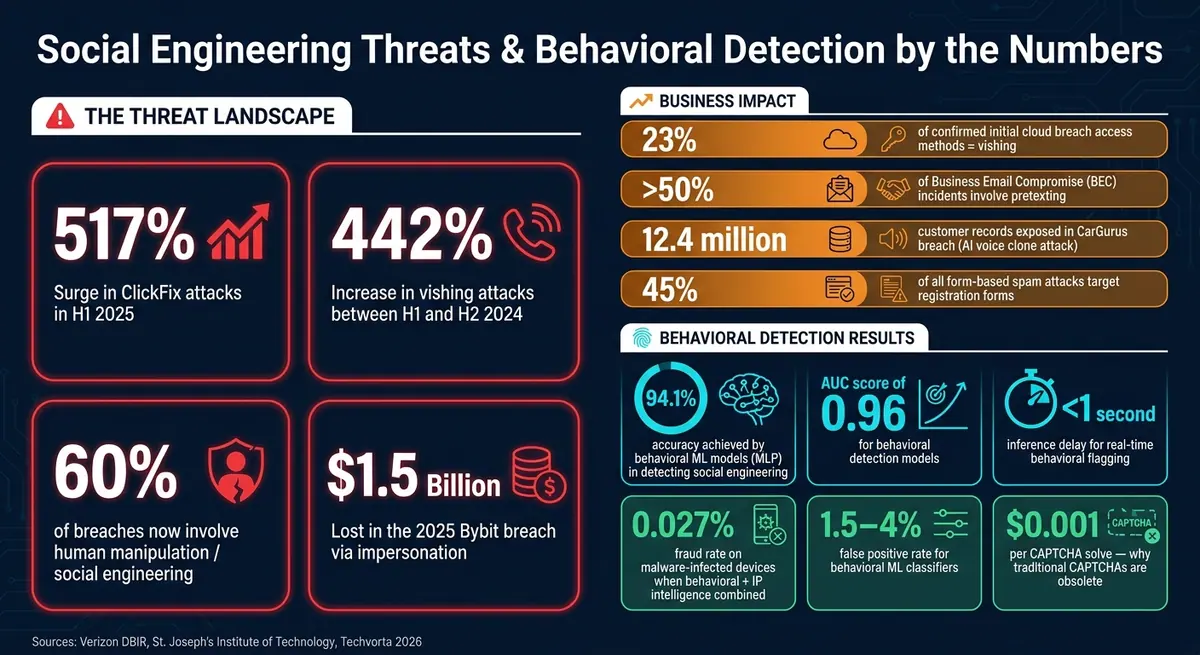
Social Engineering Threats & Behavioral Detection: Key Stats
How Modern Social Engineering Tactics Work
Social engineering attacks today are more sophisticated than ever. Attackers craft convincing personas and exploit legitimate workflows, often using AI to mimic authentic interactions. These advanced tactics highlight the shortcomings of older security measures and emphasize the growing importance of behavioral analysis.
Take AiTM phishing, for example. Attackers use proxy servers to intercept session tokens in real time. Even when multi-factor authentication (MFA) is correctly used, they can capture valid session cookies, allowing them to bypass MFA entirely.
Another common tactic is pretexting, which now accounts for more than half of all Business Email Compromise (BEC) incidents. Attackers spend days or even weeks building a believable backstory before launching their attack. A striking case occurred in February 2025, when a Bybit breach cost the company $1.5 billion. The attacker had spent weeks impersonating a trusted open-source contributor, gaining developers' trust before introducing malicious code [Techvorta, 2026].
Then there are ClickFix attacks, which lure users into executing malicious commands by showing fake error messages or CAPTCHA prompts. Since the user initiates the action, no malicious file is delivered, meaning traditional endpoint security tools have nothing to scan. These attacks surged by 517% in the first half of 2025.
The Impact on U.S. Businesses
These evolving tactics are taking a heavy toll on U.S. businesses. Social engineering-based breaches have caused significant disruptions, with some retail operations unable to process online orders for over six weeks. In 2026, CarGurus, an automotive platform, experienced a breach involving 12.4 million customer records. The root cause? An AI-generated voice clone of an executive tricked a finance employee during a vishing call [Techvorta, 2026].
Vishing itself has seen explosive growth, increasing by 442% between the first and second halves of 2024. It now represents 23% of confirmed initial access methods in cloud-based compromises. These aren't isolated incidents - they're becoming the norm.
Why Behavioral Analysis Is Needed
Traditional defenses like firewalls, signature-based filters, and IP blocklists are designed to counter technical threats, not the conversational and deceptive nature of social engineering. These static defenses struggle to detect the nuanced behaviors that define these attacks, underscoring the need for real-time behavioral analysis.
"By 2026, deepfake video and audio will be undetectable through technical analysis. Spectrograms will show no artifacts. Video frame analysis will reveal no rendering flaws. The only reliable defense is refusing to authenticate through channels that can be spoofed." - Paul Nguyen, Co-founder, Permiso
Behavioral analysis steps in where legacy defenses fall short. It identifies patterns that distinguish genuine users from attackers, such as how long someone spends on specific fields, whether their mouse movements appear natural, or if their submission sequence aligns with typical user behavior. These insights provide a critical layer of defense against the increasingly sophisticated tactics of social engineering.
sbb-itb-5f36581
The Solution: Real-Time Threat Detection Through Behavioral Insights
What Is Behavioral Analysis in Cybersecurity?
Behavioral analysis in cybersecurity focuses on examining how users interact with systems, emphasizing patterns of behavior rather than relying on a static list of known threats. By establishing a baseline of what "normal" looks like, this method can detect deviations that might indicate malicious activity.
"In a world of AI-driven vulnerability discovery that evolves its code every second, you cannot rely on knowing what the threat 'looks like.' Instead, you must know what 'normal behavior' looks like." - Weskill.org
This technique is especially effective against social engineering attacks, which often appear legitimate at first glance. By identifying subtle inconsistencies in how users behave during a session, it can catch manipulative tactics that traditional rule-based systems might miss. These baseline-driven insights form the backbone of anomaly detection.
Key Behavioral Signals to Watch in Forms
When it comes to monitoring form interactions, certain behavioral cues can signal suspicious activity:
- Keystroke Timing: Human typing patterns have natural rhythms, unlike the uniform timing of automated scripts.
- Mouse Movement Patterns: Humans navigate forms in less precise, more organic ways compared to bots.
- Field-Entry Sequence: Legitimate users tend to follow a logical order when filling out forms; deviations may indicate tampering.
- Paste Detection: Pasting information, rather than typing it, could suggest stolen credentials or automation.
- Unusual Re-Edit Frequency: Frequent edits in specific fields might point to scripted or automated behavior.
"The new spam doesn't look like spam. So the new defense has to stop reading the text and start reading everything else: how the form was filled, by whom, from where, in what time, with what behaviour." - Raman Makkar, Founder, splitforms
Research backs up the effectiveness of these techniques. In April 2026, Yuvaraja P. and Sathyanarayanan R. from St. Joseph's Institute of Technology demonstrated that a Multi-Layer Perceptron model could detect social engineering attempts with 94.1% accuracy and an AUC score of 0.96.
How Real-Time Detection Works
Real-time detection systems use these behavioral signals to continuously monitor and evaluate user sessions. By comparing live interactions against established baselines, these systems can assess risk in real time. If a user's behavior significantly deviates from the norm, the session is flagged - often with an inference delay of under 1 second.
Unlike older binary systems, modern solutions assign a dynamic risk score based on the overall context of the session. For example, a combination of irregular typing patterns, a flagged IP address, and an unusual field-entry order could collectively trigger further investigation. Machine learning classifiers used in these systems typically maintain false positive rates between 1.5% and 4%.
Integrating behavioral data with external intelligence, such as IP reputation and email risk assessments, enhances detection capabilities even further. One study reported that this combined approach reduced fraud on malware-infected devices to just 0.027% - a remarkable achievement.
Putting It Into Practice: Adding Behavioral Detection to Form Security
Setting a Baseline for Normal User Behavior
To effectively detect suspicious activity, start by establishing a baseline of normal user behavior. Allow the system to monitor traffic for 48 to 72 hours before implementing any blocking rules. During this period, the system observes how legitimate users interact with your forms - tracking metrics like how long they spend on fields, the order in which they complete them, and how often they make corrections.
Focus on two primary behavior patterns:
- Aggregation: Identifies volume-based anomalies, such as a single session accessing an unusually high number of fields or submitting multiple forms in a short timeframe.
- Sequencing: Detects multi-step attack chains, like a form submission immediately followed by an API call from a new IP address.
One simple measure is to reject submissions completed in less than 1.5 seconds, as human users typically take between 1.5 and 15 seconds to fill out a form.
Spotting and Responding to Suspicious Behavior
Once you’ve established a behavioral baseline, it becomes easier to recognize unusual activity. A layered approach works best, escalating responses as risk indicators increase:
| Layer | Method | Purpose |
|---|---|---|
| 1 | Honeypot fields + timing checks | Instantly catch basic bots |
| 2 | Behavioral scoring | Identify sessions with irregular patterns |
| 3 | IP reputation checks | Block known malicious IPs and residential proxies |
| 4 | Content analysis | Detect AI-generated or context-aware spam |
When suspicious behavior is flagged, respond discreetly. For instance, return a 200 OK status but quietly discard the submission. This keeps attackers unaware of which security measure was triggered.
For medium-risk sessions, consider incremental responses. A lightweight proof-of-work challenge - solved silently by the browser - can slow bots without disrupting real users. This approach is far more effective than traditional CAPTCHAs, which AI tools can now bypass with nearly 100% accuracy in under a second.
Connecting Behavioral Detection to Existing Workflows
Behavioral detection is most effective when seamlessly integrated into your existing tools and workflows. The objective is to block bad data before it enters your CRM, rather than cleaning it up afterward. With registration forms being the target of 45% of all form-based spam attacks, preventing database contamination is critical.
For sensitive fields like email and phone numbers, implement synchronous validation to ensure checks happen before data is saved. For more complex fraud detection, use asynchronous alerts via webhooks to notify your security team in real time. On the backend, always validate the encrypted token from your frontend SDK with a separate API call. Relying solely on frontend signals is risky, as they can be manipulated by advanced attackers.
"Real-time form protection blocks bad contacts before they enter your CRM or marketing system, ensuring data quality from the moment users submit their information." - ApexVerify
Finally, track downstream metrics like engagement quality and bounce rates in your CRM. This provides tangible proof of improved lead quality, which can help justify the investment to stakeholders who want measurable results.
Modern form builders, such as Reform, integrate behavioral detection seamlessly. This ensures that only high-quality leads make it to your CRM, while maintaining a smooth user experience. These integrations enhance form security and protect your data from ever reaching a compromised state.
Conclusion: Better Form Security Through Behavioral Insights
By shifting from static defenses to behavioral insights, businesses can stay ahead of the ever-changing tactics employed by social engineers.
Why Behavioral Analysis Is More Effective Than Static Methods
Traditional defenses like CAPTCHAs were built to counter older threats. Today, AI tools can bypass reCAPTCHA v2 almost instantly, while CAPTCHA farms charge as little as $0.001 per solve - rendering these methods nearly obsolete.
Behavioral analysis takes a different approach. Instead of requiring users to prove their humanity, it observes how they interact. Subtle behaviors - like the timing of keystrokes, patterns of mouse movement, or the sequence in which form fields are completed - are extremely difficult to replicate on a large scale. Researchers Yuvaraja P and Sathyanarayanan R from St. Joseph's Institute of Technology explain:
"Social engineering attacks capitalize on the human mental vulnerability and not technical vulnerability and thus it is not easily spotted by traditional cybersecurity controls."
Behavioral machine learning models excel here, achieving 94.1% accuracy and an AUC of 0.96, with response times of less than a second. These results far surpass what static defenses can offer.
Key Steps for U.S. Businesses
To fully benefit from behavioral analysis, U.S. businesses should adopt a multi-signal strategy. This means combining behavioral scoring with tools like IP reputation checks, device fingerprinting, and email validation. Every form submission should be treated as potentially suspicious, even if it originates from a trusted domain or passes authentication checks.
Practical steps include rejecting submissions completed in under 1.5 seconds and using risk scores to categorize entries into auto-approve, review, or silent rejection workflows. When rejecting submissions, return a 200 OK status to prevent attackers from identifying which security layer flagged them.
As threats evolve, detection protocols must evolve too.
Keeping Your Detection Strategy Up to Date
The threat landscape is constantly changing. Advanced AI agents, such as GPT-4o, are already being used to bypass visual and audio security measures in real time. Jian Zhen, Group Product Manager at Google Cloud, emphasizes this shift:
"As threats shift from bot automation and invalid traffic to agent takeover and large-scale, AI-driven synthetic identity fraud, Fraud Defense identifies emerging threats before they reach your site."
To stay ahead, businesses should continuously adjust their risk thresholds (like reCAPTCHA v3 scores) based on observed traffic patterns. Monitoring key CRM metrics can help detect anomalies early. The goal is not a one-time solution but a dynamic detection strategy that adapts alongside evolving threats.
FAQs
How do you set a “normal behavior” baseline for a form?
When determining what counts as "normal behavior" in Reform, it's more effective to focus on interaction context rather than just the text content. This means paying attention to how users interact with the form instead of solely analyzing their input.
Key metrics to monitor include:
- Time spent on the form: Are users completing it too quickly or taking an unusually long time?
- Location: Where are the users accessing the form from? Patterns in geographic data can be revealing.
- Behavioral patterns: Look for consistent user actions, such as navigation flow or typing speed.
To ensure security without disrupting legitimate users, implement layered security techniques, such as:
- Timing checks: Identify suspiciously fast or slow completions.
- IP reputation monitoring: Flag IP addresses with a history of suspicious activity.
- Honeypots: Use traps that only bots would interact with, helping to filter out malicious activity.
By combining these methods, you can create a secure system that still feels seamless for real users.
What privacy data is collected for behavioral detection?
Behavioral detection focuses on gathering interaction data without collecting personal information. It looks at patterns like keystroke timing, mouse movements, pauses during typing, and how often users make corrections. It also examines dwell time (how long someone spends on a specific field), the sequence of entries, and how often fields are re-edited. By analyzing these behaviors, it becomes possible to spot unusual activity, such as bot behavior or attempts at cognitive manipulation, all while maintaining security without depending on conventional methods.
How do you reduce false positives without letting attacks through?
To reduce false positives without compromising security, shift the focus to analyzing behavioral context rather than solely examining content. Start by establishing a baseline of typical user interaction patterns, then monitor for any noticeable deviations. Implement low-impact defenses such as honeypots, timing checks, and IP reputation analysis. These strategies help ensure that tools like CAPTCHAs serve as advisory tie-breakers, effectively filtering out automated threats while enabling legitimate users to navigate without unnecessary friction.
Related Blog Posts
Get new content delivered straight to your inbox

The Response
Updates on the Reform platform, insights on optimizing conversion rates, and tips to craft forms that convert.



Drive real results with form optimizations
Tested across hundreds of experiments, our strategies deliver a 215% lift in qualified leads for B2B and SaaS companies.
