

FERPA and Student Consent: Marketer Guide


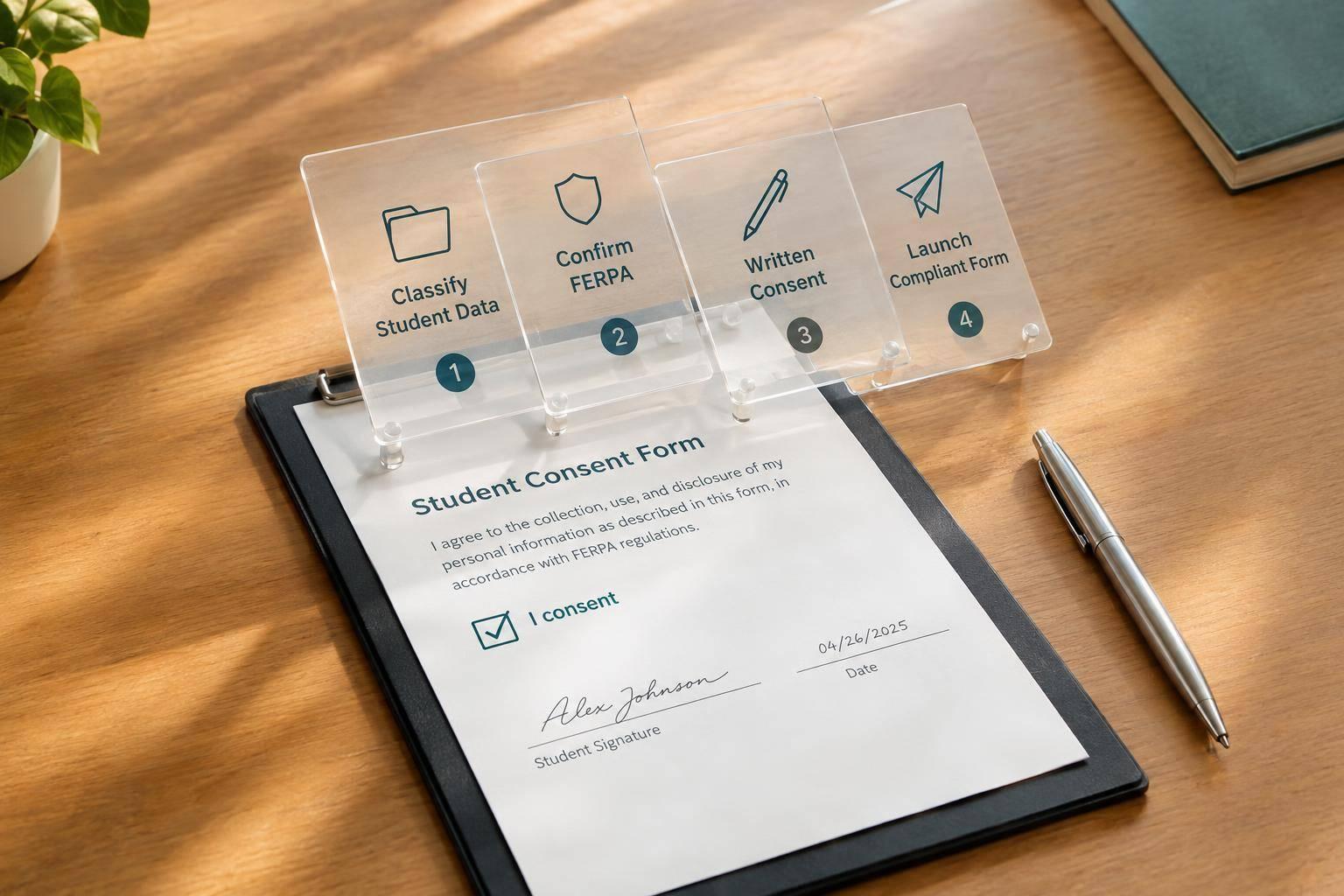
Before I send student data to a CRM or marketing tool, I check whether FERPA applies and what allows the disclosure. A consent checkbox alone isn’t enough: when consent is required, it must be signed, dated, and identify the records, purpose, and recipients.
I use three checks before launch:
- Classify the data. Inquiry data from someone who never attends generally falls outside FERPA; maintained student records may be covered.
- Confirm permission to share. Check consent requirements, vendor rules, and directory-information opt-outs. FERPA rights transfer to students at 18 or when they enroll in postsecondary education.
- Check the whole workflow. Separate high-converting lead forms from FERPA consent, limit fields and access, test routing, and keep required records in institution-approved systems.
My rule: <u>get documented institutional approval before launch</u> - including for Reform or any other form tool.
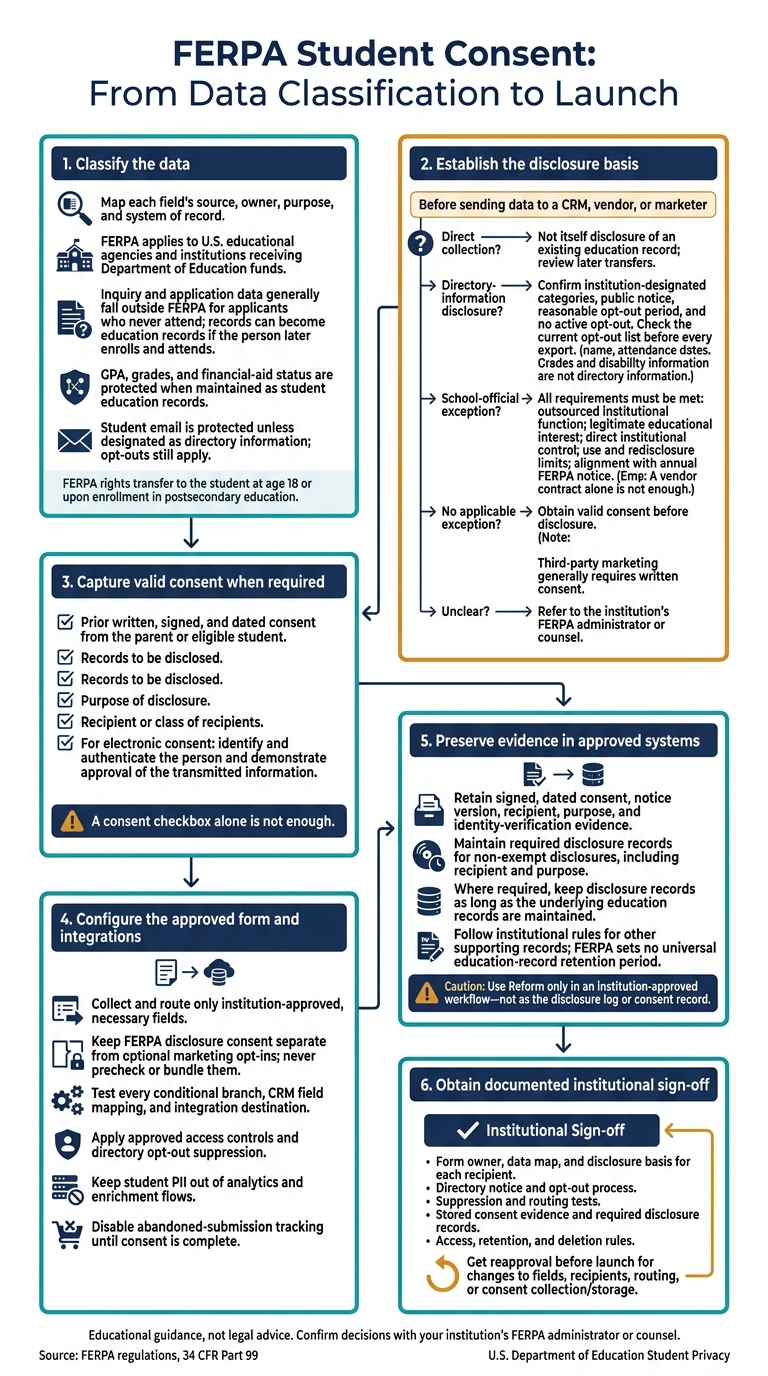
FERPA Student Consent: From Data Classification to Launch
Episode 48 - FERPA: Education Records and Student Rights
sbb-itb-5f36581
Who and What FERPA Covers
Check FERPA coverage first. The rules for your forms depend on whether FERPA covers the data.
Institutions, Vendors, and Student Rights
FERPA applies to U.S. educational agencies and institutions that receive Department of Education funds. That includes most public schools and many private colleges. FERPA rights transfer from parents to the student at age 18 or when the student enrolls in postsecondary education.
Schools may disclose records without consent to school officials with a legitimate educational interest. This can include contractors and vendors performing institutional services, provided the school-official exception’s requirements are met. Vendors must use form data only for the institution-approved purpose.
When Inquiry Data Becomes an Education Record
Inquiry and application information generally falls outside FERPA for applicants who never attend. If someone later enrolls and attends, those records can become education records. Academic, advising, financial-aid, and communication records maintained by the institution or its vendor can also qualify.
Classify Data Before Building Forms
Before building a form, map each field’s source, owner, purpose, and system of record to determine whether you can collect or share it. Before disclosing data, check the directory-information notice and opt-out list.
| Field type | FERPA status |
|---|---|
| Inquiry email and inquiry date | Generally outside FERPA before attendance |
| Student email | Protected unless designated as directory information; opt-outs still apply |
| GPA or grades | Protected in maintained student records |
| Financial-aid status | Protected in maintained student records |
Use that classification to decide which fields the form can collect, store, and send - and whether disclosure requires consent.
When Disclosure Requires Consent
Once a field is classified as FERPA-covered, check its source, recipient, purpose, and any exception before approving form routing or an export. Direct collection does not disclose an existing education record, but later transfers need review. Send unclear workflows and new vendor setups to the institution’s FERPA administrator or counsel, then check whether consent is required.
What FERPA Consent Must Include
Unless an exception applies, get prior written, signed, and dated consent from the parent or eligible student. Consent must identify the records, the purpose of disclosure, and the recipient or class of recipients. Electronic consent must identify and authenticate the person giving consent and show their approval of the transmitted information. Forms should request this approval only when the disclosure path requires it.
Disclosure Exceptions and Vendor Rules
To qualify under the school-official exception, a vendor must perform an outsourced institutional function, serve a legitimate educational interest, remain under direct institutional control, and follow limits on use and redisclosure. The arrangement must also match the institution’s annual FERPA notice. A vendor contract alone is not enough.
| Workflow | Consent decision and conditions | Operational owner | Documentation to retain |
|---|---|---|---|
| Direct inquiry | No existing-record disclosure; review later transfers | Admissions team | Source and routing notes |
| Consent-based disclosure | Obtain valid consent before release | Authorized records office | Signed, dated consent |
| School-official processing | No consent if all exception requirements are met | FERPA administrator | Annual notice and vendor agreement |
| Directory disclosure | Designated directory data; no active opt-out | Registrar | Public notice and opt-out check |
| Third-party marketing | Generally requires written consent | FERPA administrator | Consent or documented exception |
Directory Information and Opt-Out Limits
Directory information is the main exception marketers will encounter, but notice and opt-out rules still apply. Names, majors, and attendance dates qualify only if the institution designates them as directory information. The public notice must identify those categories and give parents or eligible students a reasonable period to opt out.
Check the current opt-out list before every export. An active opt-out blocks directory disclosure. Grades and disability information are not directory information - even when they appear alongside directory fields.
| Category | Opt-out status | Recipient and purpose | Required approval and disclosure rule |
|---|---|---|---|
| Name, major, attendance dates | No active opt-out | Public or marketing use; routine inquiry | Permitted if designated as directory information |
| Grades or GPA | N/A | Third-party marketer | Consent or valid exception required |
| Disability information | N/A | Any third party | Separate lawful disclosure basis required |
Design Forms and Integrations for FERPA Compliance
Once you’ve classified the data, build the form to collect, store, and route only what the institution permits.
Limit Fields and Separate Consent Choices
Ask only for information needed for the approved purpose. Keep FERPA disclosure consent separate from marketing opt-ins. Never precheck either choice or bundle them together.
Use multi-step forms and conditional logic to hide questions that don’t apply. Let users skip optional marketing subscriptions, and keep the approved identity check within the consent step.
Apply those same limits to storage, transfers, and audit logs after collection.
Keep Consent Records and Control Transfers
Retain signed, dated consent along with the notice version, recipient, purpose, and identity-verification evidence. Keep disclosure records for non-exempt disclosures. Where required, retain those records for as long as the underlying education records are maintained. Follow institution-approved retention rules for other supporting records.
| Control | Configuration to verify | Risk addressed | Configuration owner |
|---|---|---|---|
| Notices | Save the displayed notice version with each submission | Unclear disclosures or disclosures that can’t be traced | Privacy office |
| Consent verification | Keep approved authentication evidence and signed, dated consent | Unverified authorization | Records office and IT |
| Conditional logic | Test every branch before launch and after changes | Bypassed consent or incorrect routing | Form owner |
| Audit trails | Log each non-exempt disclosure, including recipient and purpose | Missing disclosure records | Registrar |
| Data limits | Exclude unnecessary fields from submissions, analytics, and enrichment | Excess collection or secondary use | Form owner and privacy office |
| Routing | Match CRM fields and destinations to the approved scope | Transfers outside the approved scope | Integration administrator |
| Suppression | Check current directory opt-outs before exports; keep marketing subscriptions separate | Disclosures despite an applicable opt-out | Registrar and CRM administrator |
| Access controls | Check permissions for submissions, exports, and connected systems | Access without a legitimate educational interest | IT security |
Use the form builder to collect submissions. Compliance still depends on the institution’s approved workflow and controls.
Use Reform in an Institution-Approved Workflow
Use Reform’s multi-step forms, conditional routing, validation, and integrations only after the institution approves the workflow and reviews vendor terms, security, and data handling. Do not use Reform as the disclosure log or consent record.
Keep student PII out of analytics and enrichment flows. Disable abandoned-submission tracking until consent is complete. Check retention settings, test every integration destination, and use institution-approved controls for any safeguard the form cannot provide.
Conclusion: FERPA Form Launch Checklist
Use this final prelaunch checklist to check the approved form flow before release. Require documented institutional sign-off before launch. Confirm the approved form owner, data map, and basis for disclosure to each recipient. The approval should cover:
- The directory notice and opt-out process
- Suppression and routing tests
- Stored consent evidence and required disclosure records
- Approved access, retention, and deletion rules
Keep required disclosure records for as long as the underlying education records are maintained. FERPA does not set a universal retention period for education records. Follow state law or institutional policy for other retention and deletion decisions.
Get reapproval before launch for any change to fields, recipients, routing, or how consent is collected or stored.
For official guidance, see the FERPA regulations and the U.S. Department of Education Student Privacy site. This guide is educational, not legal advice.
FAQs
What happens to my prospect data when applicants enroll?
Once applicants enroll at a postsecondary institution, they become eligible students under FERPA and control consent to share their records. Prospect data - including academic, disciplinary, or personal records - becomes part of their education record.
Schools must protect this information. They may disclose it only with the student’s written consent or under specific exceptions, such as sharing it with school officials who have a legitimate educational interest or for financial aid purposes.
Can students revoke FERPA consent after I share their data?
FERPA does not explicitly explain how students can revoke written consent after a disclosure has been completed. Once a school lawfully shares records under valid written consent, that transfer is final.
Students can stop future releases of directory information by notifying their institution in writing. To help schools follow the rules and set clear expectations, consent forms should state what data will be shared, why, and with whom when consent is collected.
What should I do if a form exposes student records?
Flag affected submissions immediately and send them to your organization’s privacy, security, or legal staff - not into standard marketing campaigns.
To help prevent future exposure, add a plain-language disclaimer asking users not to submit grades, transcripts, or individualized education details. Update form logic to detect and separate submissions that contain education-related terms or student rosters, so only approved systems and staff handle them.
Related Blog Posts
Get new content delivered straight to your inbox

The Response
Updates on the Reform platform, insights on optimizing conversion rates, and tips to craft forms that convert.



Drive real results with form optimizations
Tested across hundreds of experiments, our strategies deliver a 215% lift in qualified leads for B2B and SaaS companies.
