
.webp)
How GDPR 2025 Impacts Cross-Border Data Transfers



GDPR 2025 introduces stricter rules for cross-border data transfers, focusing on real-time monitoring, mandatory Transfer Impact Assessments (TIAs), and updated safeguards. Here's what you need to know:
-
Key Updates:
- Continuous monitoring replaces annual reviews.
- TIAs are now required for high-risk transfers.
- New Standard Contractual Clauses (SCCs) tailored for specific scenarios.
- Fines can reach 4% of global revenue or €20 million.
-
Challenges:
- Managing overlapping global regulations (e.g., U.S. and China laws).
- Higher penalties for non-compliance.
- Complex localization requirements in countries like China and India.
-
Solutions:
- Use adequacy decisions where possible (e.g., Singapore added in 2024).
- Implement SCCs with updated templates and conduct TIAs.
- Strengthen security with encryption and pseudonymization.
GDPR 2025 shifts compliance from static reviews to active governance, requiring businesses to constantly evaluate data transfer practices. Staying compliant means adopting updated safeguards, conducting regular assessments, and integrating privacy workflows into operations. This includes using optimized conversion paths to ensure data collection remains compliant from the first touchpoint.
GDPR 2025 Rules for Cross-Border Data Transfers
Legal Methods for Transferring Data
Under GDPR, there are four main ways to legally transfer personal data outside the European Economic Area (EEA). The most robust option is through adequacy decisions, where the European Commission evaluates a country's data protection laws to ensure they align with EU standards. As of 2025, 15 jurisdictions have earned this status, including the UK, Japan, and South Korea. Singapore joined the list in late 2024, and discussions are ongoing for Taiwan and India to be added.
For countries without adequacy decisions, Standard Contractual Clauses (SCCs) are the go-to solution. These are pre-approved legal templates that establish binding data protection obligations between parties. The 2021 SCC framework introduced four modules tailored to specific transfer scenarios: Controller-to-Controller (Module 1), Controller-to-Processor (Module 2), Processor-to-Processor (Module 3), and Processor-to-Controller (Module 4). Each module is designed to address varying data transfer relationships and compliance needs.
Binding Corporate Rules (BCRs) provide another option, enabling multinational companies to share data within their corporate group. Although the approval process was streamlined in 2025, BCRs remain resource-heavy and are typically used by large enterprises with complex global operations. Lastly, derogations offer limited exceptions for specific cases, such as explicit user consent or contractual necessity. However, these are narrowly interpreted and unsuitable for regular transfers.
What Changed in 2025
The regulatory landscape for data transfers saw a significant overhaul in 2025, shifting from static compliance to active, ongoing governance. Previously, companies could rely on annual reviews and archived agreements. Now, they must conduct continuous monitoring and reassess safeguards whenever there are changes, such as updates to a country's surveillance laws or a vendor's data practices. Annual audits alone no longer meet the requirements.
Transfer Impact Assessments (TIAs) became mandatory for all high-risk data transfers. These assessments evaluate the legal environment of the destination country, focusing on issues like government surveillance and judicial redress options. Additionally, the European Commission plans to release updated SCC templates by Q2 2025. These new templates address scenarios where both the data exporter and importer are directly subject to GDPR, a gap not fully addressed by the 2021 versions. This change acknowledges the reality that data often flows between entities already operating under EU rules.
The importance of these updates is underscored by enforcement trends. In 2023, 43% of GDPR enforcement actions stemmed from improper use of SCCs. A notable example is the €290 million fine imposed on Uber for inadequate protections during internal data transfers, highlighting that even intra-group movements require stringent safeguards.
"Modern data ecosystems demand dynamic protections rather than static paperwork." - European Data Protection Board Member
sbb-itb-5f36581
GDPR International Data Transfers: Navigating Cross-Border Compliance
Common Compliance Challenges Under GDPR 2025
The new 2025 rules bring a range of compliance challenges, many of which go beyond the updated transfer protocols.
Managing Multiple Data Protection Laws
Global businesses are now caught in a web of overlapping and sometimes conflicting data protection regulations. For example, the U.S. Department of Justice's Data Security Rule, effective April 2025, restricts the transfer of bulk sensitive data to "countries of concern" such as China, Iran, and Russia. Meanwhile, China’s PIPL requires government security assessments before any data can leave its borders. Companies operating internationally must juggle these conflicting rules while ensuring compliance with GDPR.
Adding to the complexity is the Transfer Impact Assessment (TIA) process. Since the Schrems II decision, Standard Contractual Clauses (SCCs) alone are no longer enough. Organizations must now evaluate surveillance laws in the destination country, such as the U.S. FISA 702, to ensure GDPR protections are upheld. This challenge is particularly pronounced for financial services and healthcare organizations, which must also comply with sector-specific rules like anti-money laundering requirements or international standards for clinical trial data. These overlapping mandates create a minefield of regulatory risks, increasing the likelihood of severe penalties.
Higher Penalties and Stricter Enforcement
Regulators are stepping up enforcement, backed by continuous monitoring systems. This shift has already resulted in record-breaking fines. For instance, in May 2023, Meta Platforms Ireland Limited was fined $1.3 billion for transferring EU user data to the U.S. using SCCs that failed to protect against U.S. government surveillance. More recently, in January 2025, the Dutch Data Protection Authority fined Uber $315 million for transferring European driver data to the U.S. without valid safeguards, after the company stopped using SCCs in 2021.
The stakes are high, with penalties reaching 4% of global annual turnover or $21.7 million, whichever is greater. Continuous monitoring replaces annual compliance reviews, meaning businesses must reassess their practices immediately when destination countries update surveillance laws or vendors alter their data handling procedures. In 2023 alone, 43% of enforcement actions were tied to the improper use of SCCs. Regulators now expect detailed evidence of safeguards, especially for sensitive data categories like biometrics, employment records, and location data. Beyond the financial penalties, businesses are also grappling with operational challenges tied to managing data flows and adhering to local storage requirements.
Data Classification and Localization Requirements
Dynamic data flow mapping has become the new standard, replacing outdated static spreadsheets. This shift is particularly challenging when dealing with China’s classification of "Important Data" - information deemed a national security risk if leaked. Once data is classified as such, businesses must immediately halt transfers and conduct a Security Assessment, with no grace period offered.
Localization mandates in countries like China, Russia, India (under the DPDP Act), and Nigeria add another layer of complexity by requiring local data storage. These rules disrupt centralized processing models. The U.S. Bulk Data Rule further complicates matters, restricting onward transfers of sensitive personal data to certain countries, which poses significant challenges for U.S.-based processors. To adapt, many companies are turning to costly hybrid architectures or edge computing solutions that allow data processing to remain local while avoiding cross-border transfers. These localization demands, coupled with the need for continuous oversight, make compliance an increasingly difficult and resource-intensive task.
How to Comply with GDPR 2025 for Cross-Border Transfers
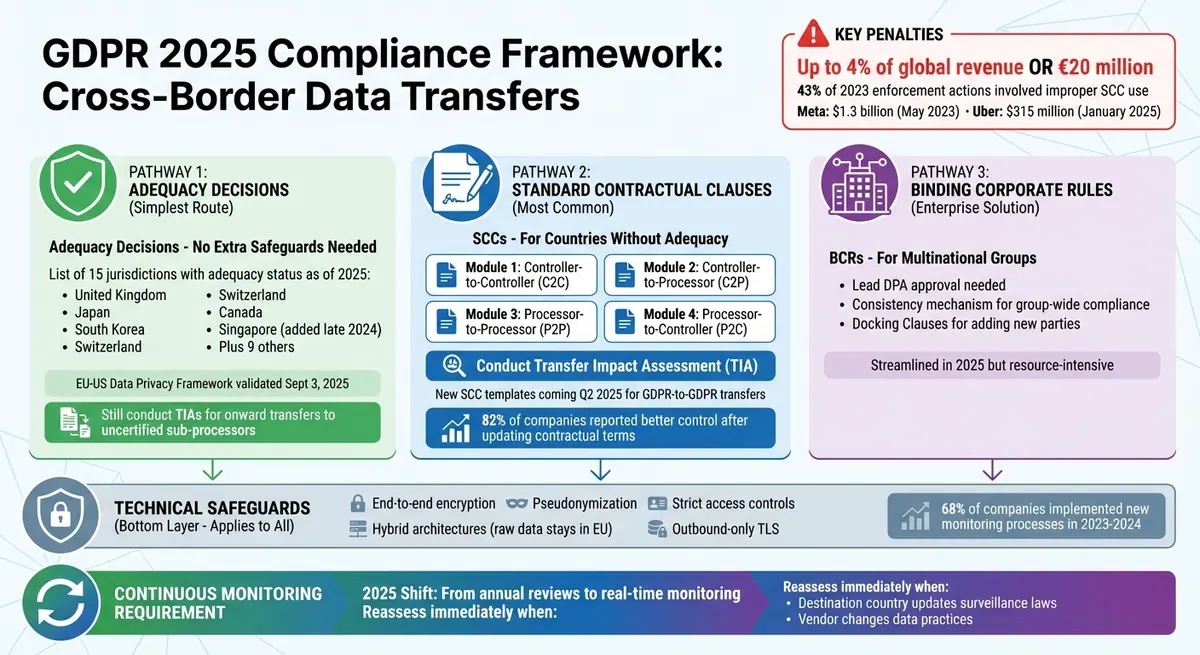
GDPR 2025 Cross-Border Data Transfer Compliance Framework
With GDPR 2025 shifting focus to real-time monitoring, staying compliant requires consistent attention and proactive measures. To meet these demands, organizations should focus on three key areas: using adequacy decisions, applying proper contractual safeguards, and bolstering security protocols.
Using Adequacy Decisions
Adequacy decisions simplify the process of lawful data transfers. These decisions are issued when the European Commission determines that a country provides equivalent data protection to the EU. Transfers to these countries don’t require extra safeguards. As of early 2025, the list includes Canada, Japan, South Korea, Switzerland, the United Kingdom, and Singapore, which gained adequacy status in late 2024. The EU-US Data Privacy Framework (DPF), validated by the EU General Court on September 3, 2025, also allows certified U.S. companies to receive EU data without needing Standard Contractual Clauses (SCCs).
However, adequacy decisions aren’t permanent - they can change based on political or legal developments. For example, even when transferring data to U.S. companies certified under the DPF, conducting Transfer Impact Assessments (TIAs) for onward transfers to uncertified sub-processors is still advisable. While this route reduces administrative complexity, it’s only applicable to a limited number of countries with adequacy status.
Implementing Standard Contractual Clauses and Binding Corporate Rules
For transfers involving countries without adequacy decisions, SCCs remain the go-to tool. The 2025 framework introduces a modular approach with four specific modules: Controller-to-Controller (C2C), Controller-to-Processor (C2P), Processor-to-Processor (P2P), and Processor-to-Controller (P2C). Choosing the wrong module is a frequent error; for instance, sub-processor agreements require Module 3, not Module 2.
SCCs now require Transfer Impact Assessments to account for risks like destination country surveillance laws that may conflict with GDPR protections. Additionally, the European Commission plans to release new SCCs by Q2 2025 for situations where both the data exporter and importer are already subject to GDPR, addressing a regulatory gap.
For multinational companies, Binding Corporate Rules (BCRs) offer a unified data protection framework across the organization. BCRs need approval from a Lead Data Protection Authority and include a consistency mechanism for group-wide compliance. They also feature "Docking Clauses", which make it easier to add new parties to existing agreements without renegotiation. After updating contractual terms, 82% of companies reported better control over data access.
Once these legal safeguards are established, technical measures are critical to reinforcing compliance.
Improving Security and Data Governance
Technical protections are now mandatory, especially when Transfer Impact Assessments reveal potential risks. Key measures include end-to-end encryption, pseudonymization, and strict access controls to enhance data security. Many organizations are adopting hybrid architectures, where raw personal data stays within the EU while only anonymized or aggregated data is shared globally.
Outbound-only TLS is another effective strategy. It limits external access to EU workloads, reducing the risk of breaches and satisfying compliance auditors. Following regulatory updates in 2023 and 2024, 68% of companies implemented new processes to monitor international data flows. Data Protection Impact Assessments (DPIAs) must also be rigorously documented, including detailed analyses of legal environments and technical safeguards.
With the shift toward continuous monitoring, businesses must move beyond annual compliance checks. Any changes in destination country laws or vendor practices require immediate reassessment to maintain alignment with GDPR 2025 standards.
How Reform Helps with GDPR Compliance
Navigating GDPR 2025 requirements for cross-border data transfers begins at the point of data collection. Reform’s form builder includes features designed to help businesses gather, secure, and document personal data in alignment with current regulations. This step sets the stage for a broader compliance strategy, which is explored in later sections.
Collecting User Consent with Multi-Step Forms
When using consent as the legal basis for cross-border data transfers under GDPR Article 49, it must be informed, specific, and freely given. Reform’s multi-step forms simplify this process by breaking down complex privacy information, ensuring users clearly understand what they’re agreeing to before their data is transferred. With conditional logic, the forms dynamically display consent checkboxes or specific disclosures when data is destined for a country without adequacy status.
"Fintechs should offer clear, accessible privacy notices and, where consent is used as a legal basis, ensure it is informed, specific and freely given." - Paul Krasy, Data Protection Officer, Mentor Group
This method is critical, as non-compliance with GDPR data transfer rules can lead to fines of up to €20 million or 4% of a company’s global annual turnover. Reform’s conditional routing enhances transparency by informing users about where their data will be stored and who will access it. This approach not only builds trust but also aligns with GDPR’s emphasis on continuous monitoring and auditable consent documentation.
Improving Data Quality and Security
Accurate and secure data collection is key to reducing compliance risks. Reform addresses this with features like email validation, which prevents typos and fake addresses from entering your system, and spam prevention, which filters out bot submissions. Additionally, lead enrichment adds verified details to submissions, minimizing the need for follow-up data requests that could require renewed consent.
These tools ensure that only legitimate, accurate data enters your workflows, creating a secure foundation for compliance efforts.
Connecting Compliance Workflows to CRM Systems
Maintaining data quality is just one piece of the puzzle - integrating compliance workflows with CRM systems is equally important for managing and documenting data transfers.
Reform integrates seamlessly with CRM and marketing tools like HubSpot and Salesforce, enabling businesses to map data flows - a critical step for identifying where personal data is transferred and selecting the appropriate transfer mechanism. By connecting form data directly to these systems, companies can centralize records that show when and how explicit consent was obtained for cross-border transfers.
This integration supports a proactive approach to compliance, helping businesses defend transfers at the system, vendor, and use-case levels. Automated consent management also allows companies with limited resources to scale their compliance efforts without relying on manual processes. For organizations integrating with CRMs hosted outside the European Economic Area, conducting a Transfer Impact Assessment (TIA) to evaluate the recipient country’s legal framework remains essential. These integrations ensure consent documentation is at the core of operations while meeting GDPR 2025’s continuous reassessment requirements.
Conclusion
GDPR 2025 has shifted cross-border data transfers from a routine compliance task to a critical, ongoing priority. With penalties reaching up to 4% of global revenue or $21.7 million, enforcement actions highlight the serious financial and reputational risks at stake. To stay ahead, businesses must tackle adequacy decisions, perform Transfer Impact Assessments, and keep documentation flexible enough to adapt to regulatory changes.
The shift from static, annual reviews to real-time monitoring mirrors the complexity of today’s data landscape. Integrated compliance workflows that respond immediately to new risks are now essential. Surveys reveal that proactive compliance efforts can reduce potential issues by 40%, and continuous monitoring plays a key role in minimizing exposure to regulatory penalties.
Taking action early is crucial. Reform’s tools, like multi-step forms, email validation, and CRM integrations, empower businesses to document consent, maintain data accuracy, and map data flows - key elements for defending data transfer practices under GDPR 2025. Automating consent management and centralizing records allows companies to scale compliance processes efficiently.
Compliance isn’t just about avoiding fines - it’s about maintaining trust with international partners and ensuring smooth global operations. As regulatory enforcement extends across borders, staying proactive offers a competitive edge. This approach not only shields businesses legally but also strengthens their position in the global market by prioritizing data protection and trust.
FAQs
When is a Transfer Impact Assessment (TIA) required?
A Transfer Impact Assessment (TIA) is essential when personal data is being sent to a country that the European Commission has not deemed adequate in terms of data protection. This assessment is also required when relying on tools like Standard Contractual Clauses (SCCs), especially if the destination country's laws might clash with the safeguards outlined in the GDPR.
How do I choose the right SCC module for a transfer?
To choose the right SCC module, start by determining the nature of your data transfer relationship. It could fall into one of these categories:
- Controller to Controller
- Controller to Processor
- Processor to Processor
- Processor to Controller
Once you've identified the relationship, select the corresponding module:
- Module 1: Controller to Controller
- Module 2: Controller to Processor
- Module 3: Processor to Processor
- Module 4: Processor to Controller
After selecting the appropriate module, make sure to complete the annexes, perform a Transfer Impact Assessment (TIA), and implement safeguards if any risks are identified.
What does “continuous monitoring” mean in practice?
Continuous monitoring means consistently reviewing data flows, spotting potential risks, and leveraging automated tools to catch anomalies. This approach helps maintain compliance with data transfer regulations by staying ahead of issues and addressing them as they occur.
Related Blog Posts
Get new content delivered straight to your inbox

The Response
Updates on the Reform platform, insights on optimizing conversion rates, and tips to craft forms that convert.


Drive real results with form optimizations
Tested across hundreds of experiments, our strategies deliver a 215% lift in qualified leads for B2B and SaaS companies.
