
.webp)
Key Features of Effective Compliance Training Courses



Effective compliance training ensures employees follow legal and policy requirements, especially for data protection. Here's what sets successful programs apart:
- Interactive Learning: Scenario-based exercises and gamification engage employees better than static slides.
- Blended Methods: Combining short videos, infographics, and hands-on activities caters to different learning styles.
- Regular Updates: Training must reflect current regulations like GDPR, HIPAA, and CCPA to avoid penalties.
- Role-Specific Content: Tailoring training to job responsibilities improves relevance and understanding.
- Flexible Delivery: Mobile-friendly, on-demand modules fit into busy schedules.
- Tracking Systems: Learning Management Systems (LMS) automate updates, track progress, and provide audit-ready records.
Compliance training isn’t just about avoiding fines - it drives better decision-making and reduces risks. Companies using modern methods cut compliance incidents by up to 40% while saving time and resources.
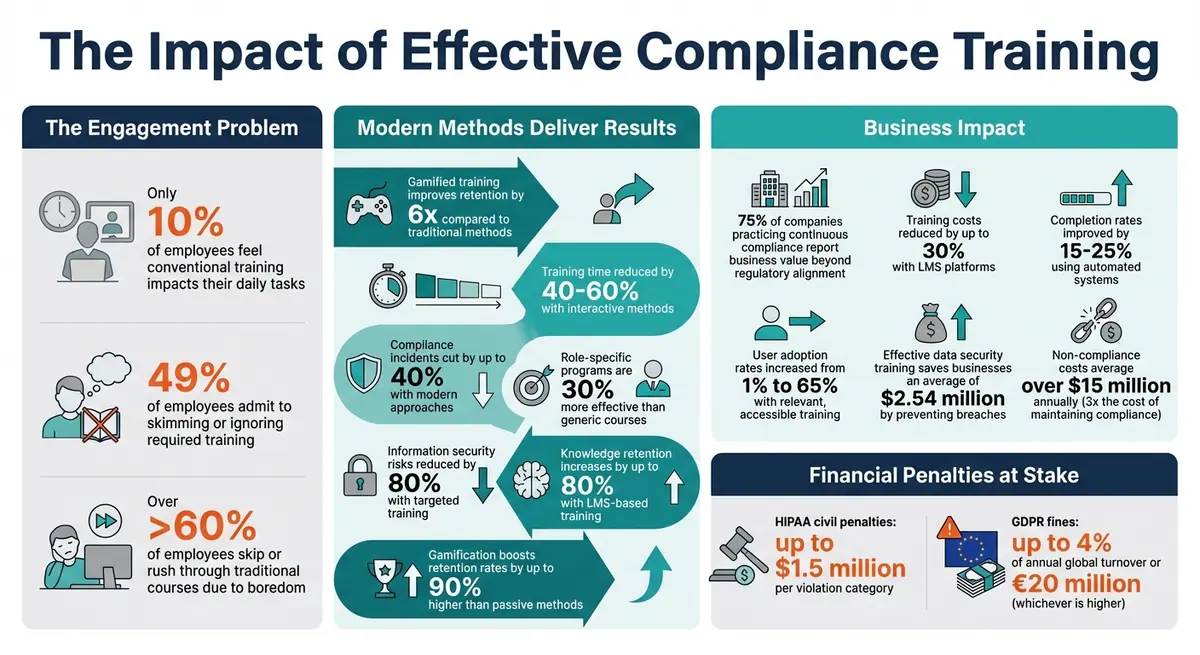
Compliance Training Effectiveness: Key Statistics and Impact Metrics
4 Ways to Level Up Your Compliance Training
sbb-itb-5f36581
Interactive Content and Engagement Methods
Traditional training methods like static slides and documents often fall flat when it comes to keeping employees engaged. Studies reveal that just 10% of employees feel conventional training has any meaningful impact on their daily tasks. Passive learning approaches not only fail to inspire engagement but also struggle to drive the behavioral changes needed to comply with strict data-sharing regulations.
One effective alternative is scenario-based learning (SBL), which places employees in realistic, decision-driven situations. For example, they might handle a data deletion request, navigating the steps of verification and documentation. These branching storylines present different outcomes based on the choices made, offering a hands-on way to explore the complexities and "gray areas" that policy manuals often overlook.
"The real strength of scenario-based eLearning is its ability to contextualize abstract policies." - eLearning Industry
Adding gamification can amplify engagement and retention. In fact, gamified training can improve information retention by up to six times compared to traditional methods, while also reducing training time by 40–60% and cutting compliance incidents by as much as 40%. Features like points, badges, leaderboards, and timed challenges tap into competitive instincts and the satisfaction of mastering challenging content.
Blended learning offers even more flexibility, combining short, digestible modules - like videos, podcasts, and infographics - with interactive, hands-on activities. These microlearning segments, lasting just 5–10 minutes, fit seamlessly into employees' daily workflows, avoiding cognitive overload. Pairing digital content with in-person role-play or team discussions in platforms like Slack ensures employees engage with the material in ways that suit their individual learning styles. This approach is especially effective, as over 60% of employees admit to skipping or rushing through traditional courses due to boredom.
Scenario-Based Exercises and Case Studies
Scenarios do more than test knowledge - they develop critical thinking skills for situations where the "right" answer isn’t clear-cut. Branching storylines are particularly effective for tackling complex compliance topics like anti-money laundering or conflicts of interest. Employees learn to balance competing priorities and navigate ambiguous situations.
"When you're designing compliance training, you're not just teaching rules - you're helping people recognize the gray areas they'll face at work and equipping them to act with integrity when no one is watching." - Carly Chasin, Director of Compliance Insights & Strategy, Learning Pool
The secret to impactful scenarios lies in their realism. Collaborate with frontline managers and compliance teams to craft scenarios based on real challenges employees face. Use the DEAR Framework to make them engaging: include Details for authenticity, Emotion to make them memorable, Attention-grabbing twists, and Relevance to organizational priorities. By featuring relatable characters and familiar workplace pressures, these stories create emotional connections that stick far better than dry statistics ever could.
Immediate, personalized feedback is another key element. When employees make a choice in a scenario, provide clear explanations of why it was correct or incorrect. This reinforces the desired behavior and helps them understand not just what to do, but why it matters in their specific roles.
Scenario-based learning sets the stage for gamification, which takes engagement to the next level by rewarding progress and mastery in real time.
Gamification and Blended Learning
Gamification transforms otherwise dry compliance training into an engaging, interactive experience. With retention rates up to 90% higher than passive methods, it’s no wonder organizations are embracing elements like progress bars, achievement badges, and leaderboards. These features not only track progress but also encourage friendly competition among teams.
Interactive tools like digital flashcards, drag-and-drop activities, and games such as "Spot the Phish" turn passive reading into active participation, catering to visual and hands-on learners alike. Some companies even introduce playful elements like themed avatars to make complex compliance topics more approachable and memorable.
"Compliance training doesn't have to be dense and boring. Focusing on storytelling, personalization, and interactivity can boost engagement and knowledge retention." - Stu Pease, Articulate
Blended learning takes this a step further by accommodating diverse learning preferences. Remote employees can complete microlearning modules on their phones during a commute, while in-office teams might engage in live simulations that mimic real-world scenarios - like managing vendor relationships or responding to suspicious activity during an audit. Following up with peer discussions in platforms like Slack or Teams helps solidify these lessons.
Modern platforms enhance this experience by tailoring difficulty levels to individual performance, ensuring a personalized learning journey. This adaptability addresses the fact that people learn in different ways. By combining multimedia elements and interactive methods, blended learning meets the expectations of today’s workforce while supporting a wide range of sensory preferences.
Regular Updates for Regulatory Changes
Data-sharing laws like GDPR, CCPA, and PIPEDA are in constant flux. Outdated training can lead to legal penalties, financial setbacks, and reputational damage. Take HIPAA, for instance - civil penalties can climb as high as $1.5 million annually for each violation category. When training materials fail to keep up, employees are left unprepared, creating compliance gaps that regulators are quick to spot. This evolving landscape calls for training methods that stay aligned with current regulations.
Staying updated isn’t just about avoiding fines - it’s about fostering real behavior change. Employees who receive timely and relevant training are less likely to engage in risky actions, such as falling for phishing scams. In fact, effective data security training can help businesses save an average of $2.54 million by preventing costly breaches. Yet, 49% of employees admit to skimming or ignoring required training. Providing fresh, localized content that reflects the latest rules can keep employees engaged and confident in their roles.
Continuous and Just-in-Time Training
Unlike the traditional one-and-done annual sessions, continuous training has no set beginning or end. Employees complete modules as needed - whether due to a policy update, a job change, or a new regulation - ensuring learning happens when it’s most relevant.
Just-in-time (JIT) learning takes this a step further by delivering targeted guidance precisely when an employee faces a compliance challenge. Instead of relying on memory from months-old sessions, employees receive quick, focused refreshers - like a 5-minute module on consent verification or data deletion - right when they need it. Modular course designs make this approach practical: if one policy changes, you update just that section, and the revision is automatically applied across all affected courses.
To keep compliance modules up to date, establish review cycles every 12 to 18 months - or sooner if there’s a major regulatory change. Tools like RSS feeds, Google Alerts, or LMS notifications can automate updates, delivering new regulatory information directly to dashboards. This proactive strategy ensures your training team stays ahead of changes instead of scrambling to catch up.
Using Learning Management Systems (LMS)
Continuous training becomes even more effective when paired with automated systems that streamline updates across all modules.
Learning Management Systems (LMS) simplify the process of keeping training current. Courses are broken into self-contained units, so updating one module - like a data privacy policy - automatically refreshes every course that includes it.
These systems also automate recertification workflows. For example, when certifications expire or roles change, employees are prompted with reminders to complete the necessary training. If they fail to comply, the system can restrict access to sensitive systems, creating the audit trails regulators expect.
Consider this: in 2025, MidFirst Bank used an AI-driven learning platform to automate compliance training. This led to a 10% increase in completion rates and saved $11,000 annually in administrative costs. Similarly, a major U.S. bank automated training for over 70,000 employees, eliminating manual audits and boosting course participation by 75%. Many LMS platforms also integrate with HR systems, automatically enrolling employees in updated courses when their roles or locations change.
LMS platforms often support multi-tenant architecture, enabling a central update to be pushed across all subsidiaries or departments simultaneously. Additionally, third-party content libraries ensure that updates are managed by specialists, reducing the risk of outdated material. AI-powered tools can revise text, scenarios, and policies in just hours, allowing organizations to respond to new regulations almost instantly. Companies using LMS-based compliance training report up to an 80% increase in knowledge retention, while overall training time decreases by 40% to 60% compared to traditional methods.
Role-Specific Training Programs
Role-specific training takes the idea of interactive, regularly updated methods and zeroes in on the unique compliance challenges employees face in their specific roles. By tailoring training to match job responsibilities, companies ensure employees get the exact tools they need to manage their compliance risks. This approach not only keeps employees more engaged but also aligns with strict data-sharing regulations by delivering the right practices to the right people. In fact, role-specific programs are 30% more effective than generic courses, and in critical areas like information security, they can cut certain risks by 80%.
Think about it this way: HR teams need to master handling sensitive data during recruitment and managing personnel records. On the other hand, customer service representatives must know how to verify identities and process data subject requests within the required one-month timeframe. Meanwhile, marketing and sales teams need to grasp the nuances of valid consent - ensuring it’s freely given, specific, informed, and unambiguous. For IT and security staff, the focus shifts to encryption, access controls, incident response, and integrating "privacy by design" principles into their workflows.
Needs Assessments and Stakeholder Input
The foundation of role-specific training is understanding where employees are struggling. interactive surveys, interviews, and performance reviews can help uncover knowledge gaps and establish a baseline for confidence and understanding. Reviewing past privacy incidents within your organization is another way to pinpoint recurring mistakes.
Collaboration is key. Work with IT, legal, and compliance teams during the design phase to identify organizational vulnerabilities and regulatory requirements. Create a Compliance Training Matrix that maps roles to specific regulations, outlining the training module, delivery method, and frequency for each. For instance, a Sales Director might benefit from quarterly GDPR and CCPA modules delivered via mobile microlearning, while an R&D Engineer may need annual in-depth sessions on data minimization and storage limitation principles.
Focus on Key Compliance Areas
Once gaps are identified, training can be fine-tuned to address the most critical compliance topics.
Every program should cover the six core principles of data protection: lawfulness, purpose limitation, data minimization, accuracy, storage limitation, and integrity. Additionally, employees need to understand the eight individual rights of data subjects, ranging from access requests to the right to erasure. These principles and rights are directly tied to managing risks in data-sharing compliance.
But it doesn’t stop there. Training should also tackle the real-world scenarios employees face daily. For example, marketing teams need to differentiate between lawful bases for processing - like using consent for voluntary surveys versus relying on legitimate interests for fraud prevention. Customer service staff should practice identity verification before fulfilling data requests. For IT teams, the focus should be on breach response protocols, especially since GDPR fines can reach 4% of annual global turnover or €20 million, whichever is higher.
Make these lessons stick by replacing abstract concepts with hands-on simulations. Role-play a data breach response, or practice handling a complex access request to give employees a feel for real-world challenges.
"GDPR training transforms theoretical compliance into practical, everyday competence." - Kevin Yun, Complydog
Tracking and Record-Keeping Systems
Accurate record-keeping is a cornerstone of compliance, especially when audits or regulatory reviews come into play. Auditors demand clear, verifiable evidence - everything from timestamps to detailed reports - to ensure compliance efforts are legitimate and effective. Without proper tracking systems in place, even the most well-designed compliance programs can falter. Consider this: nearly 75% of risk and learning leaders admit they struggle to produce audit-ready reports on demand. And the financial stakes are high - non-compliance costs an average of over $15 million annually, nearly triple the cost of maintaining a compliance program.
Take the case of Altaba (formerly Yahoo!). In April 2018, the company faced a $35 million penalty from the U.S. Securities and Exchange Commission for failing to disclose a 2014 data breach. The SEC found that Altaba lacked proper internal controls for disclosure, illustrating just how critical it is to have systems in place that trigger timely, documented actions.
Integration of Learning Management Systems
Learning Management Systems (LMS) have revolutionized compliance record-keeping by automating what used to be manual, error-prone processes. These platforms track everything: who started training, who completed it, and who still needs certification. They also generate time-stamped digital records and certificates of completion, which serve as crucial evidence during audits. Another advantage? LMS platforms can document the exact version of a training module an employee completed - an essential feature when regulations are frequently updated.
For instance, Wincanton, a major logistics provider, upgraded from a manual, paper-based system to the "MyLearning" platform powered by Absorb LMS in 2024. This transition introduced features like eSignature functionality and automated tracking, allowing the company to modernize its compliance processes. Now, electronic signatures and instant audit readiness are standard.
"AbsorbLMS ticks the boxes for what I have looked for in an LMS... Most notably, 21CFR11 compliance for signatures of training acknowledgement. Additionally, the system provides leadership insight into training compliance and places the onus on the company's team members rather than leadership."
- Nathaniel B. Greer, Vice President of Compliance & Data Governance at Datacubed Health.
The benefits go beyond convenience. Organizations using an LMS for compliance training have reported up to a 30% reduction in training costs and a 15–25% improvement in completion rates. With these systems in place, performance analytics can further enhance compliance efforts.
Performance Analytics and Reporting
Real-time analytics transform compliance tracking from a reactive process to proactive risk management. These tools build on LMS-generated records, using audit trails to provide instant insights into training completion rates, assessment scores, and overdue tasks. Managers can quickly identify gaps and address them before they escalate into compliance failures. Many modern systems even automate stakeholder-specific reports, delivering them on a recurring schedule.
The real power lies in customization. Instead of relying on generic enrollment stats, advanced platforms allow organizations to filter reports by department, job role, location, or risk level. This targeted approach ensures that regulators receive precise, organized data rather than overwhelming information dumps. Platforms can also tag training content by specific mandates - like OSHA, GDPR, or HIPAA - making it easy to generate comprehensive reports during audits. Some systems even incorporate AI-driven querying, enabling real-time insights through natural language questions.
Companies are also shifting their focus beyond just tracking completion rates. They're now analyzing how training influences employee behavior and overall organizational culture. For example, in 2024, AT&T partnered with Watershed to evaluate the effectiveness of its ethics compliance training. By comparing a high-fidelity simulation with previous methods, they found that shorter, more engaging content was far more effective - saving over 160,000 employee course hours in the process.
Frequent and Flexible Training Schedules
Frequent and flexible training schedules build on the principles of continuous and just-in-time training, ensuring employees stay up-to-date with compliance requirements.
The old "one-and-done" approach to compliance training doesn't cut it anymore. Employees tend to forget rules over time, especially as regulations shift and new threats emerge. In fact, 49% of employees admit to skim-reading or ignoring mandatory compliance training. The solution? Shorter, more frequent training sessions that fit seamlessly into modern workflows.
Quarterly Refreshers and Access to Resources
Instead of packing everything into an annual marathon session, break compliance training into smaller, manageable lessons spread across the year. For example, quarterly micro-lessons lasting just 5 to 10 minutes can keep compliance topics fresh without disrupting daily tasks. A 2025 poll revealed that while 43% of medical groups dedicate a week or month annually to compliance, 55% fail to provide ongoing refreshers after onboarding.
Automated recertification workflows can simplify the process. Learning management systems (LMS) can send reminders at 30, 14, and 7 days before certifications expire. This not only ensures employees refresh their knowledge before it fades but also demonstrates to patients and payers that your organization prioritizes ethics and privacy.
This bite-sized, modular approach makes training more adaptable and user-friendly.
Flexible Delivery Options
Flexibility is critical for today’s diverse workforce, including distributed teams, shift workers, and field employees. Asynchronous training allows employees to complete modules at their own pace, accommodating different time zones and schedules. Mobile-friendly designs and offline functionality mean frontline staff can train during commutes or breaks, even without internet access.
"When employees have to leave their daily tools to complete training, friction goes up and completion drops. On the other hand, fewer clicks means faster completions, better engagement and less IT work." - D2L Brightspace
Just-in-time training takes flexibility a step further. For instance, pop-up alerts can provide guidance right when an employee is about to perform a high-risk task, such as accessing sensitive data. Integrating single sign-on (SSO) reduces login hassles, making participation easier. This approach embeds training into the "flow of work", minimizing disruptions while maintaining compliance readiness.
Conclusion
Effective compliance training goes far beyond simply ticking off a box - it’s about shaping behavior where it counts the most. Companies that shift from one-and-done annual sessions to more dynamic approaches, like role-specific modules, interactive scenarios, and ongoing microlearning, create programs that stick. These methods transform training from a regulatory chore into a genuine business advantage. When employees understand why regulations matter, they’re more likely to take proactive steps toward compliance.
The data backs this up: 75% of companies practicing continuous compliance report that their training programs add business value, not just regulatory alignment. Additionally, modern platforms can boost user adoption rates from 1% to 65% by making training more relevant and accessible. These advancements don’t just mitigate risks - they empower teams to make smarter, ethical decisions. This shift in behavior lays the groundwork for integrating advanced tools into training delivery.
"Compliance effectiveness is achieved through doing. Learners must be activated, not merely informed." - Sunny McCall and Blaise Stanicic, TRACE International
Using tools like data analytics, automated workflows, and leadership modeling can help position compliance as a core company value. Embedding training into daily routines - through mobile access and timely reminders - reduces barriers and encourages consistent participation.
As highlighted throughout, a tailored, regularly updated training strategy delivers big results. Building a culture of compliance takes effort, but the payoff is undeniable. Practical, measurable, and scalable programs not only meet regulatory requirements but also foster ethical decision-making, empowering every employee to protect the organization.
FAQs
How can I measure if compliance training changes behavior?
To evaluate behavior changes following compliance training, leverage data and analytics to monitor key areas like engagement, knowledge retention, and how well employees apply new skills on the job. Surveys can also be a powerful tool for gathering feedback, offering insights into how training influences actions and adherence to policies. For a more detailed view, advanced performance dashboards can deliver real-time data, showing how training outcomes translate into measurable behavior shifts across teams or specific individuals.
How often should compliance training be updated for new regulations?
Compliance training needs regular updates to stay aligned with changing regulations and the evolving needs of an organization. Although there’s no specific legal requirement dictating how often this should happen, it’s a good idea to revise training materials whenever new laws are enacted or major operational changes take place. Keeping training current ensures it stays relevant and helps maintain compliance effectively.
What’s the best way to tailor compliance training by role?
To make compliance training more effective, customize it based on job roles. This means creating content that directly ties to the responsibilities and potential risks associated with each position. When training is specific to what employees face in their daily work, it becomes more engaging, relevant, and easier to remember.
Incorporate learning techniques that adjust to individual needs and include scenarios that mimic real-life situations. This way, employees can better grasp the material and feel prepared to handle the unique challenges of their roles while staying compliant with changing regulations.
Related Blog Posts
Get new content delivered straight to your inbox

The Response
Updates on the Reform platform, insights on optimizing conversion rates, and tips to craft forms that convert.



Drive real results with form optimizations
Tested across hundreds of experiments, our strategies deliver a 215% lift in qualified leads for B2B and SaaS companies.
