
.webp)
How to Write a Privacy Policy for Online Stores



Your privacy policy is a legal document that informs customers how their data is collected, used, and protected. It’s essential for compliance with laws like GDPR, CCPA, and CalOPPA, and it builds trust with your customers. Here’s what you need to know:
- Why It Matters: Privacy laws require transparency. Non-compliance can lead to fines up to €20M (GDPR) or $7,500 per violation (CCPA). Trust also impacts sales - 25% of shoppers abandon carts due to privacy concerns.
- Key Laws:
- GDPR: Requires opt-in consent for EU users.
- CCPA/CPRA: Grants California residents rights like opting out of data sharing.
- CalOPPA: Mandates visible privacy policies for sites collecting data in California.
- What to Include:
- Data collected (e.g., personal, financial, technical).
- How data is used (e.g., order processing, marketing).
- Customer rights (e.g., deletion, correction, opting out).
- Third-party sharing details (e.g., payment processors, analytics tools).
- Steps to Create:
- Map data collection methods (manual and automated).
- Link data use to legal justifications (e.g., consent, contract).
- Write in plain, clear language.
- Maintain Compliance: Update policies annually or when practices change. Notify customers of updates via banners or emails.
Key takeaway: A clear, accurate privacy policy isn’t just about legal compliance - it’s about earning customer trust and protecting your business.
How to Create Professional Privacy Policy Pages On Shopify

sbb-itb-5f36581
Data Privacy Regulations for E-Commerce
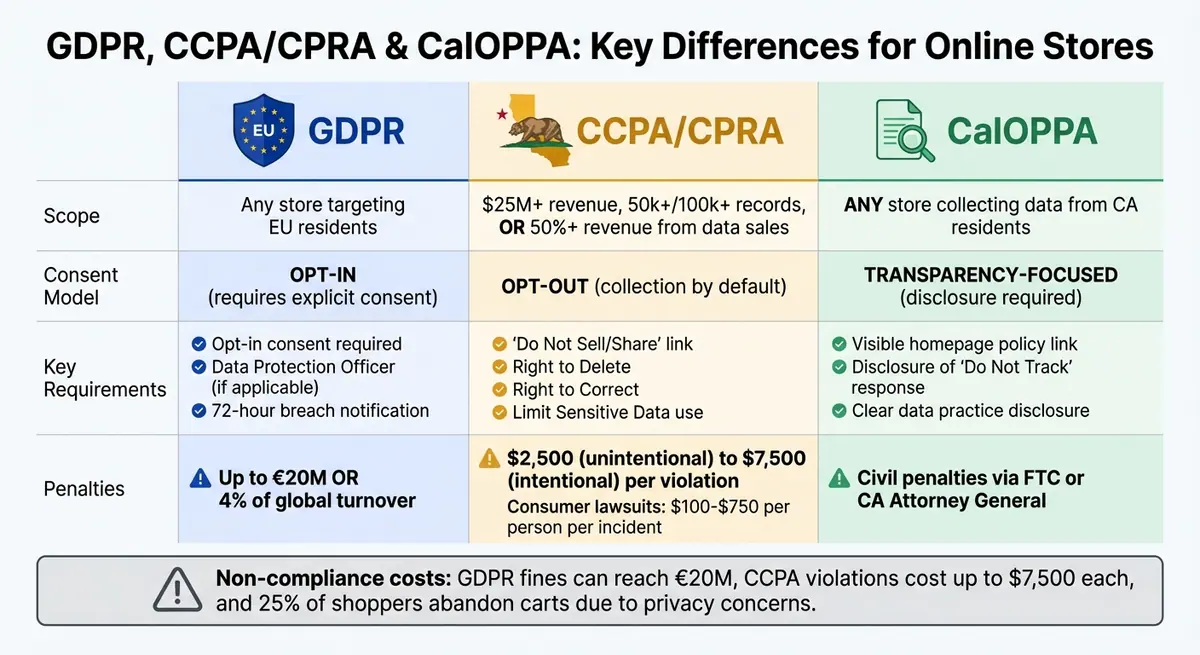
GDPR vs CCPA vs CalOPPA Privacy Regulations Comparison for E-Commerce
Major Data Privacy Laws
E-commerce businesses in the U.S. must navigate a maze of state and federal privacy laws. California has been a trailblazer in this area, starting with CalOPPA (California Online Privacy Protection Act). This law requires any commercial website collecting personal information from California residents to display a privacy policy prominently.
- Under CalOPPA, websites must clearly disclose their data collection practices. For e-commerce stores, this means ensuring your privacy policy is easy to find - ideally linked right on your homepage.
The CCPA/CPRA (California Consumer Privacy Act and California Privacy Rights Act) sets the bar even higher. The CPRA, which came into effect in 2023, gives consumers rights such as knowing what data is collected, requesting its deletion, opting out of data sales or sharing, correcting inaccuracies, and limiting the use of sensitive data like precise location or health information. Other states, including Virginia (CDPA), Colorado (CPA), Connecticut (CTDPA), Utah (UCPA), and Nevada (SB220), have followed California’s lead with their own privacy laws.
On the federal level, the FTC enforces rules against "unfair or deceptive practices", which include failing to comply with your posted privacy policy. Additionally, sector-specific laws like COPPA (children’s data), HIPAA (health data), and GLBA (financial data) apply to particular industries. For stores targeting European Union customers, compliance with GDPR (General Data Protection Regulation) is mandatory, no matter where your business operates.
"A privacy policy isn't just a legal formality you can knock out in an afternoon. It's a legally binding document that must accurately reflect your actual data practices while satisfying the requirements of multiple privacy regulations." - PrivacyForge
GDPR, CCPA/CPRA, and CalOPPA Comparison
These regulations differ significantly in their approaches to consumer privacy. GDPR adopts an "opt-in" model, which requires explicit consent before collecting or processing personal data. In contrast, CCPA/CPRA use an "opt-out" model, allowing data collection by default unless consumers take action to opt out. CalOPPA, meanwhile, emphasizes transparency, requiring websites to disclose their data practices but without mandating specific consumer rights.
| Regulation | Scope / Threshold | Key Requirements | Penalties |
|---|---|---|---|
| GDPR | Any store targeting EU residents | Opt-in consent, Data Protection Officer (if applicable), 72-hour breach notice | Up to €20M or 4% of global turnover |
| CCPA/CPRA | $25M+ revenue, 50k+/100k+ records, or 50%+ revenue from sales | "Do Not Sell/Share" link, Right to Delete, Right to Correct, Limit Sensitive Data | $2,500 (unintentional) to $7,500 (intentional) per violation |
| CalOPPA | Any store collecting data from CA residents | Visible link to policy on homepage, disclosure of "Do Not Track" response | Civil penalties via FTC or CA Attorney General |
The financial consequences of non-compliance are steep. For example, under CCPA, consumers can file lawsuits for data breaches, seeking damages of $100 to $750 per person per incident. Nevada’s SB220 allows fines of up to $5,000 per violation. These penalties highlight the importance of taking privacy regulations seriously - not just as a legal necessity but as a safeguard against costly risks.
What to Include in Your Privacy Policy
Your privacy policy should address three key areas: the data you collect, how it’s used and shared, and the rights customers have. Leaving out any of these can lead to legal troubles and erode trust.
Types of Personal Data Collected
Start by outlining all the types of data you collect. This includes:
- Personal data: Names, emails, phone numbers, physical addresses, usernames, account credentials, and dates of birth.
- Financial data: Credit and debit card numbers (often processed through third parties like PayPal or Stripe), billing addresses, bank details, and transaction histories.
- Technical data: IP addresses, browser types and versions, operating systems, and device identifiers.
Don’t forget to mention indirect data collection. Tools like Google Analytics, Facebook Pixels, and email marketing platforms gather information beyond what users directly provide. Be transparent about this and explain how the data is used.
Data Usage and Sharing Practices
Your privacy policy must clearly explain how data is used and shared, while staying compliant with legal standards. Break this down into categories like:
- Order fulfillment: Processing payments and shipping orders.
- Customer support: Handling inquiries and resolving issues.
- Marketing: Sending newsletters and promotions.
- Service improvements: Analyzing site performance and user behavior.
Under GDPR, you’re required to justify each type of data processing, whether it’s for fulfilling a contract, complying with legal obligations, or pursuing business interests.
When it comes to sharing data, be specific. For example, mysupermarket.co.uk in February 2023 provided a detailed table listing Awin as an affiliate marketing partner, explaining that partial IP addresses were shared with them, and linking directly to Awin’s privacy policy. Your policy should list all third-party recipients - payment processors, shipping carriers, marketing agencies, analytics providers - and explain why each one receives customer data.
"Your privacy policy needs to be explicit about when and with whom data is shared. This includes the use of tools like Google Analytics or Google Tag Manager and third-party email or marketing services." - Jimmy Rodriguez, Shift4Shop
Additionally, disclose any tracking technologies like cookies or pixels. If you’re using tools such as Google AdWords for retargeting ads, make sure to mention this explicitly. Lastly, include a clause about releasing data to comply with legal requests, such as subpoenas or court orders.
Customer Rights and Data Requests
Your policy should outline the rights customers have regarding their data. These vary depending on the regulations:
- GDPR: Customers can correct, delete, restrict, transfer, or object to data processing. They’re also protected against automated decision-making.
- CCPA/CPRA: California residents have rights to know what personal information is collected, whether it’s sold or shared, opt out of such practices, limit the use of sensitive data, access their information, delete it, correct inaccuracies, and not face discrimination for exercising these rights.
Provide clear instructions for opting out or making data requests. Options can include email, web forms, account settings, or mail (such as a demo request form). Explain how you verify a user’s identity before processing requests and state the typical response time - usually within 30 days.
"Describing rights in your policy without having systems to honor them creates liability, not protection." - PrivacyForge
With 73% of consumers willing to share personal data if they trust it will be handled responsibly, meeting these expectations can directly influence your success.
How to Write Your Privacy Policy
Creating a privacy policy involves understanding your data collection practices, ensuring compliance with legal requirements, and presenting the information in a way that's easy for your customers to grasp. Here's a step-by-step guide to get you started.
Step 1: Map Out Your Data Collection
Start by listing every way your store collects customer data. This includes direct collection points like checkout pages, account sign-up forms, newsletter subscriptions, contact forms, and live chat widgets where users manually provide information.
Then, identify automatic collection points - data gathered without customer input. This could include cookies, tracking pixels, web beacons, and server log files that record details like IP addresses, device identifiers, browser types, and browsing patterns (e.g., time spent on pages or click activity).
Don’t forget third-party tools. Services like Google Analytics, payment processors (e.g., Stripe, PayPal), marketing platforms (e.g., Mailchimp, HubSpot), and social media plugins often collect and process data in the background. Regularly audit these integrations and create a flowchart to visualize how data moves from collection to deletion.
Step 2: Link Data Use to Legal Justifications
For every type of data you collect, determine the legal basis for its processing. Under GDPR, you’ll need to choose from six lawful bases: Consent, Contract, Legal Obligation, Vital Interests, Public Task, or Legitimate Interests.
Be strategic - don’t automatically rely on "consent" for essential activities. For example, if you're processing an order or resetting a password, use "contract" as the justification, ensuring these services continue even if a customer opts out of marketing communications. Similarly, for CCPA/CPRA compliance, clearly state the business purpose for collecting each type of information.
Documenting these legal bases not only keeps you aligned with GDPR and CCPA/CPRA but also strengthens transparency and accountability. If you later decide to use the data for a new purpose, you’ll need to establish a fresh legal basis and, in many cases, obtain new consent.
Once your legal justifications are clear, focus on communicating them effectively to your customers.
Step 3: Use Plain, Straightforward Language
Ditch the legal jargon and write in a way your customers can easily understand. Instead of saying "data subject access requests", try something like, "You can ask to see your information." Use question-based headings such as "What data do we collect?" and organize details with bullet points or tables for better readability.
Reflect your brand's tone in the policy. Use clear formatting, concise headings, and a layout that’s easy to scan. A layered approach works well - offer a short privacy notice at key data collection points (like sign-up forms) with a link to the full policy.
Lastly, add a "Last Updated" date at the top of your policy to show customers that it’s actively maintained. Pilot the policy with a few users to ensure it’s clear and user-friendly. Remember, trust is key: 88% of consumers say their willingness to share information depends on trust, and 40% have stopped supporting businesses due to a lack of it. Clear communication isn’t just helpful - it’s what keeps your customers coming back.
Maintaining Privacy Policy Compliance
Keeping your privacy policy accurate and compliant is an ongoing process. As laws change and your business evolves, staying ahead can feel daunting. But with the right approach, you can manage compliance effectively.
Update Your Policy Regularly
Regulations like the CCPA/CPRA require businesses to review and update their privacy policies at least once every 12 months. However, don't wait for the yearly review if changes occur sooner. For instance, if you add new tracking tools, launch a product, or bring on a new partner, update your policy immediately.
Conduct an annual data audit to map out how personal information flows through your business. This helps you spot new data collection points or changes in usage that need to be reflected in your policy. Keeping an archive of previous policy versions is also important - it creates a legal audit trail and demonstrates accountability. Additionally, always include a clear "Last Updated" date at the top of your policy, so customers and regulators know it's current.
Under GDPR, if you're using previously collected data for a new and unrelated purpose, you must obtain explicit consent from users again.
Once you've updated your policy, make sure your customers are informed.
Communicate Clearly with Customers
Updating your policy isn't just about publishing a new version. You need to actively notify your customers. Use website banners, emails, and blog posts to inform them about the changes. Every notification should include a direct link to the full policy text.
"Privacy policies are evolving documents requiring regular re-evaluation and change whenever your data collection practices do."
- Natasha Piirainen, Director of Global Privacy, Termly
When notifying customers, explain the updates briefly and clearly. If the changes affect their data rights, provide instructions on how they can opt out or adjust their privacy settings. Also, ensure that the privacy policy link opens in a new browser tab - this prevents customers from losing their place during checkout or registration.
Privacy Policy Compliance Checklist
Before publishing or updating your privacy policy, double-check that it includes these key elements:
- Your business's identity and contact details, along with those of your Data Protection Officer (if applicable).
- Categories of personal data collected, such as email addresses, IP addresses, or payment information.
- Legal basis for processing data, as required under GDPR.
- List of third parties with whom data is shared or sold.
- User rights, including access, deletion, and portability.
- Data retention periods, specifying how long different types of information are kept.
- Children's privacy disclosures, if your site markets to minors (COPPA compliance).
- Notification process for future policy changes.
Your policy should be accessible at all key data collection points, such as the website footer, checkout pages, account registration forms, and newsletter sign-ups. Make sure it's mobile-friendly as well. Regularly reviewing these elements ensures your policy remains reliable and transparent. With 68% of consumers expressing concerns about online privacy, a clear and accessible policy builds the trust needed to keep them coming back.
Conclusion
Your privacy policy is more than just a legal formality - it's a commitment to your customers and a protective measure for your business.
A carefully written privacy policy does two critical things: it reassures customers that their personal data is handled responsibly and shields your business from hefty fines. In the world of e-commerce, where 79% of Americans express concern about how their data is used, transparency sets trustworthy stores apart. When shoppers see a clear and honest privacy policy, they're more likely to follow through with their purchase. On the flip side, 25% of consumers abandon their carts because they don't trust a site with their payment details. Ignoring compliance not only risks losing sales but also invites severe penalties, as past enforcement actions have shown.
"A transparent and well-crafted e-commerce privacy statement not only keeps you compliant but also builds trust - and in e-commerce, trust is crucial for converting shoppers into customers."
FAQs
Do I need a privacy policy if I don’t sell to the EU or California?
Even if you're not selling to customers in the EU or California, having a privacy policy is still a smart move. It can help you stay in line with other regulations and shows your customers that you're committed to being transparent. This kind of openness can go a long way in building trust and showing that you handle personal data responsibly.
What’s the easiest way to map all the data my store collects?
The simplest way to organize your store’s data is by using a data mapping platform that offers visual tools, pre-built connectors, and automation features. These platforms work like translators, aligning data such as customer details, sales figures, and marketing information across different systems. This approach not only streamlines the process but also cuts down on manual work and ensures your data is accurate and compatible across platforms.
How do I handle customer data requests without breaking checkout or support?
Handling customer data requests shouldn't interfere with critical operations like checkout or support. To keep things running smoothly, set up a clear Data Subject Request (DSAR) process. This ensures customers can easily access, update, or delete their data without unnecessary friction.
Here’s how to make it work:
- Streamline the Workflow: Integrate a seamless process into your system that allows data requests to be processed without manual hassle.
- Leverage Privacy Tools: Use automation tools designed for handling DSARs. These tools help you stay compliant while saving time.
- Be Transparent: Clearly outline how customers can submit these requests. Include this information in your privacy policy or make it accessible through your support channels.
A clear and efficient process not only keeps your operations running smoothly but also builds customer trust by showing you take their privacy seriously.
Related Blog Posts
Get new content delivered straight to your inbox

The Response
Updates on the Reform platform, insights on optimizing conversion rates, and tips to craft forms that convert.


Drive real results with form optimizations
Tested across hundreds of experiments, our strategies deliver a 215% lift in qualified leads for B2B and SaaS companies.
