
.webp)
Real-Time Interaction Data for Lead Scoring Success



Real-time interaction data is changing how sales teams approach lead scoring. Instead of relying on outdated, static information, this method uses live behavioral signals - like website visits, form completions, or email clicks - to identify high-intent prospects instantly. Acting on these signals within seconds can boost conversion rates by up to 381%.
Key insights:
- Traditional models: Lead scoring accuracy is only 40–60%, often delayed by hours.
- Real-time models: AI-powered systems achieve 85–95% accuracy, reducing response time to minutes.
- Behavioral signals: Actions like visiting pricing pages or using multi-step form design or API documentation are strong predictors of buying intent.
- Speed matters: Responding within 5 minutes makes leads 21x more likely to qualify.
- Multi-channel integration: Combining first-party (e.g., website) and third-party data creates a complete prospect profile.
This shift isn’t just about speed - it's about using smarter data to prioritize leads and close deals faster. Companies like DocuSign and Fivetran have already seen major gains, including a 38% jump in sales-qualified leads (SQLs) and ROI increases of up to 22x. Sales teams that centralize and act on real-time data are seeing shorter sales cycles, higher productivity, and better results.
Master AI-Powered Lead Scoring & Automation (Predictive AI CRM Explained)
sbb-itb-5f36581
What Research Says About Real-Time Interaction Data
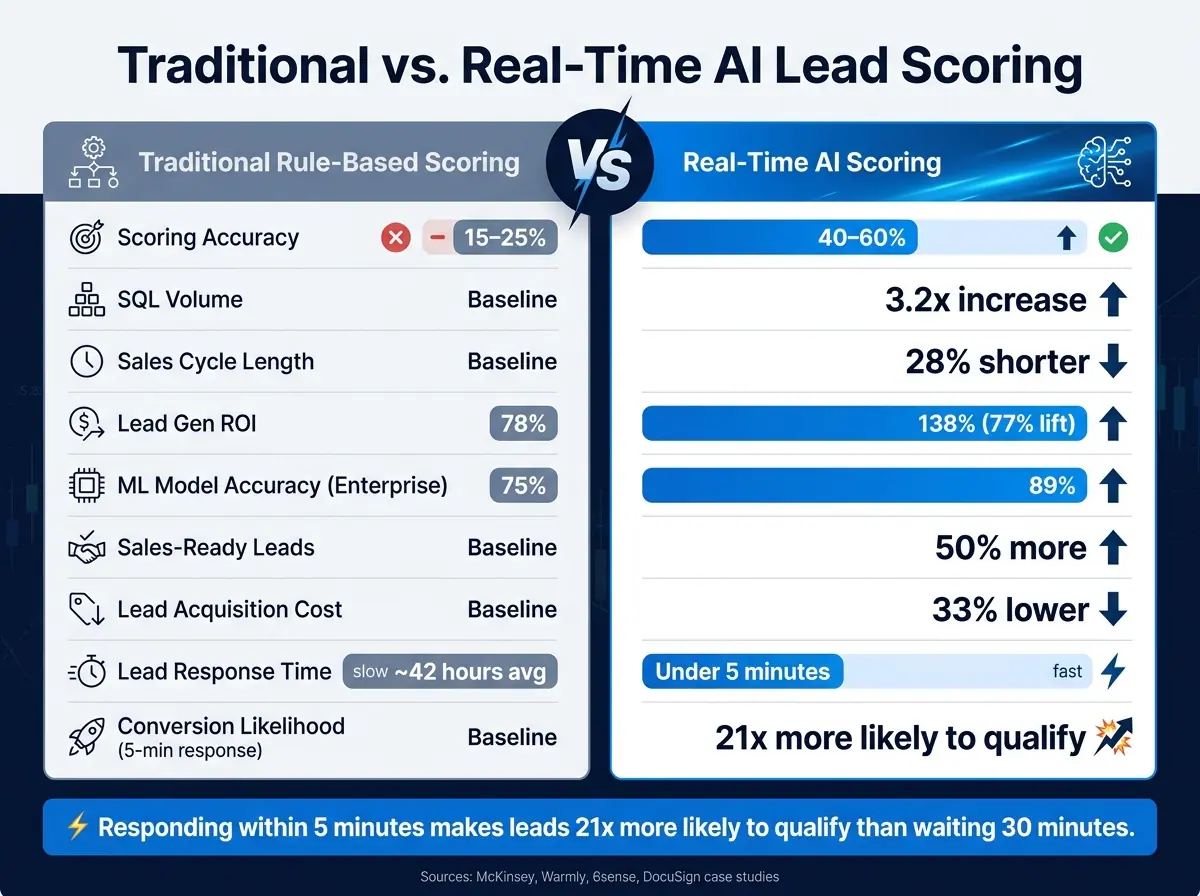
Traditional vs. Real-Time AI Lead Scoring: Key Metrics Compared
Behavioral Signals That Predict Conversion
Not all prospect actions are equally meaningful when it comes to predicting conversions. In fact, a group of related behaviors - known as intent bundles - is far more telling than isolated actions. McKinsey’s analysis highlights this point:
"87% of buying signals are behavioral and occur within a 72-hour window before a prospect makes contact with sales. Miss that window, and your conversion probability drops by 80%."
The sequence of interactions matters too. For instance, when a prospect moves from reading a blog post to exploring a case study, then dives into API documentation and finally visits the pricing page, it signals they’re nearing a decision. On the other hand, someone who reads multiple blog posts but doesn’t engage further shows less intent.
Another key indicator? When three or more individuals from the same company engage simultaneously, the likelihood of conversion skyrockets - by 3 to 5 times compared to engagement from just one contact.
These refined signals aren’t just theoretical; they directly translate into better conversion outcomes, as shown in the next section.
How Real-Time Data Affects Conversion Rates
Real-time data takes these behavioral insights and amplifies their impact. AI-driven scoring systems outperform traditional methods, boosting accuracy from 15–25% to 40–60%. The results? A 41% increase in sales productivity and a 28% reduction in the sales cycle. Companies leveraging real-time insights also see 3.2x more sales-qualified leads (SQLs) compared to those relying on slower, batch-processed data.
Real-world examples back this up. DocuSign, for instance, implemented predictive lead scoring and saw a 38% jump in SQLs along with a 22x return on investment within two months. Similarly, Fivetran used 6sense’s predictive scoring and experienced a 121% boost in in-market account engagement.
Speed is another game-changer. Responding to a lead within 5 minutes makes them 21 times more likely to qualify than if you wait 30 minutes. Yet, the average response time for B2B leads is a staggering 42 hours, with 30% of leads never contacted at all.
"The average lead response time across B2B is 42 hours. And 30% of leads never get contacted at all. That's not a sales problem. That's a scoring problem." - Chris Miller, Head of Demand Generation, Warmly
Benefits of Multi-Channel Data Integration
While real-time data is powerful, integrating insights from multiple channels takes lead scoring to the next level. Relying on a single data source leaves valuable information untapped. Combining first-party signals - like website visits, optimized lead forms, and product usage - with third-party intent data creates a more comprehensive picture. First-party signals alone can lead to conversion rates 15 times higher than those based solely on third-party data.
The true strength of multi-channel integration lies in its ability to recognize patterns. Advanced machine learning models that connect CRM data, product interactions, and marketing engagement achieve 89% accuracy on enterprise benchmarks, compared to 75% for traditional models. Companies using these mature systems report 50% more sales-ready leads while cutting lead costs by 33%.
| Metric | Traditional Rule-Based | Real-Time AI Scoring |
|---|---|---|
| Scoring Accuracy | 15–25% | 40–60% |
| SQL Volume | Baseline | 3.2x increase |
| Sales Cycle Length | Baseline | 28% shorter |
| Lead Gen ROI | 78% | 138% (77% lift) |
Interaction Features That Improve Scoring Models
Categories of High-Value Interactions
The most predictive signals for improving scoring models can be grouped into four main categories.
Engagement depth signals include metrics like time spent on pricing pages, how far users scroll through case studies, and clicks on high-value CTAs (calls to action). These behaviors show how seriously someone is considering your product. Intent-rich behavioral signals - such as visits to API documentation, integration pages, or comparison content - reveal that prospects are actively building a business case.
Account-level signals also carry significant weight. For example, if a colleague at the same company has already converted, others from that organization are 3–5 times more likely to convert as well. This "colleague signal" is one of the strongest predictors available, yet many flat scoring models overlook it.
Negative signals are just as crucial as positive ones. Actions like unsubscribing from emails, abandoning trials, skipping meetings, or selecting "just browsing" on a timeline should lower a lead's score:
"Negative scoring is presidential: subtracting points for disqualifying answers creates cleaner segmentation than positive scoring alone."
These insights are the backbone of real-time scoring upgrades that help drive higher conversion rates.
How Form Analytics Inform Lead Scoring
Forms are one of the richest sources of real-time intent data, yet they are often underused. By analyzing user behavior on forms, you can translate interactions into actionable lead scores.
For instance, tracking progress through multi-step forms and field-level behavior can reveal purchase intent. Completing each step signals genuine interest, while filling out detailed open-text fields - like describing a specific use case - shows more intent than selecting a generic dropdown option. Completing optional fields can add 10–20 points to a lead's score.
Even abandoned submissions provide valuable data. With 81% of visitors leaving web forms incomplete, partial submissions shouldn't go unnoticed. Capturing this data creates a pool of high-intent leads - individuals who started filling out the form but didn’t finish. Knowing which specific field caused them to drop off (e.g., budget, timeline, or company size) gives your team a clear starting point for follow-up.
"Descriptive systems tell you 'this submission came from a VP at a 500-person company.' Predictive systems tell you 'based on response patterns, this submission has an 87% probability of converting within 30 days.'" - OrbitForms
Feature Engineering for Real-Time Models
To make interaction and form data actionable, feature engineering techniques can help transform raw inputs into predictive metrics.
Recency weighting ensures that recent interactions carry more weight than older ones. By applying exponential decay to behavioral signals, a recent engagement (e.g., yesterday) will influence the score far more than an action from three months ago. This prevents outdated activity from skewing results.
Sequence encoding focuses on the order of interactions rather than just the total number of page views. For example, a prospect moving from a blog post → case study → API docs → pricing page is clearly following a decision-making process. As Kumo.ai explains: "The sequence is the signal. The count is noise."
Intent bundles combine multiple signals to reduce noise and improve accuracy. For instance, a visit to the pricing page alone might indicate casual interest, but when paired with a visit to the documentation page, it signals serious evaluation. Adding conversion velocity - how quickly a lead moves through different stages - introduces urgency as a factor, since faster-moving leads tend to have a higher likelihood of closing.
How to Implement Real-Time Lead Scoring
Scoring Model Approaches for Real-Time Data
Choosing the right scoring model depends on your data capabilities and available resources. Here are three key approaches to consider:
- Rule-based scoring: This is the simplest way to start. You assign point values to specific actions or attributes - like giving +15 for visiting the pricing page, +10 for a VP-level title, or -20 for unsubscribing. It’s straightforward and easy for sales reps to grasp. However, it becomes unwieldy when you exceed 10–20 criteria, making it harder to manage effectively.
- Machine learning scoring: This eliminates the need for manual point assignments. Instead, the model uses historical conversion data to analyze hundreds of signals at once, including complex patterns and sequences. This approach can boost lead-to-opportunity conversion rates by 30% to 50%. That said, it requires a solid amount of historical data and can feel opaque to sales teams unless properly explained.
- Hybrid scoring: This combines the strengths of both methods. A rule-based layer applies hard filters upfront, such as disqualifying competitor domains or student emails. Then, a machine learning layer evaluates intent and behavioral signals. For many SaaS and B2B teams, this strikes the best balance.
To make this work, create a dual-layer scoring structure. Separate firmographic and technographic data from behavioral signals, and combine them into a clear Priority Score out of 100. This way, sales reps can act on the score immediately. These approaches help you tap into structured data from critical touchpoints.
Using Reform for Lead Scoring and Data Collection
Once you’ve built your scoring model, the next step is gathering accurate data to fuel it. Forms play a key role here as a primary data source. Reform offers several features that enhance data collection for lead scoring:
- Real-time analytics and incomplete response tracking: These ensure you’re capturing signals not just from completed submissions but also from leads who started filling out forms but didn’t finish. This can reveal intent even without a full submission.
- Multi-step forms: By breaking forms into steps, you can gather richer behavioral data. For instance, each completed step indicates growing interest. Detailed open-text responses can weigh more heavily in scoring than generic dropdown selections.
- Conditional routing: This feature dynamically tailors the form path based on a respondent’s answers. High-value leads can be routed into more detailed qualification flows, while lower-fit respondents are guided elsewhere.
- Lead enrichment: When prospects provide minimal information (like just their name and email), Reform’s enrichment tools fill in the gaps. Using the email domain, it can reliably add details like company size, industry, and tech stack. Features like email validation and spam prevention ensure the data is clean and accurate from the start.
Once a form is submitted, Reform integrates seamlessly with CRM and marketing automation tools. This allows both the form data and behavioral signals captured during the session to flow directly into your scoring engine - no manual exports required.
Centralizing and Integrating Behavioral Data
To make lead scoring actionable, centralize behavioral signals into a unified system. Relying solely on form data isn’t enough.
"The CRM captures what the lead told you. The warehouse captures what the lead showed you." - Adrienne Vermorel, Data Consultant
While your CRM stores form submissions and deal stages, other signals - like web analytics from GA4, product telemetry, and support interactions - are often scattered across different platforms. Bringing these together in a data warehouse like BigQuery gives your scoring model a complete view of each lead’s behavior.
From there, map score ranges to specific actions. For example:
- Scores of 80–100 could trigger an immediate Slack alert to the assigned rep.
- Scores between 60–79 might enter a high-priority automated nurture sequence.
- Scores below 40 could be placed in standard nurture flows without involving sales reps.
To ensure sales teams trust and use these scores, always provide context alongside the number. For example:
"A score of 87 means nothing without context. Show the top three scoring drivers alongside the lead: 'ICP industry match (+20), pricing page visit in last 2 hours (+15), Series B funding (+10).'" - Sanket Goyal, CEO, Bitscale
Lastly, incorporate continuous calibration. Every 4–6 weeks, review false positives and negatives, adjusting weights based on actual conversion results rather than assumptions. Buyer behaviors change over time, and regular reviews keep your scoring model aligned with what’s driving real results.
Conclusion: Using Real-Time Data to Improve Lead Scoring
Key Takeaways
The research highlights a critical point: real-time interaction data can transform lead scoring into a dynamic measure of buying intent. Yet, only 44% of B2B organizations currently score leads - a missed opportunity that could offer a major competitive advantage.
When behavioral signals - like visiting a pricing page or completing a multi-step form - are captured and processed within minutes, sales teams can act while the prospect's interest is at its peak. Responding within 5 minutes instead of an hour can make a huge difference in conversion rates.
The best lead scoring systems combine three elements: fit, intent, and friction signals. These scores are then linked to actionable workflows, such as Slack notifications, fast-tracked sequences, or direct routing to the appropriate sales rep. With these strategies in place, the future of lead scoring is poised to become even more dynamic.
What's Next for Real-Time Lead Scoring
The evolution of lead scoring isn't just about speed - it’s about intelligence. Two emerging trends stand out.
First, predictive deal velocity is changing the game. Advanced models are moving beyond predicting if a lead will convert to forecasting how quickly it will convert and at what deal size. This shift enables sales teams to better allocate their time and resources.
Second, conversational AI qualification is gaining traction. Instead of relying solely on passive signals like page views, AI tools can now gather explicit intent through natural conversations. For instance, a prospect stating, "We’re planning to buy in Q2", provides far more actionable insight than multiple visits to a features page. George, the Founder of Leadpipe, captures this shift perfectly:
"A lead score is an average over a person's entire relationship history. A moment score is a snapshot of this specific visit... Averages hide the thing you actually want to act on: the live buying window."
One challenge to anticipate is model drift - where AI models lose accuracy over time as buyer behaviors evolve. To address this, regular calibration reviews, ideally on a quarterly basis, are essential to maintain the system's accuracy and effectiveness .
FAQs
What counts as a “high-intent” real-time signal?
High-intent signals are those telltale actions that reveal when someone is shifting gears - from casually browsing to actively considering a purchase or decision. These actions indicate they're no longer just researching; they're ready to engage. Here are a few examples:
- Submitting forms: Think demo requests, trial signups, or any form that shows they’re raising their hand for more information.
- Frequent visits to pricing pages: Especially when these visits happen multiple times in a short period - this often signals serious interest.
- Engaging with decision-focused content: This includes tools like ROI calculators or reviewing documents like security policies, which are typically explored by prospects nearing the final stages of decision-making.
Reform makes it easier to spot these high-intent signals. With features like branded forms, conditional routing, and real-time analytics, it helps you quickly identify and prioritize prospects who are ready to take action.
How much data do I need to start real-time lead scoring?
You don’t need an overwhelming amount of data to kick off real-time lead scoring. Instead, zero in on 7 to 10 key indicators that are most likely to predict conversions. Begin with 3 to 4 core signals - things like firmographic details or specific actions that have a strong connection to closed deals. Tools like Reform can help you gather this information using high-performing forms. Combine this data with real-time enrichment and behavior tracking to score your leads on the spot.
How do I route leads differently based on their score?
Using rule-based routing, you can automatically direct leads based on their qualification status. With Reform, you can create custom logic to handle leads effectively. For instance, high-intent leads can be sent to a VIP scheduling link, while others might be directed to a prerecorded demo.
Don't forget to set up fallback logic to ensure no leads slip through the cracks. This approach helps improve your speed-to-lead and boosts your overall conversion efficiency.
Related Blog Posts
Get new content delivered straight to your inbox

The Response
Updates on the Reform platform, insights on optimizing conversion rates, and tips to craft forms that convert.




Drive real results with form optimizations
Tested across hundreds of experiments, our strategies deliver a 215% lift in qualified leads for B2B and SaaS companies.
