
.webp)
Real-Time Routing for Website Leads: Benefits



Responding to website leads quickly can dramatically boost your sales conversions. Here's why: Real-time lead routing ensures every lead is instantly assigned to the right sales rep, cutting response times to under 30 seconds. This matters because reaching out within 5 minutes makes you 400% more likely to qualify a lead compared to waiting 10 minutes. Yet, most companies still take hours - or even days - to respond, losing potential customers to faster competitors.
Real-time routing automates lead distribution based on factors like geography, skills, or account ownership. It eliminates delays caused by manual processes, improves team productivity, and ensures leads are handled by the most qualified reps. Tools like Reform make setup easy by enabling instant, rule-based routing directly from lead capture forms.
Key Takeaways:
- Speed is critical: Contacting leads within 5 minutes increases conversion rates by up to 391%.
- Routing methods include round-robin, geographic, account-based, and skill-based matching.
- Automation reduces errors, balances workloads, and improves sales and marketing alignment.
Real-time routing is the solution to faster lead response times and improved conversions. Start leveraging it today to stay ahead of the competition.
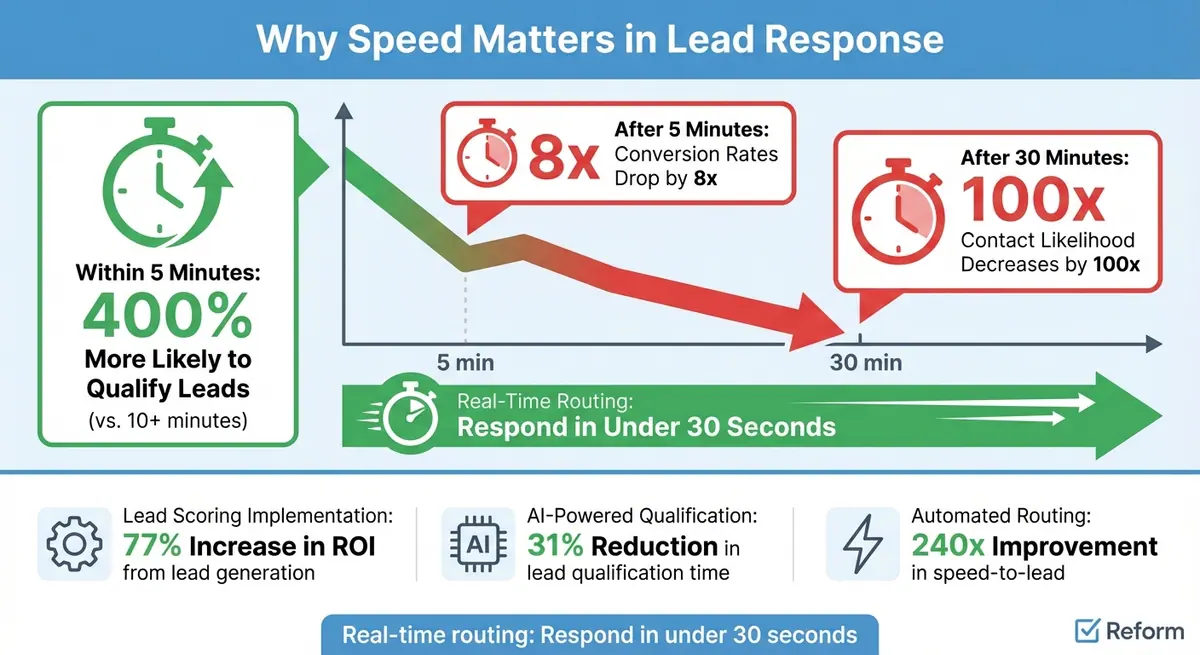
Real-Time Lead Routing Statistics: Response Time Impact on Conversion Rates
Optimising lead routing | Fix your Funnel Episode 2
sbb-itb-5f36581
Problems with Manual Lead Assignment
Manual lead assignment slows down lead response times, quietly chipping away at ROI.
Delays in Lead Assignment
Leads often get stuck in a general queue, waiting for a manager to review and assign them. What should take just a few minutes can stretch into hours - or even days. Many companies rely on batch syncing with scheduled imports (every 15 minutes, hourly, or daily), creating what’s essentially a "digital waiting room" where leads grow cold. And when competitors respond within minutes, even a 15-minute delay can make all the difference.
"While your prospects are ready to buy right now, your leads are sitting in a queue, waiting to be assigned." - Orbit Forms
Human error adds another layer to the problem. During busy times, leads may be overlooked entirely or assigned to team members who are unavailable or already overwhelmed. Email notifications, often buried in crowded inboxes, force reps to manually check for updates and juggle between systems - slowing things down even more. These delays not only hurt response times but also disrupt the coordination between marketing and sales.
Impact on Sales and Marketing Alignment
Unlike automated systems, manual processes leave gaps that can stifle pipeline growth by skipping lead qualification. Delayed lead delivery undermines the effectiveness of high-performing marketing campaigns, wasting budget and creating friction between teams. Static lead assignments further complicate things, often leading to uneven workloads - some reps are overwhelmed while others have too little to do. Worse, mismatched assignments can hurt credibility when complex leads are handed off to less experienced team members. Without proper context during the handoff, sales reps are left unprepared, making it harder to build the trust and rapport needed to close deals.
Benefits of Real-Time Routing for Website Leads
Real-time routing removes manual delays, delivering quick and measurable outcomes.
Faster Response Times and Higher Conversion Rates
When it comes to leads, speed is everything. Real-time routing cuts the time between form submission and agent contact to under 30 seconds by simultaneously texting the prospect and calling the agent’s phone.
And the numbers back this up: responding to leads within five minutes makes companies 400% more likely to qualify those leads compared to waiting 10 minutes or more. In fact, conversion rates plummet by 8x just five minutes after a lead reaches out.
But there’s more to it than just speed. Reaching out quickly capitalizes on the prospect’s "peak interest" - when their problem is fresh in their mind. This creates an immediate connection and builds trust. A great example of this in action is Zoom Video Communications. In March 2020, just before the COVID-19 pandemic hit, Zoom implemented LeanData’s routing system. This allowed them to handle a massive surge of leads - from K-12 schools to global enterprises - by instantly directing them to the right sales tiers or product reps. What previously took months to adjust now took just one week.
These improvements set the stage for more effective lead handling, as we’ll explore next.
Better Lead Quality Through Rule-Based Assignment
Real-time routing doesn’t just speed things up - it makes sure the right person gets the right lead. Rule-based routing uses firmographic data (like company size, industry, or tech stack) and behavioral signals to assign leads to the most qualified reps. This ensures that senior reps handle complex enterprise deals, while smaller accounts are directed to the appropriate team members.
Lead scoring plays a key role here, and it’s no small thing: companies that implement lead scoring see a 77% increase in ROI from lead generation.
Take Heap, a digital analytics platform, as an example. They used Clearbit to enrich form submissions with firmographic data, enabling them to keep forms short while routing leads based on company size (startup, mid-market, or enterprise). This saved each Business Development Representative 3–5 minutes of research per lead - adding up to nearly an hour saved per rep each day.
Account-based routing ensures that leads tied to existing accounts go directly to the current account owner, maintaining a seamless customer experience. Geographic and time-zone alignment also ensures prospects are handled by reps who understand local regulations and are available during the prospect’s business hours.
| Routing Method | Best For | Primary Advantage |
|---|---|---|
| Round-Robin | Small teams with similar skills | Ensures fair lead distribution |
| Geographic | Region-specific sales teams | Reps understand local laws and preferences |
| Account-Based | B2B Enterprise / ABM | Maintains relationship continuity |
| Skill-Based | Complex products / technical sales | Matches leads with experts |
| Priority-Based | High-value / long sales cycles | Top reps handle high-revenue leads |
Improved Team Productivity and Collaboration
Real-time routing doesn’t just boost conversions - it makes life easier for sales teams. By automating lead research, territory assignments, and ownership decisions, it frees up reps to focus on what they do best: selling. AI tools can reduce lead qualification time by 31%, and automated lead routing can improve speed-to-lead by 240X when integrated with tools like lead capture and scheduling software.
Clear rules also prevent common frustrations like "lead hoarding" or confusion over ownership. Leads are automatically matched to existing account owners, ensuring continuity and avoiding duplicate outreach. Plus, capacity-aware routing helps balance workloads and prevent burnout.
"Reps hate when deals go silent, and having an instant alert that their prospect may be thinking about our platform again gives them an indication of the perfect time to follow up." - Dan Ahmadi, former Director of Demand Gen, Outreach
Automated notifications - via Slack, SMS, or mobile push - keep sales teams informed about marketing interactions, enabling smarter, faster follow-ups. And fallback rules ensure no lead is neglected; if a rep is unavailable due to illness or workload, the system reassigns the lead to someone else.
Tools like Reform even allow conditional routing directly at the point of lead capture. This means routing decisions happen instantly when a form is submitted, without waiting for data to sync with your CRM.
How to Set Up Real-Time Lead Routing
To establish real-time lead routing, you’ll need to define clear rules, integrate your tools, and choose systems that can assign leads instantly.
Creating Routing Rules
Start by documenting your lead sources and outlining the roles of your sales team - for example, distinguishing between SDRs and AEs. Define routing criteria using lead scoring, and choose a distribution method that fits your sales model. Options include round-robin, geographic-based, or account-based routing. To improve accuracy, enrich your data with tools like Clearbit or Apollo, and set up backup protocols to ensure leads are addressed within the critical five-minute response window.
For real-time notifications, integrate your routing system with communication platforms like Slack or email. This ensures that sales reps receive immediate alerts along with key lead details.
These routing rules are the backbone of seamless integration with your CRM, enabling instant lead assignment.
Connecting Routing with CRM and Marketing Tools
Once your routing rules are in place, the next step is connecting them to your CRM. This integration ensures that every lead detail captured translates into immediate action. Use an orchestration layer to bridge your CRM and marketing platforms, creating a central hub for real-time routing. Link lead capture forms to data enrichment tools, so firmographic details are automatically populated. Automated lead-to-account matching helps avoid duplicate outreach and ensures smooth routing without manual delays.
You can also use form builders like Reform to implement real-time, conditional routing directly at the point of lead capture.
Using Form Builders Like Reform for Conditional Routing

Form builders play a key role in capturing inbound leads by gathering important data like company size, location, and product preferences. Reform, a no-code form builder focused on conversions, lets prospects self-select their needs or regions. This information is then routed instantly based on your predefined rules. Qualified leads are sent directly to account executives, while others are directed into nurture workflows.
"The BDR team already has to do enough research as is, so Clearbit cuts down their time if they don't have to think about whose lead it is." - Charlie Liang, former Head of Demand Gen, Heap
To reduce friction, request only the most essential details on your forms. Combine this data with third-party enrichment tools for precise conditional routing, ensuring your sales team can act quickly and effectively.
Conclusion
Real-time lead routing is a game-changer for managing leads, allowing businesses to engage prospects when their interest is at its peak. Companies that respond to leads within five minutes are 400% more likely to qualify them compared to those who wait 10 minutes. Stretch that wait to 30 minutes, and the chances of making contact drop dramatically - by as much as 100 times.
But speed isn’t the only factor. Rule-based lead assignment ensures every prospect lands in the hands of the right sales rep, whether it’s based on expertise, territory, or account ownership. This eliminates common issues like manual errors and lead hoarding, which can slow down sales teams.
"Lead routing is table stakes for businesses that want to increase their speed-to-lead and get more qualified bookings", says Stan Rymkiewicz, Head of Growth at Default.
Tools like Reform make implementing real-time routing simple. With no-code conditional logic and CRM integrations, Reform captures and routes leads instantly. Its lead enrichment and email validation features ensure sales teams focus only on real opportunities, while abandoned submission tracking helps recover leads that might otherwise be lost.
Flexibility is another key benefit. Take Zoom, for example. After automating their lead routing in March 2020, they gained the ability to make changes in a week - something that previously took months. This adaptability allows businesses to tweak routing rules as their strategies evolve, whether that means redefining target customers or scaling their teams.
FAQs
What data do I need to route leads in real time?
To manage leads efficiently and in real time, having detailed lead data is essential. This includes contact information like name, email, and phone number, as well as the lead source, such as whether they came through a form or an ad campaign. Additionally, behavioral data - like how they interact with your website - can provide valuable insights.
Incorporating lead qualification and scoring helps identify and prioritize high-value leads, ensuring they get routed quickly. Automation tools can take this a step further by assigning leads to sales reps based on factors like location, industry, or lead score. This approach not only speeds up response times but also boosts the chances of converting those leads into customers.
How do I prevent leads from going unassigned when reps are busy?
To keep leads from slipping through the cracks, implement automated routing systems paired with backup protocols and real-time notifications. Streamline workflows by establishing clear decision points, integrating your CRM, and using tools that support conditional routing and real-time analytics. These measures ensure leads are assigned quickly - even when the primary rep is unavailable - reducing delays caused by manual errors or misrouting.
How can I add real-time routing to my website forms with Reform?
With Reform, you can streamline your website forms using conditional routing and real-time analytics. Thanks to its no-code builder, you can create rules that instantly route leads to the appropriate team or action based on their answers.
On top of that, real-time analytics let you track performance as it happens. This helps you fine-tune your routing strategies, leading to quicker follow-ups and higher-quality leads.
Related Blog Posts
Get new content delivered straight to your inbox

The Response
Updates on the Reform platform, insights on optimizing conversion rates, and tips to craft forms that convert.



Drive real results with form optimizations
Tested across hundreds of experiments, our strategies deliver a 215% lift in qualified leads for B2B and SaaS companies.
