
.webp)
Retail Data Collection: Privacy Best Practices


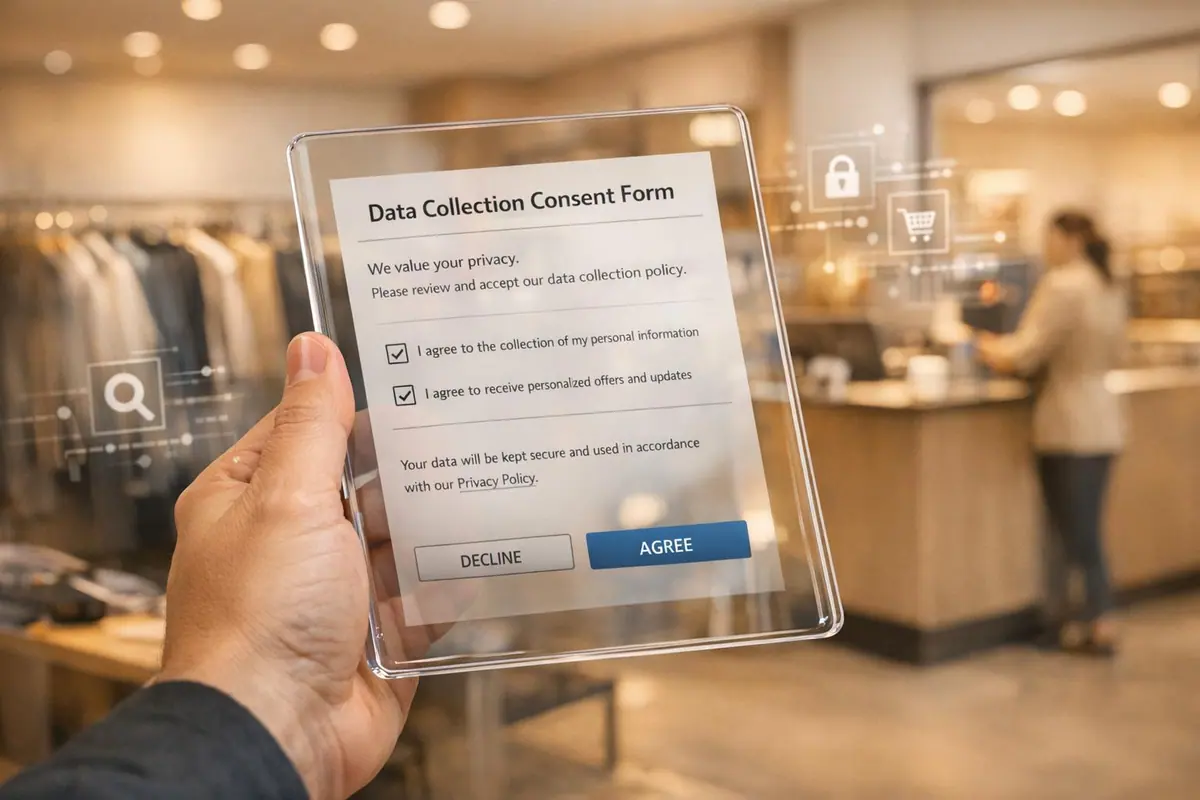
Retailers collect data to improve operations and customer experiences, but privacy concerns and laws like the CCPA and CPRA demand clear, responsible handling of personal information. Here's what you need to know:
- Types of Data Collected: Names, emails, purchase history, geolocation, biometric data, and online activity.
- Privacy Laws: Regulations like CCPA/CPRA, COPPA, and GLBA require transparency, consent, and data protection.
- Compliance Requirements: Notify customers about data use, honor opt-outs, secure sensitive data, and audit third-party vendors.
- Best Practices: Limit data collection to what's necessary, secure it, and delete it when no longer needed.
- Key Tools: Use privacy-focused platforms for data collection and retention.
From Data Collection to Consumer Trust: How Retailers Adapt to Evolving Privacy and Security Laws
sbb-itb-5f36581
U.S. Privacy Laws and Retail Compliance Requirements
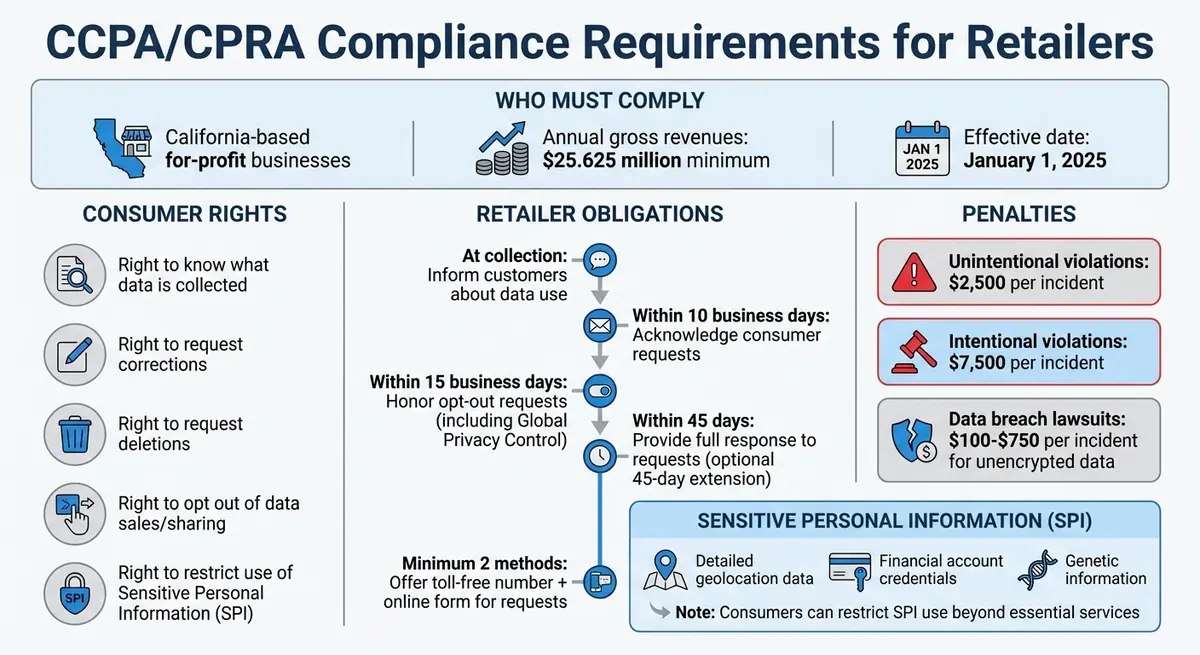
CCPA/CPRA Compliance Requirements and Penalties for Retailers
Key Privacy Laws Explained
The California Consumer Privacy Act (CCPA) and its successor, the California Privacy Rights Act (CPRA), have become benchmarks for privacy compliance in the retail industry. Starting January 1, 2025, these laws will apply to California-based for-profit businesses with annual gross revenues of at least $25.625 million. These regulations grant consumers the right to know what personal data is collected, request corrections or deletions, and opt out of data sales or sharing.
The Fair Credit Reporting Act (FCRA) comes into play when retailers use consumer reports for decisions involving creditworthiness, employment, or insurance. Additionally, if your store offers branded credit cards or financing options, the Gramm-Leach-Bliley Act (GLBA) mandates that you disclose information-sharing practices and ensure the security of sensitive financial information.
Sensitive Personal Information (SPI) has gained special attention under the CPRA. This category includes detailed geolocation data (especially relevant for mobile retail apps), financial account credentials, and genetic information. Consumers now have the right to restrict how their SPI is used beyond essential service delivery. Furthermore, as of January 1, 2023, exemptions for employee and business-to-business transaction data have expired, meaning these types of data are now subject to the same protections as consumer information.
Retailers face strict penalties for noncompliance. Consumers can sue for statutory damages ranging from $100 to $750 per incident if their nonencrypted personal data is compromised due to inadequate security measures. Fines for violations range from $2,500 for unintentional breaches to $7,500 for intentional ones. These laws create a framework that emphasizes transparency and accountability, requiring retailers to notify customers and obtain their consent for certain activities.
Notice and Consent Requirements
Retailers must inform customers at the point of data collection about what information is being gathered, why it’s needed, and whether it will be sold or shared. The California Privacy Protection Agency highlights:
This means businesses must limit the collection, use, and retention of your personal information to only those purposes that: a consumer would reasonably expect, are compatible with the consumer's expectations... or purposes that the consumer agreed to.
For in-store data collection, such as through point-of-sale terminals or paper forms, provide clear notices via posted signage or directly on the forms.
Once a consumer submits a data-related request, retailers must acknowledge it within 10 business days and provide a full response within 45 calendar days, with an optional 45-day extension if necessary. Retailers must offer at least two ways for consumers to submit requests, such as a toll-free number and an online form, unless the business operates exclusively online.
The CPRA also requires retailers to honor Opt-Out Preference Signals (OOPS), such as the Global Privacy Control (GPC), which browsers can send automatically. Once an opt-out request is received, retailers must comply within 15 business days. Additionally, California law invalidates consent obtained through manipulative interfaces.
For retailers offering financial services, the GLBA requires a privacy notice when establishing a customer relationship, with annual updates thereafter. The Federal Trade Commission (FTC) states:
You must provide a clear and conspicuous notice that accurately reflects your privacy policies and practices to... [an] individual who becomes your customer, not later than when you establish a customer relationship.
Third-Party Vendor Compliance
Retailers are not only responsible for their own data practices but also for those of third-party vendors handling customer information, such as point-of-sale system providers, loyalty platforms, and call centers. Before outsourcing, it’s crucial to assess each vendor’s data security protocols. As the FTC advises:
Put your security expectations in writing in contracts with service providers.
Contracts with vendors must clearly outline data handling, protection, and disposal procedures. Under the CCPA, agreements with service providers must explicitly prohibit them from using, retaining, or disclosing data for purposes beyond those specified. Vendors are also prohibited from selling the data they process on your behalf.
Regular audits and independent reviews are vital to ensure vendors meet compliance standards. Contracts should require vendors to notify you immediately of any security incidents, even before a full breach is confirmed, so you can meet your breach notification obligations.
Maintaining a detailed data map - tracking where personal information is stored and who has access to it - can streamline the process of responding to consumer deletion or access requests. If your business involves areas like pharmacies or financial services, ensure your vendors also comply with sector-specific regulations like HIPAA or GLBA.
The consequences of vendor failures can be steep. For instance, YouTube faced a $170 million fine for violating COPPA by tracking minors’ online activity without parental consent, and British Airways was fined £20 million after a breach exposed the data of 400,000 customers.
Privacy by Design in Retail Data Collection
Privacy by Design (PbD) is all about embedding privacy into every step of the data collection process, reinforcing compliance from the ground up. The Federal Trade Commission sums it up well:
Safeguarding personal information is just plain good business.
With global data volumes projected to skyrocket from 33 zettabytes in 2018 to an estimated 175 zettabytes by 2025, and around 74% of retailers planning to ramp up their investment in personalization tools like location tracking and facial recognition, taking a proactive approach to privacy isn't optional - it's essential.
Data Mapping and Minimization
Start by mapping every point where customer data enters your system: websites, high-converting forms, point-of-sale terminals, mobile apps, loyalty programs, and even digital copiers. Don't overlook devices like copiers - ensure they’re routinely overwritten and securely wiped to prevent unauthorized access.
Once you’ve mapped your data flows, apply the principle of least privilege. This means limiting employee access to only the data they absolutely need. For instance, if an email address is all that's required at checkout, avoid asking for unnecessary details like a phone number or date of birth. As one IT consulting director put it:
Data provide a huge competitive advantage. Personalization works as a marketing strategy. Customers like it but it requires data.
However, collecting more data than necessary increases your risk if a breach occurs. Instead of storing sensitive identifiers like Social Security numbers, consider using attribute claims. For example, partner with third-party validators who can confirm identities with a simple "yes/no" response, so you don’t have to store sensitive data. The same logic applies to payment details - unless you're running a subscription service, there's no need to retain full credit card information after a transaction is complete.
Data Retention and Deletion Policies
After mapping your data, establish clear retention and deletion policies to protect customer information. Create a written policy outlining what data you'll keep, for how long, and how it will be securely disposed of. For example, you might retain receipt emails for 90 days or marketing data for one year.
When it’s time to delete data, use secure tools that permanently overwrite files to prevent recovery. For sensitive paper records, such as credit applications or handwritten forms, use shredding, burning, or pulverizing methods to ensure the information cannot be reconstructed.
Also, remember that privacy laws often include provisions for deletion requests. While you must honor these requests, there are exceptions - you can retain data if it’s needed to complete a transaction, provide a service, or meet legal requirements. If you delete data, notify your service providers to ensure the information is removed from their systems as well.
Privacy Impact Assessments
Once your data handling protocols are in place, evaluate potential risks by conducting Privacy Impact Assessments (PIAs). Before rolling out new data collection methods - like in-store tracking, facial recognition, or enhanced mobile app features - a PIA can help identify vulnerabilities. Launch a PIA for any new electronic data collection initiative that impacts 10 or more individuals.
A PIA should address several key questions: Is the data you're collecting necessary? Who will have access to it? How will it be secured? What could happen if it’s compromised? For example, if you’re considering facial recognition for loss prevention, a PIA would explore less invasive alternatives, outline consent mechanisms, and ensure compliance with laws like Illinois' Biometric Information Privacy Act (BIPA). Similarly, retailers managing health data through pharmacy operations must meet stricter standards under HIPAA.
Don’t forget to update your privacy assessments whenever you merge databases, centralize systems, or transition from paper to electronic formats. These changes often create new data flows and access points that weren’t part of your original risk analysis. Regular audits and third-party penetration testing can help uncover vulnerabilities in your data storage systems.
Transparent and Consent-Based Data Collection
Building on the concept of Privacy by Design, transparent and consent-based data collection ensures customers have a clear understanding of how their data is used and gives them control over it. When it comes to retail, this means providing clear, easy-to-understand notices at every customer interaction. The Federal Trade Commission stresses that businesses must explain their data practices in plain language - customers need to know what data is being collected, why it’s needed, and who it’s shared with.
How to Communicate Clearly with Customers
Your privacy notice should be both noticeable and easy to understand. Present it at the beginning of the customer relationship. For example, whether someone is signing up for an in-store loyalty program or completing an online checkout, the notice must appear before the transaction is finalized.
Notices should be tailored to the specific context. For instance, a store credit card application will require different details compared to an email newsletter signup. Use concise notices for quick interactions, but always provide a way for customers to access the full privacy policy - this could be through a toll-free number, a website link, or a QR code.
When designing forms, make it clear which fields are mandatory and which are optional. This approach not only improves clarity but also reduces unnecessary data collection.
Once clear communication is established, effective consent management becomes the next step in empowering customers.
Consent Management Best Practices
California laws like the CCPA and CPRA require retailers to operate on an opt-out basis for adult consumers. However, opting out should be simple. Include links such as "Do Not Sell or Share My Personal Information" and "Limit the Use of My Sensitive Personal Information" prominently on your homepage, typically in the footer or header.
Simplify the process further by using a single link like "Your Privacy Choices" or "Your California Privacy Choices" to handle these requests. The opt-out process should be straightforward - avoid confusing multi-step forms, dark patterns, or requiring customers to draft custom letters. Instead, offer simple options like checkboxes, electronic forms, or toll-free numbers.
For minors under 16, an opt-in model applies. Affirmative authorization is required before selling or sharing their data, and for children under 13, parental or guardian consent is mandatory. Additionally, businesses must honor automated opt-out signals, such as Global Privacy Control (GPC), and comply within 15 business days.
| Opt-Out Method | Best Practices | Poor Practices |
|---|---|---|
| Physical/Forms | Check-off boxes; pre-addressed forms | Requiring custom letters |
| Digital | Electronic forms; "Privacy Choice" portals; email opt-out | Only offering a checkbox in the initial notice |
| Telephonic | Dedicated toll-free numbers | Requiring in-person visits for online customers |
By integrating clear communication and simple consent processes, you can create a smoother experience for your customers.
Privacy-Compliant Form Design
Data collection forms should be designed with purpose and efficiency in mind. Breaking complex data requests into multi-step forms can make the process feel less overwhelming, reducing abandonment rates and providing opportunities to explain why each piece of information is needed.
Leverage conditional logic to display only the fields relevant to a customer’s choices. For instance, fields related to communication preferences should only appear if someone opts into a loyalty program. Additionally, real-time email validation can help catch typos, while spam prevention measures protect data quality and improve the user experience.
Tools like Reform offer features such as conditional routing, lead enrichment, and real-time analytics to help you create forms that are both efficient and compliant. Their multi-step forms and custom CSS options allow you to maintain your brand’s identity while ensuring transparency. Features like abandoned submission tracking also provide insights into where customers drop off, helping you refine your approach without over-collecting data.
Well-designed, privacy-compliant forms not only enhance transparency but also support strong consent management practices.
Internal Governance and Compliance Monitoring
Transparent data collection is just one piece of the privacy puzzle. To truly uphold privacy standards, retailers need strong internal governance and regular audits. These measures ensure not only compliance but also the ability to detect and address potential issues before they grow. Achieving this requires clear policies, consistent training, and systems that track and enforce compliance across the board.
Governance Structures and Policies
Transparency in data collection must be backed by solid governance. This starts with defining who in the organization is responsible for privacy. Key departments - like marketing (handling customer data), IT (managing security systems), and legal (ensuring regulatory compliance) - must collaborate effectively. The FTC outlines a practical framework with five steps: Take Stock, Scale Down, Lock It, Pitch It, and Plan Ahead. This means keeping an inventory of all devices storing sensitive data, minimizing data collection to essentials, and enforcing strict access controls following the "least privilege" principle.
Policies should also cover data retention and secure disposal. For instance, they should specify how long data is kept and outline secure methods for destroying it, such as shredding paper records or using digital wiping tools. Vendor management is equally important - contracts with third-party partners must include clear security requirements, and compliance should be verified through audits or site visits. Additionally, authentication policies need to enforce strong, unique passwords, multi-factor authentication (MFA), and encryption for sensitive data, whether stored or in transit.
Employee Training and Awareness
Employee training isn’t a one-and-done task - it’s an ongoing effort. To foster a strong security culture, training sessions must include everyone, from full-time staff to seasonal workers. These sessions should teach employees how to spot common cyber threats, handle data requests appropriately using interactive flows, and communicate privacy notices effectively. Background checks for those with access to sensitive data and protocols for reporting lost or stolen devices are also critical safeguards.
Compliance Audits and Incident Response
Regular audits are a cornerstone of effective compliance. These audits should cover everything from equipment inventories to network security assessments and log file reviews for signs of unusual activity, like repeated login failures or large data transfers. Third-party service providers should also be audited to ensure they meet agreed-upon security standards.
In addition, having a designated response team and a detailed incident response plan is essential. Under the FTC's Health Breach Notification Rule, companies must notify affected individuals, the FTC, and sometimes the media in the event of a breach. Similarly, the FTC Safeguards Rule, effective May 14, 2024, requires covered entities to notify individuals promptly in case of a breach. When a breach happens, immediate actions - like enforcing password changes and implementing MFA - are crucial. Retailers can also use the NIST Privacy Framework to assess their current privacy measures, identify gaps, and address them quickly. With these proactive steps, retailers can maintain a strong compliance posture and minimize risks across their operations.
Conclusion
Summary of Best Practices
Privacy-compliant data collection isn’t just about following regulations - it’s about fostering trust and reducing risks. The Federal Trade Commission puts it plainly:
Safeguarding personal information is just plain good business.
The principles are simple: only collect what’s necessary, be upfront about how you’ll use the data, secure it with robust protections, and properly dispose of it when it’s no longer needed. Empower customers by honoring deletion requests, respecting opt-out preferences like Global Privacy Control, and making privacy options easy to access. Remember, failing to secure unencrypted personal data could lead to lawsuits, with damages reaching up to $750 per incident.
Strong internal processes are essential. Regular audits, employee training, and clear plans for handling incidents ensure that your privacy policies translate into real-world practices. California’s new Delete Request and Opt-out Platform (DROP), launching January 1, 2026, will allow residents to send deletion requests to all registered data brokers at once. This shows how privacy laws are evolving to give consumers more control. By staying ahead of these changes, businesses can reduce legal risks while earning customer loyalty.
Adopting these best practices becomes even easier with tools designed to prioritize privacy while simplifying data collection.
Using Privacy-Conscious Tools
Using the right tools can make compliance both manageable and effective. For example, when gathering customer data - whether for newsletters, loyalty programs, or purchases - choosing a platform that prioritizes privacy can save time and reduce potential risks. These tools align with governance strategies and ensure you follow data minimization principles.
Reform is one such platform, offering features like email validation, spam prevention, and conditional routing to help you gather only the most relevant information while maintaining data accuracy. Its multi-step forms, conditional logic, real-time analytics, and seamless CRM integrations make data collection both efficient and privacy-compliant. By starting with tools designed for privacy, businesses can focus on building meaningful customer relationships instead of retrofitting compliance into outdated systems.
FAQs
How can retailers comply with CCPA and CPRA regulations?
To meet the requirements of the CCPA and CPRA, retailers should focus on a few important practices:
- Regularly evaluate how personal data is collected, stored, and processed to ensure compliance.
- Stick to data minimization principles, collecting only the information necessary for business operations.
- Create clear and straightforward privacy policies, including an easy way for users to opt out and support for the Global Privacy Control (GPC) signal.
- Set up systems to handle consumer requests efficiently - whether it's accessing, correcting, or deleting their data - and make sure updates are both accurate and prompt.
By focusing on these steps, retailers can not only comply with California's privacy laws but also strengthen customer trust.
What are the best practices for managing customer consent and opt-out requests?
Retailers should make it simple and straightforward for customers to manage their data preferences. This could mean creating a dedicated hub where users can easily view, update, or revoke their consent. Including a clearly visible "Do Not Sell or Share My Personal Information" link is also essential to comply with privacy laws like the California Consumer Privacy Act (CCPA). Adding user-friendly options like toggles or checkboxes for specific permissions, along with an instant opt-out button, ensures clarity and convenience for customers.
To remain compliant, retailers must implement a centralized system to log and track all consent and opt-out requests. This system should record details like timestamps and verification methods and ensure requests are processed within the legally required time frame (e.g., 15 days). It’s also crucial that these changes are applied consistently across all platforms, including marketing tools and third-party vendors. Regular audits and automated workflows can help reduce errors and keep everything running smoothly.
Tools like Reform can streamline this process by embedding customizable consent forms directly into checkout pages, sign-up forms, or other customer-facing touchpoints. Features such as conditional routing and real-time analytics allow retailers to manage consent efficiently, minimize manual effort, and stay compliant - all while respecting customer choices.
What are the best practices for protecting and securely disposing of customer data in retail?
Protecting customer data begins with a well-thought-out, written security plan that aligns with your business's size and the sensitivity of the data you handle. Start by encrypting data - both when it's stored and when it's being transmitted. Limit access to sensitive information to only those employees who need it, enforce strong password policies, and implement multi-factor authentication. Keep an eye on your systems for any unusual activity that might signal a security issue.
Don't overlook physical security. Paper records, backup drives, and portable devices should be stored in locked, secure locations, and encryption should be applied where possible.
When data is no longer needed, dispose of it in a way that ensures it can't be recovered. Shred paper documents, destroy magnetic media, and use certified tools to permanently erase electronic files. Retain only the information that's absolutely necessary for your operations, and make sure employees are regularly trained on secure disposal practices to avoid compliance issues and reduce the risk of breaches.
By using a mix of technical tools, administrative measures, and physical protections, businesses can safeguard customer data, meet U.S. privacy law requirements, and lower the chances of a data breach.
Related Blog Posts
Get new content delivered straight to your inbox

The Response
Updates on the Reform platform, insights on optimizing conversion rates, and tips to craft forms that convert.


Drive real results with form optimizations
Tested across hundreds of experiments, our strategies deliver a 215% lift in qualified leads for B2B and SaaS companies.
