
.webp)
How SLAs Impact Marketing Automation Integrations



When marketing automation integrations fail, the problem is often not the technology but unclear expectations between teams. Service Level Agreements (SLAs) solve this by defining responsibilities, timelines, and performance metrics. Here's why SLAs matter:
- Improved Sales and Marketing Alignment: Only 43% of companies use lead management SLAs, yet aligned teams see 20% annual revenue growth.
- Faster Lead Response: SLAs ensure leads are acted on quickly, with practices like responding to demo requests within 5 minutes increasing qualification rates by 9x.
- Reduced Data Issues: Problems like sync failures, duplicate records, or mismatched fields are minimized with clear SLA standards for data accuracy and synchronization.
- Accountability Across Teams and Vendors: SLAs assign clear ownership for tasks, set escalation protocols, and hold vendors to uptime and response commitments.
SLAs turn vague goals into measurable actions, ensuring smoother integrations, better lead management, and stronger revenue outcomes.
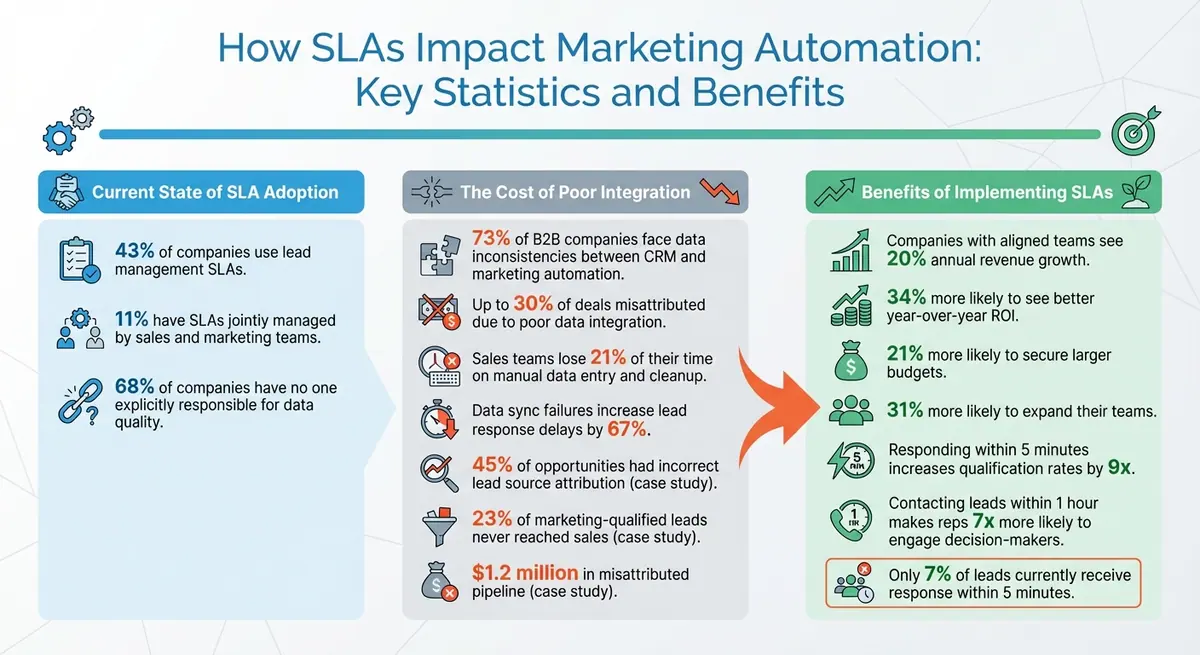
How SLAs Impact Marketing Automation: Key Statistics and Benefits
How to Use SLAs for Sales Teams | Strategic HubSpot Tutorial
sbb-itb-5f36581
Common Problems in Marketing Automation Integrations
Marketing automation integrations are often touted as a way to streamline data flow between systems, but the reality is far messier. According to research, 73% of B2B companies face challenges with data inconsistencies between their CRM and marketing automation platforms. These inconsistencies don’t just cause headaches - they directly affect revenue. For instance, companies with poor data integration might see up to 30% of deals misattributed, while sales teams can lose 21% of their time on manual data entry and cleanup.
Data sync failures also have a major impact on lead response times, increasing delays by 67%. Timing is everything in lead management - responding to a lead within five minutes is 21 times more effective than waiting 30 minutes. Yet, technical issues often mean a qualified lead might fill out a form, only to get stuck in a sync queue for hours - or worse, never make it to the sales team. These technical hurdles often lead to larger problems involving team coordination and vendor relationships.
Data Synchronization and Accuracy Issues
Data synchronization problems are often rooted in system incompatibilities. For instance, field mapping errors can occur when a Salesforce picklist is mapped to a HubSpot open text property, leading to sync failures or lost data. Similarly, duplicate record rules can clash - while HubSpot allows only one contact per email, Salesforce permits multiple records for the same email address.
Other challenges include API rate limits and sync delays. Salesforce, for example, caps API calls at 15,000–100,000 per day, which can disrupt data flow during high-demand periods like SDR prospecting. Sync latency, with intervals ranging from 5 to 15 minutes, can further slow operations. Large data imports can also clog the system, creating backlogs that take hours - or even days - to clear.
CRM validation rules add another layer of complexity. Custom logic or mandatory fields, such as requiring a "State" or "Industry" field, can block new lead data from syncing properly. In one case study from 2024, a 500-employee B2B SaaS company discovered that 45% of opportunities had incorrect lead source attribution, and 23% of marketing-qualified leads never reached sales. The result? $1.2 million in misattributed pipeline. These issues are often amplified by a lack of clear operational ownership.
Unclear Expectations Between Teams and Vendors
Technical issues are only part of the problem - organizational misalignments can make things worse. In 68% of companies, no one is explicitly responsible for data quality, which allows critical issues to go unresolved. Marketing teams often manage the automation platform, while sales oversees the CRM, leaving no clear owner for the integration itself. Without someone accountable, sync errors can persist for weeks.
Vendors often promise smooth integrations, but businesses frequently encounter problems like halted lead creation or corrupted data due to mismatched field rules or API settings. Poor change management can magnify these issues. For example, if a marketing team adds a new field without alerting the CRM admin, the entire synchronization process can break overnight. Without clear handoff protocols - such as agreed-upon qualification criteria, lead assignment rules, or follow-up timelines - misalignment between sales and marketing can increase by 43%, as conflicting data between platforms undermines collaboration.
How SLAs Set Standards for Integration Performance
Once integration challenges are identified, Service Level Agreements (SLAs) help turn these hurdles into measurable targets. Essentially, SLAs take vague assurances and turn them into specific, trackable commitments. As Jon Englund from Pipeline CRM explains:
SLAs define the 'what' and 'who,' while KPIs measure the 'how well'.
Interestingly, only 43% of companies have lead management SLAs in place, and even fewer - just 11% - have agreements jointly managed by sales and marketing teams. Yet, the benefits are clear: businesses with SLAs are 34% more likely to see better year-over-year ROI and 21% more likely to secure larger budgets. By clearly defining roles and expectations, SLAs not only help streamline processes but also contribute to measurable improvements in both financial performance and resource allocation. For example, instead of a vague goal like "leads should sync quickly", using integrated form builders to ensure data consistency, SLAs set clear, quantifiable benchmarks for teams and vendors to follow.
Key SLA Metrics for Marketing Automation Integrations
SLAs for marketing automation integrations typically measure both technical performance and business outcomes. On the technical side, key metrics include:
- Sync latency: Tracks how quickly data moves between systems, with a target of keeping the 95th percentile latency under five minutes.
- Uptime: Measured in terms of reliability, often expressed as "nines" (e.g., 99.99% or higher) to ensure systems remain operational.
- Mean Time to Recovery (MTTR): Specifies how quickly teams must address and resolve sync failures or API errors.
For business processes, the focus shifts to lead management and qualification. Metrics include:
- Speed-to-lead: Measures the time from form submission to first contact, with one hour being a common benchmark. Studies show that contacting leads within an hour makes sales reps nearly seven times more likely to engage decision-makers. However, only 7% of leads currently receive a response within five minutes.
- Lead acceptance time: Often set at a maximum of eight hours.
- Follow-up depth: Tracks how many attempts are made to contact a lead, with six or more attempts being a common standard before marking a lead as unresponsive.
- Identity match rate: Measures the percentage of records successfully unified into a single "golden record" across systems.
By setting these metrics, SLAs establish clear expectations and accountability for both technical performance and lead management processes.
Defining Responsibilities Through SLAs
SLAs don’t just outline metrics - they also assign clear responsibilities to specific teams. For instance, Marketing Operations might oversee campaign tagging and attribution, while Sales Development is responsible for responding to leads within the agreed timeframe. These agreements also specify who handles what tasks, including backup personnel in case someone is unavailable.
SLAs go a step further by addressing what happens when targets aren’t met. They define escalation processes and remediation plans, detailing the steps and assigning responsibility for resolving issues. For example, if a sales rep fails to accept or reject a lead within the agreed time, the SLA might trigger automatic rerouting to another rep or return the lead to marketing for further nurturing. This level of clarity helps avoid delays and miscommunication. As New Breed Revenue explains:
SLAs translate marketing and sales expectations into quantitative goals. This takes the emotion out of the collaboration and reduces uncertainty.
Maintaining Lead Data Quality with SLAs
SLAs play a key role in keeping lead data accurate and reliable during integrations. Without clear guidelines, lead data can quickly become messy - riddled with inconsistencies, missing details, or outright errors. By setting clear benchmarks, SLAs ensure that every lead meets specific standards for accuracy and completeness. Let’s break down how SLAs help standardize data validation and align scoring models.
Data Validation and Enrichment Standards
One of the first steps to maintaining good lead data is setting clear rules for what qualifies as valid before it enters your CRM. For instance, an SLA might require that all leads go through email validation and include essential details like company size, industry, or job title to increase lead conversions before being passed to the sales team.
Tools like Reform make this process smoother by integrating email validation and spam prevention directly into form submissions. By catching low-quality data at the source, you reduce the risk of bad data spreading across your systems. Once validated, SLAs also ensure that lead scoring follows a consistent process, with accurate field mapping across platforms.
Aligning Lead Scoring and Field Mapping
SLAs don’t just stop at validation - they also align lead scoring and field mapping to avoid premature or mismanaged lead transfers. Without this alignment, leads can either be handed off to sales too early or, worse, slip through the cracks entirely.
To solve these issues, SLAs establish a unified numeric lead score that reflects both how well a prospect fits your target profile and their likelihood to make a purchase. This score determines when a lead is ready to move forward. SLAs also require sales teams to update key CRM fields - like estimated deal size and expected close date - when advancing leads to Sales Qualified Lead (SQL) status. Additionally, they define recycling criteria for stalled leads, ensuring they’re sent back to marketing for further nurturing if needed.
For companies just starting out or lacking historical data, a 1.5% Lead-to-Revenue conversion rate is a good initial benchmark. Regular review meetings - every 3–4 weeks at first, then quarterly as the process stabilizes - help fine-tune these standards over time.
Holding Vendors Accountable for Integration Reliability
Making sure vendors stick to their SLA commitments is non-negotiable. SLAs turn vague promises into measurable, enforceable terms, giving you the leverage you need when things go south. Without these agreements, you're left relying on goodwill - a risky approach. Let’s break down the technical commitments vendors must uphold.
Vendor Uptime and Support Commitments
Uptime guarantees are at the heart of integration SLAs. Vendors often promise availability in terms of "nines." For example, 99.9% uptime allows for about 43 minutes of downtime per month, whereas 99.99% uptime cuts that down to just 4.3 minutes. That difference can be huge if you're handling thousands of leads daily.
SLAs should also include error rate thresholds - for instance, downtime might be defined as server errors (HTTP 5xx responses) exceeding 10% during a five-minute window. Alongside this, vendors must commit to clear response and resolution times. For critical issues, like a complete integration failure, acknowledgment should happen within an hour, with continuous effort to resolve the issue until it’s fixed.
Financial penalties keep vendors accountable. For example, Google Cloud’s Application Integration SLA offers a 10% credit if uptime falls between 99% and 99.9%, scaling up to a 50% credit for uptime below 95%. Some agreements even allow termination if SLA targets are missed for three straight months.
Tracking Integration Health Through SLA Monitoring
Once support commitments are in place, monitoring ensures reliability over time. Automated monitoring tools provide real-time updates on system health and send alerts whenever performance dips below agreed thresholds. Switching from manual tracking (like spreadsheets) to automated solutions can cut reporting errors by 47% and save around 15 hours per week.
Vendors should also provide monthly SLA reports that cover key metrics like API success rates, form submission uploads, and data sync completion times. For additional transparency, some vendors maintain public status dashboards that display real-time system performance.
To maintain accountability, use weekly scorecards that outline any SLA breaches, assign responsibility, and list corrective actions. If issues persist, conduct a root cause analysis to figure out whether the problem stems from resource shortages, process inefficiencies, or unrealistic expectations.
Scaling Marketing Integrations with SLA Frameworks
When lead volumes grow, under-prepared systems can buckle under the pressure. Service Level Agreements (SLAs) play a critical role in preventing such breakdowns by setting clear performance expectations. These include response times, resource allocation, and processing capacity - helping teams stay ahead of potential issues. Let’s dive into actionable strategies to scale integrations effectively while maintaining performance.
Handling Higher Lead Volumes
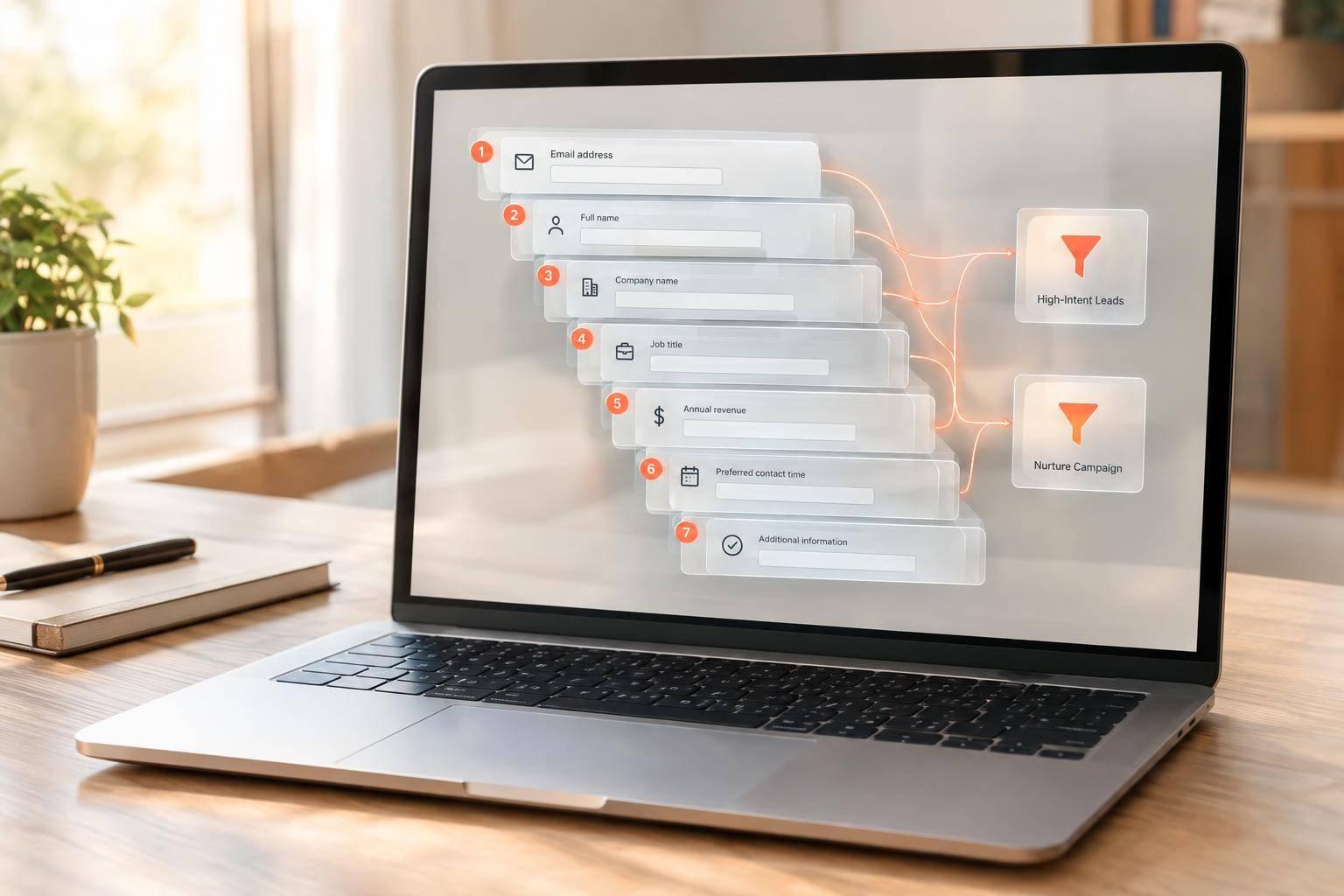
Not all leads are created equal, and treating them as such can lead to inefficiencies. Tiered SLAs help prioritize high-value leads, ensuring they receive faster attention - like contacting top-tier leads within 3 minutes, compared to 15 minutes for lower-priority ones. This segmentation helps teams focus on what matters most while avoiding burnout. Using multi-step forms instead of static ones can further reduce friction during the initial lead capture phase.
Managing thousands of leads manually is impractical. Automated systems guided by SLA rules simplify the process. For instance, 360Learning reduced response times to under 10 minutes, achieved 97% routing accuracy, and increased conversions by 40%. Shutterstock took it a step further by implementing an automated distribution engine for multi-language, skill-based routing across 20 countries, saving 60 hours of manual work per week.
"SLA policies aren't about control - they're about creating predictable rhythm." - Toms Krauklis, RevOps & Customer Success, NC Squared
Smart systems can also allocate leads based on real-time variables like agent availability, workload, and time zones. Aetna used SLA-driven case routing to assign leads based on product type, region, and agent capacity, reclaiming 8 hours daily that were previously lost to manual tasks.
To keep integrations running smoothly, monitoring the right metrics is essential. Key indicators include Queue Depth (pending tasks), Execution Time per step, and API Response Time. Average values often mask issues, so tracking the P95 percentile - the slowest 5% of cases - can highlight where performance starts to degrade. Notably, companies that contact leads within an hour are nearly seven times more likely to qualify them compared to those waiting 24 hours or more.
By prioritizing leads through tiered SLAs and monitoring performance metrics, teams can handle growing volumes without sacrificing efficiency. And as lead dynamics shift, SLAs must evolve to keep pace.
Updating SLAs as Business Needs Change
SLAs aren’t one-and-done documents - they need to adapt to shifting business goals, new product launches, and market trends. Regular reviews, ideally quarterly or when lead volumes spike, ensure targets remain realistic. Without these updates, SLAs can quickly become outdated and ineffective.
Take Vodafone UK as an example. By standardizing workflows and approval systems, they cut campaign launch times by 40% and improved compliance from 76% to 98%. This success came from treating SLAs as dynamic frameworks that evolve alongside the business.
Feedback loops are key to refining SLAs. For example, requiring disposition codes for rejected leads provides marketing teams with insights into why leads are declined. This data can improve lead scoring and qualification criteria as volumes grow.
Here’s a breakdown of how often SLAs should be reviewed and what to focus on:
| Update Frequency | Focus Area | Key Action |
|---|---|---|
| Weekly | Compliance | Check breach reports and address issues flagged by automated alerts |
| Monthly | Performance | Analyze lead rejection data and refine scoring thresholds |
| Quarterly | Strategy | Adjust targets to align with new product launches, market changes, or budget shifts |
Companies with well-developed marketing operations see 25% higher revenue growth than those with less mature systems. This growth stems from using SLAs not as rigid rules but as tools that grow with the business, ensuring long-term scalability and success.
How to Implement SLAs for Marketing Automation
SLAs should act as flexible frameworks that bring teams together while ensuring seamless integration. Start by defining measurable goals and plan for regular reviews to adapt as circumstances evolve.
Setting KPIs for Integration Performance
KPIs are essential for turning broad goals into specific, actionable targets. A common starting point is Speed-to-Lead, which tracks the time from MQL creation to first contact. For high-priority leads, the goal is typically contact within 15 minutes, while standard leads should be reached within 2 hours.
Another critical metric is data quality. The MQL Accept Rate - the percentage of leads that sales accepts - should ideally fall between 70% and 90%. If it dips below this range, it’s a sign that marketing and sales may not be aligned on what constitutes a qualified lead. To address this, require a 100% submission rate for reason codes on all rejected leads. This feedback helps fine-tune lead scoring models over time.
For monitoring integration health, focus on system uptime (aim for 99.9% or higher), data synchronization speed, and error rates. Another important KPI is the Booked Meeting Rate, calculated by dividing the number of meetings booked by the number of accepted MQLs. A healthy range is between 30% and 60%. Notably, companies with active SLAs are 34% more likely to achieve better year-over-year ROI compared to those without one.
"SLAs define the 'what' and 'who,' while KPIs measure the 'how well.' Together, they ensure alignment, accountability, and measurable success." – Jon Englund, Pipeline CRM
To ensure accountability, use tools like automated alerts, CRM timers, and required fields to flag SLA breaches in real time. For instance, if a lead isn’t acted on within the 24-hour acceptance window, the system should escalate it automatically. This removes guesswork and helps maintain focus without the need for constant supervision. Regularly reviewing these metrics ensures your SLAs stay aligned with your integration needs.
Creating Regular SLA Review Cycles
Once KPIs are established, it’s crucial to schedule regular SLA reviews to address gaps and adjust targets. Start with weekly reviews in the early stages to quickly identify and resolve issues. As the process matures, shift to quarterly strategic reviews. These sessions should include leadership from Marketing, Sales, and RevOps to evaluate trends and adjust goals based on factors like territory shifts, product launches, or market changes.
Weekly reviews should focus on operational metrics - tracking SLA breaches, lead velocity, and immediate fixes. Sharing a weekly scorecard or breach report fosters transparency and keeps everyone informed. Quarterly reviews, on the other hand, provide a chance to reassess broader strategies. For example, teams can evaluate whether MQL definitions align with sales requirements, whether lead scoring models need updates, and if the integration can support future growth.
These review meetings should involve all relevant stakeholders to ensure alignment. When teams analyze the same data and collaborate to identify root causes - without assigning blame - they can address systemic issues before they escalate.
Organizations with SLAs are also 21% more likely to secure larger budgets and 31% more likely to expand their teams. Regular reviews not only validate the effectiveness of your system but also make a strong case for investing in better tools, additional staff, and process enhancements.
Conclusion
SLAs (Service Level Agreements) play a key role in turning chaotic marketing automation integrations into dependable, scalable systems. They close interdepartmental gaps by establishing clear, measurable metrics that everyone can be held accountable for. Companies with active SLAs often see higher ROI and faster annual revenue growth. Despite this, only 43% of companies have lead management SLAs, and a mere 11% have agreements that are jointly managed. This gap presents a huge opportunity for businesses ready to adopt structured integration strategies.
"SLAs turn handoff friction into alignment and trust, giving GTM leaders confidence that every team is pulling in the same direction." – Sam Magnuson, AccountAim
A well-crafted SLA can eliminate the "black hole" where leads disappear between systems. By standardizing lead qualification processes and automating follow-ups, SLAs ensure sales teams spend their time on high-value prospects. Companies with SLAs are also 21% more likely to secure larger budgets and 31% more likely to expand their teams.
SLAs should be treated as living documents. Regular updates, clear plans for addressing issues, and real-time monitoring keep integrations aligned with shifting market demands and business goals. When marketing automation integrations are guided by thoughtfully designed SLAs, teams can focus less on resolving friction and more on generating revenue.
FAQs
What should an integration SLA include?
An integration SLA is all about setting clear, measurable promises to keep your marketing automation running smoothly. The key components to focus on are:
- Response times: How quickly issues or requests will be addressed.
- Data accuracy: Ensuring the information exchanged is correct and reliable.
- System availability: Guaranteeing the system is up and running when you need it.
- Performance indicators: Tracking metrics to measure how well the integration is functioning.
These elements work together to create a dependable and efficient system.
Which SLA metrics matter most for lead handoffs?
When it comes to lead handoffs, two key metrics stand out: response time and lead quality.
- Response Time: This refers to how quickly a lead is addressed after being handed off. For example, responding within 5 minutes can make a huge difference in engaging potential customers while they're still interested.
- Lead Quality: Ensuring leads are properly scored and qualified before handoff is equally important. This helps teams focus on prospects with the highest potential, streamlining follow-ups and boosting efficiency.
By focusing on these metrics, businesses can improve both the speed and precision of their lead management process.
How do you enforce SLAs with vendors and internal teams?
To make sure SLAs are followed, start by setting clear, measurable goals - things like response times, deadlines, and follow-up steps should all be defined in the SLA. Use tools such as queues, alerts, timers, and mandatory fields in your CRM or workflow systems to help everyone stay on track. Regularly share scorecards that include breach reports to monitor compliance. During leadership reviews, focus on identifying and resolving root causes to keep teams accountable and improve processes over time.
Related Blog Posts
Get new content delivered straight to your inbox

The Response
Updates on the Reform platform, insights on optimizing conversion rates, and tips to craft forms that convert.


Drive real results with form optimizations
Tested across hundreds of experiments, our strategies deliver a 215% lift in qualified leads for B2B and SaaS companies.
