
.webp)
AI Demographics for Lead Segmentation



AI is transforming how businesses identify and target their audiences. Instead of relying on broad categories like age or gender, AI combines detailed demographic and behavioral data to create precise, actionable customer profiles. This approach helps marketers craft campaigns that resonate, improve lead form conversion rates, and drive higher revenue.
Key takeaways:
- AI refines segmentation: Groups leads using dynamic data like income, location, and behavior.
- Better targeting: Predicts lead actions (e.g., purchase likelihood) and adjusts campaigns in real time.
- Privacy-compliant methods: Adheres to US regulations and prioritizes ethical data use.
- Proven results: Businesses using AI-driven segmentation see up to 40% higher revenue and 2.9x ROI compared to traditional methods.
Core Components of AI-Driven Demographic Segmentation
Key Demographic Attributes Used in AI Models
AI segmentation models go far beyond the basics of age and gender. They integrate a wide range of attributes to create a detailed profile of each lead. For U.S. audiences, the most impactful attributes fall into several key categories:
| Demographic Category | Key US Attributes | AI Application |
|---|---|---|
| Individual | Age brackets, gender, ethnicity | Grouping leads into generational cohorts (e.g., Gen Z, Millennials) for tailored tone and creative strategies |
| Economic | Household income (USD), education level | Estimating purchasing power and gauging price sensitivity |
| Geographic | ZIP code, metro area, urban vs. rural | Customizing offers and directing leads to regional sales teams |
| Household | Parental status, homeownership, marital status | Spotting high-spending life stages like new parenthood or first-time homeownership |
| Professional | Job title, company size, industry | Prioritizing B2B leads between SMBs and enterprise accounts for targeted marketing efforts |
One critical insight: multicultural audiences now make up 40% of the U.S. population and are growing at a faster pace than the general market. Overlooking ethnicity and cultural context in segmentation means missing out on a substantial and expanding audience.
By analyzing these diverse data points, AI can reveal patterns that traditional methods often miss, leading to more precise and actionable segmentation.
How AI Processes Demographic Data
AI excels at spotting patterns across multiple attributes by analyzing historical CRM and transaction data. It scores leads using real-time enrichment and groups them into behavioral clusters using a method called clustering. This approach organizes leads based on shared behaviors tied to conversions, even when those behaviors don’t fit neatly into traditional demographic categories. The result? AI-driven campaigns see 41% higher conversion rates, as they uncover high-value clusters that manual analysis often overlooks.
"The algorithm is only as smart as the data you give it." - Knowledge Hub Media
To get the most out of AI, businesses need to feed it high-quality first-party data, such as CRM records, purchase histories, and form submissions. To maximize data quality, businesses often use expert form strategies to capture and qualify leads effectively. This data acts as a "seed", teaching the AI to recognize what a high-value customer looks like. On the flip side, poor-quality or incomplete data will lead to weak segmentation, regardless of the AI’s sophistication. This transformation of raw demographic data into actionable insights is what drives better lead targeting and conversion.
Real-Time and Predictive Segmentation
Static segmentation is a thing of the past. AI takes pattern detection to the next level by continuously updating segments as lead behaviors change. Dynamic segmentation ensures that leads who lose interest are immediately removed from high-priority targeting tracks.
Predictive segmentation goes even further. Instead of just describing a lead's current profile, it anticipates their next move - whether they’re likely to churn, upgrade, or enter a high-spend phase. Among marketers using AI, 41% already leverage predicted behaviors for segmentation, compared to just 30% of those without AI tools.
AI uses a 3x3 matrix to cross-reference demographic fit (High/Medium/Low) with behavioral signals (Hot/Warm/Cold). For example:
- A "High-fit/Hot" lead might get personalized 1:1 sales outreach.
- A "Low-fit/Cold" lead could be deprioritized or excluded, saving your budget from unnecessary spend.
This dynamic and predictive capability ensures that your segmentation strategy stays relevant and cost-effective, adapting to both current and future lead behaviors.
sbb-itb-5f36581
Data Collection and Sources for AI Demographic Profiling
Reliable Data Sources for US Demographics
When it comes to accurate segmentation, starting with reliable data is key. Trusted sources like the U.S. Census Bureau are a cornerstone. For instance, the American Community Survey (ACS) provides annual updates on social and economic characteristics. As of the 2024 ACS 1-year estimates, the median U.S. household income stands at $81,604, and 36.8% of adults aged 25 and older hold a bachelor's degree or higher. These numbers are vital benchmarks for calibrating AI models, especially when assessing purchasing power and education trends.
But government data alone doesn’t cover everything. Commercial platforms like Claritas and Adentity add depth by combining Census data with behavioral and lifestyle insights. Adentity, for example, manages over 280 million verified consumer profiles across 500+ data fields. Claritas, on the other hand, uses over 10,000 demographic and behavioral indicators to define consumer groups. Here's a quick comparison of where these sources shine:
| Source Type | Best For | Update Frequency | Cost |
|---|---|---|---|
| U.S. Census Bureau (ACS) | Benchmarking and geographic modeling | Annual | Free |
| Decennial Census | Population-level counts | Every 10 years | Free |
| Commercial platforms | Lead scoring and behavioral targeting | Real-time or monthly | Subscription |
If your team plans to use Census data programmatically, note that the Census Data API now requires a personal API key for detailed queries. Setting this up early can save time, especially when pulling ZIP code or census tract-level data.
By combining these data sources with well-structured collection methods, you can ensure your AI model has a robust foundation for demographic profiling.
Using Forms to Capture Demographic Data
Forms are a direct way to gather first-party demographic data, but they come with a challenge: forms with demographic fields typically have a 9% view-to-completion rate. The more fields you add, the more likely users are to abandon them.
The best strategy? Only ask for what you’ll actually use. As OrbitForms explains:
"The core principle is simple: every question you add to a form must have a clear purpose. If the data won't directly influence your marketing, sales, or product strategy, it's often better to leave it out." – OrbitForms
For sensitive questions like income or gender, small tweaks can make a big difference. For example:
- Use age brackets (e.g., 25–34) instead of asking for exact birth dates.
- Include a "Prefer not to say" option for income-related fields.
- Utilize hidden fields to capture backend data, like geographic routing, without cluttering the form visually.
Forms can also pick up indirect signals - things like how long users spend on a specific step, where they abandon the form, or how they navigate conditional paths. These signals enrich the demographic data feeding into your AI model.
Improving Data Quality with Reform
Collecting data is just the first step; keeping it accurate is the real challenge. That’s where tools like Reform come into play. Reform combines email validation, lead enrichment, and multi-step design to ensure clean, actionable data.
For example, Reform appends firmographic and demographic data instantly after a form submission, avoiding delays from batch updates. This is especially useful for B2B leads - where a verified business email can immediately provide details like industry, company size, and revenue. Without this, you’d likely need a separate qualification call.
Reform’s setup is straightforward: connect an enrichment provider at the team level and map specific fields to form blocks. This gives you control over what data gets appended and how it flows into your CRM. It also includes email validation to catch typos, disposable addresses, and invalid domains before they clutter your system. Pair this with multi-step forms, which break longer questionnaires into smaller, more manageable screens, and you’ll see higher completion rates without sacrificing data quality.
The result? Cleaner, more reliable data that strengthens your AI model’s segmentation capabilities. This ensures your efforts are built on a dependable and accurate foundation.
How to Use AI Demographics in Lead Generation
Designing Form Flows for AI Segmentation
Crafting effective form flows is all about collecting the right data at the right time, which is key to powering AI-driven segmentation. With Reform's multi-step form templates, you can start with simple, low-barrier questions - like asking about job role or industry. Using conditional routing, you can then dive deeper, asking more specific demographic questions only when earlier responses make it relevant. Additionally, hidden fields can enrich the data automatically, pulling in details like company revenue or tech stack without overwhelming users with extra fields. This keeps your forms clean and efficient. Reform's "Shorten Forms" feature (available on the Pro plan for $35/month) takes it a step further by dynamically hiding fields when AI enrichment already provides the data. If the enrichment doesn’t succeed, it falls back to manual input.
With this streamlined approach, you can collect enriched data while keeping the user experience smooth. These enhanced segments then become the foundation for targeted campaigns.
Using Demographic Segments in Campaign Execution
Once you've gathered enriched demographic data, the next step is putting it to work in your marketing campaigns. One practical tool for this is the 3x3 segmentation matrix, which pairs demographic fit (high, medium, or low) with behavioral signals (hot, warm, or cold):
| Demographic Fit | Behavioral Signal | Recommended Action |
|---|---|---|
| High | Hot | 1:1 sales outreach, personalized landing page, exec sponsor |
| High | Warm | 1:few personalization (5–20 accounts), coordinated BDR cadence |
| High | Cold | Quarterly nurture, surface to sales when new signals emerge |
| Medium | Any | Inside-sales territory, light industry-level personalization |
| Low | Any | Generic content, organic engagement only |
This matrix ensures that your high-value prospects get immediate, personalized attention while avoiding wasted effort on low-fit leads. By integrating behavioral insights with demographic data, you can prioritize leads more effectively. As Abmatic AI explains, "Demographics alone are too noisy; behavior alone is missing context." In most cases, demographics contribute around 30% to 40% of lead scoring, while behavioral data accounts for 60% to 70%. Ignoring behavioral data can lead to a loss of up to 80% of actionable insights.
Tracking Performance by Demographic Segment
Once your campaigns are rolling, continuous tracking is critical to fine-tune your strategy. Understanding which segments convert helps you make smarter decisions. Reform's real-time analytics make it easy to monitor form performance at the segment level as submissions come in. This is particularly important because demographic and behavioral trends can shift quickly, so refreshing segments at least weekly is a good practice. Instead of relying solely on overall figures, track metrics like conversion rates and ROI by specific demographic segments. This granular view helps you identify which profiles deserve more attention and provides valuable feedback to improve your AI segmentation models over time.
Ethical and Regulatory Considerations for AI Demographic Profiling
US Regulations on Demographic Targeting
The use of AI for demographic segmentation involves navigating a complex mix of technical and legal considerations. Staying compliant with federal regulations is essential to ensure AI-driven lead segmentation is both effective and lawful.
Executive Order 14110, signed on October 30, 2023, introduced a government-wide framework to ensure AI systems adhere to federal civil rights laws. This order focuses on combating discrimination in areas like housing, healthcare, and financial services. It also mandates the use of privacy-enhancing technologies (PETs) to minimize risks tied to improper data handling. President Biden emphasized the importance of this framework, stating:
"My Administration cannot - and will not - tolerate the use of AI to disadvantage those who are already too often denied equal opportunity and justice."
Additionally, the Federal Communications Commission (FCC) has implemented digital discrimination rules, effective March 22, 2024. These rules prohibit policies or practices that disproportionately affect consumers based on income, race, ethnicity, color, religion, or national origin - unless such practices are justified by genuine technical or economic constraints.
AI systems used in lead generation must also align with the Blueprint for an AI Bill of Rights and the AI Risk Management Framework. These guidelines emphasize transparency, bias prevention, and consumer protection. A key recommendation is to perform AI red-teaming - structured adversarial testing - before deploying any demographic segmentation model. This approach helps identify and address discriminatory outputs early, ensuring compliance and ethical integrity in lead segmentation strategies.
Ethical Use of Ethnic and Cultural Data
Adhering to ethical standards is just as important as legal compliance when using AI for demographic profiling. Under the Fair Housing Act, liability can arise even without discriminatory intent - demonstratory effects alone are sufficient.
"Under the Fair Housing Act, discriminatory intent is not required for a violation. Discriminatory effects are enough." - Tami Siewruk, Multifamily NEXT
In April 2024, the Department of Housing and Urban Development (HUD) issued guidance on how platform delivery algorithms can steer ads toward or away from protected groups. This followed a 2022 settlement with Meta, which required the company to overhaul its housing ad delivery algorithms after they were found to discriminate based on protected characteristics.
To avoid ethical and legal pitfalls, steer clear of practices like ZIP code targeting for housing, employment, or credit ads - this is prohibited in both the US and Canada, as ZIP codes can act as proxies for race. Similarly, avoid creating mirror or lookalike audiences from data skewed toward a particular racial group, as this can amplify existing biases. Following these guidelines not only reduces legal risks but also enhances audience targeting for more effective campaigns.
Privacy-by-Design Practices
Incorporating privacy into your systems from the outset is one of the most reliable ways to ensure ethical demographic profiling. Here are some best practices:
- Data Minimization: Use multi-step lead gen forms to collect sensitive demographic data only when absolutely necessary. Never repurpose this data for ad targeting without explicit consent.
- Probabilistic Estimation: Use probabilistic methods instead of categorical labels. For instance, LinkedIn’s Privacy-Preserving Probabilistic Race/Ethnicity Estimation (PPRE) method combines Bayesian Improved Surname Geocoding, secure two-party computation (2PC), and differential privacy. This approach measures AI fairness without storing sensitive data in plaintext.
"Data justice asserts that people have a right to choose if, when, how, under what circumstances, and to what ends they are represented in a dataset." - Eliza McCullough, Partnership on AI
Consent practices are evolving too. Advertisers must now ensure clear, ongoing opt-ins rather than relying on hidden checkboxes. Starting in Q2 2026, detecting Global Privacy Control (GPC) signals at page load has become a near-mandatory requirement for advertisers under California's CPRA. This involves suppressing data collection for advertising purposes until explicit consent is given. The California Privacy Protection Agency has provided a six-month grace period beginning in April 2026, with enforcement set to start in October 2026. If your business collects demographic data from California residents, meeting this deadline is critical.
AI-powered customer segmentation:Stop Guessing Your Audience - Use AI Instead
Measuring and Improving AI Demographic Segmentation
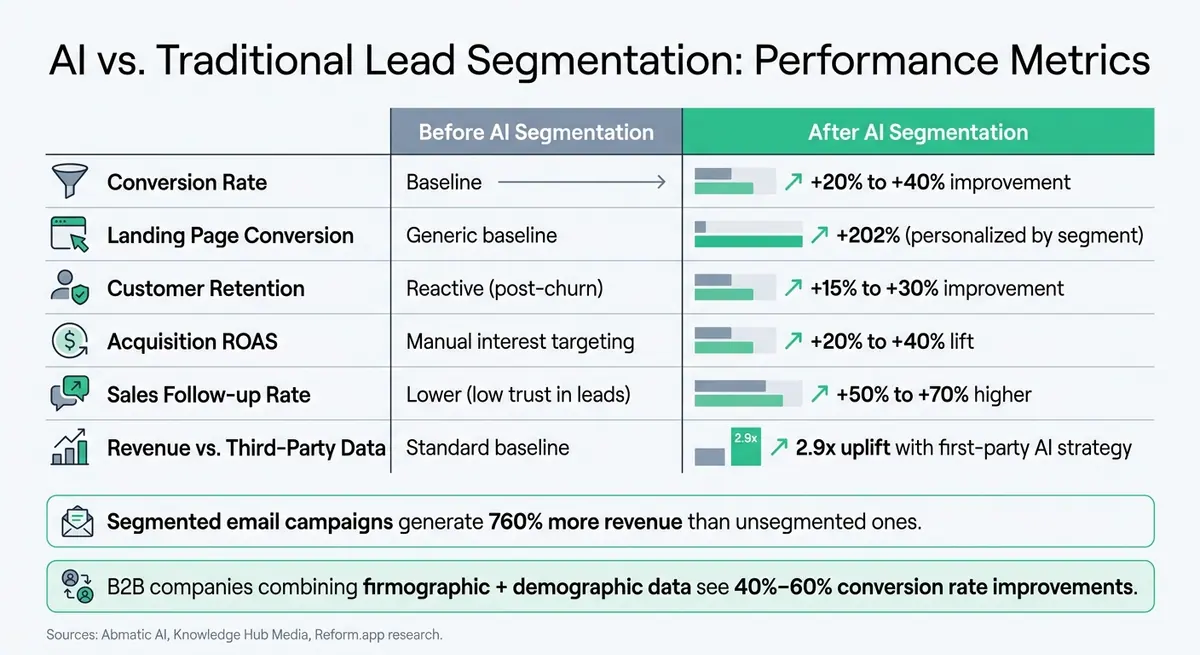
AI vs. Traditional Lead Segmentation: Performance Metrics
When it comes to AI-driven segmentation, tracking performance is the key to making informed adjustments and achieving better results.
Key Metrics for Measuring Segment Performance
To evaluate how well your AI segmentation is working, focus on metrics that matter. Financial indicators like Cost Per Lead (CPL), Return on Ad Spend (ROAS), and Revenue per Customer (LTV) give you a clear sense of whether your segments are delivering leads that justify the investment.
But don’t stop at financial data. Look at conversion rates for each demographic segment and keep an eye out for false positives (low-quality leads that seem promising) and false negatives (high-quality leads that are overlooked). These missteps highlight where your model needs fine-tuning. Additionally, metrics such as form completion rates and email click-through rates by segment can reveal where potential customers lose interest before they even reach your sales team.
Once these metrics are in place, you can focus on refining your segmentation model to drive consistent growth.
How to Improve Segmentation Models Over Time
Regular calibration is essential. Adjust your model monthly to ensure AI scores align with actual closed deals. If your "high-fit" segments aren’t converting, it’s a clear sign the model needs retraining.
A/B testing can be a powerful tool here. By experimenting with different messaging strategies for each demographic segment, you can uncover what resonates most. Combine these tests with the 3x3 matrix framework mentioned earlier to create tailored messaging tracks, each designed with specific ROI expectations in mind.
"Demographics alone are too noisy; behavior alone is missing context. The 2026 segmentation stack uses demographics as the framing layer and behavior as the signal layer." - Abmatic AI
Keep your data fresh. Update segments weekly and refresh firmographic data quarterly for active prospects. For high-priority accounts, consider monthly updates. Outdated profiles can waste up to 30% of outreach efforts. Treat recency as a critical factor - a lead that showed interest a week ago will behave very differently from one that’s been inactive for three months.
Performance Before and After AI Segmentation
Consistently refining your segmentation model not only improves individual metrics but also drives impressive overall performance gains. For instance, segmented email campaigns can generate 760% more revenue compared to unsegmented ones. The table below highlights the typical improvements businesses experience after implementing AI segmentation:
| Metric | Before AI Segmentation | After AI Segmentation |
|---|---|---|
| Conversion Rate | Baseline | +20% to +40% |
| Landing Page Conversion | Generic page baseline | +202% (personalized by segment) |
| Customer Retention | Reactive (post-churn) | +15% to +30% improvement |
| Acquisition ROAS | Manual interest targeting | +20% to +40% lift |
| Sales Follow-up Rate | Lower (low trust in leads) | +50% to +70% higher |
| Revenue vs. Third-Party Data | Standard baseline | 2.9x uplift with first-party AI strategy |
For B2B companies, the combination of firmographic and demographic data can lead to conversion rate improvements of 40% to 60%, making continuous model refinement a worthwhile investment.
Conclusion: Better Lead Segmentation with AI Demographics
AI-driven demographic profiling has shifted from being a luxury to an essential tool for businesses in the US. With third-party cookies set to disappear by 2026, the ability to create accurate audience segments using first-party data has become a critical advantage. Companies that have focused on building direct relationships with their audiences and gathering demographic data through their own platforms are now better positioned than those relying on purchased lists.
As we’ve discussed, the combination of demographic and behavioral data is key. Demographics reveal who a lead is, while behavior shows what they’re ready to do. On their own, each data point is limited. Together, they provide a complete picture, creating a segmentation layer that can boost conversion rates by 40% to 60% when combining firmographic and individual demographic insights.
The process starts with capturing accurate, consent-based demographic data right at the entry point. Tools like Reform streamline this by enriching lead data as soon as a form is submitted. Their lead enrichment feature automatically appends firmographic and demographic details, reducing form fields while ensuring the data stays up-to-date. Additionally, their behavioral threat detection prevents bot submissions from skewing your segments before they even reach your CRM.
This robust data foundation directly fuels better conversion rates and revenue growth. The numbers back it up: segmented campaigns consistently outperform generic ones. For instance, personalized landing pages can achieve conversion rates up to 202% higher than generic versions, often by personalizing the page based on previous interactions, while first-party data strategies deliver a 2.9x increase in revenue compared to third-party methods. Businesses that prioritize collecting high-quality data, keeping it current, and using AI to identify valuable patterns reap these rewards.
FAQs
What first-party data do I need to start AI demographic segmentation?
To kick off AI demographic segmentation, start by collecting accurate first-party data during your lead capture process. Focus on key variables such as:
- Age range
- Household income
- Education level
- Occupation
- Location
- Housing tenure
- Household composition
If you're working in a B2B context, shift your attention to firmographics. Gather details like industry, company size, and the individual's role within the organization.
Tools like Reform make this process easier. With its high-performing forms, you can not only collect this data but also enhance it through lead enrichment. Plus, real-time CRM integration ensures your insights stay up-to-date and ready for action.
How do I combine demographics and behavior without hurting conversion rates?
To get the most out of combining demographics and behavior, start by using demographics to outline your ideal customer profile. Then, use behavior to evaluate their intent. Cross-referencing these factors in a matrix - like high-fit/hot-intent versus low-fit/cold-intent - helps you prioritize high-value leads effectively.
Tools like Reform can be invaluable here. They allow you to collect firmographic data during form submissions while ensuring consent and compliance. This approach not only keeps your data accurate but also minimizes friction, boosting your conversion rates.
How can I use demographic targeting while staying privacy- and bias-compliant in the U.S.?
When operating in the U.S., it's crucial to prioritize transparent, consent-based data collection to meet privacy standards and avoid bias. Regulations like the California Consumer Privacy Act (CCPA) emphasize minimizing data collection and clearly documenting its legal basis.
Key practices to ensure compliance include:
- Field-Level Consent Tracking: Record consent details at the field level, including the source, legal basis, and a timestamp. This helps maintain a clear audit trail.
- Regular Targeting Reviews: Continuously evaluate your targeting methods to identify and address any potential biases.
- Hidden Fields for Backend Processes: Use hidden fields to manage secure backend operations without disrupting the user experience.
By following these steps, you can create a responsible and user-friendly approach to data collection and processing.
Related Blog Posts
Get new content delivered straight to your inbox

The Response
Updates on the Reform platform, insights on optimizing conversion rates, and tips to craft forms that convert.




Drive real results with form optimizations
Tested across hundreds of experiments, our strategies deliver a 215% lift in qualified leads for B2B and SaaS companies.
