
.webp)
How AI Personalizes Lead Nurturing Content



AI is transforming lead nurturing by making it smarter, faster, and more personalized. Instead of generic, one-size-fits-all campaigns, AI uses real-time data - like website visits, email clicks, and downloads - to tailor messages for each lead. This approach boosts engagement, saves time for sales teams, and drives better results.
Key Takeaways:
- Personalized Messaging: AI crafts emails, content, and workflows based on individual lead behavior and preferences.
- Data-Driven Decisions: AI relies on demographic, behavioral, and intent data to predict the next best action.
- Efficiency Gains: Automating lead segmentation and scoring helps small teams manage thousands of leads effectively.
- Improved Metrics: Behavioral-based campaigns see click-through rates of 5–12% compared to 1% for generic emails.
- Workflow Automation: AI-powered workflows adjust dynamically to lead actions, ensuring timely and relevant communication.
AI doesn’t just improve efficiency - it creates a better experience for leads by delivering the right message at the right time. Let’s break down how it works and what you need to get started.
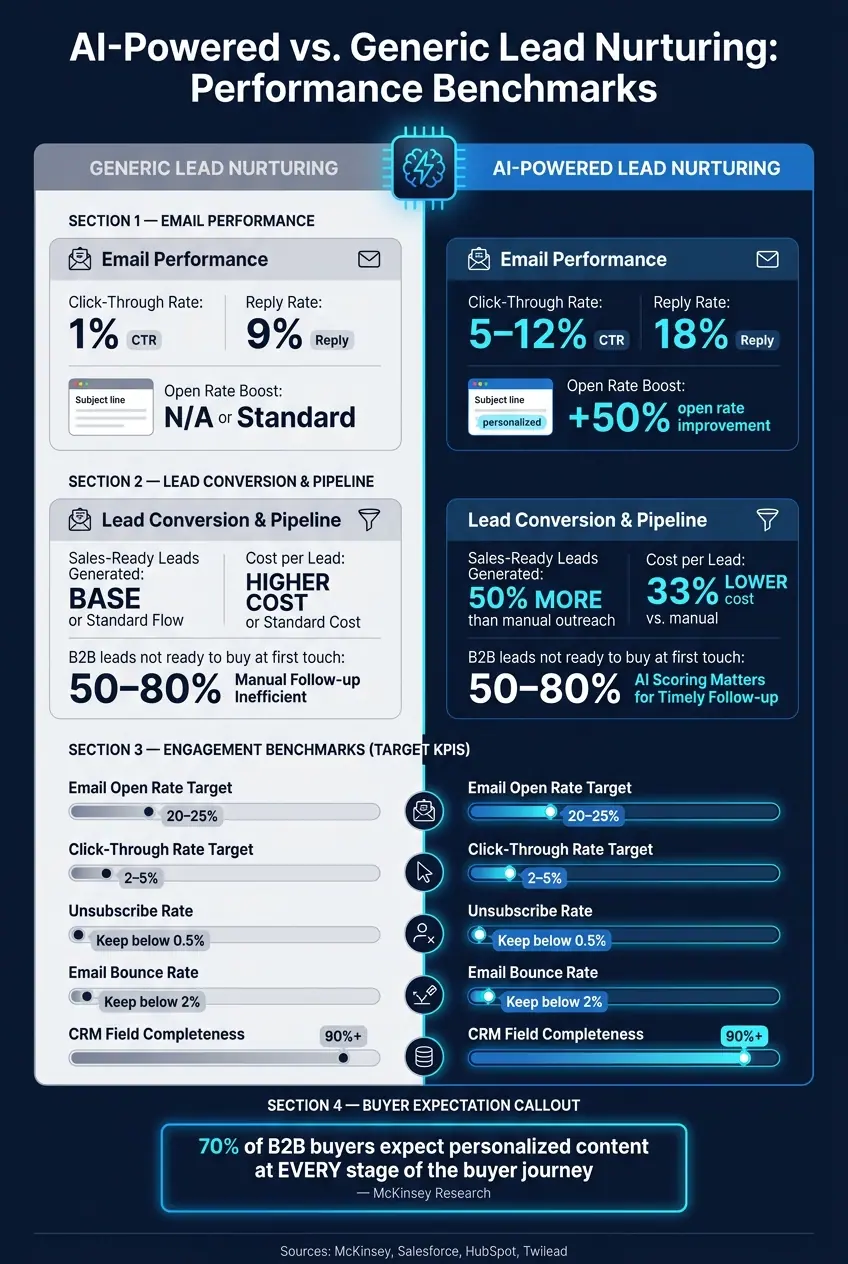
AI vs. Generic Lead Nurturing: Key Metrics & Performance Benchmarks
The Future of AI-Driven Lead Nurture: Hyper-personalized Emails
Setting Up Data Foundations for AI Personalization
Strong AI personalization relies on well-organized, integrated data. It all starts with capturing high-quality information at every interaction.
Building High-Quality Lead Data
The data collection process begins with well-designed forms. Tools like Reform allow you to create multi-step forms with conditional routing and built-in lead enrichment. This ensures the data entering your CRM is already structured and useful. Instead of using simple, static forms, switch to conditional forms (like Reform) that provide additional context for each lead.
It's also essential to distinguish leads based on both their intent and identity. For example, a lead who visits your pricing page and requests a demo has very different needs compared to someone downloading a top-of-funnel ebook. Capturing these nuances at the form level and routing them appropriately gives your AI meaningful data to work with from the start.
Integrating Data Across Systems
Consolidating your data sources is the next critical step. Fragmented data creates gaps in AI personalization. When form submissions, chat logs, and ad leads are scattered across different systems, your AI ends up with an incomplete view of each lead, which affects the quality of your messaging.
The solution? Create a single source of truth - a unified CRM record for every lead that combines data from all capture points. To do this effectively, segment leads by their capture source and intent before connecting systems. Here's a practical framework to guide you:
| Capture Source | Intent Signal | Recommended Sequence |
|---|---|---|
| Web form | Pricing page or demo request | Short sequence (5–7 days), fast handoff |
| Web form | Gated content download | Longer sequence (21–30 days), educational |
| Chat | Pricing or demo question | Very short (3–5 days), direct to sales |
| Chat | General or feature inquiry | Medium sequence (14–21 days) |
| LinkedIn/Meta ad | Demo or trial offer | Short sequence (5–7 days) |
| LinkedIn/Meta ad | Content offer | Longer sequence (21–30 days) |
Automate exit conditions to ensure leads meet specific engagement or qualification thresholds before receiving additional touches. Skipping this step can lead to awkward situations, like sending nurture emails to leads who’ve already booked a call.
Keeping Data Clean and Compliant
Maintaining clean data is an ongoing process. To keep your database in good shape, aim for 90% or more of active contacts to have all required fields completed, and ensure email bounce rates stay below 2%. If over 10% of your Sales Qualified Leads show no activity in the last 90 days, it’s a sign that your data has drifted, which can compromise your AI scoring.
"Making your HubSpot CRM data AI-ready is an implementation problem, not a philosophy problem." - Charlie Nadler, Chief Strategy Officer, Simple Machines Marketing
A few simple practices can make a big difference. Replace freeform text fields like "Industry" or "Job Title" with controlled picklists to help your AI process data consistently. Tag new records as "Pending Verification" and exclude them from scoring until they’ve been validated. Use a data health dashboard to track field completeness and identify stale records monthly. Addressing issues early prevents larger problems down the line and ensures your AI outputs remain reliable.
A well-maintained data foundation sets the stage for the AI-driven strategies that come next.
Designing AI-Driven Lead Segmentation and Workflows
Mapping the Buyer Journey
To create effective AI-driven personalization, start by defining the stages of the buyer journey. Typically, this journey includes three stages: awareness, consideration, and decision. Each stage requires tailored content that matches the lead's mindset and level of urgency.
- Awareness Stage: At this point, leads are just identifying their problem. They engage with educational materials like blog posts, how-to guides, and explainer videos.
- Consideration Stage: Here, leads are actively comparing solutions. ROI calculators, benchmarks, and in-depth case studies help them weigh their options.
- Decision Stage: Leads in this stage are ready for specifics. They want to see pricing details, demos, and evidence that your product or service works for companies like theirs.
"70% of B2B buyers now expect personalized content at every stage of the buyer journey - making role-based segmentation a baseline expectation, not a differentiator." - McKinsey Research
By setting clear personalization goals for each stage, you can avoid one of the most common pitfalls: treating all leads the same. Proper segmentation ensures your AI delivers the right message at the right time, laying the groundwork for accurate scoring and adaptive workflows.
Using AI for Segmentation and Lead Scoring
Traditional segmentation based solely on form data has its limits. AI takes things further by analyzing both explicit data (e.g., job title, industry, company size) and behavioral signals (e.g., pages visited, emails opened, time spent on the pricing page). This allows you to pinpoint where a lead truly is in their decision-making process.
This is where predictive scoring becomes invaluable. Instead of manually evaluating leads, AI assigns scores based on historical conversion trends and real-time engagement. For instance, a lead who downloads an introductory ebook gets a different score than one who repeatedly visits your pricing page and watches a product demo. These scores help determine how quickly a lead moves through your workflow - and whether it's time for a sales rep to step in.
Here’s an important insight: Between 50% and 80% of B2B leads that eventually convert aren’t ready to buy when they first interact with your brand. Predictive scoring helps you identify which leads are gradually moving toward a decision, allowing you to engage them at the ideal moment. This avoids overwhelming your audience with generic messaging and supports the creation of workflows that adapt in real time to lead behavior.
Building Nurturing Workflows That Adjust Automatically
Dynamic workflows are the next step after mapping the buyer journey and implementing predictive scoring. Unlike rigid "if-then" sequences, AI-powered workflows adjust based on a lead's behavior. For example, if a lead opens multiple emails and then visits your pricing page, the workflow should recognize this heightened interest and accelerate the sequence, rather than sticking to a pre-set 30-day drip schedule.
To make this work, define triggers based on behavior (e.g., visiting high-intent pages) and scoring thresholds (e.g., reaching a specific score). For instance:
- A demo request might trigger a short, high-priority sequence lasting 5 to 7 days, with a quick handoff to sales.
- A gated guide download could initiate a longer, educational sequence spanning 21 to 30 days.
Exit conditions are just as critical as entry triggers. Leads should automatically exit a workflow as soon as they take key actions, like replying to an email, booking a meeting, or reaching MQL status. Neglecting this step can lead to awkward moments, such as sending a "getting started" email to someone already deep in a sales conversation. When handing off leads, ensure your AI provides sales with the full context of the lead's journey so their outreach feels personal and informed.
sbb-itb-5f36581
Creating and Personalizing Content with AI
Types of Personalized Nurturing Content
Once you've established dynamic workflows and predictive scoring, the next logical step is creating content tailored to individual needs at scale. AI can personalize every aspect of an email - subject lines, openings, body text, and calls-to-action - by analyzing a lead's behavioral patterns and CRM data. It can also enhance chat interactions, allowing agents to engage visitors in real time, qualify them through natural conversations, and even schedule meetings - all without requiring a human representative. Using Retrieval-Augmented Generation (RAG), AI selects the perfect resource - whether it's a case study, webinar, or whitepaper - based on the recipient's persona and stage in the buyer's journey. This data-driven approach eliminates the guesswork, ensuring every recommendation is on point.
Using AI to Generate Content
AI combines structured prompts with live CRM data to create personalized messages. By providing details like the lead's role, intent, past interactions, and desired action, AI can draft highly tailored emails. The results speak for themselves: personalized emails achieve reply rates of 18%, compared to just 9% for generic ones, and subject line personalization can increase open rates by 50%.
"Personalization works at scale when content, data, and delivery logic share the same source of truth." - Alex Sventeckis, HubSpot
When lifecycle stages, firmographics, and behavioral signals are unified into a single data source, it becomes possible to deliver true one-to-one messaging at scale.
Keeping Brand Voice Consistent with AI
Maintaining a consistent brand voice is crucial when using AI. Start by defining your voice with 3 to 5 specific adjectives (e.g., "clear", "helpful", "direct") and include these as tone guidelines in every AI prompt. Supplement this with 3 to 5 examples of your best-performing emails to give the AI concrete patterns to emulate.
Without guidance, AI can default to generic or overly formal language. To counter this, create a banned phrase list to avoid filler text and robotic-sounding outputs. Regularly reviewing 20–50 AI-generated samples each week helps refine prompts and ensure your brand voice stays intact. A phased approach - starting in draft-only mode before transitioning to full automation - can help you build trust in the AI's output before it reaches your audience.
Measuring and Optimizing AI-Powered Lead Nurturing
Key Metrics for Measuring Success
Once your AI-powered lead nurturing system is live, tracking its performance is crucial. The most important metrics fall into three main areas: engagement, conversion, and velocity. Engagement metrics include open rates, click-through rates, and reply rates. Conversion metrics focus on the lead-to-opportunity ratio and final conversion rate. Velocity measures how quickly leads move through your sales pipeline.
For engagement, aim for open rates between 20–25% and click-through rates of 2–5%, while keeping unsubscribe rates below 0.5%. A sudden increase in unsubscribes could indicate that your cadence is too aggressive or your content is losing its relevance.
"The best lead nurturing strategies start with knowing exactly where each lead stands." - Twilead
Another essential metric is lead scoring accuracy. Compare the scores assigned by your AI system to actual conversion outcomes. If high-scoring leads aren’t converting, it’s a sign that the model needs fine-tuning. These metrics are the backbone of any effort to refine and improve your lead nurturing strategy.
Using AI for Ongoing Optimization
With these metrics in hand, AI can play a pivotal role in continuously improving your lead nurturing efforts. Every interaction updates your lead profiles and sharpens predictive models. This creates a feedback loop that moves beyond static segmentation into dynamic personalization.
A practical way to keep your system effective is to refresh performance data every 30 days. Regularly feed the AI with insights from your best- and worst-performing content to ensure it stays aligned with current audience preferences. AI can also handle large-scale multivariate testing, rapidly experimenting with subject lines, content formats, and send times far more efficiently than manual methods.
"A personalization engine without a signal-to-outcome feedback loop is static segmentation with extra steps." - Victor Hoang, Co-Founder & CMO, Rework
It’s equally important to set exit triggers. For instance, once a lead books a meeting or converts into a customer, they should automatically exit the nurture sequence. Continuing to send automated emails after conversion risks eroding trust.
Scaling Your Personalization Efforts
As your lead nurturing efforts grow, maintaining relevance becomes increasingly challenging. Scaling personalization isn’t just about adding more leads; it’s about ensuring your content stays meaningful as the audience expands. A few strategies can help:
- Avoid creating "filter bubbles" by reserving 10–20% of recommendations for adjacent categories. This approach encourages discovery and prevents stagnation. Netflix’s research on its recommendation engine revealed that engagement with new content dropped by 23% in six months without active diversity quotas.
- For critical communications like pricing or contract emails, include a human review to ensure quality and accuracy.
Automated lead nurturing already delivers impressive results, generating 50% more sales-ready leads at a 33% lower cost compared to manual outreach. The key to sustaining these benefits is to minimize errors and maintain high standards as you scale.
Conclusion: Getting the Most Out of AI in Lead Nurturing
AI-driven lead nurturing thrives when every piece of the puzzle is fine-tuned - from the quality of your data to the workflows that act on it. Companies with effective nurturing strategies see impressive results, generating 50% more sales-ready leads while cutting costs by 33%.
The key lies in combining accurate data with responsive workflows. Tools like Reform help ensure your CRM collects dependable data through features like lead enrichment, spam prevention, and email validation. With this foundation, you can provide leads with content that speaks directly to their current interests and needs.
Instead of sticking to rigid, time-based sequences, adopt workflows that adapt to real-time actions - like visiting a pricing page, downloading a resource, or engaging in a live chat. Regularly update your AI with fresh engagement data, and don't hesitate to revise or eliminate messages with open rates under 15%.
"AI automates scoring, personalization, and timing so sales teams can focus on high-value prospects." - Salesforce
AI excels at handling speed and scale, while your team brings the human touch - nuance, trust, and relationship-building. Striking this balance - AI for efficiency, humans for connection - transforms a functional lead nurturing system into an exceptional one. Use the tips outlined here as your guide to building a smarter, more effective system with every interaction.
FAQs
What data do I need before using AI to personalize lead nurturing?
To make lead nurturing more tailored using AI, start by ensuring your CRM data is accurate and up-to-date. Focus on gathering three key types of information:
- Demographic and firmographic data: Includes details like name, job title, and industry.
- Behavioral data: Tracks actions such as website visits and email engagement.
- Qualitative inputs: Covers insights like pain points or recent events impacting the lead.
Additionally, organize a well-structured content library. Include summaries and detailed audience personas so AI can better align the right resources with each lead's specific needs.
How do I set AI triggers and exit rules so leads get the right emails at the right time?
You can configure AI to take action based on specific lead events or data changes. For example, triggers might include form submissions, email opens, link clicks, or even visits to high-priority pages on your site. These triggers help automate responses and keep your leads engaged at the right moments.
To ensure your sequences remain effective, implement exit rules. These rules can stop a sequence when a goal is achieved - like when a lead books a demo - or when engagement thresholds have been reached. This prevents over-communication and keeps interactions meaningful.
AI also has the ability to dynamically choose the most relevant content from your library. By analyzing a lead’s behavior and history, it ensures the messaging stays personalized and avoids sending repetitive or irrelevant material. This keeps your communication sharp, timely, and aligned with the lead's interests.
How can I keep AI-written nurture emails on-brand and avoid sounding generic?
To ensure AI-generated nurture emails feel aligned with your brand and avoid sounding mechanical, start by feeding the AI with reliable data. This includes details like intent signals, engagement history, and lifecycle stages. A structured knowledge base is also key - this should include approved content, audience definitions, and examples of previous successful emails to shape both tone and messaging.
Keep improving the output by regularly updating user profiles based on recipient responses. This way, your communication stays personalized, relevant, and engaging for your audience.
Related Blog Posts
Get new content delivered straight to your inbox

The Response
Updates on the Reform platform, insights on optimizing conversion rates, and tips to craft forms that convert.



Drive real results with form optimizations
Tested across hundreds of experiments, our strategies deliver a 215% lift in qualified leads for B2B and SaaS companies.
