
.webp)
How Reinforcement Learning Improves Lead Scoring


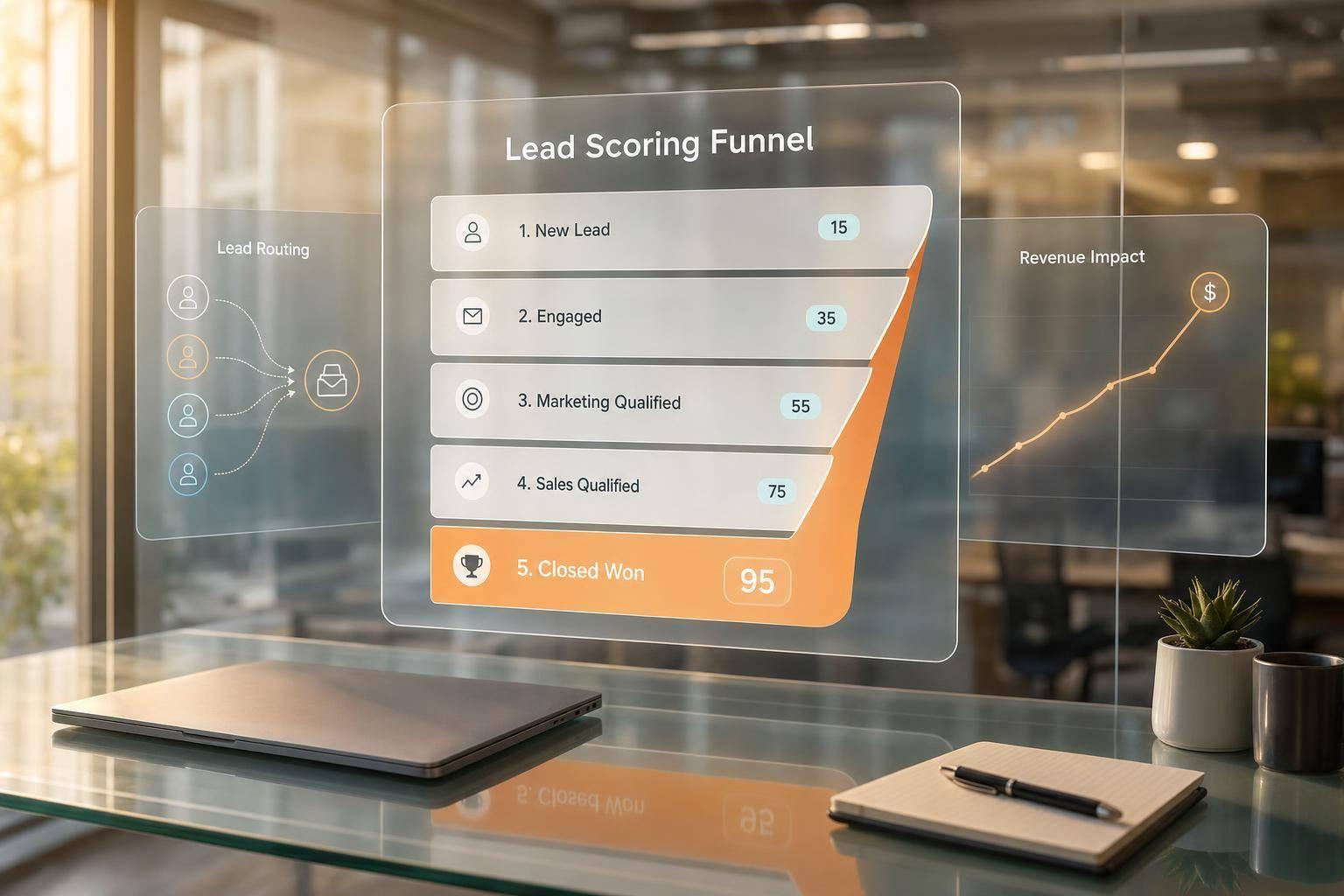
Lead scoring works better when it learns from sales results, not just page views and form fills. In this article, I show that reinforcement learning (RL) helps B2B and SaaS teams update scores and routing based on what leads actually do and whether those leads turn into pipeline and revenue.
Here’s the short version:
- I explain how RL treats lead scoring as a loop of state, action, and reward
- I show why fixed scoring rules can get out of date as buyer behavior shifts
- I break down the data RL needs from forms, CRM records, and product usage
- I cover when RL fits best, such as high-volume, PLG, and long sales-cycle funnels
- I outline how to measure results with metrics like MQL-to-SQL rate, speed-to-lead, and closed-won revenue
- I point out that teams often need 30-day, 90-day, and 180-day views to judge whether the model is working
A few numbers stand out. In many B2B SaaS funnels, MQL-to-SQL rates often sit around 29% to 40%. Sales Acceptance Rates are often 75% to 85%. And inbound follow-up within 5 minutes can be about 100x more likely to lead to contact than waiting 30 minutes or more. That means better scoring is not just about who looks good on paper. It also affects who gets contacted first and how fast.
If I had to reduce the article to one idea, it would be this: RL can help score and route leads over time, but only when the data is clean, the funnel stages are stable, and the team has enough volume to learn from results.
| Model | Best for | Main issue |
|---|---|---|
| Rules-based | Early-stage teams | Goes stale unless someone updates it |
| Supervised | Teams with past win/loss data | Often needs retraining |
| Reinforcement learning | High-volume funnels with steady feedback | Needs clean data and enough outcomes |
So if you want a simple answer, here it is: RL improves lead scoring by tying scoring decisions to downstream sales outcomes instead of fixed assumptions. The rest of the article explains how that works, what data you need, when to use it, and how I’d measure whether it’s paying off.
Reinforcement Learning Evaluation and Optimization | L-13
sbb-itb-5f36581
How Reinforcement Learning Updates Lead Scores Over Time
Once form, CRM, and product signals are connected, RL can update lead scores after each new event. In plain terms, it treats the funnel like a decision loop. A lead moves into a given state, the system makes a scoring or routing choice, and later results feed back into the next update.
States, Actions, and Rewards in a Lead Scoring Model
At any point, a lead's state is a snapshot of what the system knows right then: job title, company size, industry, pages viewed, emails clicked, demo requests, and days since the last activity. That's the model's input.
The action is what the model does with that input. It might assign or update a score, send the lead to an account executive, place the lead in nurture, or flag it for SDR outreach. The reward comes later and is tied to downstream revenue results.
| RL Component | Lead Scoring Equivalent | Example |
|---|---|---|
| State | Current lead profile | VP Marketing, 500-person SaaS company, demo requested, 7 pages viewed |
| Action | Score assignment or routing decision | Score 85/100, route to AE within 4 hours |
| Reward | Downstream business outcome | +$50,000 closed-won ARR; −2 for "no budget" disqualification |
Penalties for disqualification, churn, or wasted rep time help the model learn which leads to push down the queue.
Feedback Loops From User Behavior and Sales Outcomes
Each new action changes the lead's state and score. A lead who fills out a basic contact form or a multi-step form may start with a middle-of-the-road score. If that same person later completes a more detailed qualification form, clicks a high-intent email, and requests a demo, the picture changes in a big way. The model reads that new state and adjusts both the score and the routing choice.
The hard part is delayed rewards. In U.S. B2B sales, deals can take 30, 90, or even 180+ days to close. If the system waits only for final revenue, learning moves too slowly for day-to-day funnel decisions. That's why teams use shaped rewards: smaller positive signals for early milestones like a meeting booked or an opportunity created, then a bigger reward when the deal closes, scaled by deal value. This gives the model feedback within weeks or months instead of making it wait for the full sales cycle.
Exploration vs. Exploitation in Lead Routing and Prioritization
Once an RL model learns which lead profiles convert well, it tends to keep prioritizing them. That's exploitation: leaning into patterns that have worked before, like routing U.S.-based SaaS companies with strong trial engagement to senior reps with aggressive follow-up SLAs.
But markets don't sit still. Exploration means sending a small sample of leads to less-tested segments on purpose, just to see what happens. Think of it as keeping one foot on solid ground and the other testing new terrain. If those leads keep turning into strong opportunities, the model updates its policy and gives them more weight. If they don't, it pulls back. That's where RL earns its keep, especially when routing and prioritization need to shift faster than fixed rules can.
These updates work best when form, CRM, and product data are clean and current.
What Data Reinforcement Learning Needs From Forms, CRM, and Product Usage
Those score updates only work if the model can read reliable signals from forms, your CRM, and product usage. Reinforcement learning can adjust lead scores only when the data going in is clean, timestamped, and linked across systems. If those inputs are incomplete, inconsistent, or delayed, the model starts learning the wrong patterns. And when that happens, lead scores drift away from actual buyer intent.
High-Value Inputs From Forms and Qualification Fields
The form fields that help RL-based scoring the most are the ones tied most closely to conversion. That usually includes role and seniority, company size, industry, estimated budget in USD, purchase timeline, primary use case, and product interest. These fields become part of the lead state the model looks at before it decides how to score or route a lead.
Structured fields matter a lot here. Dropdowns, radio buttons, and numeric ranges are much more useful than open-text responses. A structured role field is ready to use right away. Free text, on the other hand, often needs cleanup and normalization before the model can use it well.
There’s another upside: structured inputs make segment analysis much easier. You can check how the model performs for a specific group - say, mid-market SaaS companies with a budget of $25,000 or more - without digging through messy text fields.
| Form Field Category | Examples | Why It Matters for RL |
|---|---|---|
| Contact identity | Name, work email, company name | Enables reliable CRM and product record matching |
| Role and seniority | VP of Marketing, Marketing Specialist | Correlates with deal velocity and win rate |
| Company attributes | Employee count, revenue band, industry | Separates enterprise from SMB patterns |
| Buying context | Budget in USD, timeline, use case, product interest | Signals readiness and deal size for reward shaping |
CRM and Product Signals That Improve Score Accuracy
Form data gives you the starting point. CRM and product data keep that picture up to date as the lead moves through the funnel.
On the CRM side, the signals that matter most are lifecycle stage, account ownership, logged meetings and emails, opportunity stage, target close date, and closed-won or closed-lost outcomes with deal value in USD. For example, a move from proposal to negotiation can give the model a small positive reward. A closed-lost result can add a penalty that pushes down the weight of earlier signals.
For SaaS teams, product usage adds context that CRM data alone can’t show. Trial signup and activation status, feature usage depth, seat count growth, weekly active users, and integration connections all point to actual product engagement. One account may add seats fast and connect a CRM or marketing integration. Another may sign up and then disappear. Those are not the same lead, and RL can learn that difference - but only if the events are tracked with accurate timestamps and tied back to the same account and contact IDs used in the CRM.
What the model needs, in plain terms, is one event timeline per lead or account. Form submission sits at the top. CRM activity and stage changes happen in the middle. Product events run alongside them. When you join form, CRM, and product events into one timestamped timeline, the model sees real state changes instead of random snapshots.
How Reform Can Improve Data Quality Before Scoring Starts
Clean inputs are what make RL usable in the first place, and Reform helps optimize lead generation and collect that data before scoring even begins. Reform’s multi-step forms, conditional routing, enrichment, validation, and spam prevention help teams capture cleaner qualification data before it enters the model.
Its real-time analytics can also surface problems early. Maybe low-quality submissions suddenly spike. Maybe completion drops on a key qualification field. Either way, teams can spot the issue and fix it before it quietly drags down model performance over time.
When B2B and SaaS Teams Should Use Reinforcement Learning
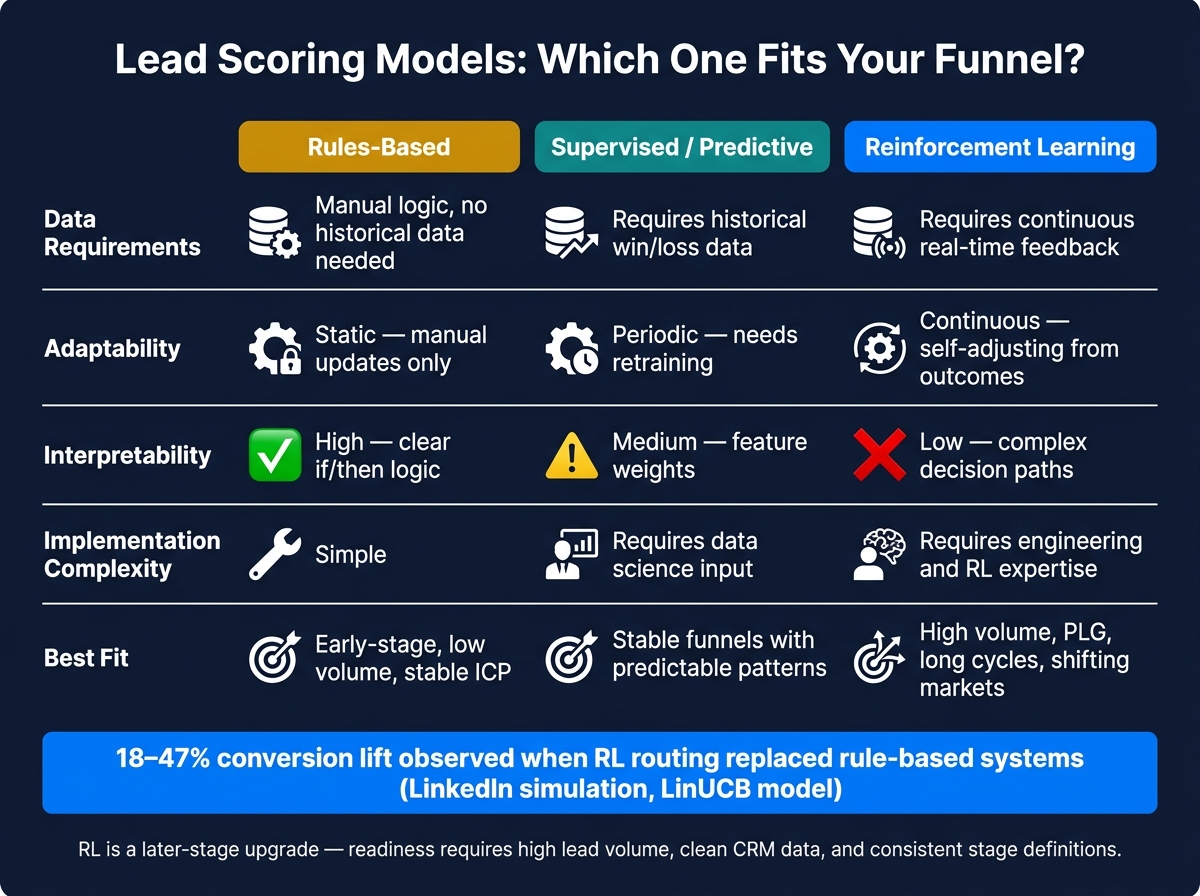
Rules-Based vs. Supervised vs. Reinforcement Learning Lead Scoring
Readiness Signals: Lead Volume, Stage Definitions, and Data Hygiene
Once your inputs are clean, the next step is simple: is the team ready for RL?
Reinforcement learning is a later-stage upgrade. It’s not where most teams should start. It only works when outcomes show up often enough for the model to learn and adjust. If feedback is slow or messy, RL has very little to work with.
Before it makes sense, four things need to be in place:
- Lead volume has to be high enough to create repeated outcomes. If your funnel only produces a handful of deals each quarter, the model won’t see enough patterns to make sound calls. In that case, rules-based scoring or supervised scoring is usually a better match.
- Stage definitions have to stay consistent. MQL, SQL, opportunity, and closed-won should mean the same thing across the CRM and across time. If those labels keep shifting, the reward signal gets noisy, and the model can’t tell which actions led to better results.
- CRM hygiene has to hold up. Duplicate records, missing timestamps, and systems that don’t connect well can break the feedback loop.
- Sales and marketing need to act on the output. Better scores only matter if teams can change routing, follow-up timing, or outreach sequences based on what the model suggests.
Funnels Where Adaptive Scoring Delivers the Most Value
Some funnel types line up well with RL.
Product-led growth (PLG) funnels are a strong match because they create rich behavior and product-usage data. That gives RL frequent feedback, which helps it refine scores and routing choices over time.
Long sales cycles with multiple touchpoints also work well. When a deal takes weeks or months to close and includes several stakeholders, static scores can get old fast, especially compared to multi-step data collection. RL can keep updating as new signals come in instead of locking the lead into a score based on the first form fill.
Markets where buyer behavior changes fast can also benefit. That might be due to competitive pressure, seasonal demand, or campaigns that shift often. Rules-based scoring needs manual changes every time behavior moves. RL adjusts as new outcome data comes in.
A LinkedIn simulation found LinUCB beat rule-based and supervised routing, with an 18–47% conversion lift.
Rules-Based, Supervised, and Reinforcement Learning Scoring: A Side-by-Side Comparison
Use this comparison to match the model to your funnel’s maturity and the speed of feedback.
| Rules-Based | Supervised (Predictive) | Reinforcement Learning | |
|---|---|---|---|
| Data requirements | Based on manual logic | Needs historical win/loss data | Requires continuous real-time feedback |
| Adaptability | Static, manual updates only | Periodic, needs retraining | Continuous, self-adjusting from outcomes |
| Interpretability | High, clear if/then logic | Medium, feature weights | Low, complex decision paths |
| Implementation complexity | Simple | Requires data science input | Requires engineering and RL expertise |
| Best fit | Early-stage, low volume, stable ICP | Stable funnels with predictable patterns | High volume, PLG, long cycles, shifting markets |
The next question is whether the model improves conversion, routing speed, and rep efficiency after deployment.
How to Measure Results and Improve the Model
Metrics That Show Whether Adaptive Scoring Is Working
Once the model is live, judge it by pipeline and revenue, not just raw lead volume. More leads can look good on paper and still waste your sales team’s time.
Focus on metrics that show whether leads move through the funnel and turn into revenue:
- Lead-to-MQL conversion rate
- MQL-to-SQL rate
- Opportunity creation rate
- Closed-won revenue in USD
- Average deal size
- Speed-to-lead
- Meetings booked per 100 leads
- Sales productivity by rep or team
These numbers help answer a simple question: are reps spending time on leads that are likely to convert?
In advanced B2B SaaS funnels, MQL-to-SQL rates often land in the 29–40% range. Sales Acceptance Rates often fall between 75–85%. Response time matters too. Reaching out to inbound leads within 5 minutes is roughly 100× more likely to produce contact than waiting 30 minutes or more. That’s not a small edge. It can change the whole top of the funnel.
Evaluation Windows and Sales Team Feedback
Use 30-day, 90-day, and 180-day windows. Each one tells you something different.
The short window is useful for checking whether routing improved. The middle window shows whether leads keep moving through the funnel. The long window tells you whether early gains turn into actual revenue. If you only look at one time frame, you can miss where things start to break.
| Evaluation Window | Best for Measuring | Example Metrics | What to Watch For |
|---|---|---|---|
| 30 days | Early response and routing quality | Speed-to-lead, meetings booked per 100 leads, early conversion rate | Quick wins may not translate into pipeline quality |
| 90 days | Funnel progression and scoring consistency | Lead-to-MQL, MQL-to-SQL, opportunity creation rate | Mid-funnel lift should hold across sources and reps |
| 180 days | Revenue and sales-cycle outcomes | Closed-won revenue (USD), average deal size, sales cycle length | Early gains should still produce durable revenue impact |
Numbers matter, but sales feedback matters too. One of the most useful inputs is the sales team’s disposition codes. Standardize labels like qualified, meeting booked, bad fit, and wrong timing. Those labels feed the reward signal and help update future scores.
Without steady coding, tuning the reward function turns into guesswork. You’re basically trying to steer in the dark.
Conclusion: The Practical Role of RL in Modern Lead Scoring
RL improves lead scoring because it learns from actions and outcomes on a continuous basis instead of leaning on fixed rules that need manual updates. But the model is only as good as the data behind it. Clean form inputs, clear CRM stage definitions, and structured sales feedback all shape the reward signal and push the model in the right direction.
This setup works best in mature B2B and SaaS funnels with:
- High lead volume
- Clear pipeline stages
- Enough closed-won outcomes for the model to learn from
Teams should track impact with pipeline and revenue metrics across more than one evaluation window before rolling it out more broadly. A 30-day jump in meetings booked is a good early sign. But closed-won revenue and average deal size over 180 days are what show whether the model is doing its job.
Treat RL like a living system, not a set-it-and-forget-it launch. Measure it over time, review the reward design on a regular basis, and roll back changes when pipeline quality drops. Then use sales feedback to tune the reward signal and keep the model moving in the right direction.
FAQs
How is RL different from predictive lead scoring?
Predictive lead scoring estimates the chance that a lead will convert by looking at past patterns and current data. As new data comes in, it recalculates the score.
Reinforcement learning updates scores over time by learning from reward signals tied to what happens after funnel actions, such as conversions or non-conversions. In plain English, it uses feedback loops connected straight to those results.
How much lead volume do we need for RL to work?
You don’t need a massive pile of leads to get started. For predictive or AI lead scoring, Reform says 80 historical leads is enough to begin: about 40 won and 40 lost so the model can spot patterns.
For reinforcement-style updates, score weights should come from 6–12 months of enriched lead outcome data. From there, keep refining the model with ongoing feedback loops.
What happens if our CRM data is messy?
Messy CRM data can wreck lead scoring.
Why? Because the model depends on reliable, up-to-date field values and clean action events. If updates are missing or come in late, scores can trail behind what a lead is doing right now. And if fields are wrong, mislabeled, or not mapped at all, some rules may never fire.
There’s another issue too: missing enrichment data can lead to false positives. On top of that, unsubscribes and spam complaints can be handled the wrong way if those signals don’t flow into the CRM cleanly.
A few basics go a long way here:
- Validate email addresses
- Block spam and remove duplicates
- Map fields the same way across systems
If those pieces are in place, lead scoring has a much better shot at reflecting actual buyer behavior instead of bad data.
Related Blog Posts
Get new content delivered straight to your inbox

The Response
Updates on the Reform platform, insights on optimizing conversion rates, and tips to craft forms that convert.




Drive real results with form optimizations
Tested across hundreds of experiments, our strategies deliver a 215% lift in qualified leads for B2B and SaaS companies.
