
.webp)
Lead Routing Challenges in Hospitality and Solutions



Lead routing in hospitality is all about speed and precision. Hotels that respond to inquiries first win 72% of the time, and delays cost revenue daily. However, manual processes, misrouted leads, poor data quality, and lack of tracking often slow things down. Here's how to fix it:
- Automate lead assignment: Use real-time rules to cut response times from hours to minutes.
- Segment leads effectively: Route inquiries based on criteria like event type, group size, or budget.
- Collect better data upfront: Use high-converting lead forms to gather critical details without overwhelming prospects.
- Track routing performance: Monitor metrics like time-to-assignment and reassignment rates to identify bottlenecks.
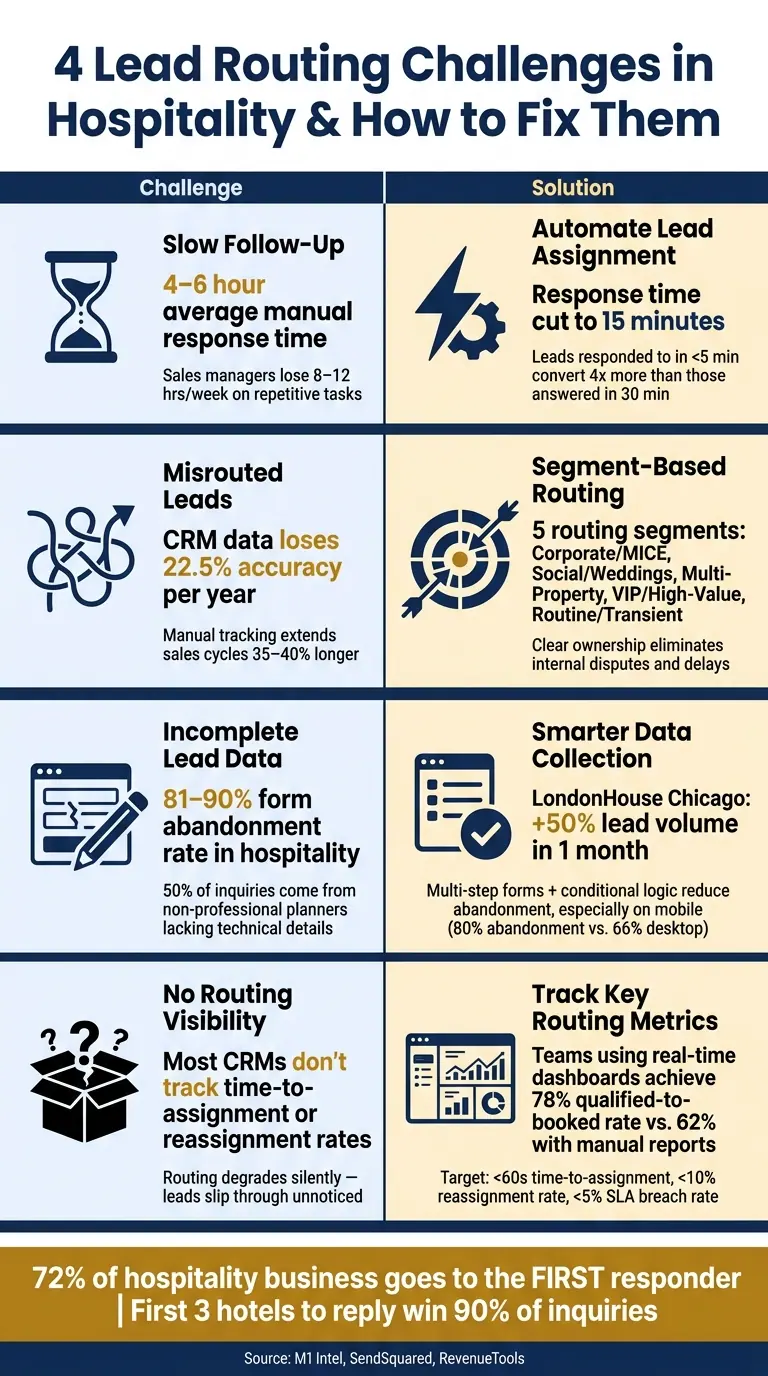
4 Lead Routing Challenges in Hospitality & How to Fix Them
Challenge 1: Slow Follow-Up from Manual Lead Assignment
Problem: Manual Processes Slow Down Lead Assignment
When leads come in without an assigned owner, manual workflows often drag the process down. Teams waste time reviewing, deciding, and handing off leads through email, Slack, or even face-to-face conversations. This inefficiency becomes worse when systems are scattered: RFPs in Gmail, group block details in Excel, and flagged inquiries in Slack. Sales teams end up chasing leads across multiple platforms. As one expert bluntly put it:
"Inboxes are where inquiries die when the sales manager is busy." - SendSquared
In these manual setups, response times often stretch to 4–6 hours, while sales managers lose 8–12 hours weekly on repetitive tasks like data entry and lead routing. Worse, leads that don’t fit neatly into pre-set categories may end up unassigned, creating "black holes" where potential business disappears. Quick responses are critical: the first three hotels to reply to an inquiry win 90% of the business. With booking windows shrinking, every hour of delay puts properties at a disadvantage.
To fix this, automation can replace these inefficient, manual processes with faster, more accurate lead assignment.
Solution: Automate Lead Assignment with Real-Time Rules
The answer isn’t hiring more staff to handle a growing queue - it’s eliminating the queue entirely. Automated systems can assign leads immediately based on predefined rules, such as event type, group size, or geography. No manual triage, no delays.
Automation can cut response times from 4–6 hours to just 15 minutes. In some cases, AI-powered tools have reduced response times from 47 minutes to under 2 minutes. Leads responded to within 5 minutes convert at four times the rate of those answered within 30 minutes.
The key to this efficiency is a optimized intake form. By collecting critical details upfront - like event type, budget, and preferred dates - the system can route leads instantly without requiring human involvement. Tools like Reform make this possible by enabling conditional routing and enriching leads at the point of capture, ensuring the right person gets the right information immediately.
To further strengthen the system, fallback rules can route unmatched leads to a default queue or manager, preventing lost opportunities. Automated escalation ensures high-priority leads are flagged if they aren’t addressed within a set timeframe, closing gaps that manual processes often leave.
"Response time isn't just a customer service metric. It's a revenue metric." - M1 Intel
sbb-itb-5f36581
How to Build Unstoppable Lead Routing Workflows with Zapier & HubSpot
Challenge 2: Misrouted Leads and Unclear Ownership
Automation can speed up follow-up times, but if leads are routed incorrectly, it creates a whole new set of problems. Quick follow-ups are important, but they won’t matter if leads end up with the wrong person.
Problem: Broad or Inaccurate Routing Rules
Routing a lead quickly is just the first step. The real challenge lies in ensuring it gets to the right person. A misrouted lead can be just as harmful as a delayed one - and often, it’s harder to catch.
In many hospitality businesses, routing rules are either overly general or based on outdated assumptions. For example, wedding inquiries might be sent to corporate managers, or multi-property RFPs get split across teams, leading to conflicting responses. Even worse, an important lead from a high-value client could end up with a new sales rep who has no knowledge of the client’s history. These mistakes happen all the time and can seriously damage client trust.
"Without clear routing rules, leads get dropped, duplicated, or fought over internally." - M1 Intel
The problem is made worse by outdated CRM data, which loses about 22.5% of its accuracy every year. If routing rules aren’t reviewed regularly, these errors can go unnoticed for months, quietly misdirecting leads. Hotels that rely on manual lead tracking often deal with sales cycles that are 35–40% longer than those using specialized software, and poor routing is a big reason for this delay.
The solution? A more targeted, segment-based routing system.
Solution: Segment-Based Routing with Clear Ownership
Effective routing starts with understanding who the lead is rather than just focusing on where it came from. Segment-based routing uses specific criteria - like event type, group size, budget, or market segment - to ensure each lead goes to the person best equipped to handle it.
Here’s how a structured routing strategy can look:
| Routing Segment | Assignment Criteria | Typical Owner |
|---|---|---|
| Corporate/MICE | 10+ rooms, weekday dates, AV needs | Corporate Sales Manager |
| Social/Weddings | Weekend dates, banquet space, high F&B | Wedding Specialist |
| Multi-Property | Requests covering three or more markets/properties | Portfolio Account Manager |
| VIP/High-Value | Large group size or high budget score | Director of Sales |
| Routine/Transient | Single room, simple availability | AI Agent / Front Desk |
This type of structure eliminates confusion and internal disputes. When a lead fits a specific segment, it’s routed automatically - no debates, no delays.
For existing accounts, routing should include lead-to-account matching, which ensures inquiries go directly to the client’s existing account manager. Sending a loyal client to someone unfamiliar with their history is a surefire way to lose their trust - and their business.
Every routing system also needs a catch-all rule to handle leads that don’t fit any defined segment. Without this, unclassified leads can end up sitting in unassigned queues, effectively disappearing. To avoid this, use a well-designed intake form with conditional logic - like those available through Reform. These forms gather the necessary segmentation details upfront, making it easier to route leads correctly from the start.
Challenge 3: Incomplete or Poor-Quality Lead Data
Even the most advanced routing systems fail when the data they rely on is incomplete. Missing information can lead to misrouted leads and lost revenue opportunities.
Problem: Key Information Missing at the Inquiry Stage
Hospitality businesses often struggle to strike the right balance with their lead forms. On one hand, overly detailed forms with 50+ fields can overwhelm prospects. On the other, overly simplified forms fail to collect the critical details needed for proper lead qualification. Both approaches result in the same issue: sales teams waste time chasing missing information before they can even begin qualifying a lead.
Complicating matters further, up to 50% of inbound inquiries come from non-professional planners - like executive assistants - who may not have access to technical details such as attrition rates or firm dates at the inquiry stage. Forcing these individuals to fill out lengthy forms often leads to form abandonment. In fact, lead forms in the travel and hospitality industry already suffer from abandonment rates of 81–90%, making every field a potential point of friction.
Missing data points - such as budget range, group size, or decision timeline - also disrupt automated lead scoring. Without complete information, routing systems can’t function effectively.
"Friction kills confidence. If your process to book business is complicated or messy, you're going to lead them to an assumption that the event execution might be that way as well." - Don Barnett, Director of Sales and Marketing, LondonHouse Chicago
Solution: Better Data Collection and Validation at Intake
The solution isn’t to reduce the amount of data collected - it’s to collect the right data in a smarter way. One effective method is using conditional logic. This approach tailors the form based on the user’s responses. For example, someone inquiring about a wedding would see wedding-specific questions, while someone else might see questions relevant to corporate events. This keeps forms clean and user-friendly while still gathering the details needed for accurate routing.
Multi-step forms are another effective tool. Breaking longer forms into smaller steps - each with 2–4 fields - can significantly reduce abandonment rates, particularly on mobile devices, where abandonment is 80% compared to 66% on desktop. These forms ensure that every step captures essential information, improving both data quality and routing accuracy. Tools like Reform support multi-step layouts and conditional routing, while also offering features like email validation and lead enrichment. These features help catch errors and fill in missing details before the routing engine processes the lead. This timing is crucial - if enrichment happens after routing, the system evaluates incomplete data, leading to misrouted leads.
A real-world example highlights how impactful this approach can be. In 2026, LondonHouse Chicago introduced a short contact form requiring just a name, contact info, and one open field alongside their standard RFP. Within a month, lead volume increased by 50%. By reducing their response time to an average of 4 hours - well below the comp set average of 5.3 hours - the hotel achieved the top market ranking for both conversion rate and awarded business value.
A well-designed form that collects clean, validated data from the start eliminates unnecessary back-and-forth and ensures accurate lead routing.
Challenge 4: No Visibility into Routing Performance
Even with routing rules in place, hospitality teams can find themselves in trouble when those rules falter unnoticed. Missing or delayed data can obscure the reasons behind underperformance in bookings, leaving teams in the dark.
Problem: Routing Metrics Are Not Being Tracked
Many hotel sales teams lack a clear understanding of their routing system's performance. Leads pour in from various sources - web forms, phone calls, social media, and direct property emails - but without a unified system, tracking these channels effectively becomes a daunting task. Markus Busch, Editor/Publisher of Hospitality.today, highlights this inefficiency:
"There is a cost that does not appear on any hotel's profit and loss statement... It is paid every week... in the form of staff time spent extracting, reconciling, and reformatting data from systems that do not talk to each other."
Adding to the challenge, most standard hotel CRMs focus on pipeline value or sales rep activity rather than routing-specific metrics like time-to-assignment or reassignment rates. When forms, CRMs, and routing tools don’t work together seamlessly, data trickles in sporadically, making it difficult to pinpoint delays. Jordan Rogers of RevenueTools describes the issue bluntly:
"Routing does not fail spectacularly. It degrades silently. Leads slip through cracks nobody notices until a rep complains or a deal is lost."
Solution: Use Analytics to Monitor and Improve Routing
The lack of visibility into routing performance calls for a more data-driven approach. By focusing on key metrics, teams can identify inefficiencies and make necessary adjustments. Here are some critical metrics to monitor:
- Time to Assignment: How quickly leads are routed to the right person.
- Time to First Contact: How fast reps respond to assigned leads.
- Reassignment Rate: The percentage of leads manually reassigned, which indicates potential flaws in the initial routing logic.
- Catch-all Volume: The proportion of leads hitting a default rule, signaling gaps in the routing framework.
| Metric | What It Reveals | Target Benchmark |
|---|---|---|
| Time to Assignment | Speed of the routing engine | < 60 seconds |
| Reassignment Rate | Accuracy of initial routing logic | < 10% |
| Catch-all Volume | Gaps in routing rule coverage | < 10% |
| SLA Breach Rate | Understaffing or capacity issues | < 5% |
For multi-property organizations, these metrics are even more critical, as fragmented data can make it harder to see the full picture.
When analyzing response times, use the median instead of the average. A median response time of 4 hours might seem solid, but if the 90th percentile hits 96 hours, it’s clear that many leads are being neglected. Multi-property companies often face even greater challenges without a centralized dashboard to track lead activity across locations. Teams that adopt real-time dashboards to monitor routing performance see better results - some achieve a 78% qualified-to-booked rate, compared to 62% for those relying on manual weekly reports.
As Jordan Rogers puts it:
"If you cannot answer two questions - 'what is our misroute rate?' and 'what is our average time-to-assignment?' - then your routing system is a black box."
Tools like Reform can help by providing real-time analytics at the intake stage, offering insights into form performance and submission data before leads even hit the routing process. Combining front-end visibility with CRM-level tracking ensures that every lead is handled efficiently. By aligning automated routing with analytics, hospitality teams can close the loop between data collection and performance, creating a smoother and more effective system overall.
Conclusion: Fixing Lead Routing in Hospitality
Hospitality lead routing issues often show up in subtle ways - missed RFPs, slow responses, or inquiries landing in the wrong hands. As Jordan Rogers, a Revenue Operations Expert, explains: "Telling reps to 'respond faster' does not work when the routing system takes four hours to assign the lead. Speed-to-lead is a systems problem."
The good news? Every challenge discussed here has a practical solution.
Key Takeaways
Tackling these problems boils down to four main strategies: swift automation, accurate segmentation, thorough data collection, and effective analytics.
| Challenge | Root Cause | Core Fix |
|---|---|---|
| Slow follow-up | Manual lead assignment | Real-time automated routing rules |
| Misrouted leads | Broad or inaccurate logic | Segment-based routing with clear ownership |
| Poor-quality data | Weak intake forms | Validated, structured data collection at intake |
| No routing visibility | Missing metrics and dashboards | Analytics tracking time-to-assignment and reassignment rates |
Here’s the stark reality: manual tracking can drag out sales cycles by 35–40%. And with 72% of business going to the first responder, even small delays can hit revenue hard.
To keep your lead routing system running smoothly, it’s essential to refine it regularly. Routing rules should adapt to changes in staff, territories, and property additions. A monthly check on routing logic, rep availability, and the performance of intake forms ensures accuracy and prevents the system from quietly breaking down over time.
FAQs
What lead details should we require on the first form step?
Keeping the first step of your form simple is key to boosting conversions. Stick to the basics - ask for a name, an email, and maybe include an open-ended question like "How can we help?" to encourage engagement. Keep the total number of fields under five since longer forms tend to scare people off, leading to lower completion rates.
To collect more information later, use tools like conditional logic or progressive profiling. These allow you to ask for extra details during subsequent steps, ensuring you only gather what's necessary for advancing the sales process - without overwhelming users upfront.
How do we prevent leads from going unassigned or into a “black hole”?
To avoid unassigned leads slipping through the cracks, implement automated routing using a centralized CRM. Set up rules based on property logic - like ZIP codes or qualifying questions - to assign ownership instantly. Ensure this routing happens only after lead enrichment and completion of required fields.
Once a lead is assigned, start an SLA timer, notify the assigned rep immediately, and establish fallback or escalation processes for leads that remain unengaged. Regular audits of the routing process can help identify and address any gaps, ensuring a smooth transition for every lead.
Which routing metrics should we track to catch problems early?
Tracking a few key metrics can make a big difference in spotting issues and keeping your sales process on track:
- Lead response time: Look at the median and 90th percentile to catch delays or missed leads.
- Stuck opportunities: Focus on deals that have been inactive for over 14 days in each stage.
- Lead conversion rates: Break this down by source and review trends over the last 12 weeks to spot any declines.
- Pipeline velocity: Check this weekly to gauge how fast deals are moving and assess overall revenue health.
By keeping an eye on these metrics regularly, you can address bottlenecks - like manual errors or disconnected systems - before they start affecting your bookings.
Related Blog Posts
Get new content delivered straight to your inbox

The Response
Updates on the Reform platform, insights on optimizing conversion rates, and tips to craft forms that convert.



Drive real results with form optimizations
Tested across hundreds of experiments, our strategies deliver a 215% lift in qualified leads for B2B and SaaS companies.
