
.webp)
Navigating Consent for Minors in Multinational Firms


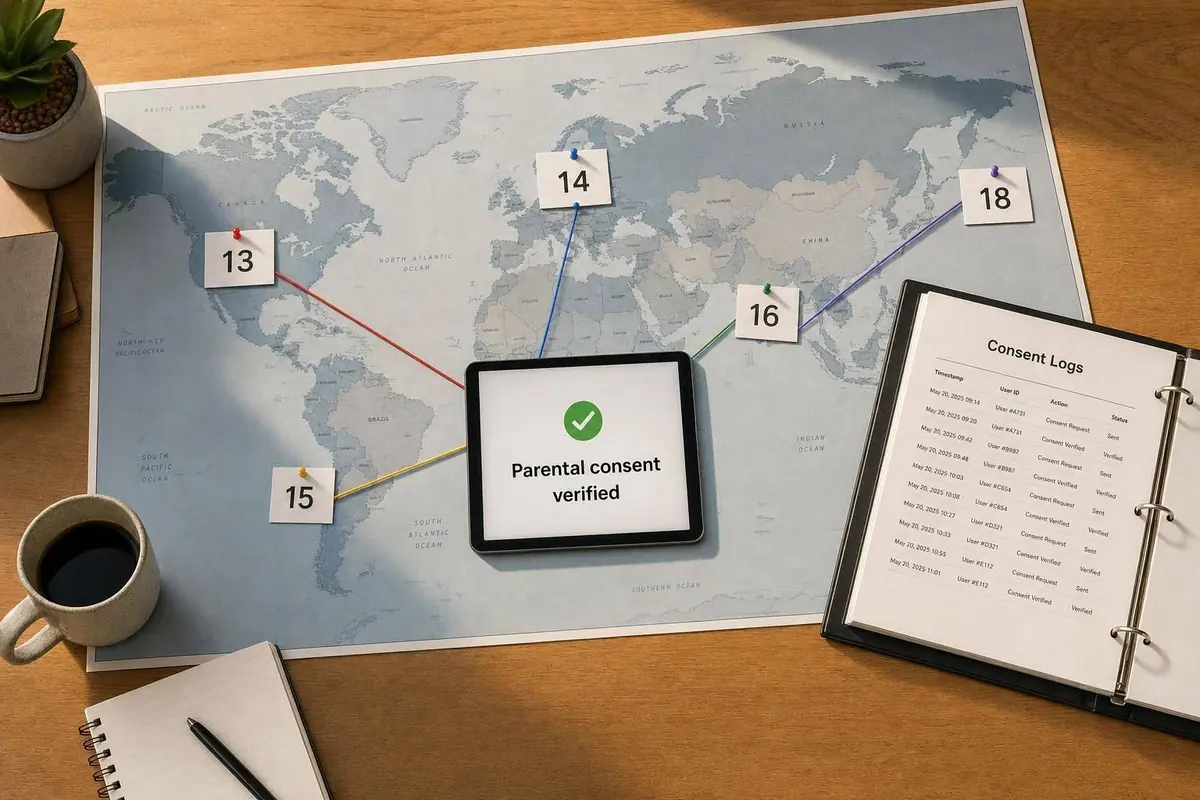
If you collect data from minors across countries, one signup flow is often not enough. I’d treat minor consent as a system problem, not just a legal checkbox: route users by country first, check age against local rules, trigger parent approval when needed, and keep proof of what was shown and agreed to.
Here’s the short version:
- In the U.S., COPPA applies to users under 13 and can trigger verifiable parental consent before data collection.
- In the EU, the digital consent age is 13 to 16, depending on the member state.
- In California, users 13–15 may need to opt in themselves before a company can sell or share data.
- In Brazil, child rules often apply under 12, with added protections for minors under 18.
- In the U.K., design rules for children can reach users under 18, not just very young children.
- Self-declared age is weak on its own: one 2025 sweep found 72% of age-assurance measures were easy to bypass.
- Enforcement is costly: the FTC’s $520 million Epic settlement and TikTok’s €345 million Irish fine show the risk is not theoretical.
What I’d do first:
- Map age thresholds by market
- Branch forms by location, age, and data type
- Separate child and parent steps
- Limit profiling, ads, and extra data use for minors
- Store consent logs and notice versions
- Set deletion and revocation rules from day one
Children’s Privacy in 2026: Age Gating Isn’t Enough | Children's Privacy U.S. Requirements
sbb-itb-5f36581
Quick comparison
| Region | Main age trigger | Who must act | Main issue for teams |
|---|---|---|---|
| U.S. | Under 13 | Parent/guardian | FTC-style parent verification |
| EU | 13–16 | Parent below local threshold | Country-by-country age split |
| California | Under 13, plus 13–15 | Parent or teen, based on age | Sale/share opt-in rules |
| Brazil | Under 12, plus under 18 | Parent for children | “Best interest” standard |
| U.K. | Under 13, plus under 18 | Parent for younger users | Child-focused design and privacy defaults |
The core point is simple: I wouldn’t use one global consent flow for minors. I’d use one framework with local rules, clear routing, and audit records that hold up if regulators ask questions.
The legal landscape: GDPR, COPPA, CCPA/CPRA, LGPD, and other regional rules
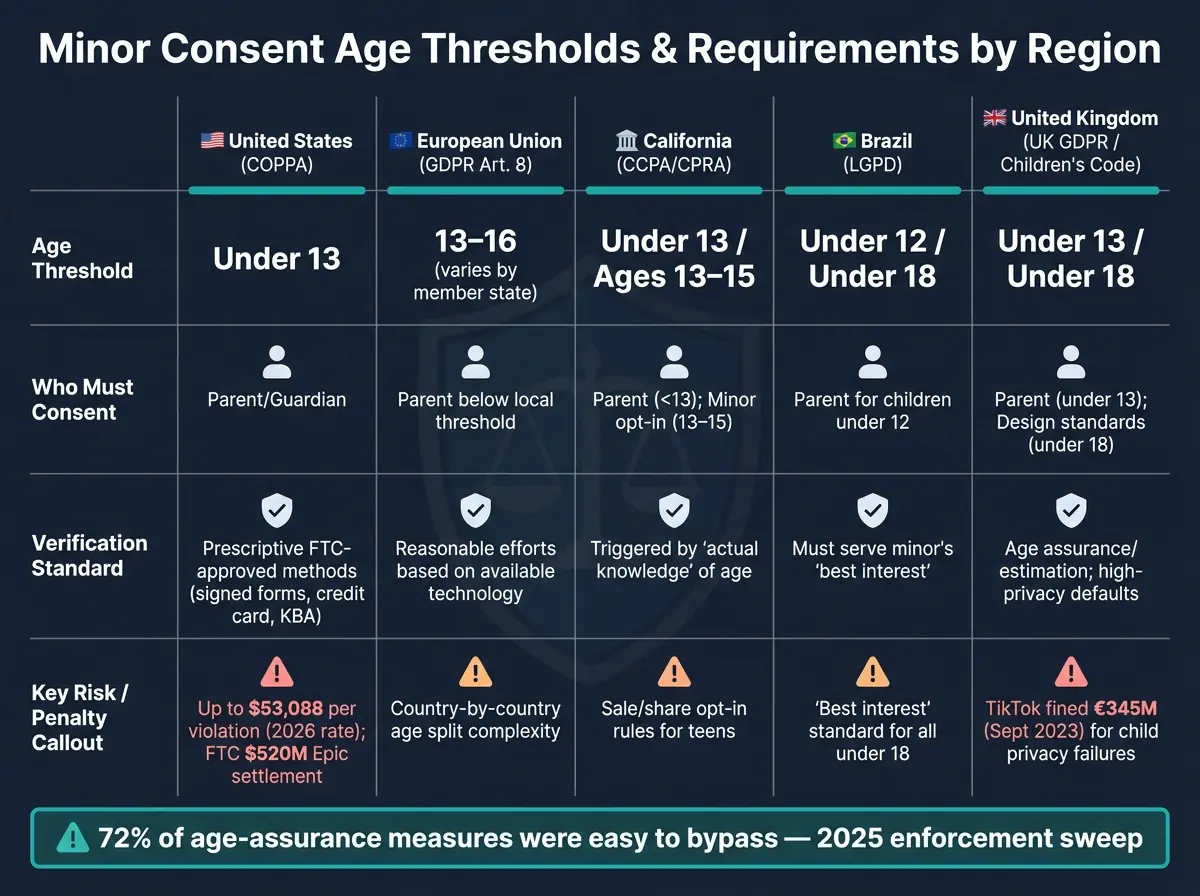
Minor Consent Age Thresholds & Requirements by Region
Rules for minor consent change by region in three main ways: the age cutoff, who has to give consent, and how that consent must be checked. If you run a global form flow, you have to account for all three. That affects the age gate you show, the consent step you trigger, and the proof you need to keep.
In day-to-day practice, the differences usually surface in three spots: age threshold, consent proof, and how sensitive data is handled.
How age thresholds and parental consent standards differ by region
In the United States, the federal baseline under COPPA starts at age 13. If a child is under 13, an operator must get verifiable parental consent (VPC) before collecting, using, or disclosing personal information. The FTC spells out approved VPC methods, including signed forms, credit card checks, and knowledge-based authentication. Civil penalties can reach $53,088 per violation as of 2026.
Under GDPR Article 8, the default age for digital consent is 16. But member states can lower that age to 13, which means the cutoff depends on where the user is located. Verification must involve reasonable checks based on the technology available.
In California, CCPA/CPRA splits minors into two groups. Children under 13 need parental opt-in. Teens ages 13 to 15 must opt in on their own before a business can sell or share their data. In Brazil, LGPD usually requires parental consent for children under 12 and applies broader child-protection rules to minors under 18.
Here’s the side-by-side view:
| Jurisdiction | Law | Age Threshold | Parental Consent Required | Verification Expectation |
|---|---|---|---|---|
| United States | COPPA | Under 13 | Yes, before any data collection | Prescriptive: FTC-approved methods |
| European Union | GDPR Art. 8 | 13–16 (varies by member state) | Yes, below the state-set threshold | Reasonable efforts based on available technology |
| California (U.S.) | CCPA/CPRA | Under 13 / 13–15 | Parental (<13); minor opt-in (13–15) | Triggered by "actual knowledge" of age |
| Brazil | LGPD | Under 12 / Under 18 | Required for children under 12 | Processing must serve the minor's "best interest" |
| United Kingdom | UK GDPR / Children's Code | Under 13 / Under 18 | Yes (under 13); design standards apply (under 18) | Age assurance/estimation; high-privacy defaults |
When sensitive data adds another layer
Age is only the first filter. The kind of data you collect can add a second set of duties. Once the data goes beyond a basic name or email address, the compliance bar gets much higher. Health data, biometric identifiers, genetic data, and precise geolocation can all trigger extra rules under GDPR, LGPD, and several U.S. state laws.
Under GDPR, sensitive data falls under Article 9 and will often require a Data Protection Impact Assessment (DPIA). The U.K. Children's Code and the Colorado Privacy Act also call for DPIAs when a company profiles minors or handles data in ways that could harm them.
Third-party disclosure, targeted advertising, and AI training can create a separate consent issue too. Under COPPA, those uses now require separate verifiable parental consent.
Children’s data also comes with tighter retention rules. Companies need jurisdiction-specific policies, and they must delete the data once the original purpose has been met.
Regional and local factors that change how consent should be presented
Statutes set the floor. But they don't tell you how a consent notice should look for a child in one market versus another.
In practice, presentation changes by region. Local expectations, reading level, and norms around family authority all shape what consent should look like. That's a big reason regulators are shifting beyond basic notice-and-consent and toward age-appropriate design and safety-by-design rules.
Use those differences to decide how the notice is written, who needs to approve it, and how many steps the flow should include.
Here’s a side-by-side view of the regions that most often shape presentation choices:
| Region | Parental Involvement Expectations |
|---|---|
| EU / UK | High; reasonable efforts to verify parental responsibility |
| United States | Prescriptive; specific VPC methods required |
| Latin America | Required for children; heightened care for teens |
| APAC | Strict parental consent in China and South Korea; maturity-based in Singapore and Japan |
Language, readability, and child-friendly notice design
The first big presentation choice is wording.
Both GDPR and the UK Children's Code say privacy notices must be written in language the intended age group can understand. That means short sentences, plain words, and visual cues that help kids follow along. It also means localization can't stop at translation. A notice should sound natural in each market, not like it was pushed through a machine and left there.
A child in London, São Paulo, or Seoul may be looking at the same product. The notice still can't read the same way in each place.
How local norms affect parental responsibility checks
The second issue is who the law treats as the consenting adult.
Guardianship rules change by jurisdiction. In Hong Kong, consent can come from a "relevant person", which goes beyond biological parents and includes recognized guardians. In Germany, authorities have looked closely at school-based app use, especially when schools process data under public task instead of parental consent. In India and Indonesia, parental responsibility stays at the center, reflecting a strong view of the family as the main protector of a child’s digital life.
APAC adds another layer. Vietnam and Thailand require dual consent from both the child and the parent for certain age ranges, while Singapore and Japan use maturity-based frameworks that may let older minors consent on their own.
That’s where many global teams hit a wall. One interactive consent flow for every market sounds neat on paper, but it starts to fall apart once these local rules and norms come into play.
Building compliant consent workflows and internal governance
Regional consent rules need to turn into actual workflows. That means your forms should branch by market, age band, and data risk. If the logic in the flow can't enforce those differences, the policy doesn't do much.
Designing age gates, parental consent steps, and minor assent flows
Once consent changes by market, age screening becomes your first control point.
Start with more than a simple self-declaration. A practical setup is step-up verification: begin with a basic age declaration, then move to AI-based behavioral analysis or government ID checks if the declared age doesn't line up with user behavior.
Route users by country before the age gate appears. Build jurisdiction-based branching into the flow from day one, and use geo-detection to apply the right national threshold instead of falling back to one global rule.
For fraud control, lock the age field after a user has been classified as a minor so it can't be edited later.
If parental consent is required, keep the parent and child steps separate. The parent flow should collect verifiable consent. Then link the parent and child records in your database so revocation and deletion requests go to the right place when either person takes action later.
Choosing verification and audit methods that match risk
Not every product needs the same verification bar. The right method depends on the data you're collecting and how sensitive that data is.
| Method | Best Use Case | Key Limitation |
|---|---|---|
| Email Plus (email plus follow-up confirmation) | Low-risk, internal data use only | Higher litigation risk; not sufficient for sensitive data |
| Government ID and facial recognition | High-risk data; global products | Creates biometric data collection risk; high friction |
| Live video call | High-value accounts; failed automated checks | Extremely high cost; difficult to scale |
Whatever method you pick, the audit trail matters just as much as the verification step itself. Store consent artifacts - cryptographic proofs of what was shown and agreed to - instead of raw ID photos or biometric templates. In practice, that means extracting the verified parent or guardian flag and deleting the underlying sensitive evidence right away to cut breach exposure. Keep tamper-evident logs that record:
- The parent identity reference
- The minor reference
- A hash of the exact disclosure text shown
- A timestamp
Revocation and deletion should be built into the workflow from the start. Data Protection Impact Assessments should kick in early, before features ship, whenever the product involves profiling or other high-risk processing tied to known minors' data.
Governance falls apart when ownership is fuzzy. Each team needs a clear lane.
| Team | Primary Duties | Key Deliverables |
|---|---|---|
| Legal & Compliance | Regulatory tracking, DPIA triggers, defining "verifiable" standards | Jurisdictional age threshold matrix; DPIA reports |
| Product Management | Age gate UX, child-friendly notices, consent branching logic | PRD with child-safety specs; consent flow wireframes |
| Engineering | Verification API integrations, tamper-evident logging, automated revocation and deletion jobs | VPC workflow; deletion logs; tamper-evident consent records |
| Marketing | Ensuring ad targeting excludes flagged minors; managing parental email loops | Ad-exclusion lists for minor segments |
| Customer Support | Handling parental access and deletion requests; manual verification escalations | Support playbooks for minor data rights |
| Security | Access controls for sensitive minor data; audit of verification records | Access logs; encryption standards for biometric or ID data |
Map these ownership rules into your forms and data systems before launch. From there, the work shifts to wiring them into the form, CRM, and retention layers.
Putting minor consent into practice with form infrastructure and data systems
Those rules only matter if your systems actually enforce them. Your forms, CRM fields, and consent logs need to work together so jurisdiction tagging, age classification, and parental authorization status move through the system automatically.
Using conditional logic and multi-step forms for region-specific consent
A single entry point can branch based on age, location, and data type. If a U.S. user enters a date of birth that shows they are under 13, the form should send them to a parent contact step. Country-specific age thresholds handle everyone else. But that routing only works if the form, CRM, and audit trail stay aligned.
Reform supports this setup with its no-code, multi-step form builder. Teams can build localized consent flows with conditional routing and email validation before CRM sync.
Routing is only half the job. Your logging needs to match it. That means using CRM fields that connect parent and child identities in a linked parent-child record, so withdrawal or deletion requests carry over to both records automatically.
Here’s a simple way to map each legal requirement to a system control:
| Requirement | Form/System Capability | Implementation Detail |
|---|---|---|
| Age Gating | Conditional logic + DOB input | Collect date of birth; route by declared age and jurisdiction threshold. |
| Localization | Geo-detection + jurisdiction tagging | Apply regional age limits and display notices in the user's language. |
| Parent Verification | Multi-step conditional routing | Route under-age users to a separate parent contact step for email-plus or KBA confirmation. |
| Audit Logging | Immutable consent records | Store user ID, consent version, timestamp, IP, and verification method per submission. |
| Consent Syncing | CRM + API integration | Map parent-child identifiers so withdrawal or deletion requests propagate to both records. |
| Data Minimization | Conditional field logic | Hide non-essential fields for users flagged as minors. |
Conclusion: A practical model for reducing cross-border consent risk
Minor consent isn't a one-time legal task. It's an operating model that sits across legal, product, and engineering. The right answer isn't one global rule. It's one model that works market by market.
Start with a jurisdiction map that tracks local age thresholds, parental consent rules, and law update cycles. Then keep that map current as rules change.
Notices and interfaces also need to make sense to minors, not just lawyers. Use language they can understand, and set privacy to the highest level by default. GDPR Recital 58 calls for child-appropriate language. TikTok was fined €345 million in September 2023 for failing to meet those standards.
After the rules are mapped, the workflow needs to enforce them on its own. Automate routing, verification, and logging. Keep auditable consent logs with timestamps, notice version, and verification method. Policy on paper means very little if the form logic, CRM, and audit trail don't back it up.
The final control is ownership. One team needs to keep the jurisdiction map, logs, and review cycle current. Assign one owner for the jurisdiction map, consent records, and DPIA cadence.
Compliance can't live in legal alone. It has to be built into the systems the product runs on.
FAQs
How should we verify a parent’s consent?
Businesses must make reasonable efforts to confirm that the person giving permission is a parent or legal guardian. A simple checkbox or self-declaration doesn’t meet that bar.
Approved methods include:
- a signed consent form
- a reversible credit or debit card transaction
- a toll-free call or video call with trained staff
- government ID verification
- knowledge-based authentication
For internal data use, an email-plus method may also be allowed.
What if a minor travels or uses a VPN?
If a minor travels or uses a VPN to hide their location, compliance still depends on the law that applies where the data is collected or where the minor lives.
That’s why laws like GDPR and COPPA can reach across borders. A business usually can’t rely on a user’s stated location alone. If a service is likely to be used by minors, age verification and gating measures may still be required.
When do we need a DPIA for minors’ data?
You’ll generally need a DPIA when you process a child’s personal data to provide an information society service. Why? Because that kind of processing is often seen as likely to create a high risk to the child’s rights and freedoms.
Some U.S. states, including Maryland and New York, also require privacy impact assessments for digital services reasonably likely to be accessed by minors. The rules can shift from one place to another, so you need to look at both the level of risk and the local legal requirements.
Related Blog Posts
Get new content delivered straight to your inbox

The Response
Updates on the Reform platform, insights on optimizing conversion rates, and tips to craft forms that convert.


Drive real results with form optimizations
Tested across hundreds of experiments, our strategies deliver a 215% lift in qualified leads for B2B and SaaS companies.
