
.webp)
7 Key Elements of a Valid HIPAA Release Form


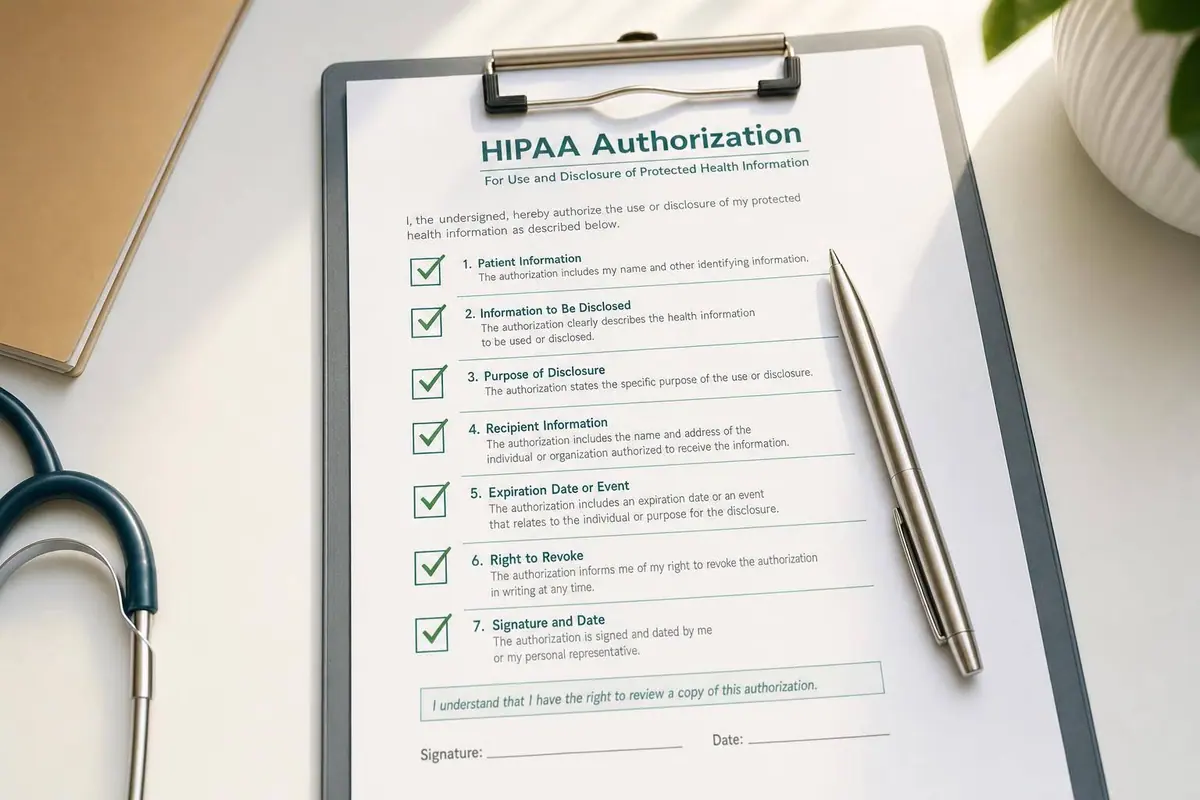
A HIPAA release form is only valid if it includes all 7 required parts. If even one is missing, the disclosure can fail under federal rules.
Here’s the short version: if a use or disclosure falls outside treatment, payment, or health care operations, you usually need a signed HIPAA authorization. And that form must clearly state:
- What PHI can be shared
- Who can share it
- Who can receive it
- Why it can be shared
- When the permission ends
- How the person can revoke it
- The needed notices, plus signature and date
A few points stand out:
- HIPAA authorizations are tied to 45 CFR § 164.508
- A vague form can be just as risky as a missing form
- Some records, like psychotherapy notes and substance use disorder records, may need extra review
- In one OCR case, a provider paid $300,640 after disclosing PHI without a valid, purpose-based authorization
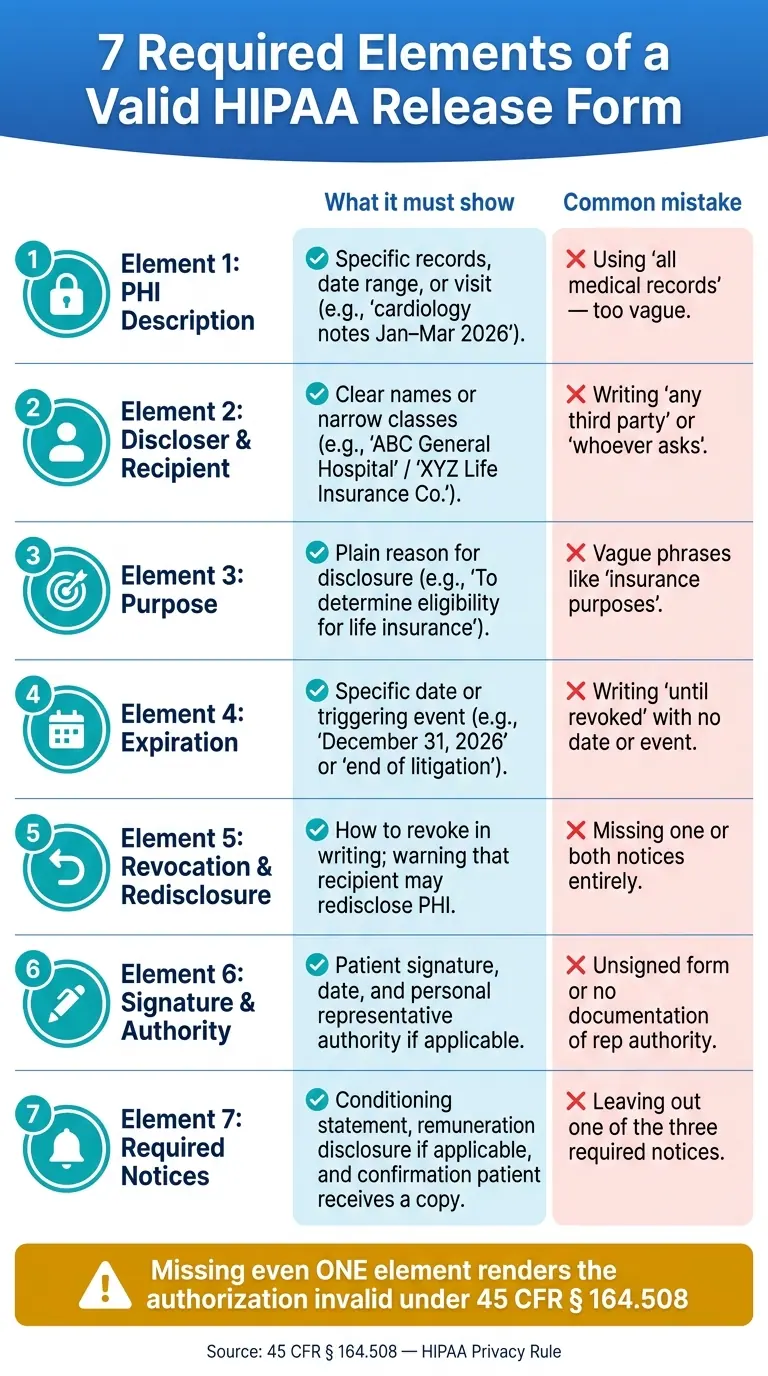
7 Required Elements of a Valid HIPAA Release Form
HIPAA Form Resources
sbb-itb-5f36581
Quick comparison
| Element | What the form must show | Common mistake |
|---|---|---|
| 1. PHI description | Specific records, date range, or visit | “All records” |
| 2. Discloser and recipient | Clear names or narrow classes | “Any third party” |
| 3. Purpose | Plain reason for disclosure | “Insurance purposes” |
| 4. Expiration | Date or event | “Until revoked” |
| 5. Revocation and redisclosure | How to revoke in writing; warning about later sharing | Missing notice |
| 6. Signature and authority | Signature, date, and rep authority if used | Unsigned or no rep proof |
| 7. Required notices | Conditioning, pay-related notice if needed, and copy right | Leaving out one of the notices |
If I had to sum up the article in one line, it would be this: match the form to the exact disclosure, keep each field specific, and check state-law rules before any records go out.
When a HIPAA Release Form Is Actually Required
A HIPAA authorization is required only when a disclosure falls outside treatment, payment, and health care operations (TPO).
That’s the key line to remember.
Under the Privacy Rule, covered entities can usually share PHI for TPO without a signed release. A common example is submitting a claim to a health insurer. That does not need patient authorization.
A signed authorization is needed when the disclosure goes beyond TPO. That includes disclosing records to a life insurer, legal requests, marketing with remuneration, using PHI for research, and most psychotherapy notes. Psychotherapy notes usually need a separate authorization.
Here’s the practical breakdown:
| Disclosure Type | Authorization Required? | Example |
|---|---|---|
| Treatment | No | Sending records to a referring specialist |
| Payment | No | Submitting a claim to a health insurer |
| Health care operations | No | Internal quality review or staff training |
| Marketing (with remuneration) | Yes | Sharing a patient list with a pharmaceutical company for a paid promotion |
| Legal matters | Yes | Disclosing records to a personal injury attorney |
| Research | Yes | Enrolling patients in a clinical trial |
| Psychotherapy notes | Yes | Sharing psychotherapy notes with a third party |
Getting this wrong can create risk from both sides. If a disclosure is outside TPO, a signed authorization is required. Once you know authorization is required, the form must include seven specific elements.
1. Description of PHI to Be Used or Disclosed
Under 45 CFR § 164.508(c), a valid HIPAA authorization must describe the protected health information in specific, meaningful terms. If the description is vague, the authorization can be invalid. In plain English: the form needs to spell out exactly which PHI is covered.
A lot of forms still lean on broad wording like "all medical records" or "everything in my file." That’s where trouble starts. Describe the PHI in specific, meaningful terms; "all medical records" is too broad.
A better approach is to define the PHI by record type, date range, or a specific visit. For example: "cardiology clinic notes from Jan. 1, 2024, through Mar. 31, 2026" or "lab results from Quest Diagnostics, Jan.–Mar. 2026."
For digital forms, a little structure goes a long way. Use checkboxes for common record categories, plus From and To date fields so patients can be precise without guessing. If psychotherapy notes are involved, use a separate authorization.
2. Identification of Who May Disclose and Receive the Information
A valid HIPAA authorization must name who may disclose the PHI and who may receive it. That rule helps stop vague or overly broad disclosures. Just like the PHI description, these parties need to be clear enough that there’s no real doubt about who is involved.
The disclosing party is usually the covered entity that holds the records, such as a hospital, clinic, or health plan. The receiving party might be an attorney, insurer, employer, researcher, or the patient. What matters is clarity on both ends. Wording like "any unspecified third party" is too vague and can make the authorization defective. A class label can work, but only if it is narrow and easy to identify, such as "Any physician within ABC Health System."
When drafting the form, identify the disclosing party by name or department, such as "ABC General Hospital, Health Information Mgmt." For the recipient, list the organization and the recipient’s role. "Sarah Kim, Attorney at Kim & Associates" is much clearer than "my lawyer." It also helps to pre-fill the disclosing organization’s name and use structured form features like recipient fields or checkboxes for common recipient types, such as attorney, insurance company, or self.
Use names when you can. If you use a class label, make sure it is precise.
| Party | Valid Example | Invalid Example |
|---|---|---|
| Discloser | "ABC General Hospital, Health Information Mgmt." | "My healthcare providers" |
| Recipient | "XYZ Life Insurance Co." or "Attorney John Doe" | "Any third party" or "Whoever asks" |
Once the parties are identified, the form must also state why the disclosure is allowed.
3. Purpose of the Use or Disclosure
Once the authorization names who can disclose PHI and who can receive it, it also needs to say why the use or disclosure is allowed.
Under 45 CFR § 164.508(c)(1)(iv), a valid HIPAA authorization must include a meaningful description of the purpose of the use or disclosure. That purpose needs to be specific enough to show what the patient is approving and to limit the disclosure to that stated reason.
A vague phrase like "insurance purposes" doesn't do the job. A description like "To determine eligibility for life insurance" does. The difference is simple: one is broad and fuzzy, the other tells you exactly what the disclosure is for.
Other clear examples include:
- "Coordination of care with Dr. Smith (Cardiology)"
- "Support for a personal injury claim"
- "Participation in [Study Name]"
If the patient starts the request and doesn't want to give a reason, "at the request of the individual" is legally enough.
| Purpose Type | Recommended Description Example |
|---|---|
| Clinical | Continuity of care for specialist referral |
| Financial | Life insurance underwriting or claim review |
| Legal | Support for a personal injury claim |
| Research | Participation in [Study Name] |
This isn't just a paperwork detail. In 2023, a New England dermatology practice settled with OCR for $300,640 after disclosing PHI to an employer without a valid, purpose-specific authorization. If the purpose language is vague, the authorization may be invalid, and that can lead to enforcement risk.
For that reason, the purpose field should be required in prefilled digital forms. Paper authorizations with a missing purpose or a purpose that conflicts with the rest of the form should be rejected.
After purpose, the authorization must also state when it expires.
4. Expiration Date or Expiration Event
Every authorization needs a clear end point. Under 45 CFR § 164.508(c)(1)(v), that means the form must include either a specific expiration date or an expiration event tied to the individual or the purpose of the disclosure. If that piece is missing, the authorization is invalid. And it can’t be vague. Staff need to look at it and know, without guessing, whether the authorization is still active.
The simplest option is a date in the expiration field, such as "December 31, 2026" or "one year from the date of signature." If a date doesn’t make sense for the situation, use a specific event instead. Common examples include "end of litigation," "completion of treatment episode," or "final claim determination." One thing to avoid: "until revoked" on its own does not work.
Here’s a simple way to think about it:
| Expiration Type | Clear Language Examples | Typical Use Case |
|---|---|---|
| Calendar date | "December 31, 2026" | Standard clinical requests, insurance audits |
| Triggering event | "End of litigation", "Final claim determination" | Legal cases, specific episodes of care |
For research databases or repositories, HIPAA permits "end of the research study" or "none" as the expiration point. That exception does not apply to standard clinical or insurance authorizations, which still need a clear end point.
In digital forms, make the expiration field required. In paper workflows, check the expiration before any release happens. If the listed date has passed, or the event already happened, and disclosure is still needed, the answer is simple: get a completely new authorization signed.
Next, the form needs to explain how revocation works and what happens after disclosure.
5. Statements About Revocation and Redisclosure
A valid authorization also needs to tell the patient how to cancel it and what can happen after the information is shared.
Under HIPAA, the form must include two notices. The first must say that the patient can revoke the authorization in writing, explain how to send that revocation, and make clear that revocation does not apply to actions already taken based on the authorization. The second must warn that the person or organization receiving the information may redisclose it, and that once that happens, the information may no longer be protected by the HIPAA Privacy Rule.
In plain English, the revocation statement can read: "You may revoke this authorization in writing at any time by sending your request to our Privacy Officer at [address]. Revocation will not affect any actions already taken based on this form."
For SUD records, 42 CFR Part 2 may also limit redisclosure.
The authorization must also include a signature, date, and any personal representative authority that applies.
6. Signature, Date, and Personal Representative Authority
Even if the notice language is there, the authorization still fails without a valid signature and date. Under 45 CFR § 164.508, a valid HIPAA authorization must include the signature of the individual, or the individual's personal representative, and the date of the signature. If the form is unsigned or undated, it's invalid.
When someone other than the patient signs, the form also needs a clear description of that person's legal authority to act for the individual. This matters more than people think. A signature by itself doesn't do the job if the form doesn't say why that person has the right to sign.
Common personal representatives include:
- Parents
- Legal guardians
- Healthcare proxies
- Court-authorized representatives
A simple fix is to add a field labeled "Representative Authority." If a personal representative signs, the form must state that person's legal authority. Keep the supporting authority document with the authorization.
For online forms, require signature and date fields. Also include an upload field for representative authority documents. Electronic signatures are valid if they meet applicable e-signature laws and the form includes every HIPAA element.
The final required element is the notice language on conditioning, compensation, and copies.
7. Required Notices on Conditioning, Compensation, and Copies
A valid HIPAA authorization needs to spell out three things: whether signing is required for treatment, payment, enrollment, or benefits; whether money is tied to the disclosure; and whether the person signing will get a copy of the form.
Conditioning: The form must say if signing is required for treatment, payment, enrollment, or benefits. Most of the time, it is not. If one of the limited exceptions applies, such as certain research or enrollment situations, the form needs to say that in clear terms.
Compensation: If the authorization covers marketing or the sale of PHI, the form must disclose any financial payment connected to that disclosure. A plain-language statement such as, "[Covered Entity Name] will receive financial remuneration from a third party for the use or disclosure of your PHI for marketing purposes," meets this requirement.
The right to a copy: The person who signs must receive a copy of the signed authorization. In a paper process, that usually means handing over a photocopy right after signing. In a digital process, send the signed form as a secure PDF, through encrypted email, or through a portal.
For digital forms, put these notices before the signature step.
How to Use These Elements in Digital and Online Authorization Forms
Once the authorization language is right, the next step is building the digital form around it. Putting a HIPAA authorization online changes how you collect it. It does not change the legal rules.
Multi-step layouts help with the plain-language standard. A long, packed one-page form can be hard to read. Split that same authorization into clear screens, and the required fields and statements become much easier to check. That lowers the odds that a signer misses something critical.
Conditional logic is also useful when the form needs to handle more than one path. Say a user selects marketing as the disclosure purpose. The form can show the purpose-specific language only at that point. That keeps the main flow simple while still showing extra language when sensitive records are involved.
Validation, date stamps, and audit trails are the backbone of a digital process you can defend. Real-time validation can block submission when a required field is left blank. Automated date stamps record the signed version and time stamp. And an audit log that shows who signed, when, and what was disclosed can support compliance reviews. Those controls help cut errors, but the wording still needs legal review.
You can build this with a no-code tool, a custom workflow, or a portal that supports:
- Multi-step forms
- Conditional logic
- Validation
- Audit logs
Your privacy officer and counsel should review the final language.
Common Drafting Mistakes That Can Put a Release Form at Risk
If any required element is vague or missing, the authorization is invalid under HIPAA. The most common defects tend to show up in five patterns.
Here’s where forms most often go off the rails:
- Vague PHI descriptions and broad recipient labels are the most common drafting errors. Both can invalidate the authorization.
- Missing expiration terms or undocumented representative authority also void the form.
- Missing required notices - the redisclosure warning, the conditioning statement, and the remuneration disclosure when applicable - make the entire form defective. A defective form can make the disclosure impermissible.
- Another common error is bundling a HIPAA authorization with unrelated consent forms. This is invalid or misleading and must be avoided.
- Sensitive record types such as psychotherapy notes may need a separate, standalone authorization.
A good rule of thumb: each sentence in a completed form should line up with one of the seven required elements. If any field is blank, vague, or mixed with unrelated content, fix it before any disclosure happens.
Conclusion
A HIPAA release form is more than a signature page. It is a legal document, and to be valid, it must include the required elements and statements under 45 CFR § 164.508. If the form leaves out a required item, uses unclear language, or is filled out the wrong way, the authorization is invalid.
Use this checklist as the final review before any disclosure.
| Checklist Element | What to Confirm |
|---|---|
| 1. Description of PHI | Specific PHI and date range |
| 2. Discloser & Recipient | Named parties or clear classes |
| 3. Purpose | Stated reason |
| 4. Expiration | Date or triggering event |
| 5. Revocation & Redisclosure | Revocation rights and redisclosure warning |
| 6. Signature & Authority | Signed, dated, and authority shown if applicable |
| 7. Required Notices | Conditioning and remuneration notices; copy provided |
Once the HIPAA checklist is done, take one more pass for stricter state-law or special-record rules. Check state law for stricter privacy rules. Some records may need separate authorizations, including substance use disorder records, psychotherapy notes, and HIV/AIDS information. If the record falls into one of those categories, send it for added review before release.
Match each form to the exact disclosure. A narrow form lowers liability and makes the permission clear for everyone involved.
FAQs
When do I need a HIPAA release form?
You need a HIPAA release form when you want to share protected health information for a purpose that the HIPAA Privacy Rule does not otherwise allow.
In most cases, you do not need one for:
- Treatment
- Payment
- Health care operations
A signed authorization is required for uses like marketing, the sale of protected health information, psychotherapy notes, or sharing records with third parties such as employers, life insurers, or attorneys.
Can a broad or vague HIPAA authorization be invalid?
Yes. A broad or vague HIPAA authorization can be invalid and create serious compliance risk.
For an authorization to hold up, it needs to be clear and specific. Blanket wording like “all records” is risky and often not enough on its own. The form should spell out the protected health information being released by specific categories and date ranges. It also needs a clear expiration date or a defined expiration event.
If those core details are missing, the authorization is defective.
Do some records require separate authorization?
Yes. Under HIPAA, psychotherapy notes usually need their own clear, specific authorization. They generally can’t be lumped in with other authorization forms.
The same can apply to other sensitive records. For example, substance use disorder records, or health information covered by stricter state laws, may need a separate form or added consent steps.
It’s also smart to avoid bundling authorizations for different uses, such as research, unless a specific exception applies.
Related Blog Posts
Get new content delivered straight to your inbox

The Response
Updates on the Reform platform, insights on optimizing conversion rates, and tips to craft forms that convert.



Drive real results with form optimizations
Tested across hundreds of experiments, our strategies deliver a 215% lift in qualified leads for B2B and SaaS companies.
