
.webp)
Scaling Cross-Channel Nurturing with Automation



Most B2B buyers don’t convert after one interaction. Between 50% and 80% of leads who eventually convert aren’t ready to buy during their first engagement. This is where cross-channel nurturing, powered by automation, becomes essential. By 2026, 94% of marketers will use multiple platforms like email, SMS, social media, and ads to guide prospects through the buyer’s journey. Automation ensures these channels work together, delivering timely, personalized interactions at scale.
Here’s what you’ll learn in this guide:
- How to set clear goals and integrate data for efficient workflows.
- Designing trigger-based systems that adapt to real-time lead behavior.
- Running coordinated campaigns across multiple channels.
- Tracking and optimizing performance with clean data.
Automation doesn’t just save time - it drives results. Companies using lead nurturing strategies see 50% more sales-ready leads at a 33% lower cost. Let’s dive into how you can build a scalable, automated system.
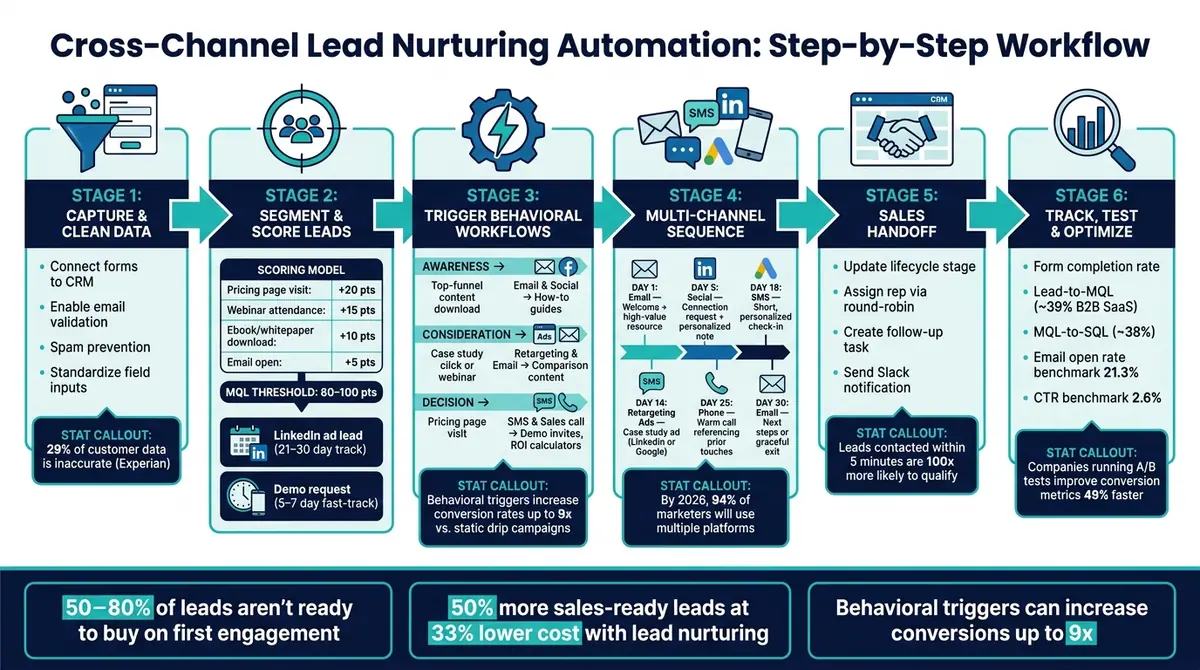
Cross-Channel Lead Nurturing Automation: Step-by-Step Workflow
MULTIPLE Lead Nurture Workflows For Your Digital Marketing Agency
sbb-itb-5f36581
Setting Up the Groundwork for Cross-Channel Automation
Before diving into workflows, it's crucial to lay a solid foundation. Skipping this step - without clear goals, integrated tools, and clean data - can lead to inefficiencies and missed opportunities.
Setting Goals and Defining Success Metrics
Start by defining what success means for your team. Goals like "nurture more leads" are too vague to track progress or justify resources. Instead, focus on specific, measurable targets tied to outcomes, such as improving your Marketing Qualified Lead (MQL) to Sales Qualified Lead (SQL) conversion rate or reducing average lead response times.
Organize your metrics into categories that reflect both efficiency and impact. Here's a breakdown:
| Metric Category | What to Measure |
|---|---|
| Lead Quality | MQL-to-SQL conversion rate, lead score distribution |
| Channel Performance | Open rates, click-through rates, ad engagement by channel |
| Operational Efficiency | Workflow completion rates, average time-to-contact |
| Revenue Attribution | Pipeline value influenced by nurture, cost per SQL in USD |
To ensure smooth collaboration between marketing and sales, align both teams around these shared metrics. Agree on clear definitions - such as what triggers a lead to become an SQL - to avoid confusion during handoffs.
Once your goals and metrics are set, ensure your forms are integrated to support seamless data flow into your workflows.
Connecting Forms to Automation Tools
Forms are often the first interaction a lead has with your system, making them a critical piece of the puzzle. If the data from these forms isn’t automatically flowing into your CRM or marketing automation platform, you’re already facing inefficiencies.
Accurate metrics rely on dependable data inputs, and this starts with your forms. Tools like Reform connect directly to CRMs and automation platforms, ensuring every form submission - whether it’s a demo request, content download, or inquiry - automatically triggers the appropriate workflow. Plus, because Reform is a no-code platform, you can set up these integrations without needing a developer. Use conditional logic to route leads based on their responses and seamlessly pass structured data into your CRM from the very first interaction.
Keeping Data Clean and Consistent
Inaccurate or inconsistent data - like invalid emails, missing job titles, or inconsistently formatted company names - can derail automation efforts. To avoid these issues, focus on cleaning data at the point of capture.
Here’s how to keep your data clean:
- Use email validation to catch errors before they enter your system.
- Implement spam prevention tools to filter out bot submissions.
- Standardize field inputs (e.g., dropdown menus for fields like "Industry").
Centralizing all this information in one CRM ensures your team has a complete view of each lead’s history, behavior, and acquisition source. This unified perspective is essential for accurate lead routing and creating personalized outreach.
Designing a Cross-Channel Nurture System
Once your CRM is equipped with clean data and your metrics are in place, it’s time to create the framework for your nurture system. This is where planning transitions into action, laying the groundwork for running synchronized, multi-channel campaigns.
Mapping the Buyer's Journey to Automation Triggers
Instead of sticking to rigid, time-based sequences like "Day 1, Day 3, Day 7", design workflows that adapt to lead behavior. Why? Because a lead who checks out your pricing page on Day 2 is in a much different mindset than someone downloading a top-of-funnel ebook. Your system needs to respond to their actions, not just their timeline.
You can align each stage of the buyer’s journey with specific trigger events. Here’s an example:
| Journey Stage | Trigger Event | Channel Action | Content Type |
|---|---|---|---|
| Awareness | Top-funnel content download | Email & Social | How-to guides, frameworks |
| Consideration | Case study click or webinar attendance | Retargeting & Email | Social proof, comparison content |
| Decision | Pricing page visit | SMS & Sales call | Demo invites, ROI calculators |
Also, define clear exit conditions. For instance, remove leads from workflows as soon as they engage with sales to avoid redundant communications.
"The goal isn't to send more emails. The goal is to surface sales-ready intent automatically." - Mason Phillips, HubSpot Expert
Segmenting Leads and Scoring for Targeted Outreach
Not all leads follow the same path, so your nurture system shouldn’t treat them all the same. For example, a lead from a LinkedIn ad might need a longer, awareness-focused sequence (21–30 days), while someone who requests a demo should be fast-tracked into a shorter sequence (5–7 days) with a quick sales follow-up.
Start by using form data - like job titles, company size, or the page they converted on - to assign leads to the right segment immediately. Then, add behavioral scoring to track their intent over time. A scoring model could look like this:
| Action | Points |
|---|---|
| Pricing page visit | +20 |
| Webinar attendance | +15 |
| Ebook/whitepaper download | +10 |
| Email open | +5 |
| MQL threshold | 80–100 points |
When a lead hits your MQL threshold, trigger an automatic sales handoff. This could be a Slack notification or a CRM task, with a 24-hour response time to ensure no opportunities are missed. By combining segmentation and scoring, your workflows can scale while staying precise.
Building Modular Workflows for Scale
With clean data and clear metrics, you can build modular workflows that adapt to lead activity. These might include tracks for welcoming new leads, educating them, helping them evaluate options, and finally transitioning them to sales.
Stick to a 3-to-1 content ratio: share three pieces of actual value - like educational articles, useful frameworks, or case studies - before making a direct sales pitch. Additionally, set a hard 30-day limit for active nurturing. Leads that don’t engage after 30 days should be moved to a low-frequency re-engagement track. This approach protects your email deliverability while keeping your main workflows focused on leads who are actively engaging with your content.
Running Multi-Channel Workflows
Once you've defined your segments and built modular workflows, it's time to bring them to life. This means connecting email, SMS, ads, and sales outreach into one cohesive system instead of running them as separate efforts. At this stage, your clean data and modular workflows come together across multiple channels.
Using Email as the Core Channel
Email serves as the backbone of your strategy. Every other channel should complement it, not compete with it. Set up automated email sequences triggered by specific behaviors, and personalize messages using CRM data tailored to each lead's role and company size. For instance, a VP of Marketing at a 500-employee SaaS company should receive a different email than a founder of a 10-person startup, even if both downloaded the same resource.
To make your emails even more effective, schedule them based on the recipient's time zone, ensuring they land at the most convenient local time.
"The sequence should respond to real-time signals, not just elapsed time." - Camellia, Principal Product Marketing Strategist, Rework
After establishing email as your foundation, integrate SMS, retargeting ads, and sales outreach to create a seamless multi-channel experience.
Adding SMS, Ads, and Sales Outreach
Think of SMS, ads, and sales outreach as layers that strengthen your email campaigns. Each channel plays a specific role depending on the lead's stage in the funnel.
Here’s a sample sequencing model for layering channels effectively:
| Day | Channel | Action |
|---|---|---|
| 1 | Welcome + high-value resource | |
| 5 | Social | Connection request + personalized note |
| 14 | Retargeting Ads | Case study ad (LinkedIn or Google) |
| 18 | SMS | Short, personalized check-in |
| 25 | Phone | Warm call referencing prior touches |
| 30 | Next steps or graceful exit |
Retargeting ads create a "surround-sound" effect. Imagine a lead who has already opened a few emails and then sees a LinkedIn ad showcasing a relevant case study. This reinforces your message without feeling overbearing. Use tools like LinkedIn Matched Audiences or Google Customer Match to ensure your ads align with your email messaging.
SMS is best reserved for high-intent moments, such as when a lead clicks on a demo link or signs up for an event. A timely, concise SMS at these points can turn interest into action, like booking a meeting. To maintain its effectiveness, use SMS sparingly as a strategic nudge.
When a lead hits the Marketing Qualified Lead (MQL) threshold, your workflow should handle the sales handoff automatically. This includes updating the lifecycle stage, assigning the lead to a sales rep via round-robin, creating a follow-up task, and sending a Slack notification - all without requiring manual input.
Using Reform to Trigger and Route Workflows
For smooth multi-channel integration, tools like Reform can ensure your data and workflows are precise. The quality of your outputs depends on the quality of your inputs, making your form design critically important. Reform’s multi-step forms allow you to collect richer data in stages. Start with basic details like name and email, then request additional information, such as job title or company size, in later steps. This approach reduces form abandonment while giving your CRM the context it needs to route leads correctly.
Reform’s conditional routing adds another layer of precision. Based on a lead’s responses - like team size or their primary use case - the form can automatically assign them to the right workflow. For example, a lead selecting "Enterprise (500+ employees)" might enter a high-touch sequence with quicker sales engagement, while someone choosing "Solo / Freelancer" could be placed in a longer, self-serve nurture track. This routing happens instantly upon form submission, eliminating the need for manual reviews.
Reform also integrates directly with CRM and marketing automation tools via API, ensuring real-time lead data flow. With built-in email validation and spam prevention, you're not just capturing more leads - you’re capturing accurate ones that won’t skew your MQL metrics or harm your email deliverability.
Tracking Performance and Scaling the System
Measuring Form and Channel Performance
Once your multi-channel campaigns are live, tracking their performance becomes essential. Focus on metrics that tie form activity to actual business results: form completion rate, lead-to-MQL conversion rate, MQL-to-SQL conversion rate, and meeting-booked rate. These metrics reveal whether your system is effectively advancing leads through the funnel, not just capturing them.
For example, an 18% form conversion rate might look promising, but if most of those leads fail to progress to MQLs, it signals deeper issues. This could point to problems with your routing logic, scoring criteria, or follow-up process - not just the form itself. Tools like Reform offer real-time analytics, helping you quickly identify where leads drop off in multi-step forms. This means you can address issues immediately rather than waiting for monthly reports to uncover them.
When it comes to channel-specific tracking, each touchpoint requires its own metrics. For email, monitor open rates, click-through rates, and reply rates. For SMS, focus on response and opt-out rates. With ads, measure cost per SQL. The key is to ensure every channel contributes to overall conversion outcomes. For reference, Mailchimp's 2023 data shows average B2B email open rates at 21.3% and click-through rates at 2.6%. By aligning all channels to shared conversion goals, you avoid prioritizing the loudest channel over the most effective one.
Testing and Refining Workflows
Improving your nurture system requires ongoing testing. Experiment with one variable at a time - such as subject lines, email length, form design, send timing, or channel combinations - to identify what works best.
For email campaigns, HubSpot suggests running A/B tests for 1–2 weeks with at least 1,000 recipients per variant to ensure reliable insights. For forms, consider testing multi-step versus single-step designs early on. Many experts in conversion rate optimization report that multi-step forms can boost completions by 10–30% because they feel less overwhelming to users. However, if lead quality drops despite higher completion rates, the “winning” form may not be truly effective. Strive to balance both volume and lead quality, rather than focusing solely on top-of-funnel metrics.
Prioritize tests that have the potential for the greatest impact. A small improvement at the top of your funnel can lead to significant gains throughout the entire process. In fact, companies that consistently run A/B tests improve their conversion metrics 49% faster than those that don’t. However, consistent testing must go hand-in-hand with strong data management practices to ensure lasting improvements.
Maintaining Data Quality and Compliance
Once you’ve established clean and integrated data systems, maintaining their quality is crucial for long-term success. Issues like duplicate contacts, invalid email addresses, and inconsistent field values can hurt segmentation, inflate costs, and reduce campaign performance. According to Experian, 29% of customer data is believed to be inaccurate, and 95% of organizations report that poor data quality negatively affects their operations. IBM estimates that these issues cost U.S. businesses around $3.1 trillion annually.
The solution starts with capturing accurate data upfront. Features like email validation and spam prevention help block bad submissions before they can disrupt your metrics. Keeping bounce rates below 2% is critical for maintaining a good sender reputation, as noted in Validity's 2023 Email Deliverability Benchmark report. Proactively filtering out invalid addresses makes it easier to stay within this threshold.
On the compliance side, U.S. teams must adhere to CAN-SPAM regulations for email and TCPA consent rules for SMS. It’s important to remember that opting in for email doesn’t automatically grant permission for text messages - separate consent is required. To ensure compliance, build suppression lists, opt-out processes, and consent tracking into your workflows from the beginning. Addressing these requirements early will save you from complications as your system scales.
Conclusion and Implementation Checklist
Now that we've gone through the critical elements, here's a streamlined guide to help you build and execute a fully integrated, cross-channel nurture strategy.
Key Takeaways
A robust cross-channel nurture system hinges on a few core principles. Behavioral triggers consistently outperform static drip campaigns, with the potential to increase conversion rates by up to 9x. The journey starts with high-converting lead forms - they’re the gateway. When forms are linked to your CRM and set up to route leads effectively from the start, every subsequent workflow benefits.
To keep your outreach relevant, focus on segmentation and lead scoring. Incorporating 3–5 channels - such as email, SMS, retargeting ads, LinkedIn, and sales outreach - creates a multi-touch experience that nudges leads forward without over-relying on any one method. As your system scales, maintaining data accuracy and compliance ensures everything continues to function smoothly. Below is a checklist to help you turn these principles into actionable steps.
Step-by-Step Implementation Roadmap
Use this checklist to roll out each component of your nurture system in sequence:
- Connect your forms to a CRM: Use powerful form templates from Reform to link your forms to your CRM. Enable email validation and spam filters, and ensure every form field maps directly to a CRM property for clean data from the start.
- Define your segments: Group leads based on behavior, industry, and readiness - not just demographics. For instance, someone who downloads a pricing guide should be treated differently than someone who reads a blog post.
- Set your lead scoring rules: Assign points to key actions, such as +20 for visiting a pricing page or +10 for downloading a whitepaper. Establish your MQL threshold at 80 points.
- Build your core email workflow: Start with a five-email sequence triggered by form submissions. Add SMS follow-ups on Day 5 and retargeting ads by Day 14.
- Establish a sales SLA: When a lead reaches the MQL threshold, trigger an automated notification for the sales team with a 24-hour response deadline. Leads contacted within five minutes are 100x more likely to qualify.
- Set exit conditions: Define clear exit criteria for each sequence - remove leads after 30 days of inactivity or upon conversion. This keeps your deliverability intact and your scoring model accurate.
- Track and refine: Keep an eye on key metrics like form completion rates, lead-to-MQL conversion rates (~39% for B2B SaaS), and MQL-to-SQL conversion rates (~38%). Test one variable at a time, and double down on strategies that work well.
FAQs
What triggers should I automate first?
To expand cross-channel nurturing efforts, focus on automating these crucial triggers:
- Form Submissions: Set up nurture tracks to activate whenever someone fills out forms for things like demo requests or content downloads.
- High-Intent Actions: Automate follow-ups for leads who visit key pages, such as pricing or case studies.
- Lead Score Thresholds: Send leads to the sales team once they reach specific score benchmarks.
- Re-engagement: Reconnect with leads who show renewed interest after 60–90 days of inactivity.
Make sure your data is accurate and define clear exit rules to prevent overwhelming your leads with too many messages.
How do I set an MQL score that sales will trust?
To ensure your MQL (Marketing Qualified Lead) scoring system earns the trust of your sales team, it's all about collaboration and clear criteria. Start by working together to define the traits, behaviors, and intent signals that truly matter. For example, visiting a pricing page might indicate strong interest and could be worth assigning +20 points.
Establish a clear scoring threshold - say, 80 points - to determine when a lead is ready to pass to sales. Don’t forget about negative scoring. This allows you to subtract points for disqualifying factors, like irrelevant job titles or industries, ensuring only qualified leads make the cut.
Finally, create a feedback loop. Encourage sales to flag leads that don’t meet expectations. This feedback helps marketing fine-tune the scoring model, making it more accurate over time. It’s a continuous process, but it’s key to keeping both teams aligned and effective.
When should I add SMS and retargeting to email?
Adding SMS and retargeting to your email nurturing strategy can help reinforce your brand and nudge prospects closer to converting. Retargeting ads are perfect for reminding leads about actions they’ve already taken, like visiting a specific page or interacting with an asset. On the other hand, SMS is ideal for real-time engagement, allowing you to connect instantly.
By aligning these channels with your email efforts, you can create consistent and timely messaging that meets your audience right when they're making decisions.
Related Blog Posts
Get new content delivered straight to your inbox

The Response
Updates on the Reform platform, insights on optimizing conversion rates, and tips to craft forms that convert.



Drive real results with form optimizations
Tested across hundreds of experiments, our strategies deliver a 215% lift in qualified leads for B2B and SaaS companies.
