
.webp)
Checklist for Vendor Cybersecurity Awareness



Your data security is only as strong as the vendors you work with. By 2025, third-party providers will account for 30% of breaches. A single oversight, like skipping multi-factor authentication, can lead to catastrophic consequences - as seen in Change Healthcare's 2024 ransomware attack, which cost up to $2.45 billion.
This guide helps you build a vendor cybersecurity training program to minimize risks. Key steps include:
- Identifying Vendors: Classify vendors by risk level (e.g., sensitive data handlers vs. low-risk providers).
- Setting Goals: Examples include 95% MFA adoption or reducing phishing click rates by 40%.
- Training Topics: Cover basics like password hygiene, multi-factor authentication, secure coding, and threat response.
- Delivery & Enforcement: Use short, frequent modules and enforce compliance with reminders and access restrictions.
- Verification: Track metrics like phishing click rates (<1.5%) and ensure all training is documented for audits.
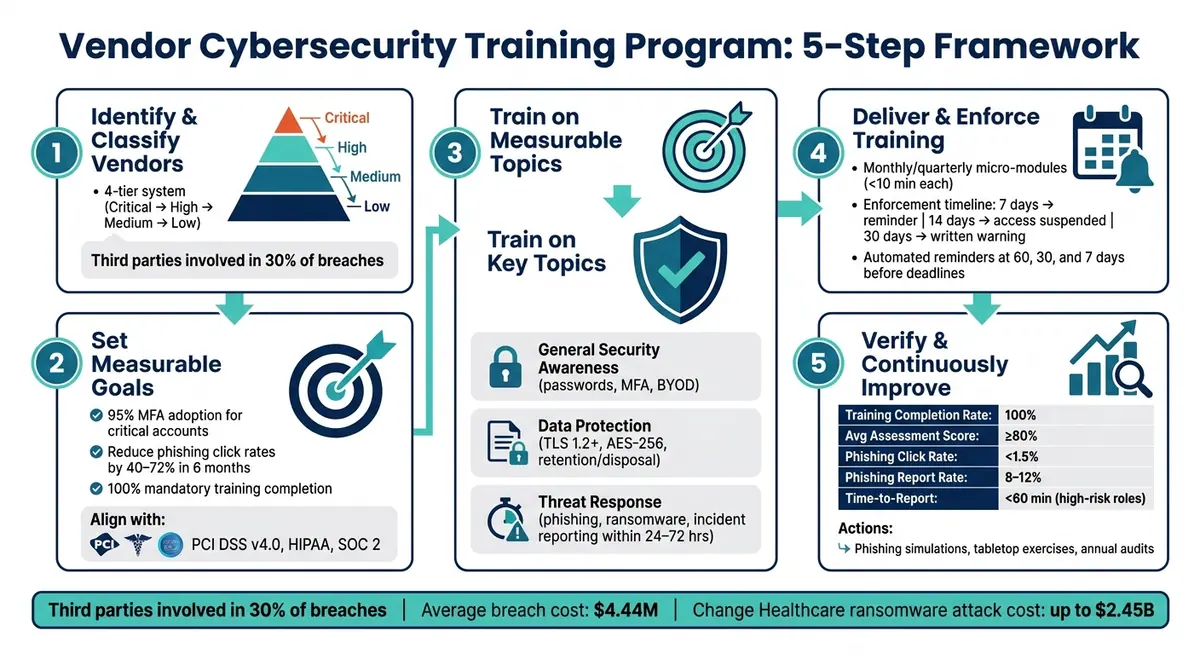
Vendor Cybersecurity Training Program: 5-Step Framework
Mastering Vendor Management | Cybersecurity Vendor Risk Management Training | TPRM
sbb-itb-5f36581
Defining the Scope and Objectives
This step focuses on identifying relevant vendors and setting clear training goals to strengthen cybersecurity awareness. By defining the scope and tailoring training to vendor risk levels, you can allocate resources effectively and stay focused.
Identifying In-Scope Vendors
Start by creating an inventory of all vendors providing services or tools that interact with your data and systems. Use a tiered classification system to decide which vendors require cybersecurity training. Evaluate vendors based on three key factors: whether they handle sensitive data (such as PII, PHI, or cardholder data), whether they have credentials, API connections, or network access to your production systems, and whether they operate in a regulated environment.
| Tier | Criteria | Training Requirement |
|---|---|---|
| Critical (Tier 1) | Handles sensitive data; essential to operations | Annual SOC 2 review, security questionnaire, role-specific training |
| High (Tier 2) | Accesses customer data; supports critical functions | Annual detailed questionnaire, contract review |
| Medium (Tier 3) | Accesses internal data only; easily replaceable | Basic security verification every 2 years |
| Low (Tier 4) | No sensitive data access; non-critical | Basic due diligence at onboarding |
Don't forget to account for fourth-party risks by mapping subprocessors. Hidden dependencies are increasingly scrutinized under frameworks like PCI DSS v4.0 and the EU's NIS2.
With a refined vendor list in hand, the next step is to establish specific training objectives.
Setting Measurable Training Goals
Define clear, actionable goals to measure the impact of your training efforts. Examples include:
- Reducing phishing click rates by 40–72% within six months.
- Achieving 100% completion of mandatory training modules for all relevant vendor personnel.
- Ensuring 95% MFA adoption for critical accounts.
Align these goals with recognized frameworks like PCI DSS v4.0 (§12.6.1), HIPAA (§164.308(a)(7)(i)), and SOC 2 (CC1.4/CC2.2) to meet both behavioral improvement and compliance requirements.
Once goals are set, assign roles to ensure smooth execution.
Assigning Roles and Responsibilities
To keep the program on track, assign responsibilities clearly using a RACI matrix.
"A program without a defined governance structure loses momentum within two quarters." - Adaptive Team
Here’s how roles might break down:
- CISO: Oversees the program and reports to the board.
- Security Awareness Manager: Develops content strategy and measures outcomes.
- IT: Handles technical aspects like deployment and provisioning.
- HR: Manages enrollment and communications.
- Compliance and Legal: Ensures training aligns with regulations and maintains audit records.
Key Topics for Vendor Cybersecurity Training
Once you've defined the vendor scope and training objectives, it's time to focus on the essential cybersecurity areas. These can be grouped into three main categories: general security awareness, data protection, and threat response.
General Security Awareness
A strong cybersecurity program starts with teaching the basics of security hygiene. Vendors need to understand how to create strong passwords, use password managers, and, most importantly, enable Multi-Factor Authentication (MFA). Strive for near-total MFA adoption (95%–100%) on critical accounts to minimize credential-based attacks.
Physical security is just as important. Vendors should follow clean desk policies, manage visitor access carefully, and adopt secure remote work practices to keep devices safe from unauthorized access. Additionally, they should know the rules for using company systems, personal devices (BYOD), and professional social media accounts.
For roles with higher risk, such as developers or system administrators, general awareness isn't enough. Developers should dive into secure coding practices and the OWASP Top 10 vulnerabilities, while system administrators need to focus on privileged access management and system hardening techniques.
Data Protection and Privacy Practices
With over 60% of data breaches involving third-party vendors, data protection is a critical training area. Vendors should learn about data classification levels and the importance of encryption - specifically TLS 1.2+ for data in transit and AES-256 for data at rest. Secure methods for transmitting sensitive information should also be covered.
Clear guidelines on data retention and disposal are essential. Vendors must understand how to securely delete data and verify its removal when contracts end. This offboarding step should also include revoking all access rights. Vendors should also be aware of their fourth-party responsibilities, ensuring their subcontractors adhere to the same security standards.
Threat Awareness and Response
Vendors need to recognize common attack methods like phishing (including vishing), social engineering, and ransomware. These threats are significant, with ransomware and similar attacks accounting for about 25% of breaches.
But recognizing threats isn't enough. Vendors must know what qualifies as a security incident, how to report it promptly, and who to contact. Reporting timelines often range from 24 hours for high-risk breaches to 72 hours, aligning with GDPR standards.
"Your security is only as strong as your weakest vendor." - Lorikeet Security
To tailor training effectively, consider the specific risks associated with each role. Here's a breakdown:
| Role | Additional Training Topics |
|---|---|
| Developers | Secure coding, OWASP Top 10, code review security |
| System Admins | Privileged access management, system hardening, incident detection |
| Finance | Wire fraud prevention, invoice scams, payment verification |
| Customer Support | Social engineering defense, data verification, escalation |
| Executives | Business email compromise, "whale phishing", board-level security |
Delivering and Enforcing Training
Knowing what to teach is only part of the challenge. The real impact comes from how the training is delivered and enforced. Without effective strategies, vendors might just skim through slides for a certificate, missing the real value of the material.
Setting Training Frequency
Think of vendor cybersecurity training as an ongoing effort, not a one-and-done event. While annual sessions meet the basic requirements for standards like SOC 2, HIPAA, and PCI DSS 4.0.1, shorter and more frequent sessions are far more effective. Monthly or quarterly micro-learning modules, each under 10 minutes, help keep security top of mind and reinforce key practices.
Start with baseline training before granting system access. Then, add targeted sessions when specific triggers occur - like a failed phishing test, a role change involving higher privileges, or a security breach. From there, focus on finding the best way to deliver these lessons.
Choosing Delivery Methods
The way training is delivered matters just as much as the content. Micro-learning modules have become a favorite because they fit into busy schedules and improve retention better than long, annual sessions. If vendors already use a Learning Management System (LMS), SCORM or xAPI-compatible modules can integrate smoothly, making completion easier.
For more complex scenarios, like addressing high-risk roles or responding to major security events, live or virtual instructor-led sessions are still valuable. These sessions allow for deeper discussion and real-time Q&A. However, for everyday training needs, self-paced modules tend to be more practical, leading to higher completion rates. Clear guidelines for completing training ensure everyone stays on track, creating a more secure vendor environment.
Enforcing Training Completion
Delivering training is one thing - ensuring it gets done is another. Accountability is key, and strong enforcement mechanisms make all the difference.
"A policy turns that into something an auditor can verify." - Upendra Varma, ComplyJet
Here’s an effective enforcement timeline to keep vendors accountable:
| Days Overdue | Action Taken |
|---|---|
| 7 days | Automated reminder sent; vendor manager notified |
| 14 days | Access to sensitive systems suspended |
| 30 days | Written warning issued; documented in vendor record |
| Repeated failure | Escalation to department head; potential contract review |
To avoid overdue training in the first place, automated reminders - scheduled 60, 30, and 7 days before deadlines - can reduce last-minute rushes. If a vendor fails a phishing simulation, they should be enrolled in remedial training within 14 days. This approach focuses on correcting behavior rather than punishing mistakes, which ultimately leads to better outcomes.
Verification and Continuous Improvement
Training enforcement is just the beginning. To truly strengthen your program, you need to verify its success and address any gaps along the way.
Collecting Evidence and Metrics
Tracking completion rates isn’t enough to measure awareness or behavior. As Alan Parker wisely points out:
"Completion ≠ awareness. Awareness ≠ behaviour change."
The focus should be on behavioral metrics - like phishing click rates, reporting rates, and how quickly suspicious emails are flagged. Below is a practical target framework to aim for:
| Metric | Target |
|---|---|
| Training Completion Rate | 100% |
| Average Assessment Score | ≥ 80% |
| Phishing Click Rate | < 1.5% |
| Phishing Report Rate | 8–12% |
| Time-to-Report Suspicious Email | < 60 minutes for high-risk roles |
| New Hire Training Completion | Within 30 days of hire |
For audits, keep a solid evidence pack. This should include LMS logs, training materials, quiz results, and signed Acceptable Use Policy (AUP) acknowledgments. Auditors will want to see that training is not only tracked but also acted upon.
Active testing is another essential step to validate the program’s effectiveness.
Running Tests and Simulations
Simulations uncover weaknesses that self-reported metrics might miss. Regular phishing simulations and annual tabletop exercises are invaluable for spotting training gaps and testing incident response. Share phishing simulation results with vendors to promote transparency and accountability.
Tabletop exercises are particularly useful for Tier 1 critical vendors. These scenario-based discussions test how well a vendor can think through an incident response. Aim to run these annually. For lower-tier vendors, a simpler walkthrough of their incident response plan works as an alternative.
The key to any simulation is the debrief. Document what went wrong, assign corrective actions, and set deadlines. Without follow-up, simulations lose their impact and become little more than a performance.
Audit and Review Processes
Once testing is complete, regular audits ensure compliance and steady progress. The depth of the audit should align with vendor risk levels. Critical vendors require a thorough annual review, including SOC 2 reports, detailed questionnaires, and evidence of recent testing. Lower-risk vendors may only need a light review during onboarding and renewal.
When reviewing SOC 2 reports, take note of Complementary User Entity Controls (CUECs). These are controls the vendor expects you to have in place. If you’re missing them, that’s a gap in your security framework - not theirs. Additionally, maintain an exceptions log to track training failures, corrective actions, and their outcomes. As the compliance principle goes:
"In compliance, what is not documented is treated as if it did not exist." - PrivaLex
A truly effective program doesn’t just show a clean completion report. It demonstrates a consistent cycle of training, measurement, follow-up, and refinement. These insights help adjust training content and delivery, ensuring the program evolves and improves over time.
Using Reform to Simplify Vendor Assessments

Once your verification processes are in place, managing vendor data becomes much easier with structured forms. Relying on email threads or shared drives often results in missing information - 45% of organizations fail to gather complete vendor security details through questionnaires alone. Reform solves this by replacing unstructured outreach with standardized, repeatable forms, creating a clear and defensible record of every vendor interaction. This approach not only simplifies data collection but also strengthens your vendor risk assessments.
Centralizing Vendor Training Data
Reform allows you to centralize key training and policy data by creating a custom vendor assessment form. This form can request specific details such as training completion rates, curriculum summaries, and signed policy acknowledgments - all stored in one place.
Instead of vague questions like, "Do you train your employees on cybersecurity?", you can ask for precise data: "What percentage of staff completed security awareness training in the past 12 months?" and require supporting evidence, such as a file upload of the training curriculum summary. This ensures responses are both specific and verifiable.
By centralizing responses, you eliminate the risk of losing crucial data in scattered inboxes or shared drives. Reform’s file upload feature also makes it easy to collect essential documents like SOC 2 reports, ISO certifications, and AUP acknowledgments in a single, organized repository.
Using Conditional Logic for Risk-Based Assessments
With centralized data in hand, conditional logic ensures your assessments are tailored to each vendor's risk level. Not every vendor needs the same level of scrutiny, and overloading low-risk vendors with unnecessary questions wastes time and resources.
Reform’s conditional logic enables you to create a dynamic form that adapts based on a vendor’s initial responses about factors like data sensitivity, system access, or geographic reach. For example, vendors handling regulated health data might trigger HIPAA Business Associate Agreement (BAA) questions, while those claiming specific controls could be prompted to upload SOC 2 reports. This keeps assessments proportional and ensures responses are relevant.
Here’s how conditional logic maps to different vendor tiers:
| Vendor Tier | Risk Level | Assessment Depth | Logic Trigger |
|---|---|---|---|
| Tier 1 | Critical | 120+ questions | Access to regulated data or production systems |
| Tier 2 | Moderate | 60–120 questions | Access to confidential data; disruption risks |
| Tier 3 | Low | 15–25 questions | No sensitive data access; easily replaceable |
Source: Synthesized from Cyberbase and CheckFirst.
This targeted approach ensures that vendors are evaluated appropriately without overwhelming them - or your team - with unnecessary data.
Using Analytics to Track and Improve Outcomes
Reform’s real-time analytics provide a clear view of submission trends across your vendor network. You can quickly see who has responded, who hasn’t, and which sections are frequently left incomplete. For instance, you might notice a pattern where Tier 2 vendors skip the incident response section or identify a specific point in the form where vendors tend to abandon it.
Conclusion: Building a Stronger Vendor Cybersecurity Program
Creating a solid vendor cybersecurity program takes consistent effort across various areas like scoping, training, verification, and review. With third parties involved in 30% of breaches and an average cost of $4.44 million per breach, managing these risks isn’t something that can be tackled once a year. Instead, it demands a continuous, proactive approach. As a security leader at Abnormal AI aptly noted:
"The biggest shift we've made is moving from viewing vendor assessment as a procurement gate to treating it as an ongoing relationship. The initial evaluation is just the beginning of continuous risk management."
This shift emphasizes tailoring oversight based on the level of vendor risk. Vendors handling critical or sensitive data should undergo thorough annual reviews, while those with minimal risk might only require basic checks during onboarding. A tiered strategy, paired with role-specific training, helps instill meaningful and lasting security behaviors. Julie Haney, a computer scientist at NIST, highlights this point:
"Organizations measuring only training completion rates reveal little about whether training actually changes and sustains security behaviors."
To streamline these efforts, tools like Reform can turn a disorganized process into a structured, auditable system. By consolidating vendor training data, leveraging conditional logic for risk-based evaluations, and using real-time analytics to track trends, Reform ensures vendor oversight remains manageable and defensible - even for those without technical expertise.
The goal is steady progress - replacing assumptions with evidence, assigning clear accountability, and ensuring every vendor interaction is documented. This evolving approach ensures that your vendor cybersecurity program remains effective, measurable, and ready to adapt over time.
FAQs
Which vendors should be required to take cybersecurity training?
When it comes to safeguarding your systems and data, it's crucial to involve all vendors who interact with your operations. This includes those accessing your systems, processing data, or supporting critical functions.
A tiered approach works best here:
- Top Priority Vendors: Focus on those with access to sensitive data, those managing production systems, or service personnel requiring remote access. These vendors pose higher risks and may need customized training programs and proof of compliance.
- Lower-Risk Vendors: For vendors with minimal access or impact, basic awareness training is often sufficient.
To streamline and monitor compliance efforts, tools like Reform can be invaluable. They help standardize processes and ensure you're keeping track of vendor adherence to your security protocols.
What metrics prove vendor training actually reduces risk?
Tracking the effectiveness of vendor training can help demonstrate its impact on reducing risk. Start by measuring annual training completion rates and assessment scores - aiming for scores of 80% or higher. Keep an eye on metrics like click-through rates on simulated phishing tests, looking for steady declines, and increases in the reporting of suspicious emails, which indicate improved awareness.
It's also important to monitor whether security incidents decrease over time. For those who don't pass the training, track remediation rates to ensure they’re improving. Lastly, verify that role-based training is tailored to the specific responsibilities of each vendor, as this alignment is key to addressing relevant risks effectively.
How do I enforce training without damaging vendor relationships?
To strengthen training efforts while preserving vendor relationships, shift the focus from strict enforcement to collaboration. Start by clearly defining your expectations in contracts, ensuring both parties understand their roles. Offering customized training sessions or developing joint security roadmaps can also help align goals.
Maintain open communication by scheduling calls to discuss findings in detail, rather than relying entirely on questionnaires. This transparency fosters trust and ensures clarity. Present enhanced security as a shared advantage, benefiting both parties in the long run.
Additionally, tools like Reform can streamline processes by providing professional, user-friendly forms to collect compliance documentation or training confirmations with ease.
Related Blog Posts
Get new content delivered straight to your inbox

The Response
Updates on the Reform platform, insights on optimizing conversion rates, and tips to craft forms that convert.

Drive real results with form optimizations
Tested across hundreds of experiments, our strategies deliver a 215% lift in qualified leads for B2B and SaaS companies.
