
.webp)
6 Vendor Risk Certifications for SaaS Teams



If I had to sum it up in one line: the right vendor risk certification depends on the kind of review work your team does most - privacy, audits, risk scoring, compliance checks, vendor intake, or supplier audits.
Here’s the short version:
- CIPP/US fits teams focused on U.S. privacy law, data use, and contract terms.
- CISA fits teams that review controls, SOC reports, and audit evidence.
- CRISC fits teams that score risk and track treatment plans.
- CCEP-I fits teams that review supplier compliance programs and ethics controls.
- CTPRP fits teams that run vendor due diligence across the full vendor lifecycle.
- ISO/IEC 27001 Lead Auditor fits teams that perform supplier security audits.
This matters because vendor risk does not stay with the vendor. If a provider causes a control failure, a data issue, or a contract gap, your company takes the hit. So when I look at these six certifications, I’m not asking which one sounds best. I’m asking which one helps a team do its weekly review work with less guesswork.
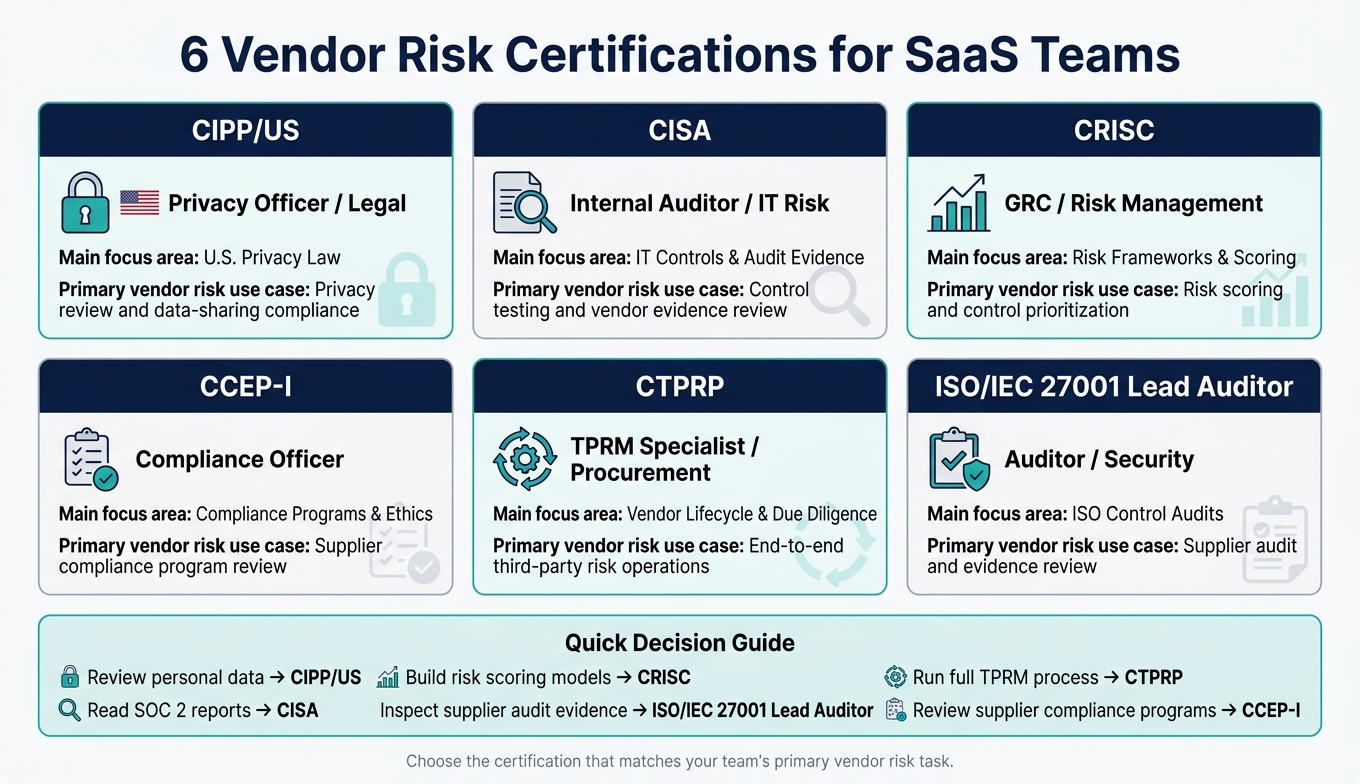
6 Vendor Risk Certifications for SaaS Teams: Side-by-Side Comparison
Third Party Vendor Risk Management Certification Training Course
sbb-itb-5f36581
Quick comparison
| Certification | Best for | Main use in vendor review | Best pick when your team spends most time on |
|---|---|---|---|
| CIPP/US | Privacy, legal, compliance | Data use reviews and privacy terms | Privacy impact checks, DPAs, U.S. privacy rules |
| CISA | IT audit, security, compliance | Control review and SOC evidence | SOC 2 review, access checks, testing controls |
| CRISC | GRC, IT risk, compliance | Risk scoring and treatment | Vendor tiering, risk ranking, tracking fixes |
| CCEP-I | Compliance teams | Supplier compliance program review | Ethics checks, training records, escalation paths |
| CTPRP | TPRM teams, procurement | End-to-end vendor due diligence | Intake, questionnaires, monitoring, vendor tiers |
| ISO/IEC 27001 Lead Auditor | Audit, security, procurement | Supplier audit work | Audit rights, security reviews, control validation |
A few fast takeaways:
- If you review personal data, start with CIPP/US.
- If you read SOC 2 Type 2 reports, start with CISA.
- If you build risk scoring models, start with CRISC.
- If you run the full third-party risk process, start with CTPRP.
- If you inspect supplier audit evidence, look at ISO/IEC 27001 Lead Auditor.
- If your work centers on supplier compliance programs, use CCEP-I.
My view: most SaaS teams do not need all six. They need the one that matches their main job, and in some cases, a second one to cover a gap between privacy, audit, and risk work.
That’s the lens I’d use to read the rest of this article.
What to Look for in a Vendor Risk Certification
Vendor risk certifications don't all teach the same thing. Some lean into U.S. privacy law. Others focus on IT controls. And some stay centered on the vendor lifecycle itself - onboarding, questionnaires, and monitoring. That split gives you a simple way to narrow the field and decide which options are worth a closer look.
Role fit for privacy, security, compliance, procurement, and GRC teams
Start with the work your team already handles. A privacy officer reviewing data processing agreements needs very different training from a GRC manager building a vendor risk scoring framework. The same goes for a security analyst digging through SOC 2 reports.
Here's a simple role-to-certification fit:
| Focus Area | Best-Fit Role | Main Tasks |
|---|---|---|
| Privacy | Privacy Officer, Legal | Data mapping, DPA reviews, regulatory mapping |
| Security Audit | IT Auditor, Security Analyst | SOC 2 report review, control testing, technical vetting |
| Risk Management | GRC Manager, Risk Analyst | Risk scoring, vendor classification, framework development |
| Compliance | Compliance Officer, Procurement | Contract negotiation, clause enforcement, audit rights |
| Third-Party Risk | Vendor Manager, Procurement | Onboarding, security questionnaires, ongoing monitoring |
Once you've matched the role, the next step is to look at how far each program goes into privacy, audits, risk, and vendor oversight.
Topic depth across privacy, audits, risk, and third-party oversight
Depth changes a lot from one program to another. Privacy-focused credentials usually cover privacy frameworks and laws, plus how to map business activities to data protection rules. Audit-focused programs spend more time on SOC 1 and SOC 2 reports as vendor evidence, especially the difference between Type 1 and Type 2 reports.
Forvis Mazars puts it this way:
"A Type 2 Report, which demonstrates the effectiveness of your controls over a period of time, provides far more value and credibility than a simple point-in-time Type 1 Report."
Third-party risk programs tend to focus more on security questionnaires and vendor checks. That often includes reviewing a vendor's encryption practices, incident response plans, and breach-notification terms.
Exam format, study time, and renewal requirements
Before you commit, look at the nuts and bolts. Some credentials come with a proctored exam, formal prerequisites, and employer-verified experience hours before you can even sit for the test. Others are easier to access.
Renewal rules vary too. Some programs ask for annual maintenance fees and continuing professional education (CPE) credits. Others use longer recertification windows. If your team is already stretched thin, this part matters more than it may seem. Time, cost, and admin work can turn a good option into a poor fit fast.
How the certification supports day-to-day vendor review work
The best certification should line up with the work your team does every week. That may mean reviewing SOC 2 reports, checking data processing terms, or scoring vendors by risk tier. If a program also shows how third-party risk ties into incident response, that's a strong plus for teams that manage vendors with deep system access.
Use those criteria to compare the six certifications below.
1. CIPP/US
For teams that start with legal exposure, CIPP/US is the clearest place to begin. It focuses on U.S. privacy law and fits privacy, legal, compliance, and GRC teams that set vendor review standards.
Best-fit role
Use CIPP/US to set due-diligence triggers, decide how deep a review should go, and shape ongoing vendor monitoring. In plain terms, it helps teams decide when a vendor needs deeper diligence, tighter contract terms, or continued monitoring.
Core topics covered
CIPP/US covers U.S. privacy frameworks from the FTC and NIST, along with accountability mapping and data classification. That gives teams a way to set review depth before sharing employee, customer, patient, or minor data with third parties.
This matters in vendor oversight because your company still carries the risk when a vendor handles the data. It also helps with contract controls tied to storage, access, and breach-notification timing.
That legal grounding is why the credential fits policy setting and contract review so well.
Exam format and maintenance
Format: proctored multiple-choice exam.
Maintenance: review current renewal and CPE requirements before scheduling.
2. CISA
CISA is a strong match for SaaS vendor risk work when the job leans on systems, controls, and audit evidence. In plain English, it helps most when your team is checking whether a vendor’s controls hold up under scrutiny. It’s not the best pick for work tied mainly to privacy-law mapping.
Best-fit role
CISA is the strongest fit for internal audit and IT risk and compliance roles within a SaaS vendor risk team. If your team spends a lot of time reading SOC 2 reports and checking control effectiveness, this credential lines up well with that day-to-day work.
That said, there’s a clear tradeoff. It does less for teams focused on privacy-law mapping and data-protection policy.
Core topics covered
The credential lines up with audit evidence review, access controls, change management, and ongoing monitoring. That matters because vendor risk work often comes down to a simple question: Does the evidence show the control is working over time, or did it just look fine on one day?
CISA helps reviewers make that call. It also helps with ongoing oversight, including tracking:
- Performance metrics
- SLAs
- Missed audits
- Unresolved findings
- Other control exceptions
Exam format and maintenance
CISA uses a proctored exam. Before you register, review current eligibility, fees, approved study materials, and CPE requirements. Plan for a multi-week study schedule.
If your team also owns risk scoring and framework design, the next certification goes deeper into that work.
3. CRISC
If your team is moving beyond control review and into vendor risk scoring and mitigation, CRISC is usually the better fit. CRISC, from ISACA, works well for teams that score vendor risk, set up controls, and track mitigation.
Best-fit role
CRISC fits GRC, IT risk, and compliance teams that handle vendor risk scoring, mitigation plans, and control monitoring. It helps teams decide which vendors need a deeper review, tighter controls, or more frequent monitoring.
Core topics covered
CRISC is built around four domains: IT Risk Identification, IT Risk Assessment, Risk Response and Mitigation, and Risk and Control Monitoring. For vendor risk teams, that means support for vendor scoring, control requirements, mitigation plans, and ongoing monitoring.
That lines up closely with vendor review work. Teams often need to rank risk, define controls, and track exceptions, and CRISC speaks directly to that work.
Exam format and maintenance
Format: proctored, multiple-choice exam.
Candidates must have at least three years of cumulative work experience in at least two of the four CRISC domains. No waivers apply.
Maintenance: annual fees and CPE credits are required.
That experience bar makes CRISC a mid- to senior-level credential. In plain terms, it's a better match for teams that make vendor risk decisions, not teams that only review vendor evidence.
4. CCEP-I
CCEP-I makes more sense when vendor risk work leans more on compliance reviews than hands-on control testing. It fits teams that review supplier compliance programs, ethics controls, and reputational exposure. Compared with CISA and CRISC, CCEP-I is a better match for vendor ethics, compliance programs, and reporting. It is less focused on control testing or risk scoring.
Best-fit role
Use it for vendor code-of-conduct reviews, training evidence checks, escalation paths, and compliance attestations. That makes it especially useful for teams managing international vendor relationships and working across global regulatory frameworks.
Core topics covered
CCEP-I centers on the Seven Elements of an Effective Compliance Program, including standards, training, monitoring, auditing, and reporting. In vendor risk work, that means checking whether a supplier has a working compliance program in place.
For example, you may need to confirm:
- Whether escalation paths exist
- Whether training is documented
- Whether reporting mechanisms are active
That’s the day-to-day value here. You’re not just asking, “Do they have a policy?” You’re checking whether the program actually functions.
Exam format
The CCEP-I is offered by the Society of Corporate Compliance and Ethics (SCCE) as a proctored, multiple-choice exam. Candidates should review current eligibility requirements, approved study materials, and fees directly with SCCE before registering.
Time and maintenance commitment
Plan for several weeks of study time, depending on your compliance background. Maintenance requires continuing education credits under SCCE renewal guidelines. Review current CPE and renewal requirements before you schedule the exam.
If your team needs a more lifecycle-based third-party risk credential, move next to CTPRP.
5. CTPRP
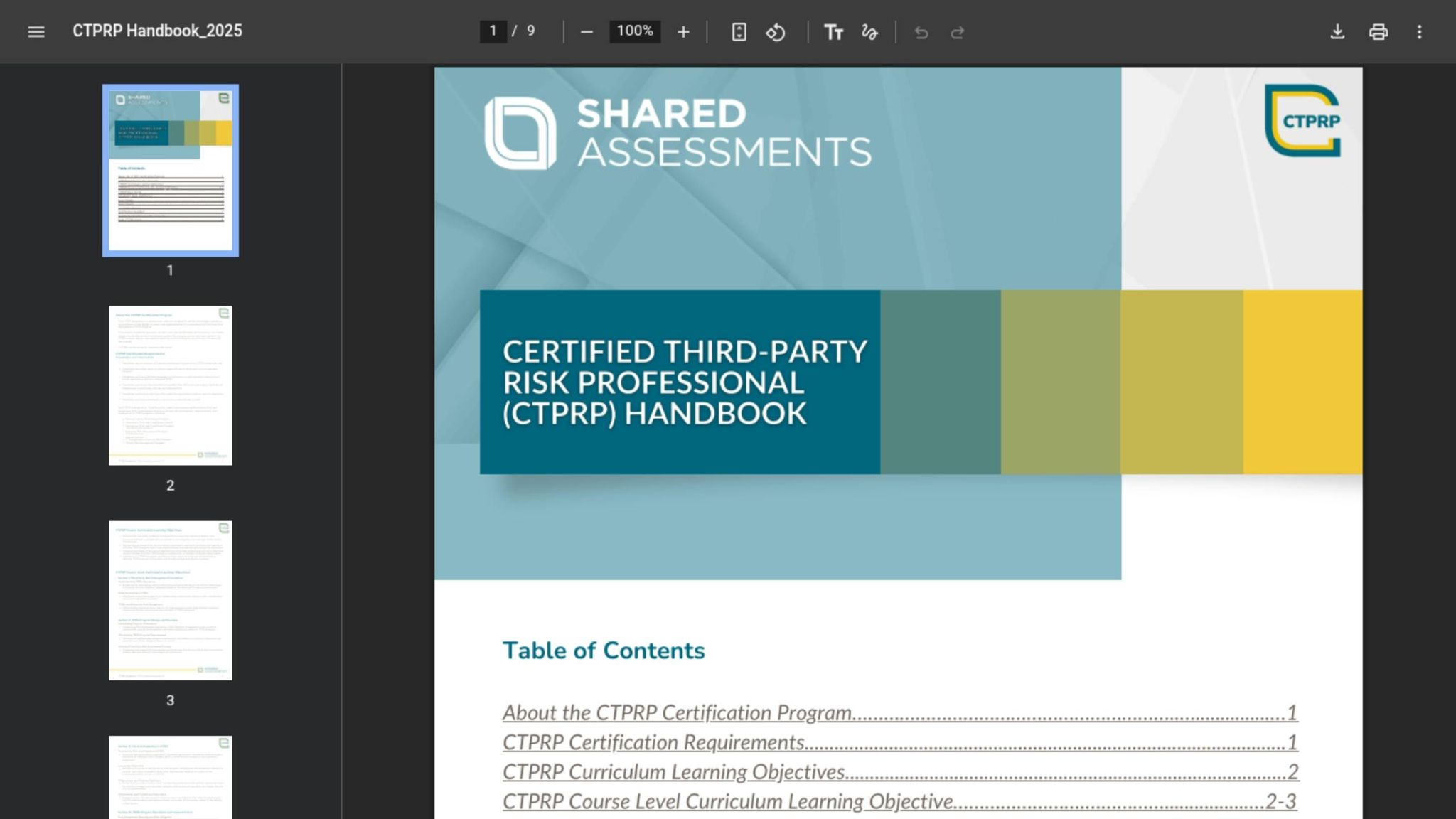
The Certified Third-Party Risk Professional (CTPRP), offered by Shared Assessments, is a vendor-focused certification for teams that manage third-party risk across the full lifecycle. It’s the most vendor-process-specific option on this list. Unlike audit- or risk-management credentials, CTPRP centers on the vendor lifecycle itself. That makes it a strong fit for teams that run third-party risk programs from start to finish.
Best-fit role
This certification fits teams that own third-party risk management and need a vendor-focused framework for steady vendor oversight and repeatable due diligence. It can help standardize intake, classify vendors, and apply the same due diligence approach across the lifecycle. For teams building repeatable onboarding and monitoring workflows, that kind of structure matters.
Core topics covered
The curriculum covers vendor risk classification, inherent risk, and due diligence, including SIG questionnaires and SCA controls. Vendors are grouped as Critical, High, Medium, or Low based on factors such as PII exposure, internal system access, and the possible financial or operational impact of failure. That rating then shapes how deep the due diligence process needs to go.
Exam or training format
Format: Shared Assessments certification program; review current exam format, prerequisites, and renewal rules before enrolling.
Time and maintenance commitment
This path makes the most sense for teams that already own vendor risk. Plan for prep time before certification, plus renewal work after that.
For teams that need a more audit-centered credential, the next option shifts from vendor oversight to control validation.
6. ISO/IEC 27001 Lead Auditor
Where CTPRP centers on third-party lifecycle management, ISO/IEC 27001 Lead Auditor is a better match for teams that run formal vendor security audits.
Best-fit role
This credential fits audit, security, and procurement staff who review vendor controls. If your job involves checking a vendor’s security posture, policies, and track record during due diligence, this gives you a clear way to validate controls through formal audit methods.
Core topics covered
Training covers ISO-style control reviews, audit evidence, and contract-defined audit rights. In plain terms, that means reviewing a vendor’s encryption processes, incident response plans, physical security, and other established best practices.
One point matters more than it may seem: audit rights need to be written into legal contracts. Without that language, your team may not be able to step in and review what it needs when issues come up.
Audit timing also depends on vendor risk level:
- Critical vendors are usually audited once or twice per year
- High-risk vendors are usually audited every one to two years
Exam or training format
The certification centers on system audits and vendor compliance checks. Before you enroll, review the current exam format, prerequisites, and fees.
Time and maintenance commitment
Plan for audit-focused study time, along with any renewal or recertification requirements.
Use the comparison below to weigh audit depth, study effort, and renewal load.
Quick Comparison of All 6 Certifications
The table below compares each certification by role, focus, and vendor-risk use case. Use this side-by-side view to narrow the list by role and use case.
| Certification | Best-Fit Role | Main Focus | Vendor Risk Use Case |
|---|---|---|---|
| CIPP/US | Privacy / Legal | U.S. privacy law | Privacy review and data-sharing compliance |
| CISA | Internal Audit | IT controls and audit evidence | Control testing and vendor evidence review |
| CRISC | GRC / Risk Management | Risk frameworks and scoring | Risk scoring and control prioritization |
| CCEP-I | Compliance | Compliance programs and ethics | Compliance program review |
| CTPRP | TPRM Specialist | Vendor lifecycle and due diligence | Third-party risk operations |
| ISO/IEC 27001 Lead Auditor | Auditor | ISO control audits | Supplier audit and evidence review |
CISA and ISO/IEC 27001 Lead Auditor both help with control verification, but they do different jobs.
CISA is a better fit when your team needs to test whether controls work over time. Think recurring checks, audit evidence, and proving that a control didn’t just exist on paper, but kept working.
ISO/IEC 27001 Lead Auditor leans more toward supplier audits and contract rights. That makes it useful when your vendor-review process includes audit clauses, document checks, and direct review of a supplier’s control setup.
Next, match the certification to your team’s vendor-review workload, budget, and renewal capacity.
How to Choose the Right Certification for Your Team
Match the certification to your team's main vendor review work
Start with the work your team does most often. That sounds obvious, but it's where a lot of teams go off track. A certification only helps if it lines up with the actual vendor-review tasks on your plate.
If your team spends most of its time on data mapping, privacy impact assessments, or vendor personal-data handling, CIPP/US is the best place to start. If the job is more about reviewing SOC 2 Type 2 reports and checking whether a vendor's controls worked over time, CISA is a better fit.
Some teams own the risk scoring process. That means sorting vendors into critical, high, medium, or low risk based on data sensitivity. In that case, CRISC tends to be more useful in day-to-day work. And if the role covers the full vendor lifecycle - from early due diligence to contract controls and ongoing monitoring - CTPRP makes the most sense.
If one credential doesn't cover the full job, pair it with another that fills the gap, especially around controls or risk scoring.
Pair certifications for broader cross-functional coverage
Use certification pairs only when there's a clear hole to fill. One credential may cover policy, while another handles control testing or risk scoring. That's where pairing makes sense.
| Team Need | Privacy/Compliance Credential | Audit/Risk Credential | Why It Works |
|---|---|---|---|
| PII-heavy vendor reviews | CIPP/US | CISA | Covers U.S. data law plus hands-on control verification |
| Global supplier oversight | CCEP-I | ISO/IEC 27001 Lead Auditor | Aligns ethics and compliance with international security standards |
| GRC and procurement | CTPRP | CRISC | Connects vendor lifecycle management to enterprise risk scoring |
| Operational risk focus | CIPP/US | CRISC | Matches data protection requirements with broader risk impact analysis |
Privacy and compliance credentials set the rules. Audit and risk credentials check whether those rules are being followed.
After that, look at study time and the renewal load before you decide.
Factor in budget, timeline, and renewal effort
These six programs don't ask for the same level of time or upkeep. Some take more study hours. Others add more renewal work later. So the smart move is to choose the credential that lines up most closely with your team's day-to-day vendor review work.
Match the certification to your current workload. Then make sure your team can handle the renewal effort too. The right pick should fit both your vendor-review scope and your team's time budget.
Conclusion
These certifications line up with different parts of vendor review work. So the right one comes down to what your team spends the most time doing: privacy review, control testing, risk scoring, compliance oversight, lifecycle management, or supplier audits.
Put simply, the best credential is the one that makes your current reviews stronger.
CIPP/US focuses on privacy. CISA centers on controls. CRISC is tied to risk. CCEP-I covers compliance. CTPRP is built for third-party lifecycle management. ISO/IEC 27001 Lead Auditor fits supplier audits.
Choose the certification that matches your team’s main vendor risk task. Then look at the practical side too: study time, cost, and renewal effort. If you’re deciding between a few solid options, go with the one that lines up with the highest-risk work your team owns.
FAQs
Which certification should I start with first?
Start by setting a clear risk framework for your business activities and compliance duties. Figure out which parts of the business are regulated, then map those activities to the data protection frameworks that already apply.
Once that internal plan is in place, shift to vendor due diligence. This is where SOC 2 Type II and ISO 27001 can help you evaluate the security posture of critical vendors.
Do I need more than one vendor risk certification?
Usually, no. A tiered approach based on vendor risk makes more sense.
For Tier 1 vendors that handle sensitive data or support critical systems, use more than one source of proof. That can include SOC 2 Type II and/or ISO 27001, along with extra artifacts.
For Tier 2 vendors and lower-risk tiers, lighter documentation is often enough, such as:
- Questionnaires
- DPA/certificates
- Self-certification
How do I choose between CISA, CRISC, and CTPRP?
Choose based on where you sit in the vendor risk lifecycle:
- CISA for technical audit work and control testing
- CRISC for aligning IT risk with business goals
- CTPRP for third-party risk and vendor oversight
If your day-to-day work is focused on outsourced risk and compliance, CTPRP is the most directly relevant fit.
Related Blog Posts
Get new content delivered straight to your inbox

The Response
Updates on the Reform platform, insights on optimizing conversion rates, and tips to craft forms that convert.

Drive real results with form optimizations
Tested across hundreds of experiments, our strategies deliver a 215% lift in qualified leads for B2B and SaaS companies.
