
.webp)
How Third-Country Adequacy Impacts SaaS Businesses



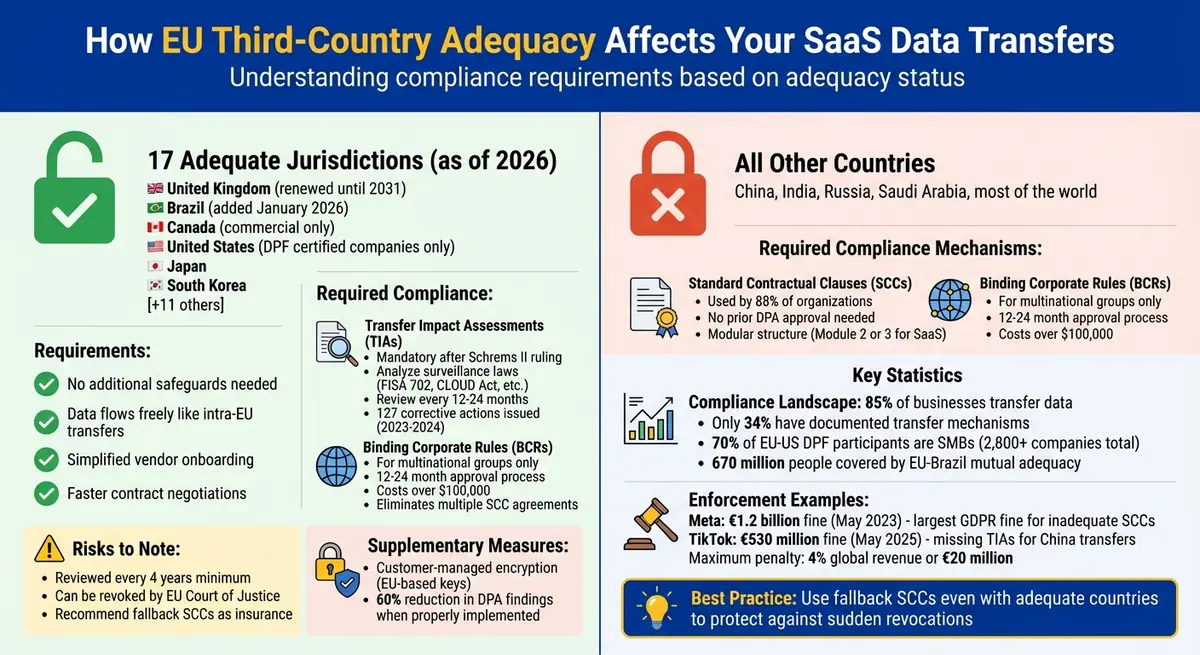
If your SaaS business handles EU customer data, third-country adequacy decisions directly impact your operations. These decisions, set by the European Commission, determine whether a non-EU country meets EU data protection standards, allowing personal data to flow freely without extra safeguards.
Key takeaways:
- Countries with adequacy: Data transfers are simpler, no extra legal steps required.
- Countries without adequacy: You’ll need Standard Contractual Clauses (SCCs), Transfer Impact Assessments (TIAs), or Binding Corporate Rules (BCRs) to stay compliant.
- Recent changes: Brazil gained adequacy in 2026, and the UK’s adequacy was renewed until 2031. However, adequacy decisions are reviewed regularly and can be revoked, creating uncertainty.
For SaaS companies, compliance requires proactive measures like fallback SCCs, vendor risk assessments, and privacy-focused architecture. Ignoring these steps can lead to fines, audits, or disrupted operations.
EU Third-Country Adequacy: Data Transfer Requirements Comparison
International Data Transfers and Onward Transfers | Privacy PowerUp #7
sbb-itb-5f36581
What Are Third-Country Adequacy Decisions?
Under GDPR Article 45, a third-country adequacy decision is a ruling by the European Commission that determines whether a non-EU country, territory, or international organization provides a level of data protection comparable to the EU's standards. This isn't just a checkbox exercise - it involves a detailed review of the country's legal framework, enforcement mechanisms, and commitment to safeguarding fundamental rights.
When a country is granted adequacy, personal data can flow from the EU to that country without requiring additional safeguards. This simplifies cross-border data transfers significantly. The European Commission explains it clearly: "The effect of such a decision is that personal data can flow from the EU... to that third country without any further safeguard being necessary. In other words, transfers to the country in question will be assimilated to intra-EU transmissions of data."
However, adequacy isn't a "set-it-and-forget-it" arrangement. These decisions are reviewed by the Commission at least every four years, and they can be overturned by the Court of Justice of the European Union if the country fails to maintain adequate protection levels. As Elena Vasquez from GDPRScoreCheck points out: "Adequacy decisions are the simplest international transfer mechanism available, but they're also the most fragile: they can be invalidated by the Court of Justice of the European Union if the Commission's assessment proves incorrect."
How the European Commission Approves Adequacy Decisions
The European Commission uses a structured, multi-step process to approve adequacy decisions:
- Drafting a Proposal: The Commission begins by analyzing the country's legal framework. This includes evaluating the rule of law, enforcement of data protection regulations, individual rights, and whether government surveillance aligns with fundamental freedoms.
- Review by the EDPB: The European Data Protection Board (EDPB) reviews the draft and provides its opinion.
- Member State Vote: Representatives from all EU member states vote on the proposal.
- Final Adoption: If approved, the Commission formally adopts the decision and publishes it in the Official Journal of the European Union.
This process can take months - or even years - depending on the complexity of the country's legal system and any political factors at play. For SaaS companies, keeping an eye on these developments is crucial.
Why SaaS Companies Need to Understand Adequacy Decisions
For SaaS companies, adequacy decisions simplify compliance in a big way. When transferring data to a country with adequacy, you avoid the need for Transfer Impact Assessments, additional encryption measures, and constant monitoring tied to Standard Contractual Clauses (SCCs). This means smoother vendor onboarding, fewer legal hurdles, and faster contract negotiations.
But there's a catch: adequacy decisions can be fragile. If a country loses its adequacy status, data transfers to that country become immediately unlawful unless you have an alternative mechanism, like SCCs, already in place. Recent enforcement actions have shown the risks of relying solely on SCCs.
To mitigate these risks, savvy SaaS companies include fallback SCCs in their contracts - even when adequacy applies. Think of it as an insurance policy against sudden regulatory changes. Additionally, if you're working with US-based vendors, ensure they are certified under the Data Privacy Framework. Remember, these certifications must be renewed annually, and a lapse could mean you're transferring data to a non-adequate country.
Current Adequacy Decisions Affecting SaaS Businesses
As of early 2026, the European Union has designated 17 jurisdictions as having adequate data protection standards. This designation allows SaaS companies to transfer personal data to these regions without needing extra safeguards. Brazil became the latest addition in January 2026, joining other jurisdictions like the United Kingdom, Canada, South Korea, and Japan.
It’s important to note that the scope of these adequacy decisions can vary widely. For example, the United States decision only applies to organizations certified under the EU-US Data Privacy Framework. By July 2024, over 2,800 companies had joined the framework, with 70% being small and medium-sized businesses. Similarly, Canada’s adequacy decision applies solely to commercial organizations governed by PIPEDA, excluding the federal public sector. This means SaaS companies must carefully verify which entities and sectors are covered to ensure compliance.
Recent Changes to Adequacy Decisions
In January 2026, the EU-Brazil mutual adequacy decision introduced a new approach to data protection agreements. Unlike traditional one-way decisions, this agreement allows both the EU and Brazil to recognize each other’s data protection frameworks. Regulators have referred to this as a "regulatory passport", enabling personal data to flow seamlessly in both directions. This agreement impacts a combined population of 670 million people and is anticipated to boost digital trade between the two regions by 7% to 9%.
"Together, we have created the world's largest area for safe, cross-border data flows, covering over 670 million people." - Michael McGrath, European Commissioner for Democracy, Justice, the Rule of Law and Consumer Protection
Additionally, the UK’s adequacy status was renewed in December 2025, extending it until 2031. This renewal followed a review of the UK’s Data (Use and Access) Act to ensure alignment with GDPR standards. For SaaS businesses, these updates directly influence strategies for cross-border data transfers. As adequacy decisions evolve, they bring new compliance challenges, especially with periodic reviews reshaping the landscape.
How Periodic Reviews Create Compliance Uncertainty
Adequacy decisions aren’t permanent - they are subject to regular reviews, which means the legal basis for transferring data can change unexpectedly. Shifts in a country’s laws or political environment can lead to sudden changes in adequacy status.
For instance, in January 2025, the dismissal of members of the US Privacy and Civil Liberties Oversight Board raised concerns among EU regulators about the stability of the EU-US Data Privacy Framework. While the framework wasn’t revoked, this incident highlighted how political changes can quickly undermine adequacy agreements. For SaaS companies locked into multi-year vendor contracts, this kind of uncertainty can be a significant challenge. Signing a three-year deal with a vendor in an "adequate" country might backfire if that status is revoked halfway through the agreement.
Other examples include Argentina’s 2024 review, which recommended legislative reforms to maintain its adequacy status, and Canada’s review, which flagged potential issues with upcoming legislative changes. These reviews are far from routine - they can lead to amendments, suspensions, or even complete withdrawals of adequacy decisions. To navigate these uncertainties, SaaS businesses should include fallback mechanisms like Standard Contractual Clauses in vendor agreements. This approach helps ensure compliance, even as the regulatory landscape continues to shift.
How to Transfer Data Without an Adequacy Decision
When there’s no adequacy decision in place, SaaS companies must turn to mechanisms like SCCs, TIAs, and BCRs to ensure secure data transfers. This is a pressing issue, as 85% of global businesses transfer personal data across borders, but only 34% have documented transfer mechanisms. Without proper safeguards, companies risk hefty penalties.
Implementing Standard Contractual Clauses (SCCs)
Standard Contractual Clauses (SCCs) are pre-approved agreements that outline binding data protection obligations for parties transferring data outside the European Economic Area. They’re the go-to choice for 88% of organizations.
The 2021 SCCs introduced a modular structure, letting companies pick the setup that best matches their business needs. SaaS providers often use Module 2 for controllers serving European customers or Module 3 for processors working with sub-processors .
SCCs don’t require prior approval from Data Protection Authorities, and they include a "docking clause" (Clause 7), which allows additional parties to join the contract as your processing chain grows.
However, after the Schrems II ruling, SCCs alone aren’t enough. You’ll also need a TIA to confirm the destination country’s laws don’t compromise the protections offered by SCCs. If risks persist, a more detailed TIA becomes essential to address and mitigate them (more on this below).
Performing Transfer Impact Assessments (TIAs)
A Transfer Impact Assessment (TIA) is a critical step in determining whether the destination country’s legal framework aligns with GDPR standards. The responsibility for conducting the TIA falls on the data exporter, while the importer provides details about local laws .
Between 2023 and 2024, EU Data Protection Authorities issued 127 corrective actions related to international data transfers, with many violations linked to inadequate TIAs. When conducting a TIA, focus on laws governing surveillance and data access in the destination country. For example, U.S. transfers require an analysis of laws like FISA 702 and the CLOUD Act, while UK transfers should consider the Investigatory Powers Act to ensure compliance with EU proportionality standards.
"A TIA is not a one-time exercise; it should be seen as an ongoing process to check for changes related to the data processing activities... and to the changes in the legislation of the countries of import." – Tudor Galos, Senior Privacy & AI Consultant
If risks are identified, supplementary measures are a must. One effective method is customer-managed encryption, where encryption keys are generated and stored within the EU. This approach, when paired with a structured TIA, has helped organizations reduce DPA examination findings by 60%. Additionally, review the entire data flow, including onward transfers to sub-processors, and schedule periodic reviews every 12–24 months or reassess immediately if surveillance laws change.
A failure to address these risks can be costly. In May 2023, the Irish Data Protection Commission fined Meta €1.2 billion, the largest GDPR fine to date, for SCCs that didn’t adequately account for U.S. surveillance laws .
For multinational organizations, Binding Corporate Rules (BCRs) offer a more comprehensive solution.
Using Binding Corporate Rules (BCRs)
Binding Corporate Rules (BCRs) are internal policies designed for multinational groups to securely transfer personal data between their own entities. Unlike SCCs, which focus on third-party relationships, BCRs create a unified, legally binding framework for all group entities worldwide .
Once approved, BCRs eliminate the need for multiple SCC agreements, making them ideal for SaaS companies with complex multinational operations and frequent intragroup data transfers. However, the approval process is lengthy, taking 12–24 months, and can cost over $100,000 to implement.
Many companies rely on SCCs as a temporary measure while seeking BCR approval. In the long run, BCRs simplify compliance, especially for organizations managing large-scale data flows across borders .
Operational Challenges and New Compliance Trends
Third-country adequacy is reshaping how SaaS companies operate. Without it, businesses must implement intricate safeguards to avoid hefty fines. These challenges are pushing SaaS providers to rethink and adjust their technical and organizational frameworks to meet evolving data protection standards.
Data Localization and Sovereign Cloud Solutions
U.S. hyperscalers currently dominate the EU cloud market, holding over 70% of it. However, strict localization laws in countries like China, Russia, India, and Saudi Arabia are forcing SaaS providers to adopt distributed architectures with regional data centers. Even in the EU, where explicit localization mandates are uncommon, regulations such as DORA create de facto requirements for processing data locally.
This shift brings operational hurdles, including managing failover systems, backups, and threat detection to comply with DORA. Companies relying on SaaS often find themselves at the mercy of vendor status pages during outages, unable to independently investigate root causes.
"Digital sovereignty is best served by ensuring that providers comply with EU rules and respect EU fundamental rights, rather than by imposing bans or rigid localization." – Orrick
To tackle these challenges, SaaS providers are forming sovereign cloud partnerships, often through joint ventures with local entities to meet regulations like France’s SecNumCloud. A more drastic solution is pass-through architectures, which eliminate the need for SaaS servers to store data. These stateless proxies simplify compliance by removing the SaaS provider as a data processor. However, moving to such models can take 3–6 months and requires running dual environments to ensure a stable transition.
New Compliance Requirements from DORA and the EU AI Act
On top of localization demands, new regulations are pushing SaaS platforms to prove operational independence. The Digital Operational Resilience Act (DORA), effective January 17, 2025, requires financial entities to ensure continuity without over-reliance on third-party ICT providers. Meanwhile, the EU AI Act, fully enforceable by August 2, 2026, introduces strict rules for high-risk AI systems. Together, these regulations emphasize operational independence over simple data transfer compliance.
DORA specifically bans financial entities from relying on a single ICT provider for critical functions, a common feature of many SaaS models. Testing methods like Threat-Led Penetration Testing (TLPT) or chaos engineering are often impractical on shared SaaS infrastructure. Additionally, more enterprises now require EU-only key custody and detailed data-flow maps that avoid trans-Atlantic transfers.
The EU AI Act adds further complexity for SaaS platforms, especially in high-risk verticals like HR (candidate ranking) or finance (credit scoring). These platforms must continuously monitor for issues like bias, drift, and explainability. Proving data lineage - tracking where computations occurred and which storage buckets were accessed - is challenging on platforms that only provide summary logs. Non-compliance penalties can reach up to 7% of a company’s global annual turnover.
"GDPR, NIS2, DORA and the AI Act are often treated as separate checklists. They are not. They overlap in controls, reporting chains and in the real-world risk models regulators expect to see." – Alexandru Trifu, Chief Sales Officer, LifeinCloud
Self-hosted platforms are emerging as a cost-effective solution, reducing expenses by 40–60% while meeting DORA requirements. Similar to fallback SCCs and TIAs, these operational changes are becoming essential to manage cross-border risks. Companies are no longer treating sovereignty as a simple checkbox but as a system constraint, investing in automation to provide compliance proof on demand. These shifts highlight the strategic adjustments SaaS companies must make to navigate the future of compliance.
Practical Steps for SaaS Companies to Meet Adequacy Requirements
SaaS companies don’t have to let compliance with third-country adequacy requirements derail their operations. By treating compliance as a core design challenge rather than just a legal checkbox, companies can create systems that both satisfy regulators and maintain operational efficiency. The secret lies in integrating data protection into the platform’s architecture, automating consent management with multi-step forms, and thoroughly evaluating every vendor in the supply chain. Together, these strategies ensure comprehensive compliance.
Building Compliance into Your SaaS Platform
Achieving compliance starts at the code level with a "Privacy by Design" approach. SaaS companies often act as both data controllers and processors, so they need tailored strategies for each role. One effective method is to set up regional infrastructure with separate data stacks for the EU, US, and other regions. This helps ensure that data doesn’t cross borders unintentionally.
Using stateless proxy architectures is another way to reduce compliance risks. These systems process data requests in real time without storing personal data on integration servers. While this approach demands careful planning, it removes a key compliance bottleneck.
To further enhance compliance, map all data flows - including tracking pixels, analytics scripts, and payment processors. Automation tools can detect cookies with up to 93.7% accuracy, cutting manual compliance efforts by as much as 60% to 80%. This proactive approach simplifies cross-border data transfers under adequacy regulations.
Using Consent Management Tools
Cross-border data transfers often happen quietly through third-party cookies and scripts, such as Google Analytics or Meta Pixels, which operate from servers outside the EEA. To address this, consent management platforms (CMPs) must block non-essential tracking until users explicitly consent. Ignoring this requirement can lead to hefty fines, as seen in May 2023 when Meta was fined €1.2 billion for transferring EU Facebook user data to the U.S. without adequate safeguards.
A robust CMP should also handle cross-domain consent synchronization, allowing user preferences to carry over across subdomains like app.company.com and support.company.com. Additionally, provide users with granular consent options so they can separately manage analytics, marketing, and functional cookies, rather than being forced into an all-or-nothing decision. Under GDPR Article 13(1)(f), users must also be informed about data transfers to third countries and the safeguards in place.
"SaaS is high-risk because data is processed continuously... trackers (e.g. Google Analytics, Hotjar, Meta Pixel) firing before consent, third-party processors without proper contracts, and hidden runtime violations are the biggest risks." – SecureSpells Team
Conduct runtime audits using real browsers to ensure trackers don’t fire before consent is given. Keep detailed audit logs with timestamps, banner versions, and user identifiers to meet regulatory requirements. Make it easy for users to withdraw consent by offering an accessible preference center where they can revoke permissions as easily as they granted them.
Creating a Vendor Risk Assessment Program
Managing third-party risks is just as important as internal platform adjustments. With enterprises using an average of over 80 SaaS applications, the web of third-party relationships can become a compliance minefield. Start by creating a thorough inventory of all vendors, including unsanctioned "Shadow IT" applications. Then, classify vendors into tiers - Critical, Medium, and Low - based on factors like data sensitivity, business importance, and access to personal or financial data.
For vendors in countries without adequacy decisions, ensure Transfer Impact Assessments (TIAs) have been completed. Failure to do so can lead to penalties, such as the €530 million fine TikTok received in May 2025 for transferring EEA user data to China without the required assessments.
"You can outsource the service, but you can never outsource the risk." – Ascella Infosec
Request and verify key compliance documents from vendors, such as SOC 2 Type II reports, ISO 27001 certifications, penetration testing results, and attestations for specific regulations like GDPR, HIPAA, or PCI DSS. Use Data Processing Agreements (DPAs) with clear "Right to Audit" clauses, breach notification timelines, and data ownership terms. Go beyond one-time assessments by using tools like BitSight or SecurityScorecard for continuous monitoring, and perform runtime audits to detect unauthorized trackers or security changes.
Don’t forget to evaluate sub-processors used by your vendors to ensure compliance throughout the entire supply chain. When offboarding vendors, revoke all API keys and SSO tokens, and obtain a "Certificate of Destruction" to confirm data deletion. For U.S.-based vendors, check their Data Privacy Framework (DPF) certification on the official website, while keeping Standard Contractual Clauses as a backup.
Conclusion
Third-country adequacy decisions can simplify cross-border SaaS operations, but they come with their own set of risks. These frameworks are not set in stone - the European Commission reviews them roughly every four years, and legal challenges, like the Schrems II case that invalidated the US Privacy Shield, can lead to sudden reversals.
Relying solely on these decisions is risky. Even when working with countries that have adequacy status, it's wise to have Standard Contractual Clauses (SCCs) in place as a backup. SCCs act as a safety net, ensuring compliance and operational continuity if an adequacy decision is overturned. As discussed earlier, these fallback measures are critical for mitigating disruptions caused by regulatory changes.
To adapt to evolving regulations, it’s important to build flexibility into your compliance processes. Tools like automated monitoring systems and regular data flow mapping can keep your organization audit-ready. This is especially crucial with new regulations, such as the EU AI Act and DORA, on the horizon. Proactive measures like these not only help you stay ahead of regulatory shifts but also protect your business from costly penalties.
And the stakes are high - violating GDPR can result in fines of up to 4% of global revenue or €20 million. Companies that prioritize compliance often see better outcomes, with reports showing 67% improved security performance. By embedding Privacy by Design principles into your systems early on, you can avoid expensive retrofits and create solutions that satisfy regulators while keeping your operations efficient. Treating data protection as a foundational element, rather than just a legal requirement, sets your business up for long-term success.
FAQs
How do I know if my vendor is actually covered by an adequacy decision?
To determine if your vendor falls under an adequacy decision, check whether their country or jurisdiction is officially recognized by the European Commission for maintaining an adequate level of data protection. This information is publicly accessible and updated regularly. Make sure to locate a formal adequacy decision to ensure compliance.
What should my SaaS do if a country suddenly loses adequacy status?
If a country loses its adequacy status, your SaaS needs to take action by implementing Standard Contractual Clauses (SCCs) or other appropriate safeguards. On top of that, conducting Transfer Impact Assessments is essential. These assessments help identify potential risks tied to data transfers and provide ways to address them. Taking these steps ensures compliance while keeping sensitive data secure.
Which technical changes reduce cross-border transfer risk the most?
One of the strongest ways to safeguard data during transfers is encryption with EU-held keys. This ensures that even if data crosses borders, it remains secure and inaccessible to unauthorized entities. Encryption acts as a protective shield, significantly lowering the risk of breaches or misuse.
Another essential step is to clearly document data flows within contractual annexes. This transparency helps all parties understand how data moves and ensures accountability throughout the process.
Conducting Transfer Impact Assessments (TIAs) is also critical. These assessments help identify and address potential risks posed by local laws in the destination country, ensuring that data transfers remain compliant and secure.
Lastly, selecting the right Standard Contractual Clauses (SCC) module and integrating safeguards into agreements, such as Data Processing Addendums (DPAs), adds an extra layer of protection. These measures not only ensure legal compliance but also reduce the risks tied to international data transfers.
Related Blog Posts
Get new content delivered straight to your inbox

The Response
Updates on the Reform platform, insights on optimizing conversion rates, and tips to craft forms that convert.



Drive real results with form optimizations
Tested across hundreds of experiments, our strategies deliver a 215% lift in qualified leads for B2B and SaaS companies.
