
.webp)
AI-Driven CRM: Future of Lead Management



AI-driven CRMs are transforming lead management by automating repetitive tasks, improving data accuracy, and enabling smarter decision-making. Here's how:
- Automated Processes: AI handles tasks like data entry, follow-ups, and lead routing, saving teams hours of manual work.
- Smarter Lead Scoring: Machine learning analyzes behavior, demographics, and engagement to prioritize high-potential leads.
- Enhanced Personalization: AI customizes messages and timing based on user preferences and behavior, leading to higher conversion rates.
- Real-Time Data Updates: CRMs now integrate external data - like company size or recent funding - into lead profiles without manual effort.
- Improved Lead Capture: Tools like Reform ensure clean, high-quality data through features like email validation, conditional logic, and lead enrichment.
These systems help businesses engage leads at the right time with the right message, boosting revenue by up to 25% within months. AI-driven CRMs are not just about saving time - they enable sales teams to focus on building stronger relationships and closing deals faster.
How to Qualify Leads in Your CRM with AI
Core Capabilities of AI-Driven Lead Management
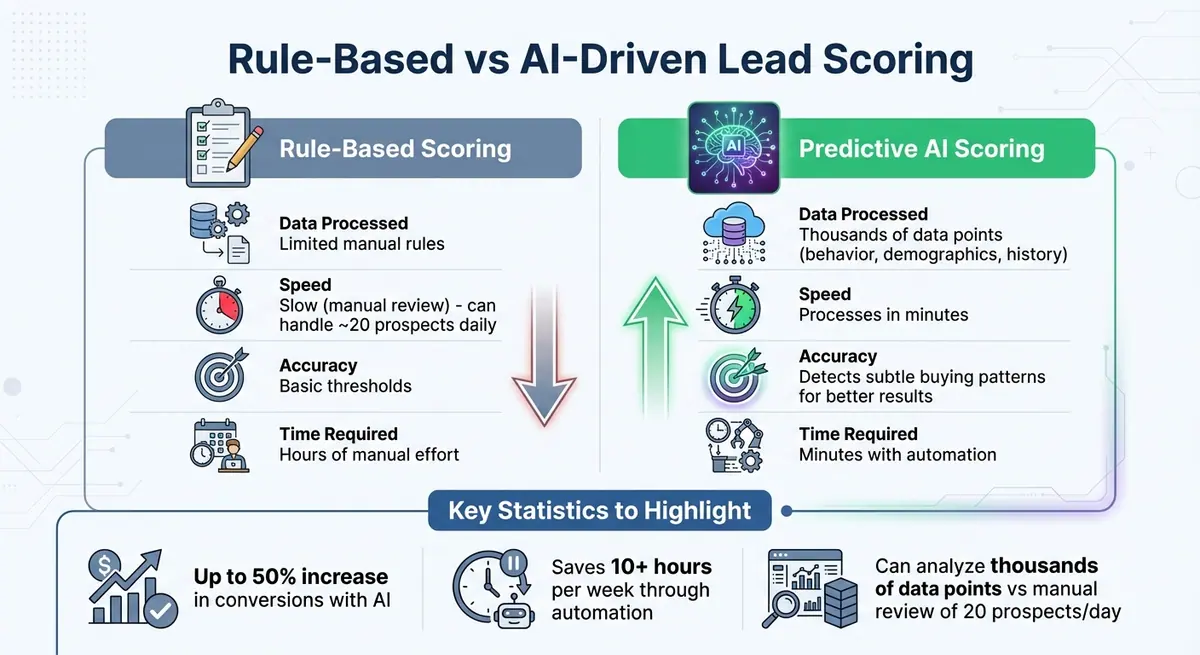
Rule-Based vs AI-Driven Lead Scoring Comparison
AI-powered CRMs bring a fresh approach to managing leads, offering three standout features: predictive lead scoring and intent modeling, automated lead qualification and routing, and data quality and enrichment. Together, these features allow businesses to process thousands of data points in just minutes - something that previously required hours of manual effort and could only cover about 20 prospects daily. These capabilities aren’t just about saving time; they redefine how efficiently and effectively leads are managed.
Predictive Lead Scoring and Intent Modeling
Predictive lead scoring relies on machine learning to analyze factors like engagement patterns, demographics, behavioral signals, and purchase history. The result? A dynamic score that indicates how likely a lead is to convert. Unlike traditional rule-based scoring, which uses fixed criteria, AI can detect nuanced patterns - like the sequence of website visits, specific email interactions, or combinations of downloaded content - that manual systems often overlook. For example, advanced AI models can instantly evaluate variables such as company size, industry type, and online behavior, streamlining qualification processes that used to take hours.
Intent modeling goes a step further by focusing on real-time behaviors like website interactions, content downloads, and search activity to determine a lead’s readiness to buy. By identifying patterns from past successful conversions, sales teams can zero in on leads with the highest potential, improving conversion accuracy. With AI-driven platforms, businesses have reported up to a 50% increase in conversions while saving more than 10 hours per week through automation.
| Aspect | Rule-Based Scoring | Predictive AI Scoring |
|---|---|---|
| Data Processed | Limited manual rules | Thousands of data points (behavior, demographics, history) |
| Speed | Slow (manual review) | Processes in minutes |
| Accuracy | Basic thresholds | Detects subtle buying patterns for better results |
Automated Lead Qualification and Routing
AI takes the guesswork out of lead qualification by instantly comparing prospects against ideal customer profiles using dozens of factors - like engagement, demographics, technology usage, and buying signals. This automation eliminates the need for manual research, allowing sales teams to focus only on the most promising leads. For instance, some AI systems score leads based on their interaction history, significantly improving pipeline efficiency.
When it comes to routing, AI ensures qualified leads are sent to the right sales rep based on factors such as readiness to buy, product interest, and past performance. Tools like Reform make this process even smarter by enabling conditional routing. For example, high-value leads can be directed to VIP scheduling links, while others are funneled into nurturing campaigns. This level of automation has been shown to increase qualified leads by as much as 215% for B2B and SaaS companies.
Data Quality and Enrichment
A key part of AI-driven lead management is maintaining clean, enriched lead data. Accurate data is the foundation of effective decision-making, and AI ensures this by automating data entry, removing duplicates, validating entries in real-time, and standardizing fields like job titles and company names. Beyond that, it enriches lead profiles by pulling in external details like company size, industry, technology stack, funding rounds, and even recent job changes. This ensures that lead profiles remain comprehensive and up to date.
AI also improves data integrity through real-time validation and spam prevention. Automated enrichment tools can even gather specific information from the web to answer qualification questions, delivering richer datasets without requiring longer forms or additional customer effort. The result? A CRM that continuously updates and refines its data, helping businesses achieve up to a 25% boost in revenue through more personalized and accurate lead handling.
Improving Lead Capture with Reform
For AI-powered CRMs to perform at their best, they need accurate and reliable data. That’s where Reform, a no-code form builder, steps in. Reform simplifies lead capture while ensuring the data integrates smoothly into AI workflows. Since AI's predictive capabilities depend on clean data, tools like Reform are becoming essential for effective lead management.
Reform addresses the common problem of messy data inputs by delivering clean, well-structured information to AI systems. With features like multi-step forms, conditional logic, lead enrichment, email validation, and spam prevention, Reform ensures only high-quality leads enter your CRM. The results speak for themselves: B2B and SaaS companies using Reform have seen a 215% increase in qualified leads by improving both the volume and the quality of form submissions.
Features for High-Quality Data Collection
Reform is designed to collect better data without adding unnecessary friction to the user experience. Its multi-step forms break down lengthy submissions into smaller, digestible steps. Instead of overwhelming users with a long list of fields, questions are presented one or two at a time, gradually building a complete profile. This method can boost conversion rates by up to 300% compared to traditional single-page forms.
Conditional logic takes this a step further by tailoring the form to each user. For instance, if someone identifies their business as "B2B", the form dynamically displays fields like company size and decision-making authority - critical details for feeding AI intent models.
Reform also includes features to safeguard data quality. Real-time email validation ensures email addresses are correct as they’re entered, reducing bounce rates by 10–25%. Meanwhile, advanced spam prevention filters out bots, keeping your database clean. The platform also offers lead enrichment, pulling firmographic details like company revenue, industry, and technology stack from external sources. This minimizes the number of fields users need to fill while providing your AI tools with the precise data they need for scoring and qualification.
"Reform is what Typeform should have been: clean, native-feeling forms that are quick and easy to spin up. Reform does the job without a bunch of ceremony."
– Derrick Reimer, Founder, SavvyCal
Another standout feature is the ability to capture abandoned submissions. Even if a user doesn’t complete the form, partial data is saved. This gives AI tools extra information for retargeting campaigns or further analysis, ensuring no potential lead goes unnoticed.
Integration with CRM and Automation Tools
Reform doesn’t just collect data - it ensures it flows seamlessly into your CRM. The platform integrates directly with popular systems like Salesforce and HubSpot, as well as automation tools via webhooks, APIs, and native connections. This means that as soon as a prospect submits a form, their information transfers instantly to your CRM. No delays, no manual uploads - just real-time data transfer that enables AI systems to start scoring, qualifying, and routing leads immediately.
Reform also supports custom field mapping and handles duplicate entries, ensuring data lands exactly where it belongs within your CRM. When enriched with firmographic details, this data syncs directly to the right fields, triggering AI-based qualification rules without requiring any manual effort.
"Beautiful forms that are easy to brand with company colors and logo. Simple UI. Definitely recommended!"
– David Hehenberger, Founder, Flamingo
Real-Time Analytics for Continuous Improvement
Reform offers real-time analytics dashboards that give you a clear view of how your forms are performing. Metrics like conversion rates, drop-off points, device performance, and geographic trends help marketing teams identify areas for improvement. For example, if a step in the form causes high abandonment, you can tweak the wording, adjust field requirements, or rework the flow to keep users engaged.
With A/B testing, you can experiment with different form layouts, question sequences, or field requirements to see which version generates better leads. These analytics close the loop, allowing you to refine your forms and improve the quality of the data feeding your AI-driven CRM.
Collaboration between marketing and sales teams becomes more effective when forms are designed to meet the needs of AI-driven systems. By focusing on the fields that matter most - like role, budget, or timeline - you ensure every submission provides the signals your AI models need for accurate predictions.
"One of the best parts of being a customer is that they constantly send emails with new additions to the software. And each addition is based on real customer requests."
– Andrew Warner, Founder, Mixergy
For U.S.-based companies, Reform includes localized options like MM/DD/YYYY date formats, USD currency fields, and state/ZIP code inputs. These tailored features reduce confusion for American users while capturing geographic and financial data in a format that’s ready for territory-based routing or budget qualification. Reform’s attention to these details ensures a smooth experience for both prospects and businesses.
sbb-itb-5f36581
Future Trends in AI-Driven CRM
AI-driven CRMs are set to transform the way businesses operate, especially in terms of automation and personalization. With advancements in data integration and workflow automation, these systems are becoming increasingly sophisticated.
Autonomous CRM Workflows
AI is now capable of handling entire workflows autonomously. Instead of just automating basic tasks like sending emails or updating fields, these systems can manage complex processes. For instance, AI can capture leads, score them, assign them to the appropriate sales representatives, and initiate multi-step nurturing sequences - all without human intervention. According to monday.com, AI can analyze thousands of prospects in just minutes, whereas manual processes might handle only about 20 leads per day. As this technology evolves, the efficiency gap will grow even larger.
No-code tools are making these capabilities accessible to operations teams, eliminating the need for developers. Teams can use visual workflow builders to design intricate lead journeys. For example, AI can automatically route high-intent leads to VIP scheduling while directing others to recorded demos, based on factors like engagement patterns, company size, or budget. For businesses operating across multiple time zones, AI ensures that leads are routed to the right representative immediately, whether it’s 9:00 AM in New York or 6:00 AM in San Francisco.
AI also identifies patterns, such as a prospect downloading a whitepaper and attending a demo, and predicts conversion probabilities. For example, it might determine a 70% chance of conversion within two weeks. Based on this insight, the system can notify sales reps or trigger the next step in the nurture sequence, enabling highly customized and timely engagement.
Hyper-Personalized Lead Journeys
Personalization has become a standard expectation for businesses in the U.S., with AI enabling real-time tailored interactions across email, chat, social media, and SMS. These systems craft unique, contextually aware messages by analyzing factors like industry, company size, and user behavior. Sentiment analysis further refines the tone and timing, ensuring outreach feels relevant and engaging.
Unified customer data platforms (CDPs) play a key role in this process. By consolidating marketing, sales, and service data into a single profile, these platforms allow AI to deliver consistent experiences across all touchpoints. For example, if a lead opens an email about pricing but doesn’t click through, the AI might send a follow-up SMS with a link to a pricing calculator or initiate a chat when the lead revisits the website. Tools like Reform’s conditional forms enhance this personalization by collecting detailed data from the start, enabling smarter segmentation and more precise messaging.
Privacy and Regulatory Considerations
As AI-driven workflows and personalized interactions become more advanced, businesses face increasing challenges related to data privacy. In the U.S., regulations like California's CCPA/CPRA impose strict consent requirements and hefty penalties for violations. Additionally, emerging federal privacy laws and AI-specific regulations are expected to demand greater transparency in how AI systems operate, including how they score and route leads. Businesses will also need to provide mechanisms for users to challenge automated decisions.
To address these challenges, CRMs are incorporating features like role-based access controls, consent tracking, and explainable AI into their platforms. Companies must now clearly explain how lead scores are calculated and how decisions are made, while offering opt-in and opt-out options at every stage. Privacy-preserving techniques, such as federated learning and differential privacy, allow AI to analyze aggregated data without exposing individual user information. These measures strike a balance between delivering personalized experiences and maintaining compliance.
For U.S. companies, privacy must be treated as a core design principle. This starts with transparent lead capture forms that disclose data usage and integrate consent directly into CRM workflows, ensuring both compliance and trust.
Conclusion: Using AI for Smarter Lead Management
Key Benefits Recap
AI-powered CRM systems are reshaping how businesses manage leads by streamlining repetitive tasks like data entry, follow-ups, and lead routing. With AI analyzing leads on a large scale, your team can focus on meaningful conversations and building relationships instead of getting bogged down in administrative work. Automation not only reduces costs and human errors but also enhances personalization. This targeted, context-aware outreach increases conversion rates, ensuring your CRM operates with accurate, unified data. Features like predictive lead scoring let sales teams zero in on the most promising leads, boosting win rates and delivering a stronger return on investment.
The results speak for themselves: AI tools can save teams over 10 hours per week and increase conversion rates by as much as 50%. When combined with efficient data capture - like enriching, validating, and routing leads before they enter your CRM - you create a system where every prospect gets the right message at the right time.
Next Steps for Implementation
To fully harness AI's potential in lead management, start by auditing your current processes. Identify weak points such as poor data quality, slow follow-ups, or missed opportunities with qualified leads. Establish measurable goals, like cutting lead response times to under five minutes or increasing lead-to-opportunity conversions by 20% within the next quarter.
Next, refine your lead capture process. Use forms that validate emails instantly, enrich data automatically, and apply conditional routing to segment prospects as soon as they submit their information. This ensures only clean, actionable data enters your CRM from the start. Roll out AI features - such as predictive scoring, task automation, and smarter routing - on a small scale first to test their effectiveness before expanding them across your entire operation.
Finally, monitor your progress monthly. Track metrics like lead response time, form conversion rates, sales cycle length, and cost per qualified lead. Use this data to tweak your scoring models, routing strategies, and lead capture forms. Running a 60- to 90-day pilot program can help fine-tune your approach, improving response times and qualification rates. These steps will not only validate AI's benefits but also lay the groundwork for a full-scale rollout.
FAQs
How does an AI-powered CRM enhance the accuracy of lead scoring?
AI-driven CRM systems bring a new level of precision to lead scoring by leveraging machine learning and advanced analytics. These tools analyze a variety of data points - like user behavior, engagement trends, and demographic details - to pinpoint high-potential leads with greater accuracy. Plus, this evaluation happens in real time, reducing the chances of mistakenly prioritizing less valuable leads.
By automating the entire lead scoring process, AI not only speeds things up but also delivers more dependable results. This allows businesses to channel their energy toward the most promising prospects, boosting productivity and driving better sales outcomes.
Why is data quality essential for AI-powered lead management?
Data quality plays a key role in AI-driven lead management because it shapes how accurately and effectively processes like lead scoring, automation, and personalization perform. When data is clean and well-organized, AI systems can produce actionable insights, rank leads more effectively, and create personalized experiences that resonate with potential customers.
However, poor-quality data can lead to mistakes, miscategorized leads, and inefficient use of resources, all of which can hurt conversion rates. Maintaining high-quality data ensures businesses get the most out of their AI tools, boosting the overall success of their lead management efforts.
What steps can businesses take to ensure AI-driven CRMs comply with privacy regulations?
To meet privacy regulations, businesses need to prioritize strong data protection practices and keep pace with laws such as GDPR and CCPA. This means getting explicit user consent before collecting data, securing sensitive information with appropriate safeguards, and conducting regular audits to spot and fix potential vulnerabilities.
Transparency is also key. Companies should make it clear how they use customer data, ensuring this information is easy to understand. Training employees on privacy best practices and integrating compliance checks into daily processes can further protect data and maintain customer trust.
Related Blog Posts
Get new content delivered straight to your inbox

The Response
Updates on the Reform platform, insights on optimizing conversion rates, and tips to craft forms that convert.




Drive real results with form optimizations
Tested across hundreds of experiments, our strategies deliver a 215% lift in qualified leads for B2B and SaaS companies.
