

API Caching for Scale: Guide for SaaS Forms



I cache repeated API reads - not form submissions - to cut API calls without mixing customer data. I start with one low-risk endpoint, set a maximum data age, and keep each tenant’s cached values separate.
My checklist is simple:
- Choose the right layer: Start with local memory; add Redis when workers need shared data. Keep private responses out of shared CDN caches.
- Control access and age: Check permissions before cache lookups, use tenant-aware keys, and define expiration and deletion rules.
- Plan for failures: Set timeouts, limit retries, and use idempotency to prevent duplicate submissions.
- Measure before expanding: Track p95 and p99 latency, upstream costs, data age, and form completion rates - not just cache hits.
For example, serving 800 of 1,000 eligible reads from cache avoids 80% of upstream read calls, before accounting for background updates and retries. But <u>fewer calls are only a win if access checks, data accuracy, and submission delivery still hold up</u>.
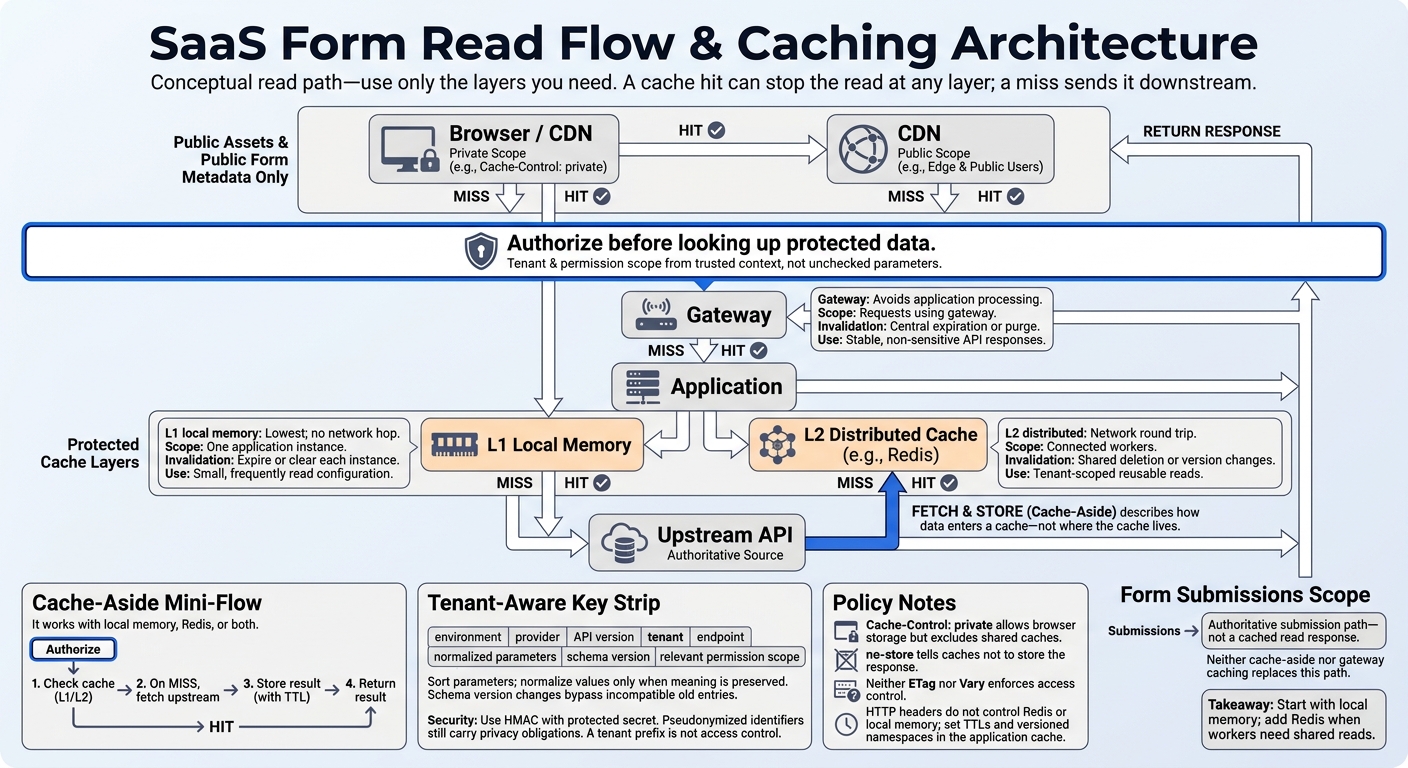
Tenant-Safe API Caching: Read Flow and Cache Layers
Caching API Responses with Redis
sbb-itb-5f36581
2. Choose Cache Layers and Tenant-Safe Keys
Map the read path for field options, validation rules, and tenant-scoped reference data: browser/CDN → gateway → application → L1 local cache → L2 distributed cache → upstream API. A cache hit can stop the read at any layer; a miss sends it downstream.
Start with local memory for a single instance. Use Redis when workers need to share reads. Keep private responses out of CDN caches, and reserve gateway caching for stable, non-sensitive responses. Then choose the fewest layers that meet your freshness and isolation needs.
Choose a Caching Architecture
Cache-aside describes how data enters a cache - not where the cache lives. The application checks the cache, fetches missing data, and stores the result. This pattern works with local memory, Redis, or both. Run authorization before any protected gateway cache lookup. Neither cache-aside nor gateway caching replaces the authoritative submission path.
| Design | Location | Latency | Consistency concern | Form use case |
|---|---|---|---|---|
| Application cache-aside | Local memory | Lowest lookup overhead | Workers can hold different values | Form field and validation config |
| Shared cache-aside | Redis | Adds a network round trip | Shared values still need invalidation | Tenant-scoped lookup data |
| Gateway caching | Before application | Avoids application work on hits | Cache policy must preserve access boundaries | Stable, non-sensitive form reference responses |
| Multi-tier cache-aside | Local L1 plus shared L2 | Local hits avoid shared-store calls | Both tiers can become stale | Frequently requested form configuration across workers |
Define Each Cache Layer's Role
Use browser and CDN caching only for public assets and public form metadata and design. Cache-Control: private allows browser storage but excludes shared caches. no-store tells caches not to store the response. Neither ETag nor Vary enforces access control.
Set TTLs and versioned namespaces in the application cache itself. HTTP headers don't control Redis or local memory.
| Layer | Latency characteristic | Sharing scope | Invalidation | Suitability |
|---|---|---|---|---|
| L1 local memory | Lowest; no network hop | One application instance | Expire or clear each instance | Small, frequently read configuration |
| L2 distributed | Network round trip | Connected workers | Shared deletion or version changes | Tenant-scoped reusable reads |
| Gateway | Avoids application processing | Requests using the gateway | Central expiration or purge | Stable, non-sensitive API responses |
| CDN | Avoids origin requests | Edge locations and public users | Expiration, purge, or versioned URLs | Public assets and public schemas |
Build Tenant- and Permission-Aware Cache Keys
Use a bounded key structure that includes environment, provider, API version, tenant, endpoint, normalized parameters, schema version, and relevant permission scope. Sort parameters, and normalize values only when doing so preserves their meaning. Changing the schema version sends reads to new keys, bypassing incompatible entries from the old version.
Derive the tenant and permission scope from trusted authorization context - not unchecked request parameters. Authorize before looking up protected data. Use HMAC with a protected secret rather than raw sensitive identifiers or plain hashes in keys. Pseudonymized identifiers still carry privacy obligations, and a tenant prefix does not provide access control.
With the keys defined, set TTLs, invalidation rules, and failure behavior for each layer.
3. Set Data-Age, Failure, and Privacy Policies
Set each integration’s data-age limit, failure behavior, and fallback before enabling caching. Optional enrichment can use approved stale data; compliance and fraud checks cannot. Once the cache path is defined, assign age limits, fallback rules, and privacy controls to each data class.
Combine TTLs With Distributed Invalidation
Keep soft refresh TTLs separate from maximum data age. A refresh must not make stale source data appear current. Allow stale-while-revalidate only within that age limit, and use hard expiration where correctness matters. Treat event-driven invalidation as a hint; favor delete-on-write or versioned keys in distributed systems.
| Data | TTL and age policy | Invalidation rule | Allowed fallback |
|---|---|---|---|
| Optional lead enrichment | Soft TTL; maximum age | Event-driven invalidation hint | Serve approved stale data or queue enrichment |
| Routing configuration | TTL bounded by acceptable routing delay | Delete on write | Use an approved fallback queue |
| Consent and region gates | Hard expiration or fresh fetch only | Versioned keys; immediate invalidation | Hold or reject if required evidence is missing |
| Lead status or owner | Short, business-approved TTL | Invalidate after status or ownership changes | Defer status-dependent actions until verified |
Use TTL jitter and request coalescing to prevent cache stampedes. Make invalidation handlers idempotent and version-aware so they ignore duplicate or out-of-order events.
Cache misses and upstream retries must also stay within the same deadline for these age limits to work.
Handle Cache and Upstream API Failures
Set an end-to-end deadline, a per-call timeout, and a retry budget. Retry eligible failures with exponential backoff and jitter. Honor Retry-After and similar provider wait headers without exceeding the deadline.
For writes, use provider-supported idempotency controls to prevent duplicate records during retries. A timeout does not prove that a write failed.
| Condition | Required handling |
|---|---|
| Cache miss | Coalesce reads for the same key; fetch within the deadline and cache only validated results |
| Cache failure | Use only that integration’s approved fallback |
| Upstream timeout or outage | Serve stale data only within the approved stale-if-error age limit; hold or reject submissions if required checks cannot complete |
| Rate limit | Honor provider wait/reset headers; defer optional work instead of retrying immediately |
| Negative result or auth failure | Cache only approved negative results with a short TTL; do not persist authentication failures or unauthorized access states |
With fallback behavior defined, set limits on what the cache can store and how long it can keep it.
Protect Cached Data From Storage to Deletion
Store as little personal data as possible in the cache. Enforce tenant isolation and retention limits, then verify those controls through cross-tenant access tests and eviction monitoring.
4. Measure Capacity, Cost, and Lead Outcomes
Estimate Peak Traffic and Cache Capacity
Once you’ve set a cache policy, test whether it holds up under real traffic. Estimate peak upstream reads using peak form activity, reads per interaction, and abandoned sessions. Track writes and background updates separately from reads. Check both request-rate and concurrency limits: providers may cap requests per second, in-flight requests, or both.
Size cache memory for the working set: active keys, response size, and storage overhead. Leave enough headroom to keep evictions predictable. To assess cost, compare avoided upstream calls with cache storage and refresh work. Schedule refreshes around actual traffic windows rather than revalidating entries continuously. Use burst tests to check expiry spikes and prevent thundering herds.
Track Data Age, Latency, and API Savings
Build a dashboard that separates cache-hit latency from cache-miss latency, with p95 and p99 latency broken down by endpoint or key prefix. Track avoided requests, backend queries per second (QPS) from misses, invalidation lag, data age, memory pressure, eviction rates, and coalescing wait time. A high hit rate alone doesn’t mean responses are current or correct.
Track business outcomes separately: cost per accepted submission, form completion rate, and lead enrichment completion rate. Judge cache policy changes against these results - not just hit rates. Faster responses matter only if data stays current and lead outcomes hold up. These metrics show whether caching improves both system performance and lead quality.
Apply Cache Policies to Reform Integrations
For Reform, use these measurements to guide changes at the integration layer, where you should also measure caching. Cache repeated reads in multi-step forms, but use stricter data-age limits for conditional routing, lead enrichment, email validation, and spam prevention. Pair Reform’s real-time form performance analytics with your own telemetry for hit rate, invalidation lag, and upstream load to compare lead outcomes before and after rollout.
5. Conclusion: Roll Out Caching in Stages
Before rollout, make tenant boundaries, data-age limits, and fallback rules explicit.
Check Production Readiness
Once cache layers and key rules are set, roll out in stages. Start with cache-aside and hard TTLs on one low-risk read endpoint, using local in-memory caching. Add Redis when multiple instances need shared entries. As traffic grows, introduce request coalescing, TTL jitter, and circuit breakers. Use canary invalidations and gradual traffic shifts, with observability to track their effects.
Before sending more traffic, test the exact failure and privacy boundaries defined above: tenant isolation, authorization changes, expiry, invalidation, and deletion. Check that private data stays within its authorization context and stale data stays within its allowed age. Simulate cache outages and upstream timeouts to confirm that the miss path has capacity limits and fallback requests remain rate-limited.
Use the metrics above as rollout gates: latency must stay within budget, upstream costs must decline, and completion rate and CRM delivery must not worsen. Stop the rollout if any isolation or correctness check fails. Keep a tested, rate-limited bypass path so rollback doesn't trigger an upstream outage.
FAQs
How do I choose a safe cache TTL?
Set each key’s TTL based on how long its data can stay stale and its service-level objectives (SLOs). Use a hard TTL to cap staleness. If needed, add a soft TTL so you can serve stale data while revalidating it.
For invalidation, use delete-on-write or versioned keys. Add TTL jitter to spread out expirations, and use request coalescing to prevent cache stampedes. Track cache hit rate, backend request rates caused by cache misses, evictions, and memory pressure, then use those metrics to adjust TTLs.
How do I handle permission changes across cache layers?
Invalidate or update cache entries whenever access scopes or resource roles change. If a permission or invalid-token error occurs, clear only the matching cache entry. Don’t mistake permission errors for token expiration. Pause the affected work for an access review rather than retrying repeatedly.
Keep a clear permission map, assign dedicated service identities to specific workflows, and audit access regularly so caches reflect current, authorized access.
How can I test caching without risking live submissions?
Keep testing separate from production. Use sandbox accounts, dedicated credentials, and synthetic data, along with non-production forms that match live definitions. Make sure test syncs can’t write to real lead records.
Use controlled test contacts and internal mailboxes to trigger cache operations and observe API interactions without adding test data to your CRM. Before validation, isolate downstream automations. Then use curl to check cache behavior against your defined endpoint.
Related Blog Posts
Get new content delivered straight to your inbox

The Response
Updates on the Reform platform, insights on optimizing conversion rates, and tips to craft forms that convert.



Drive real results with form optimizations
Tested across hundreds of experiments, our strategies deliver a 215% lift in qualified leads for B2B and SaaS companies.
