
.webp)
How to Build a Vendor Risk Scoring Framework



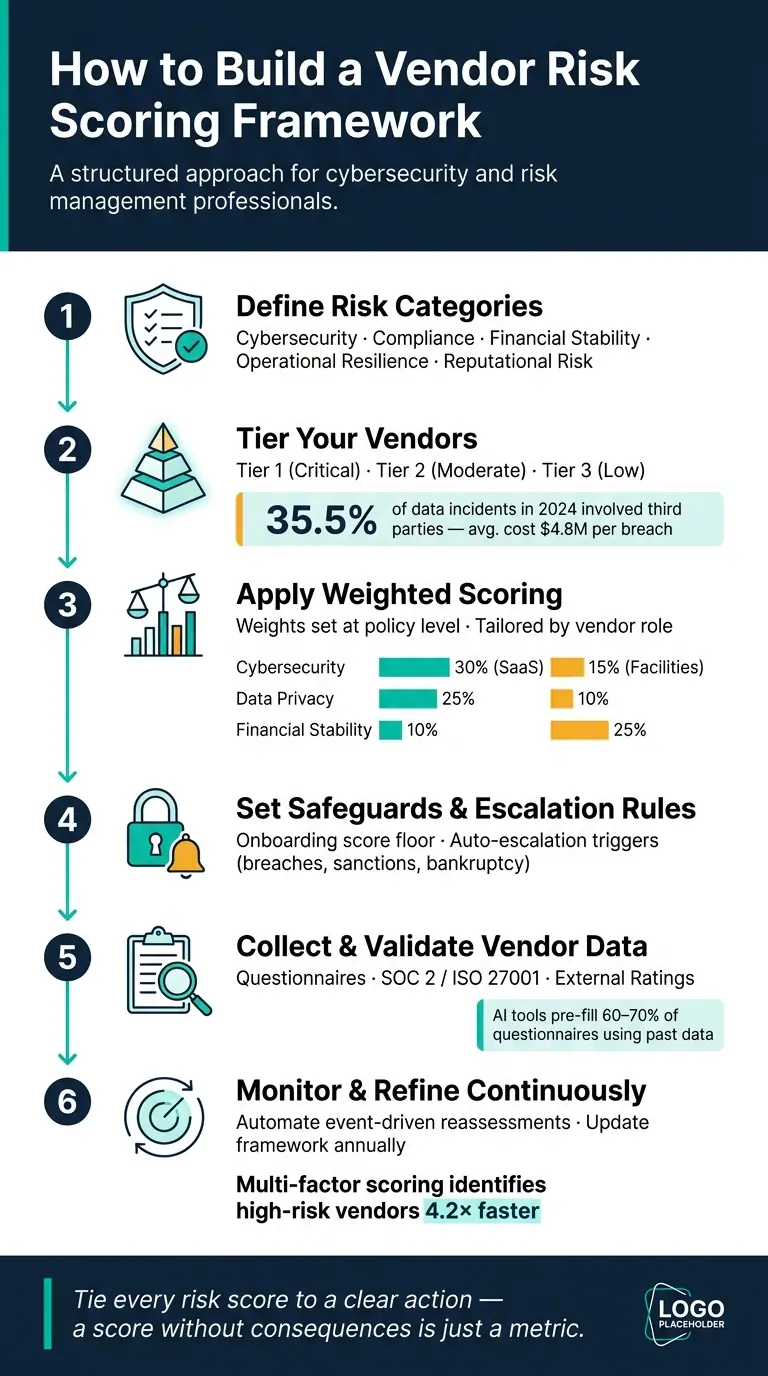
Vendor risk scoring helps organizations quantify and manage risks posed by third-party vendors. With third-party breaches accounting for 35.5% of data incidents in 2024, costing an average of $4.8M per breach, a structured framework is critical for identifying and prioritizing risks effectively.
Here’s the essence of building a vendor risk scoring framework:
- Define Risk Categories: Focus on areas like cybersecurity, regulatory compliance, financial stability, operational resilience, and reputational risks.
- Categorize Vendors: Group vendors into tiers (e.g., critical, moderate, low) based on their data access, business impact, and risk level.
- Use Weighted Scoring: Assign weights to risk factors based on vendor roles and responsibilities, ensuring assessments align with organizational priorities.
- Incorporate Safeguards: Set minimum risk score thresholds and triggers for escalation (e.g., reported breaches or financial instability).
- Collect and Validate Data: Use questionnaires, certifications (SOC 2, ISO 27001), and external ratings to assess vendors. Tailor depth based on vendor tier.
- Monitor Continuously: Automate reassessments for key events like data breaches or policy changes, and update the framework regularly to reflect new risks.
A successful framework ties risk scores to actionable steps, ensuring high-risk vendors are addressed promptly, resources are allocated effectively, and compliance requirements are met. Start small, refine over time, and focus on translating scores into clear decisions.
Vendor Risk Scoring Framework: 6-Step Process Guide
Defining Your Vendor Risk Scoring Framework
Mapping Vendor Types and Use Cases
When setting up a vendor risk scoring system, the first step is identifying all vendors. This involves consolidating records from procurement, accounts payable, and IT asset management systems. These records form a comprehensive vendor register, which serves as the foundation for your analysis.
Once you've compiled your list, categorize vendors by their inherent risk. This is determined by factors like the volume of sensitive data they handle, their integration with your systems, and the potential impact of an outage. For instance, a cloud provider managing sensitive patient data poses a higher risk than a vendor performing routine maintenance.
The table below outlines how these risk factors translate into assessment requirements:
| Tier | Data Access | Business Criticality | Assessment Depth |
|---|---|---|---|
| Tier 1 (Critical) | Handles PII/PHI at scale; Admin/Root access | Revenue-blocking; no alternatives | On-site audit, SOC 2, pen test, continuous monitoring |
| Tier 2 (Moderate) | Limited sensitive data; API access | Important but replaceable within 90 days | SIG-Lite, SOC 2 review, semi-annual checks |
| Tier 3 (Low) | Public data only; no system access | Commodity service; easily replaced | Self-certification, standard T&Cs, biennial review |
"The goal is to spend your scrutiny where failure would actually stop revenue, operations, compliance, or customer service." - Elevated Signal Research Team
Applying in-depth assessments to every vendor can drain resources and even lead to security reviews being bypassed for low-risk purchases. By tiering vendors, you ensure that resources are allocated where they matter most, in proportion to the actual risk.
Once vendors are categorized, the next step is to align your risk scoring framework with your organization’s risk tolerance and regulatory obligations.
Aligning the Framework with Risk Appetite and Compliance Requirements
Your framework should reflect your organization’s risk appetite - the level of third-party risk leadership is willing to accept. This involves setting weights, thresholds, and escalation rules at the policy level, with input from key stakeholders like the CISO, Legal, and Procurement teams.
"Weights must be set at policy level, not determined per assessment by the analyst reviewing the vendor." - Nasir R, Atlas Systems
On the compliance side, map your risk criteria to the strictest regulation that applies to your operations. Whether it’s DORA (effective January 2025), HIPAA, GDPR, or PCI DSS, a unified compliance mapping matrix allows a single assessment to meet multiple regulatory requirements.
To ensure consistency, implement two key safeguards from the outset:
- Onboarding score floor: Set a minimum residual risk score. Vendors falling below this threshold cannot be approved without executive sign-off.
- Automatic escalation rules: Define triggers for immediate escalation, such as sanctions matches, bankruptcy filings, or reported breaches. These findings should elevate a vendor to the highest risk tier, regardless of their overall score.
These safeguards minimize ambiguity and create a consistent, objective scoring process. Once your framework is aligned with risk tolerance and compliance, the next step is to define the specific criteria for evaluating vendors.
Establishing Risk Criteria
With vendor tiers and risk appetite established, it’s time to define the criteria for evaluating vendors. Most frameworks assess vendors across six to twelve dimensions. Common areas of focus include cybersecurity, data privacy, regulatory compliance, financial stability, operational resilience, and reputational risk.
The weight given to each criterion should reflect the vendor’s role. For instance, a SaaS provider handling sensitive data might have a cybersecurity weight of 30–35%, while a logistics partner’s evaluation might prioritize financial stability and business continuity. This approach ensures that assessments are both relevant and adaptable.
| Criterion | High-Risk (Cloud/SaaS) | Low-Risk (Facilities/Consulting) |
|---|---|---|
| Cybersecurity | 30% | 15% |
| Data Privacy | 25% | 10% |
| Regulatory Compliance | 20% | 20% |
| Financial Stability | 10% | 25% |
| Business Continuity | 10% | 20% |
| Reputational | 5% | 10% |
As your framework evolves, consider adding criteria for emerging risks. Fourth-party risk, which refers to risks introduced by your vendors’ subcontractors, is especially critical for Tier 1 vendors. If you work with AI vendors, include criteria for assessing training data governance, model bias, and access controls. For context, 97% of AI-related breaches in 2025 were linked to inadequate access controls.
sbb-itb-5f36581
Designing and Implementing the Scoring Model
Choosing a Scoring Methodology
Once you've defined your risk criteria, the next step is to establish a consistent way to turn vendor data into actionable scores. There are four primary approaches to consider, each suited to different stages of program maturity:
| Methodology | Best For | Key Limitation |
|---|---|---|
| Likelihood × Impact | Early-stage structured models | Relies heavily on subjective inputs |
| Weighted Scoring | Programs with well-defined risk priorities | Requires strong policy governance |
| Composite Multi-source | Programs using external data feeds | Complex data integration needed |
| Qualitative (Low/Med/High) | Broad vendor portfolios | Lacks precision for critical decisions |
For most organizations, weighted scoring becomes the go-to method. It allows you to assign percentages to risk categories based on business priorities. However, for the highest level of accuracy, the composite multi-source model is ideal. This model integrates multiple inputs - such as questionnaires, external security ratings, and certifications - providing a more complete picture. According to research, organizations using multi-factor scoring models identify high-risk vendors 4.2 times faster than those relying on single-metric methods.
To ensure fairness and consistency, incorporate deterministic scoring. For example, if a vendor lacks a SOC 2 certification, it should automatically result in a specific score deduction. This approach eliminates analyst bias and ensures your scoring process is both consistent and auditable.
Once you've selected your methodology, focus on assigning weights that reflect the specific risks associated with each vendor's role.
Defining Risk Factors and Assigning Weights
Using the risk criteria you've already established, assign weights to each risk factor based on the vendor's role and the nature of their engagement. Avoid a one-size-fits-all approach - tailor the weights to reflect the unique risks posed by each vendor type. For instance, a SaaS provider managing health data should have higher weightings for cybersecurity and data privacy, whereas a facilities vendor might be evaluated more on financial stability and business continuity. Here's an example of how weights can vary across different models:
| Risk Category | Model A | Model B | Model C |
|---|---|---|---|
| Information Security | 25% | 30% | 12% |
| Data Sensitivity / Privacy | - | - | 25% |
| Regulatory Compliance | 15% | 20% | 20% |
| Access Level | - | - | 20% |
| Financial Stability | 10% | 10% | 8% |
| Reputation & Media | 15% | 5% | - |
To align scoring with your organization's priorities, use context modifiers. For example, subtract points for vendors with strong contractual protections but add points for those with high concentration risks. Additionally, set up automatic escalations for critical issues - such as vendors with active sanctions or major security vulnerabilities - regardless of their overall score.
Calculating Inherent and Residual Risk
Each vendor should be evaluated with two distinct scores:
- Inherent risk: This represents the raw exposure a vendor poses before any mitigating controls are applied. Factors like data access, system integration, and overall business criticality play a role here.
- Residual risk: This accounts for the controls in place, such as certifications (SOC 2, ISO 27001), contractual safeguards, and your internal monitoring systems.
A practical scoring formula might look like this:
Risk Score = (Likelihood × Impact) + Modifiers.
To calculate residual risk, subtract the effectiveness of controls from the inherent risk score. Both scores should be reported side by side to leadership for clarity.
It's critical to map score ranges to specific, actionable steps. For example, a score below a certain threshold might require escalation to the CISO, while a score above a critical level could mean rejecting the vendor outright or requiring immediate remediation. As Nasir R from Atlas Systems notes:
"A score without operational consequences is a metric, not a management tool."
Without tying scores to clear actions, your framework may generate data but fail to drive decisions. These scoring outputs will become the backbone of your vendor assessments and ongoing risk management efforts.
Data Collection and Assessment Processes
Gathering and Structuring Vendor Data
The reliability of a scoring model hinges on the quality of its data sources. The best frameworks combine multiple inputs: vendor-completed questionnaires, external security ratings, and certifications like SOC 2 Type II or ISO 27001. Together, these pieces create a more complete picture of a vendor's security posture.
The depth of data you gather should align with the vendor's risk tier. For example, a Tier 1 vendor with access to sensitive customer data requires a thorough review of evidence, such as audit reports, business continuity plans, and penetration test summaries. Meanwhile, a Tier 4 vendor with limited access might only need a basic self-certification and standard contract terms. This tiered approach ensures your team focuses on what matters most.
| Vendor Tier | Questionnaire Depth | Evidence Required | Reassessment Frequency |
|---|---|---|---|
| Tier 1 (Critical) | 150+ questions | SOC 2 Type II, ISO 27001, BCP/DR, Pentest Summary | Annual |
| Tier 2 (High) | 80–120 questions | SOC 2, DPA, Cyber Insurance Certificate | Annual / 18 months |
| Tier 3 (Standard) | 30–50 questions | Security Policy, Privacy Policy | Biennial |
| Tier 4 (Low) | 10 questions or fewer | Self-certification, Contract Terms | Event-driven / Triennial |
One critical step is verifying that certifications like SOC 2 reports are scoped correctly. Vendors sometimes provide valid certifications that cover unrelated services, which can lead to a false sense of security. Always confirm that the evidence matches the product or service in question.
"Relying exclusively on vendor self-attestation without evidence verification creates a false sense of security." - vCSO.ai
It's also important to track the age of evidence. For example, SOC 2 reports older than 90 days or ISO certificates over 12 months should be flagged for renewal. Static assessments lose relevance quickly - research from 2026 showed that 67% of sub-processor pages and 41% of privacy policies changed within a 90-day period.
This structured approach to data collection sets the stage for creating smarter, more adaptive questionnaires.
Using Conditional and Multi-Step Questionnaires
A one-size-fits-all questionnaire is inefficient and often results in poor-quality responses. Instead, use conditional logic to tailor questions based on a vendor's previous answers. For instance, detailed encryption questions should only appear if the vendor confirms they handle sensitive personal data.
Tools like Reform make this process easier. Reform's multi-step forms and conditional routing adjust in real-time, streamlining the questionnaire process. Vendors are guided through relevant steps, which improves both response rates and accuracy. Reform also provides analytics to identify where vendors drop off or leave questions incomplete, helping you refine your forms over time.
To further simplify the process, consider adopting industry-standard templates like SIG Lite (Shared Assessments) or CAIQ (Cloud Security Alliance). Many vendors already have these templates completed, which can save weeks of back-and-forth. Additionally, AI-assisted tools can pre-fill 60–70% of a questionnaire using publicly available data or past assessments, reducing the burden on vendors.
Once adaptive questionnaires are in place, it's essential to integrate them into standardized workflows for consistent and reliable data collection.
Standardizing Assessment Workflows
Using vendor tier definitions as a foundation, structured workflows can streamline the assessment process for each risk level. Procurement teams handle initial outreach and distribute questionnaires, while the security team is responsible for validating evidence. Escalations to legal or the CISO should happen automatically when a high-risk issue or critical gap is identified.
Assessments shouldn't stop at scheduled reviews. Automate reassessments for significant events like data breaches, ownership changes, expanded data access, or a sharp drop in a vendor's external security rating. Tools like BitSight and SecurityScorecard can monitor these changes in real-time, flagging risks without requiring vendor input.
To ensure nothing slips through the cracks, automate reminders for certification renewals and set alerts for expiring documents like insurance certificates. Build triggers into your vendor portal to request updated evidence as needed. This way, your scoring model stays up-to-date with accurate and validated information at all times.
Operationalizing and Refining the Framework
Mapping Risk Scores to Actions
Risk scores should directly inform decision-making. As Nasir R from Atlassystems explains:
"If your team cannot articulate what a score of 68 versus 72 means for monitoring frequency or contract terms, the model is not operationalized."
To make these scores actionable, assign specific responses to each range. For example:
- Critical vendors: Notify the C-suite, implement continuous monitoring, and prioritize remediation.
- High-risk vendors: Require enhanced due diligence, including formal risk acceptance before onboarding.
- Moderate and low-risk vendors: Follow standard monitoring schedules with less intensive reviews.
Risk scores can also influence contract terms. Vendors with higher scores should face stricter requirements, such as:
- Incident notification within 24–72 hours
- Right-to-audit clauses
- Data destruction certifications upon contract termination
Additionally, establish a "score floor" in your policy to ensure no vendor is onboarded unless their residual risk score meets a pre-approved minimum threshold. In certain cases, critical issues - like an active sanctions match or lack of encryption for sensitive data - should override the overall score and trigger immediate escalation.
Once these actions are defined, the focus shifts to ongoing monitoring and adapting the framework to evolving conditions.
Monitoring Vendors and Updating the Framework
While scheduled reassessments are essential, vendor risk profiles can change quickly. For example, 67% of sub-processor pages and 41% of privacy policies are updated within a 90-day period. This makes event-driven triggers just as important as routine reviews.
Set up rules to automatically adjust a vendor's score - or flag them for manual review - based on specific events like:
- A security rating drop of over 50 points
- A reported data breach
- Mergers or acquisitions
- A credit downgrade
- Significant changes in data access
Vendor tiers should also remain flexible. For instance, a Tier 2 vendor may need to escalate to Tier 1 if new regulatory requirements or real-time signals demand closer scrutiny.
The framework itself needs regular updates. Review your due diligence questionnaires and tiering criteria annually to incorporate lessons from incidents and updated industry standards. Keep an eye on new regulations like DORA (effective January 2025) and NIS2, as they are setting stricter standards for third-party oversight. Adjusting your framework to reflect these changes - and tracking the results through KPIs - helps demonstrate its ongoing value.
Tracking Key Performance Indicators (KPIs)
To measure the framework’s success, monitor specific KPIs that highlight its ability to identify risks, process assessments efficiently, and drive meaningful remediation actions.
| KPI Category | Specific Metric | Target |
|---|---|---|
| Efficiency | Assessment cycle time | Under 10 days |
| Effectiveness | Remediation closure rate | Percentage of findings resolved |
| Coverage | Portfolio assessment % | 90–95% of active vendors scored |
| Predictive | Score trajectory/trend | Flag vendors with declining scores over 90 days |
| Impact | Inherent vs. residual risk gap | Quantify risk reduction to show ROI |
One particularly valuable metric is the gap between inherent and residual risk. This measures how much risk your controls and contract terms have mitigated, making it an excellent tool for executive reporting. Monitoring score trends can also provide predictive insights - vendors showing consistent improvement over six months experience 67% fewer security incidents compared to those with static or declining scores.
"The gap between [inherent and residual scores] quantifies what your TPRM program is delivering. Reporting only one hides that value from leadership." - Nasir R, Atlassystems
Each assessment should produce a risk register entry with clear ownership, a review date, and links to supporting evidence. This ensures findings remain actionable and auditable over time.
Risk scoring in Third-Party Risk Management (TPRM)
Conclusion
The steps we’ve covered come together to create a practical and effective vendor risk scoring system. This isn’t a one-and-done task - it’s an ongoing process that requires consistent attention. The key elements we discussed - categorizing vendors by importance, defining specific risk criteria (like cybersecurity and financial health), and calculating both inherent and residual risks - form the foundation of this approach.
Using multi-factor scoring models can help identify high-risk vendors faster, which is critical given that third-party incidents contribute to 23% of data breaches. A well-structured framework is more than just a compliance requirement; it’s a proactive way to strengthen your defenses.
Start with what you have. Even a simple weighted model, if applied consistently, beats relying on static spreadsheets. Test the model with 10–20 vendors before rolling it out fully. Establish a minimum score, and from the beginning, include triggers for updates based on events. Over time, refine your system by tweaking thresholds annually, monitoring how quickly issues are resolved, and using the gap between inherent and residual risk to highlight the program’s effectiveness.
FAQs
How do I pick the right vendor tiers for my business?
To determine the right vendor tiers, create a quantitative matrix based on clear criteria such as:
- Annual contract value: How much is being spent annually with the vendor.
- Data sensitivity: The level of confidentiality required for the data involved.
- Business criticality: How vital the vendor's service is to your operations.
- Substitutability: How easily the vendor can be replaced.
Define 4–5 tiers (e.g., Critical, High, Moderate, Low, Minimal), with each tier tied to specific levels of monitoring, approval requirements, and protective measures.
Your tiering system should be deterministic, meaning the same inputs always lead to the same classification. This consistency ensures fairness and reliability. Finally, incorporate these tiering rules into your policy to maintain uniformity and defensibility across your organization.
What’s the difference between inherent risk and residual risk?
Inherent risk represents the level of risk that exists in a process or vendor relationship before any security measures or mitigation efforts are applied. Think of it as your baseline level of exposure. Residual risk, however, is what’s left over after you’ve implemented those controls and strategies. In simple terms, inherent risk is where you start, while residual risk shows what remains after your efforts to reduce it.
How do I set score thresholds and escalation triggers?
Define specific actions for each risk tier to ensure clarity and consistency in handling risks. For instance, outline the level of assessment depth, monitoring intervals, and service-level agreement (SLA) expectations for every tier - whether low, medium, or high risk. Assign numerical ranges that align with your organization's risk tolerance to guide decisions such as when approvals are needed, what controls must be in place, or when issues should be escalated.
For critical findings, establish deterministic rules that bypass the overall risk score. Examples include immediate escalation for situations like sanctions matches or missing certifications. This ensures that high-priority issues are addressed without delay, maintaining a proactive approach to risk management.
Related Blog Posts
Get new content delivered straight to your inbox

The Response
Updates on the Reform platform, insights on optimizing conversion rates, and tips to craft forms that convert.




Drive real results with form optimizations
Tested across hundreds of experiments, our strategies deliver a 215% lift in qualified leads for B2B and SaaS companies.
