
.webp)
Key ISO 27001 Controls for Third-Party Form Security



When using third-party form builders to collect sensitive data like names, emails, and phone numbers, protecting that information is critical. ISO 27001:2022 provides a framework to manage risks tied to these vendors. Key controls (A.5.19–A.5.23) focus on supplier relationships, contracts, and cloud-specific risks. For example:
- A.5.19: Set clear security expectations with providers.
- A.5.20: Include security obligations in agreements (e.g., breach notifications).
- A.5.23: Define shared security responsibilities for SaaS tools.
Third-party breaches are rising, costing an average of $4.91 million. Using solutions like Reform, a no-code form builder, can simplify compliance. It offers features like encryption, role-based access, and real-time analytics, aligning with ISO 27001 requirements. However, thorough vetting, contracts with security clauses, and regular monitoring remain your responsibility.
Combining ISO 27001 controls with secure platforms helps protect your data and streamline vendor management.
1. ISO 27001 Annex A Controls
Risk Coverage
The 2022 update to ISO 27001 reorganized 114 controls into 93, grouping them under four themes: Organizational, People, Physical, and Technological. When it comes to third-party form security, five controls stand out as particularly important.
- A.5.19 (Information Security in Supplier Relationships): This control requires you to establish clear security requirements before working with a form provider. This includes setting expectations for encryption, access controls, and data handling protocols before signing any agreements.
- A.5.20 (Addressing Information Security within Supplier Agreements): This goes a step further by requiring that these security obligations are explicitly included in contracts. Examples include breach notification timelines (commonly 24–72 hours), data protection standards, and audit rights.
- A.5.21 (Managing Information Security in the ICT Supply Chain): This control addresses risks like phishing and ransomware targeting your form provider’s systems. It emphasizes evaluating not just the provider but also their subcontractors.
- A.5.23 (Information Security for Use of Cloud Services): This control outlines shared security responsibilities between you and the SaaS provider.
- A.8.11 (Data Masking) and A.8.12 (Data Leakage Prevention): These controls are vital for protecting sensitive data collected via forms from being exposed during processing or storage.
These controls are essential but require careful planning and consistent attention to implement effectively.
Implementation Complexity
Among the controls, A.5.22 (Monitoring and Review) is often the hardest to implement. It involves continuously verifying that your form provider adheres to their security commitments. Many organizations fall short by performing only a one-time assessment during onboarding rather than ongoing monitoring.
A.5.21 (ICT Supply Chain Management) is another challenging area. It requires detailed evaluations of your provider’s security policies, technical defenses (like firewalls and anti-malware), and internal processes. This goes beyond basic questionnaires, demanding a deeper understanding of their actual security measures.
To tackle these challenges, prioritize your efforts. Focus most of your resources on the top 20% of vendors - like your primary form builder - who handle sensitive production data or intellectual property. Using a standardized "Security Addendum" in contracts can also streamline compliance with A.5.20, reducing the need for lengthy, manual negotiations.
Form-Specific Applicability
Most modern form builders operate as cloud-based SaaS platforms, making A.5.23 particularly relevant. This control helps clarify who is responsible for specific security measures. Typically, the form provider handles infrastructure-level security, while you take responsibility for access management and data classification.
Since forms often collect personally identifiable information (PII), A.8.11 (Data Masking) and A.8.12 (Data Leakage Prevention) are critical. These controls ensure that sensitive data remains secure during processing and storage. If you’re outsourcing custom form development instead of using a standard SaaS solution, A.8.30 (Outsourced Development) ensures secure coding, testing, and delivery are part of the agreement.
"Understanding which controls matter most for your organization... is the difference between an ISMS that passes audit and one that actually improves security." - Lorikeet Security Team
sbb-itb-5f36581
2. Reform (No-Code Form Builder)
Risk Coverage
Reform is designed with a security framework that aligns with key ISO 27001 controls to protect third-party form data. It incorporates multi-factor authentication (MFA) and single sign-on (SSO), addressing controls A.8.2–A.8.4, which are critical given that human error accounts for over 80% of data breaches.
The platform ensures data security by encrypting information both during transfer and at rest, meeting controls A.8.11 and A.8.12 for safeguarding personally identifiable information (PII) collected via forms. To reduce risks like malicious data entries, it includes features such as spam prevention and email validation. With third-party breaches rising by 68% in 2024 and accounting for 15% of all incidents, these security measures play a crucial role in reducing vulnerabilities.
These built-in protections make compliance easier, a topic explored further in the implementation section below.
Implementation Complexity
Reform’s no-code design significantly reduces the time required for ISO 27001 compliance, cutting it from 550–600 hours to approximately 75 hours. Its team access controls and role-based permissions enforce the Principle of Least Privilege, aligning with control A.8.4.
However, onboarding Reform as a third-party vendor still requires standard due diligence for controls A.5.19 and A.5.20. This includes ensuring your Master Services Agreement includes breach notification protocols and "Right to Audit" clauses. Additionally, Reform provides real-time analytics and audit logs, meeting the continuous monitoring requirements under control A.5.22.
These features not only simplify the compliance process but also support secure and efficient form configurations, discussed in the next section.
Form-Specific Applicability
As a cloud-based SaaS platform, Reform adheres to control A.5.23 by securing its infrastructure while allowing users to manage access and data classification. To prevent data leakage, users must properly configure features like file uploads, custom CSS, and headless forms, ensuring compliance with control A.8.12.
Reform’s integrations with tools like HubSpot and Salesforce introduce supply chain considerations under control A.5.21. It’s essential to confirm that data exchanged between Reform and connected systems maintains encryption and access control standards throughout the data pipeline. Additionally, the platform’s abandoned submission tracking should be paired with effective data retention policies to meet privacy regulations and ISO 27001 requirements.
Assessing Third-Party Risk Management with ISO 27001
Pros and Cons
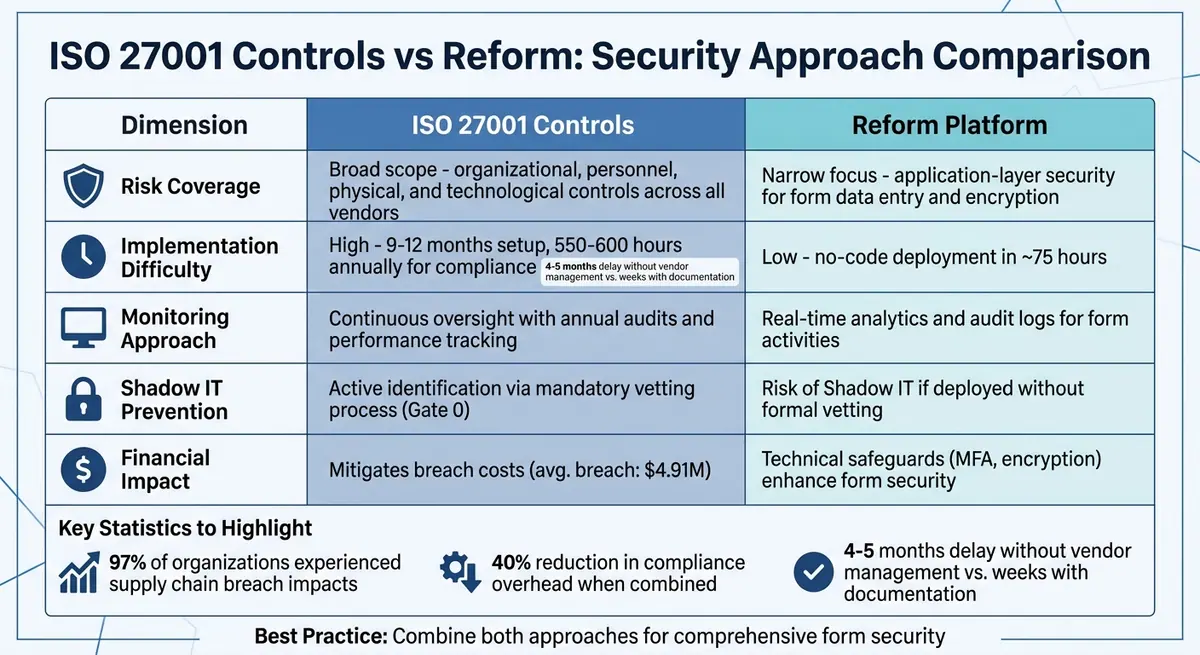
ISO 27001 Controls vs Reform Platform: Third-Party Form Security Comparison
ISO 27001 controls and Reform tackle different aspects of form security. While ISO 27001 provides a broad governance framework, Reform focuses on delivering the technical infrastructure that requires verification. This comparison helps organizations make targeted security investments.
Here’s a breakdown of how each approach addresses key security dimensions:
| Dimension | ISO 27001 Controls | Reform |
|---|---|---|
| Risk Coverage | Broad: encompasses organizational, personnel, physical, and technological controls across all vendors | Narrow: prioritizes application-layer security, focusing on form data entry and encryption |
| Implementation Difficulty | High: typically requires 9–12 months to set up and around 550–600 hours annually for compliance activities | Low: no-code deployment allows setup in approximately 75 hours |
| Monitoring Approach | Continuous oversight with annual audits and performance tracking | Real-time analytics and audit logs for form activities |
| Shadow IT Prevention | Actively identifies unauthorized tools via a mandatory vetting process (Gate 0) | Risk of Shadow IT if deployed without formal vetting |
| Financial Impact | Helps mitigate breach costs; average breaches cost about $4.91 million | Provides technical safeguards - like MFA and encryption - to enhance form security |
Industry experts emphasize the importance of addressing these dimensions effectively:
"If your cloud provider leaks client data, that is your breach, not just theirs" - Amit Gupta, Founder & CEO of Konfirmity
By integrating ISO 27001 controls with Reform's technical features, organizations can achieve both comprehensive governance and robust form security. ISO 27001 also tackles human-related risks - like background checks and internal policies - that form builders alone cannot manage.
For organizations handling sensitive data, combining these two approaches is essential. Use ISO 27001 controls (e.g., A.5.19–A.5.23) to establish strong vendor vetting processes. At the same time, deploy Reform's features - such as role-based permissions and email validation - to secure form operations. This combination addresses the high rate of supply chain breaches (97% reported in the past year) while reducing compliance overhead by 40%. Together, these strategies lay the groundwork for broader compliance efforts, which will be explored further in the conclusion.
Conclusion
When handling sensitive form data, organizations need to pair ISO 27001 controls with a strong technical foundation. Controls like A.5.19–A.5.23 from ISO 27001 offer a structured way to evaluate vendors, enforce security requirements through contracts, and maintain ongoing oversight of third-party relationships. This is critical, especially considering that 97% of organizations have experienced negative outcomes from supply chain breaches.
A layered security strategy is key. Start by implementing ISO 27001 supplier controls, such as formal vetting processes, standardized security agreements, and regular monitoring. Then, bolster these measures with Reform's technical features, including encryption, role-based access, email validation, and real-time analytics. Together, these steps create a comprehensive defense for form operations.
"ISO 27001 Third-Party Risk management becomes the difference between a stalled deal and a signed contract."
– Amit Gupta, Founder & CEO, Konfirmity
The benefits of this approach are clear. Businesses with well-documented vendor management programs can complete security reviews in a matter of weeks. In contrast, those lacking such programs may face delays of 4–5 months. By integrating ISO 27001's ongoing oversight with Reform's no-code deployment capabilities, organizations can simplify compliance and vendor management processes, improving both speed and efficiency.
Focus on your most critical vendors. Apply the strictest ISO 27001 assessments to vendors managing production data or personally identifiable information, while reserving lighter reviews for lower-risk tools. This risk-based approach ensures essential assets are protected without overburdening operations.
FAQs
Which ISO 27001 controls matter most for third-party forms?
When it comes to third-party forms, ISO 27001 emphasizes three critical areas: risk assessment, supplier security, and access management. These controls are designed to identify and evaluate potential risks that external entities might introduce. By addressing these areas, organizations can reduce vulnerabilities and strengthen their overall security posture when working with third parties.
What should a form vendor contract include for ISO 27001?
A vendor contract should clearly specify third-party security controls that align with ISO 27001 standards. It should detail provisions for risk management, security protocols, and compliance checks to verify the vendor's adherence to these guidelines. These steps help ensure the vendor contributes to your organization's ISO 27001 compliance efforts and safeguards sensitive information effectively.
Who is responsible for what in a SaaS form security model?
In a SaaS form security setup, responsibilities are divided between the organization and its third-party partners. The organization working toward ISO 27001 compliance takes charge of managing security controls, including overseeing risks tied to third-party vendors. These vendors and service providers, in turn, are expected to follow the security measures and controls outlined by the standard. This partnership helps maintain robust protection while ensuring all ISO 27001 requirements are met.
Related Blog Posts
Get new content delivered straight to your inbox

The Response
Updates on the Reform platform, insights on optimizing conversion rates, and tips to craft forms that convert.


Drive real results with form optimizations
Tested across hundreds of experiments, our strategies deliver a 215% lift in qualified leads for B2B and SaaS companies.
