
.webp)
How to Make Payment Forms PCI Compliant


If you handle online payments, PCI DSS compliance is non-negotiable. It’s a security standard designed to protect cardholder data, and failing to comply can lead to breaches, fines, and loss of trust. Here’s how to ensure your payment forms meet these requirements:
- Secure Payment Data: Use tokenization and encryption to protect sensitive card details. Hosted payment fields or redirects can keep card data off your servers entirely.
- Harden Systems: Secure your payment gateways with TLS 1.2+, implement a Web Application Firewall (WAF), and restrict third-party scripts to reduce risks like Magecart attacks.
- Validate Inputs: Use real-time input validation and fraud detection tools like the Luhn algorithm, AVS, and 3D Secure for added security.
- Maintain Compliance: Conduct regular security audits, vulnerability scans, and penetration tests. Limit access to sensitive systems using role-based controls and multi-factor authentication.
- Choose the Right SAQ: Depending on how you process payments, complete the appropriate Self-Assessment Questionnaire (SAQ) or work with a Qualified Security Assessor (QSA) for higher transaction volumes.
PCI DSS Explained: A Compliance Guide & Checklist
sbb-itb-5f36581
PCI DSS Requirements Explained
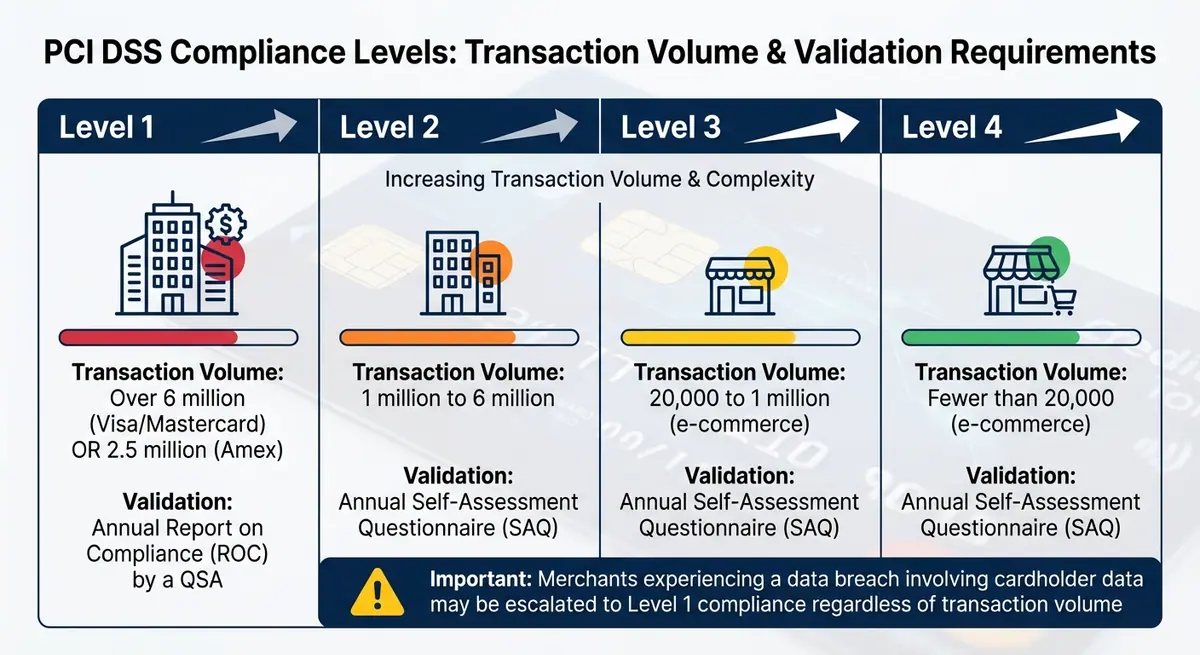
PCI DSS Compliance Levels by Transaction Volume and Validation Requirements
What is PCI DSS?
The Payment Card Industry Data Security Standard (PCI DSS) is a security framework designed for organizations that store, process, or transmit cardholder data (CHD) or sensitive authentication data (SAD). Developed by major card brands, it includes over 300 security controls grouped into 12 core requirements under six main principles.
These 12 requirements cover areas like securing networks, protecting data, controlling access, and monitoring systems. For payment forms, organizations must use strong encryption (e.g., AES-256) for stored data, TLS 1.2 or higher for data in transit, enforce strict access controls, and maintain detailed system logs. The latest version, PCI DSS v4.0, which becomes mandatory after March 31, 2025, introduces stricter password policies (minimum of 12 characters) and improved controls for e-commerce scripts.
| Compliance Level | Annual Transaction Volume | Primary Validation Requirement |
|---|---|---|
| Level 1 | Over 6 million (Visa/Mastercard) or 2.5 million (Amex) | Annual Report on Compliance (ROC) by a QSA |
| Level 2 | 1 million to 6 million | Annual Self-Assessment Questionnaire (SAQ) |
| Level 3 | 20,000 to 1 million (e-commerce) | Annual Self-Assessment Questionnaire (SAQ) |
| Level 4 | Fewer than 20,000 (e-commerce) | Annual Self-Assessment Questionnaire (SAQ) |
Your compliance level dictates whether you need a formal audit by a Qualified Security Assessor (QSA) or if you can complete a Self-Assessment Questionnaire (SAQ). Transaction volumes are calculated across all sales channels - both online and in-store - over a 12-month period. Importantly, merchants that experience a data breach involving cardholder data may be automatically escalated to Level 1 compliance, regardless of their transaction volume. Clearly defining your Cardholder Data Environment (CDE) is essential for streamlining compliance efforts.
Determining Compliance Scope for Payment Forms
The scope of PCI DSS compliance revolves around your Cardholder Data Environment (CDE), which includes all people, processes, and technologies that handle cardholder data. Payment forms are particularly vulnerable as public entry points, often targeted by attacks like Magecart, where malicious JavaScript captures customer data during input. The design of your payment form—whether you use multi-step forms or static ones—heavily influences your compliance responsibilities.
"Ensure the Cardholder Data Environment (CDE) is accurately defined. Mis-scoping leads to non-compliance or unnecessary audit complexities. Include data flows, connected systems, and third-party services in your review."
- Steve Moore, Vice President and Chief Security Strategist, Exabeam
Using hosted payment fields or iframes (offered by services like Stripe Elements) can keep sensitive data off your servers entirely. This setup qualifies you for SAQ A, which has about 22 requirements. On the other hand, if your server processes raw card data directly via API integration, you'll need to complete SAQ D, which includes over 300 requirements. Choosing the right payment form architecture can reduce your compliance workload by more than 90%, making it a critical decision. A thorough understanding of your CDE and payment form setup is key to implementing the necessary technical and administrative measures.
Technical Steps for PCI Compliant Payment Forms
Use Tokenization and Encryption
Tokenization is a method that replaces sensitive card details with randomly generated tokens that hold no exploitable value. Many Payment Service Providers (PSPs) offer features like "Hosted Fields" or "Tokenized Elements", which embed secure iFrames for card input fields (e.g., card number, expiration date, CVV) directly into your checkout page. When customers enter their card information, the data is sent directly to the PSP's servers, bypassing your infrastructure entirely. What you receive is a single-use token that allows you to process the transaction without ever handling the actual Primary Account Number (PAN).
Alternatively, you can use Hosted Payment Pages, which redirect customers to the PSP's domain (e.g., pay.example-psp.com) to complete the checkout process. While this approach minimizes PCI compliance requirements, it does interrupt the user experience by taking customers off your site. Hosted fields, on the other hand, provide a more seamless, on-site checkout while still reducing your PCI scope.
"The single best security decision you can make is not to collect, transmit, or store cardholder data on your own infrastructure." - NOC
To further enhance security, always use HTTPS with HSTS, mask card numbers (display only the last four digits), hide CVVs after input, and disable browser autocomplete for sensitive fields. With tokenization and encryption securing the front end, your next step should be strengthening your payment gateways and APIs.
Secure Your Payment Gateways and APIs
Once card data is tokenized, the focus shifts to securing the systems that transmit and process it. Embedded gateways or redirects ensure that sensitive data never passes through your servers, significantly reducing your PCI compliance burden. If you're using hosted fields, consider hosting your checkout page on a separate, hardened subdomain. This isolates it from your main website, lowering the risk of attacks.
Implement a Web Application Firewall (WAF) to block common threats like SQL injection and Cross-Site Scripting (XSS). Ensure all data transmissions use TLS 1.2 or higher - older protocols like SSL and TLS 1.0 are no longer secure. Add a strict Content Security Policy (CSP) to allow-list trusted sources for scripts and block unauthorized inline or external scripts. Use Subresource Integrity (SRI) attributes for third-party JavaScript and CSS files to verify they haven’t been altered.
Minimize third-party scripts on your payment page by removing non-essential elements like analytics tools, chat widgets, and A/B testing scripts. This reduces the risk of Magecart-style attacks, where malicious code collects sensitive information like keystrokes. Set up alerts for any unusual outbound requests, such as unexpected POST or XHR calls, which could signal a skimming attack.
Statistics show that less than 50% of organizations maintain full PCI compliance year-over-year, and 97% of top U.S. retailers reported experiencing a third-party data breach in the past year.
Validate Inputs and Detect Fraud
Real-time input validation helps reduce errors and detect potential fraud. For example, the Luhn algorithm can validate card numbers as they’re entered, catching typos immediately. Expiry dates should be checked against the current date, and CVV lengths should match the card type - three digits for Visa and Mastercard, four for American Express. On mobile devices, use numeric input fields for card and CVV entries to simplify data entry and reduce mistakes.
Adding a billing postal code field enables the Address Verification Service (AVS), which compares the postal code provided by the customer with the one on file with the card issuer. This can flag mismatches that might indicate fraud. You can also implement 3D Secure (3DS), which adds an extra verification step - handled via your PSP’s SDK - to confirm the cardholder’s identity. To prevent automated attacks, deploy rate-limiting on sensitive endpoints and block known malicious traffic.
"The payment form needs to feel reliable, protect sensitive information, validate inputs in real time, and not slow users down." - Stripe
Provide clear error messages, such as "Your card was declined", without clearing the entire form, so users can easily correct mistakes. Regularly monitor your DOM and scripts by comparing deployed assets to known hashes. Any unauthorized changes could signal a breach, so set up alerts to catch these quickly.
For businesses looking to simplify this process, tools like Reform offer no-code, user-friendly form builders that integrate these security measures while maintaining a seamless checkout experience.
Administrative Steps to Maintain Compliance
Maintaining PCI compliance isn't a one-and-done task - it's an ongoing administrative effort. With the average global data breach costing $4.88 million, and 91% of payment card breaches tied to web applications rather than physical terminals, strengthening administrative processes is just as critical as implementing technical safeguards.
Set Up Role-Based Access Control
Limiting access to sensitive systems is key to reducing insider threats and accidental data leaks. PCI DSS requires a "least privilege" approach, meaning employees should only access data essential to their job roles.
To secure access further, assign unique user IDs and enforce multi-factor authentication (MFA) for anyone accessing the cardholder data environment (CDE). Systems should also lock accounts after no more than six failed login attempts to block brute-force attacks. Additionally, PCI DSS Requirement 6.2.4 specifies that code reviews must be conducted by someone other than the original developer. This separation of duties helps catch errors and prevents malicious code from slipping through.
If you're using tools like Reform for payment forms, take advantage of subaccounts and granular permission settings to control who can access sensitive configurations and customer data. Regular audits of access permissions are another way to keep your compliance efforts on track.
Conduct Regular Security Audits
Quarterly vulnerability scans are not optional - they're required by PCI DSS and must be performed by an Approved Scanning Vendor (ASV). These scans help identify and fix internet-facing vulnerabilities before attackers can exploit them. Annual penetration tests are also a must.
Custom payment form code needs to go through pre-production security reviews, either by independent developers or automated tools. Use trusted frameworks like the OWASP Top 10 or CWE to prioritize vulnerabilities, and address critical issues within a month. Proactively investing in compliance can save organizations hundreds of thousands of dollars in potential fines and breach-related costs.
"Paying for compliance feels expensive until you price out a breach. Then compliance looks like the bargain of the century." - Satish Kumar, Security Consultant
Security awareness training is another requirement. All personnel, including developers, must complete training at least once a year. Make it a habit to review and update your security policies annually, and keep detailed logs, training records, and script inventories ready for your annual PCI assessment.
Monitor Script Integrity
Regular audits are essential, but ongoing monitoring of payment page scripts is equally important. PCI DSS 4.0 Requirement 6.4.3 mandates a documented inventory of all scripts running on your payment pages, along with a business justification for each one. This step is designed to counter Magecart-style attacks, where malicious scripts are injected to steal cardholder data in real time.
File integrity monitoring (FIM) tools like Tripwire or OSSEC can detect unauthorized changes within an hour. Subresource Integrity (SRI) hashes should be used to confirm that external scripts haven't been tampered with, and a Content Security Policy (CSP) can restrict which domains are allowed to execute JavaScript on your payment pages. Daily log reviews are crucial for spotting unusual activity, and logs must be retained for at least a year, with the latest three months readily available.
Set up alerts for suspicious outbound requests or CSP violations to catch potential compromises early. Continuous script monitoring is your first line of defense against common e-commerce threats.
How to Validate PCI Compliance
Once you've implemented the necessary technical and administrative safeguards, it's time to validate your PCI DSS compliance. This process ensures that all systems handling cardholder data align with the stringent PCI DSS standards. The method for validation depends on your transaction volume and how you process card data.
Complete Self-Assessment Questionnaires
If your business processes fewer than 6 million transactions annually (Levels 2, 3, and 4), you can typically validate compliance using a Self-Assessment Questionnaire (SAQ) instead of undergoing a full external audit. The SAQ is a self-guided tool with a series of yes/no questions that address the 12 PCI DSS requirements. Responses include options like "In place", "In place with remediation", "Not applicable", or "Not in place".
The first step is choosing the correct SAQ type. For example:
- SAQ A: For businesses that fully outsource payment processing via an iframe or redirect.
- SAQ A-EP: For businesses that host their payment page but rely on a third-party processor to handle card data.
SAQ A is relatively straightforward with just 22 questions, while SAQ A-EP is more detailed, containing around 200 security requirements.
Before starting, take inventory of all systems, applications, and network components within your Cardholder Data Environment (CDE). Under PCI DSS v4.0, you must also review the Attestation of Compliance (AoC) for any third-party service providers to verify that they meet compliance standards for the services they provide. For any requirements marked as "not in place", outline remediation plans and timelines - every requirement must eventually be fulfilled.
Once all questions are answered and any gaps addressed, complete the Attestation of Compliance. This document must be signed by an authorized representative to confirm the accuracy of your assessment. If your transaction volume exceeds the threshold for SAQs, the next step involves working with a Qualified Security Assessor.
Work with Qualified Security Assessors
Merchants processing over 6 million Visa or Mastercard transactions annually (Level 1) are required to undergo an annual review by a Qualified Security Assessor (QSA) or a certified Internal Security Assessor.
The QSA process begins with scoping and preparation. During this phase, the QSA identifies your Cardholder Data Environment and determines which systems interact with cardholder data. Following this, a gap analysis is conducted to pinpoint missing controls and provide a remediation checklist before the formal audit begins. The on-site assessment involves interviewing staff, reviewing system configurations, and gathering evidence - such as logs and screenshots - to confirm that security controls are effective.
"A QSA is a certified expert who evaluates whether your business meets PCI DSS requirements and helps you close any security gaps. QSAs help clarify a process that often feels opaque." - Stripe
Once the assessment is complete, address any identified issues and submit them for final verification by the QSA. The outcome is a Report on Compliance (ROC) and an Attestation of Compliance (AOC). Since the ROC contains sensitive technical details, it's best to share only the AOC with external parties.
Prepare Required Documentation
Proper documentation is critical to the validation process. Key items include network diagrams, firewall configurations, evidence of network segmentation, and system hardening standards. Operational records should also be maintained, such as quarterly vulnerability scan reports from an Approved Scanning Vendor (ASV), penetration testing results, and logs of security awareness training. Additionally, written policies for incident response, access control, and vendor management are required.
Mapping how cardholder data flows through your systems ensures that every component is secure. To stay on track, create a "compliance calendar" to schedule quarterly ASV scans and annual penetration testing. This makes it easier to gather evidence when it's time for your yearly renewal.
| Document | Purpose | Who Prepares It |
|---|---|---|
| SAQ | Self-evaluation of security controls | Merchant/Service Provider |
| AOC | Formal proof of compliance for banks/partners | Merchant Executive or QSA |
| ROC | Detailed audit report for high-volume entities | Qualified Security Assessor (QSA) |
Be proactive about addressing common issues, such as outdated patches or weak password policies, before submitting the AOC. Keep in mind that under PCI DSS v4.0, the minimum password length for administrative access will increase from 7 to 12 characters starting March 31, 2025. Maintaining organized records throughout the year helps streamline the validation process and demonstrates your commitment to protecting cardholder data.
Conclusion
Meeting PCI DSS compliance for payment forms requires a combination of tokenization, encryption, secure payment gateways, real-time input validation, and strong administrative controls. Together, these measures create a solid defense for your payment system.
"PCI DSS sets a baseline level of protection for consumers and helps reduce fraud and data breaches across the entire payment ecosystem." - Stripe
To stay compliant, it's crucial to adopt a proactive approach with continuous monitoring and regular audits. This means scheduling quarterly vulnerability scans, conducting annual penetration tests, and maintaining real-time monitoring to catch anomalies before they turn into breaches. Without these safeguards, breaches can go unnoticed for months, leading to hefty penalties and a loss of customer trust.
The stakes are high. GDPR fines can climb to €20 million or 4% of annual global revenue, while CCPA allows statutory damages ranging from $100 to $750 per consumer per incident. Beyond financial penalties, a data breach can damage your reputation and give competitors an advantage. By enforcing these security measures consistently, you not only protect cardholder data but also preserve customer confidence and secure your position in the market.
FAQs
Which SAQ do I need for my payment form?
The type of SAQ (Self-Assessment Questionnaire) you need hinges on how your payment system is configured. If you rely on hosted payment pages or third-party payment processors, you’ll probably fall under SAQ A. On the other hand, if your setup involves direct integrations where you handle cardholder data, you might need SAQ D. It’s crucial to evaluate your payment environment thoroughly to stay compliant without taking on extra obligations.
How can I keep card data off my servers?
To keep card data away from your servers and maintain PCI compliance, it's essential to use methods that ensure sensitive payment information never interacts with your infrastructure. Here are two effective options:
- Tokenized payment forms or hosted fields (like iFrames) offered by your payment service provider (PSP). These tools securely handle payment data without exposing it to your systems.
- Redirect-based payment pages, where customers input their payment details directly on the PSP’s domain, keeping your servers out of the process.
Both approaches significantly reduce PCI scope and help lower security risks by ensuring sensitive data remains off your infrastructure.
What changes with PCI DSS 4.0 in 2025?
In 2025, PCI DSS 4.0 will roll out with updates designed to tackle modern cyber threats and accommodate advancements in payment technologies. These updates include stronger security measures, new compliance requirements, and more adaptable frameworks to meet the needs of today's evolving payment landscape. The goal is to enhance security while keeping pace with the rapid changes in the industry.
Related Blog Posts
Get new content delivered straight to your inbox

The Response
Updates on the Reform platform, insights on optimizing conversion rates, and tips to craft forms that convert.


Drive real results with form optimizations
Tested across hundreds of experiments, our strategies deliver a 215% lift in qualified leads for B2B and SaaS companies.
