
.webp)
Common PCI DSS Pitfalls in Payment Forms



If your business processes credit card payments online, PCI DSS compliance is non-negotiable. Missteps in securing payment forms can lead to data breaches, fines up to $2.4 million, and even loss of payment processing privileges. Here’s what you need to know:
Key Pitfalls to Avoid:
- Storing Sensitive Authentication Data (SAD): Even encrypted storage of CVV codes or PINs violates PCI DSS rules.
- Poor Network Segmentation: Sharing infrastructure between payment systems and other website components increases risks and compliance scope.
- Incorrect SAQ Selection: Misclassifying your payment setup leads to compliance gaps.
- Unverified Third-Party Integrations: Assuming vendors are compliant without proof can expose your systems to attacks.
- Neglecting Vulnerability Management: Outdated payment endpoints are prime targets for cybercriminals.
Solutions:
- Tokenization: Replace sensitive data with non-sensitive tokens to reduce compliance scope by up to 90%.
- Hosted Payment Pages: Use third-party solutions like Stripe or Adyen to handle cardholder data directly.
- Network Segmentation: Isolate payment systems to minimize exposure.
- Verify Vendors: Always request and review their Attestation of Compliance (AOC).
- Regular Scans and Updates: Conduct quarterly vulnerability scans and apply patches within 30 days.
PCI DSS compliance isn’t just about avoiding fines - it’s about protecting your customers and your business. Start by addressing these common pitfalls to stay secure and compliant year-round.
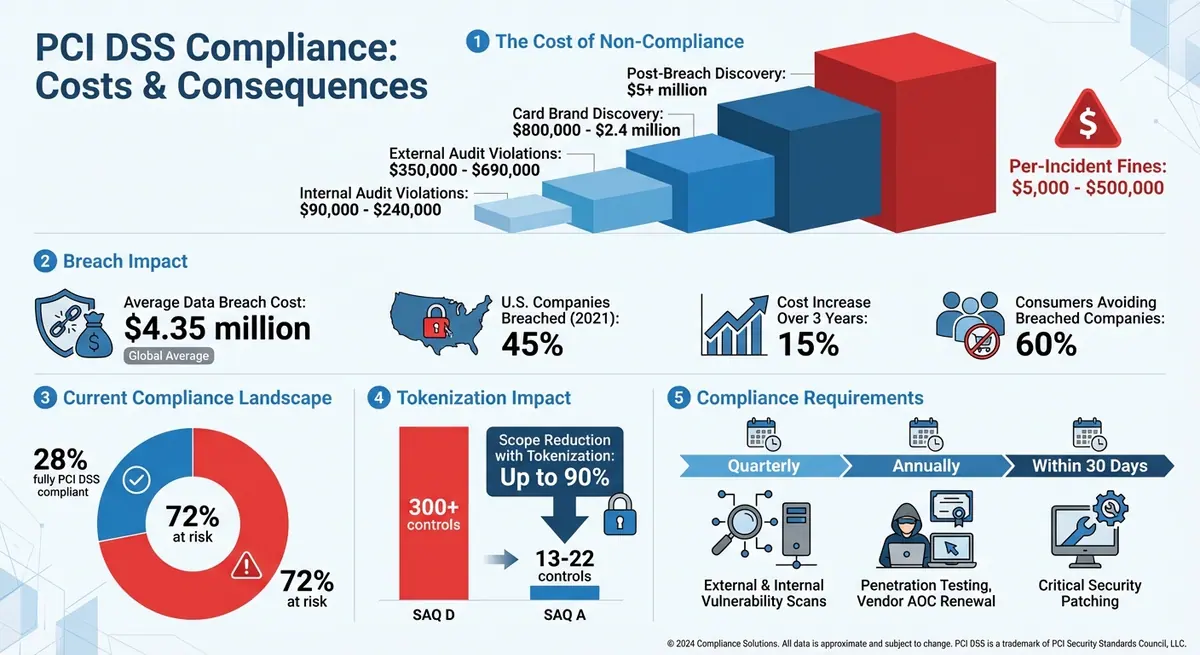
PCI DSS Compliance Costs and Consequences Infographic
Mastering PCI-DSS: Payment Security Simplified
sbb-itb-5f36581
Common PCI DSS Pitfalls in Payment Forms
Mistakes in implementing payment forms can lead to serious compliance violations, hefty fines, and increased risks of data breaches. Even businesses with the best intentions can stumble. Knowing where these errors typically occur can help you avoid costly problems.
Storing Sensitive Authentication Data After Authorization
One of the most severe violations is storing Sensitive Authentication Data (SAD) - such as CVV codes, full track data, or PINs - after a transaction is authorized. PCI DSS Requirement 3.2 strictly prohibits this, with no exceptions.
A common misconception is that strong encryption, like AES-256, allows for storing this data. However, PCI DSS makes it clear: even encrypted storage of SAD is a violation. As compliance expert Meera Sinha explains:
PCI DSS doesn't grade on intent. It doesn't matter that you stored Sensitive Authentication Data by accident. It doesn't matter that you encrypted it. The moment that data hits persistent storage, you're in violation.
These violations often show up in unexpected places - application logs, database columns, test environments, or stored responses from payment gateways.
The financial impact can be staggering. Internal audits to uncover violations cost between $90,000 and $240,000, while external audits range from $350,000 to $690,000. If card brands discover the issue, fines can escalate to $800,000 to $2.4 million. And if discovered after a breach, costs can exceed $5 million.
Inadequate Network Segmentation
Failing to separate payment form systems from other parts of your infrastructure can expand your PCI DSS compliance scope and increase security risks.
When payment forms share infrastructure with your main website - including admin panels, plugins, or CI/CD pipelines - a vulnerability in a non-payment area can grant attackers access to cardholder data. For example, marketing plugins or website themes can become entry points for malicious scripts like Magecart, which harvest payment information.
Handling PAN on any server expands your PCI DSS scope: systems, networks, logging, change control, segmentation, scans, pen tests, and more. - NOC
Without proper segmentation, your entire system falls under PCI DSS requirements, making compliance more complex and costly. One e-commerce company faced $340,000 in remediation costs after failing to segment its systems and accidentally storing sensitive data in a database.
Incorrect Self-Assessment Questionnaire (SAQ) Selection
Misclassifying your payment form setup is another frequent issue. Choosing the wrong SAQ type creates compliance gaps and increases audit risks. The correct SAQ depends on how your business handles cardholder data.
For example:
- If you use a fully hosted payment page where card data never touches your domain, you likely qualify for SAQ A.
- If you use iFrame-based hosted fields where the Primary Account Number (PAN) is sent directly to the payment processor, SAQ A also generally applies.
- However, hosting the payment form on your own servers and posting data from your domain requires the more detailed SAQ A-EP.
Selecting the wrong SAQ means you're not meeting the appropriate requirements, leaving your business vulnerable and increasing the likelihood of compliance failures.
Unmanaged Third-Party Payment Integrations
Assuming third-party vendors are PCI DSS compliant without verification is a common mistake. Third-party scripts - like those from analytics tools, chat widgets, or A/B testing platforms - can be exploited to insert malicious code into your checkout process. Each script added to your payment page increases the potential attack surface.
According to the 2021 Thales Data Threat Report, 45% of U.S. companies experienced a data breach in the previous year. The average cost of a data breach is $4.35 million, with costs rising by about 15% over three years.
Hear no card data, see no card data, touch no card data unless explicitly required for processing. - Narendra Sahoo, Founder and Director, VISTA InfoSec
Unmanaged integrations not only breach PCI DSS guidelines but also make your payment forms more susceptible to attacks.
Lack of Vulnerability Management
Another major pitfall is neglecting regular scans and updates for payment form endpoints. Without consistent monitoring and timely patching, outdated systems remain vulnerable to attacks.
This oversight is particularly risky since payment forms are prime targets for cybercriminals. For instance, a mid-sized payment processor faced costs of $2.4 million due to compliance violations related to improper data handling and logging, even though no breach occurred.
Regular vulnerability management is critical to safeguard your payment forms and maintain PCI DSS compliance.
Solutions to Address PCI DSS Pitfalls in Payment Forms
Tackling PCI DSS challenges requires a targeted approach. By applying the strategies below, you can safeguard cardholder data, streamline compliance efforts, and steer clear of costly violations.
Implement Data Deletion and Tokenization
The first step to reducing risk is keeping sensitive authentication data out of your systems. Tokenization is a powerful tool for this - it replaces the PAN (Primary Account Number) with a non-sensitive substitute, eliminating the need to store sensitive data. Unlike encryption, which is reversible and treated as equivalent to cleartext by the PCI SSC, tokenization removes the PAN entirely. Lindsay Kleuskens, a Data Security Specialist at DataStealth, explains:
The PCI SSC treats encrypted PANs as equivalent to cleartext PANs for scope purposes, because encryption is reversible. Data tokenization replaces the PAN entirely, removing sensitive data from your environment.
Hosted payment fields - using iframes or hosted solutions like Stripe Elements or Adyen Sessions - are an easy way to ensure sensitive data goes straight to the provider’s servers. This setup can qualify your business for the SAQ A compliance level, which requires managing just 13 to 22 controls, compared to over 300 for SAQ D.
For example, Points, a loyalty platform handling over 92 billion transactions annually, implemented DataStealth’s tokenization at the network layer in 2026. This was done with a simple DNS change, significantly reducing their PCI scope without modifying applications or databases. Tokenization can reduce PCI scope by up to 90%. If recurring billing is necessary, only store tokens - not raw PANs - in your environment.
Finally, always confirm that your tokenization provider is a PCI DSS Level 1 Service Provider by reviewing their Attestation of Compliance (AoC).
Use Network Segmentation and Third-Party Redirects
Tokenization alone isn’t enough - proper network segmentation can further limit exposure. If your payment forms share infrastructure with other website components like admin panels or marketing plugins, vulnerabilities in those areas could expose cardholder data.
Hosted Payment Pages (HPP) or PSP-hosted fields are a smart solution. They send card data directly to the vendor, bypassing your servers and removing entire systems from your Cardholder Data Environment (CDE). If you must host payment forms yourself, use network segmentation with firewalls and access controls to isolate payment systems from other parts of your network.
Another option is an agentless proxy, which intercepts and tokenizes PANs before they reach your application or database. This approach minimizes changes to your existing systems while reducing compliance scope.
Select the Correct SAQ for Your Payment Form Setup
Choosing the right Self-Assessment Questionnaire (SAQ) is critical. Misclassification can lead to compliance gaps or audit risks. Here’s a quick breakdown:
- SAQ A: Use this if you rely on fully hosted payment pages or iframe-based hosted fields where card data is sent directly to the processor.
- SAQ A-EP: Required when you host the payment form but still send data directly to a third-party processor.
- SAQ D: Necessary if you store, process, or transmit cardholder data on your own systems without relying on a qualified third-party solution.
If you’re unsure, consult your Payment Service Provider (PSP) or a Qualified Security Assessor (QSA) to clarify your SAQ category. The difference between SAQ A and SAQ D could mean managing 13 controls versus over 300.
Verify and Monitor Third-Party Vendors
Never assume a vendor is PCI DSS compliant - always verify. Request and review the Attestation of Compliance (AOC) from every provider involved in your cardholder data environment. This document proves they’ve implemented the required security controls and is valid for 12 months.
Set reminders to ensure each vendor’s AOC is renewed annually. Opting for a Level 1 service provider can simplify your compliance efforts, as sensitive data may never touch your systems.
Additionally, enforce contractual obligations with vendors to maintain PCI DSS compliance. Map out which providers interact with your CDE and what systems they access. Be cautious with third-party scripts, such as analytics or chat widgets, as they can introduce vulnerabilities into your checkout process.
Establish a Vulnerability Management Program
A strong vulnerability management program is essential for PCI DSS compliance. Regular scans and timely patches are non-negotiable, as outlined in PCI DSS 4.0 requirements 5, 6, and 11.
| Activity | Frequency | Source |
|---|---|---|
| External Vulnerability Scan | Quarterly (by an ASV) | PCI DSS Requirement 11 |
| Internal Vulnerability Scan | Quarterly & after significant changes | PCI DSS Requirement 11 |
| Penetration Testing | Annually & after significant changes | PCI DSS Requirement 11 |
| Critical Security Patching | Within 30 days of release | PCI DSS Requirement 6 |
Perform quarterly ASV scans with an Approved Scanning Vendor and apply critical patches within 30 days. Compliance requires four consecutive “clean” scans with no high or critical vulnerabilities. Conduct internal scans quarterly and after any major changes.
Keep a security calendar to track scans, tests, and reviews. If you’re using generative AI for payment form code, have security experts review the output. As Andrew Jamieson of the PCI Security Council warns:
AI trained to generate functional code may not always be generating code that is the most secure - 'functionality' and 'security' are different things.
Tokenization tools like Stripe Elements or hosted redirects can help minimize the systems included in your vulnerability management program. A well-executed vulnerability management process is key to maintaining the reduced scope achieved through tokenization and segmentation.
Best Practices for Maintaining PCI DSS Compliance Year-Round
Achieving PCI DSS compliance isn’t a one-and-done task - it’s an ongoing process that requires constant attention. With PCI DSS 4.0, the emphasis has shifted toward continuous monitoring and operational diligence. Compliance is no longer just a box to check; it’s part of daily business operations.
Continuous Monitoring and Logging
Keeping an eye on your systems in real time and maintaining centralized logs can help you address potential compliance issues before they escalate. By centralizing logs from all network resources, you can quickly identify unusual patterns, like repeated failed login attempts. Alerts for suspicious activities and tools like File Integrity Monitoring (FIM) are essential. FIM, for example, can notify you of unexpected changes to files or directories on your e-commerce platform - often a red flag for a security breach.
PCI DSS also mandates retaining security logs for at least a year, with the most recent three months readily available for immediate analysis. Regularly reviewing these logs can help detect unauthorized access or unusual behaviors. To stay organized, create a compliance calendar that tracks essential tasks like quarterly vulnerability scans, biannual firewall reviews, and annual penetration tests. Automated scanning services can ensure you meet the requirement of conducting at least four vulnerability scans each year, providing a consistent check on your system’s health.
Beyond the technical measures, ensuring your team is well-trained is equally important.
Regular Staff Training on PCI DSS Standards
While technology plays a critical role, human error is often the weakest link in security. Regular training helps integrate compliance into your organization’s culture, reducing the risk of mistakes that could lead to breaches.
Focus training on practical skills, such as securely handling cardholder data, spotting phishing attempts, and understanding social engineering tactics. Clearly outline each employee’s role in protecting payment data, and tailor training to specific positions rather than relying on generic sessions. This ensures employees can directly apply what they learn in their day-to-day responsibilities. Incorporate these training sessions into your routine operations so they don’t fall by the wayside.
Periodic PCI DSS Audits and Form Reviews
Passing an initial compliance assessment is just the beginning. Threats are constantly evolving, and even routine software updates can introduce vulnerabilities. Regular audits are vital to managing scope creep, which happens when unmonitored changes expand your cardholder data environment, complicating compliance. Attackers often target payment forms or redirection scripts, making periodic reviews a must.
Annual penetration tests conducted by qualified security experts can simulate real-world attack scenarios and uncover vulnerabilities. It’s also critical to perform these tests after major changes to your network or software. Additionally, ensure any third-party service providers stay compliant by requesting updated Attestations of Compliance (AOCs) every year. Review user permissions regularly to uphold the principle of least privilege and remove access for employees who’ve left the company. For organizations processing over 6 million transactions annually, engaging a Qualified Security Assessor (QSA) is a requirement for audits.
Conclusion
Maintaining PCI DSS compliance demands consistent attention to detail. Missteps like storing forbidden sensitive authentication data (such as CVV codes), choosing the wrong Self-Assessment Questionnaire (SAQ), skipping vulnerability scans, or assuming third-party processors handle everything can lead to fines ranging from $5,000 to $500,000 per incident. Even worse, a data breach could cost your business an average of $4.35 million.
To stay compliant, consider implementing tokenization, enforcing network segmentation, selecting the correct SAQ, and running a strong vulnerability management program. This includes conducting quarterly scans and annual penetration tests. As Mary Fleming, a PCI Qualified Security Assessor, wisely puts it:
If you don't need it, don't store it.
Preventive measures also play a key role. Tools like secure, no-code form builders - such as Reform - help minimize PCI scope by keeping cardholder data outside your environment. These tools automate encryption, ensure secure data transmission, and handle sensitive information properly, potentially qualifying your business for SAQ A.
The reality is striking: only 28% of businesses are fully PCI DSS compliant. Meanwhile, 60% of consumers steer clear of companies that have suffered a security breach. By embedding PCI DSS compliance into your daily operations, you not only strengthen security but also significantly reduce long-term risks.
FAQs
How can I confirm our payment form never stores CVV or other SAD?
To make sure your payment form never stores CVV or other Sensitive Authentication Data (SAD), you need to confirm that your system doesn’t keep this information after authorization. PCI DSS regulations strictly forbid storing SAD after a transaction is authorized - even if it’s encrypted. It’s essential to regularly review your systems and processes to ensure they align with this rule.
Which SAQ applies to my checkout (hosted page, iframe fields, or self-hosted)?
E-commerce merchants using payment pages hosted on their websites fall under SAQ A-EP. This applies when cardholder data flows through their systems before being sent to the payment processor. Common setups include hosted payment pages or iframe fields. It's crucial to ensure your system complies with PCI DSS requirements to safeguard cardholder information and stay compliant.
What should I review in a vendor’s AOC before adding them to checkout?
Take a close look at the vendor’s Attestation of Compliance (AOC) to confirm they adhere to PCI DSS standards. This document is essential as it shows whether the vendor has gone through proper validation and testing processes. Additionally, it’s a good way to verify that they’ve implemented strong security measures to protect cardholder data. Ensuring this level of compliance helps keep sensitive payment information safe during transactions.
Related Blog Posts
Get new content delivered straight to your inbox

The Response
Updates on the Reform platform, insights on optimizing conversion rates, and tips to craft forms that convert.



Drive real results with form optimizations
Tested across hundreds of experiments, our strategies deliver a 215% lift in qualified leads for B2B and SaaS companies.
