

SOC 2 vs ISO 27001 for Cloud Vendor Risk


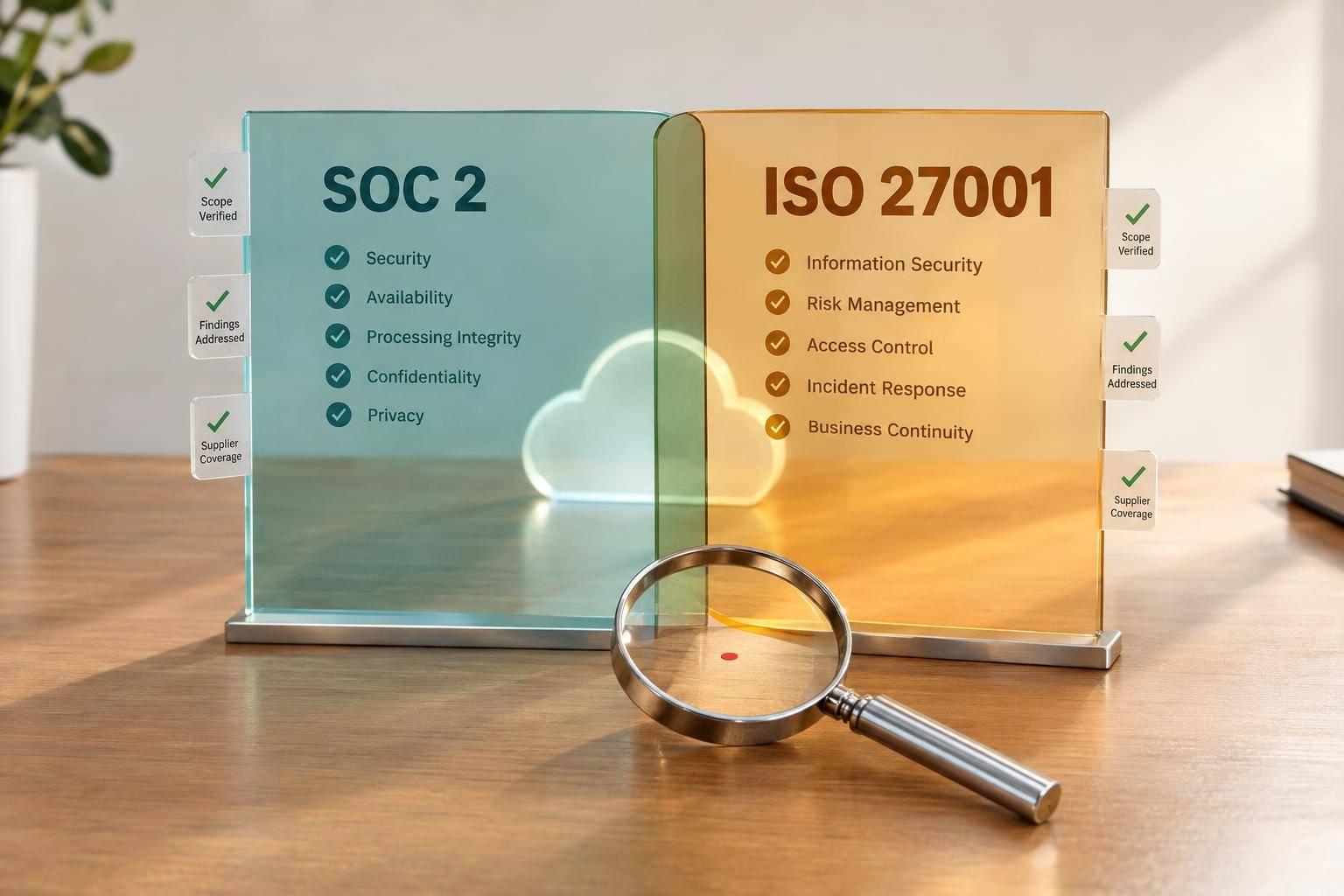
I don’t treat SOC 2 and ISO 27001 as substitutes. SOC 2 shows an auditor’s assessment of specified controls; ISO 27001 certifies a scoped information security management system (ISMS). Before approving a vendor, I check whether either covers the product, data, and suppliers you’ll use.
Quick Comparison
| Review point | SOC 2 | ISO 27001 |
|---|---|---|
| Main document | Auditor’s report | Certificate and scope statement |
| What it covers | Specified systems and controls | A defined ISMS |
| Time covered | Type I: one date; Type II: a period, typically 3–12 months | Certification maintained through surveillance audits |
| Testing detail | Type II includes tests, results, and exceptions | Certificate does not include detailed test results |
| What I request | Full report, findings, supplier coverage, and customer responsibilities | Current certificate, scope, Statement of Applicability, and available audit findings |
My rule: <u>match the review to the risk - not the badge</u>. I check document dates, unresolved findings, and proof of fixes. Then I review data storage, transfers, retention, deletion, access settings, penetration tests, and recovery tests.
Neither document answers every security or privacy question. I choose one or both based on data sensitivity, service needs, and contract terms - and approve only what the records support.
Do SOC 2 and ISO 27001 the right way with CSA STAR | Cloud Trust Summit 2024
sbb-itb-5f36581
What SOC 2 and ISO 27001 Show
Ask for the report or certificate - not the badge. Check its scope, controls, and data path to see which controls have been verified and which risks remain open.
| Comparison | SOC 2 | ISO 27001 |
|---|---|---|
| Assurance model | Independent attestation | Management system certification |
| Primary artifact | SOC 2 Type I or Type II report | Certificate and defined certification scope |
| Issuer | Licensed CPA firm | Accredited certification body |
| What it shows | Control design at a specific date; operating effectiveness over a period for Type II | The scoped ISMS meets ISO/IEC 27001:2022 requirements |
SOC 2 Scope, Report Types, and Testing
SOC 2 examinations use the AICPA Trust Services Criteria. Security is required. Availability, Processing Integrity, Confidentiality, and Privacy apply only if they’re included in scope.
| Review point | Type I | Type II |
|---|---|---|
| Control assessment | Design and implementation | Design and operating effectiveness |
| Time covered | A specified date | A defined period, typically 3–12 months |
| Testing evidence | Point-in-time assessment; no conclusion on effectiveness over time | Detailed operating-effectiveness tests and results for the period |
The findings cover only the scoped system - not every product the vendor sells. Request the full report, including the auditor’s opinion, system description, scoped criteria and controls, exceptions, subservice organizations, and CUECs.
For a Type II report, read the testing results, not just the opinion. Exceptions show where controls failed.
ISO 27001 Certification and Scope
ISO/IEC 27001:2022 certification covers the ISMS: governance, risk treatment, monitoring, continual improvement, and supplier controls. But its scope may be limited to a service, subsidiary, facility, or region.
Request the current certificate and scope statement. Check the dates, certification body, accreditation, and current surveillance or recertification status. An unexpired certificate alone isn’t enough.
Also request the Statement of Applicability (SoA). It lists applicable controls, their implementation status, the reasons for including them, and Annex A exclusions. If supplier-related controls are excluded, require the risk-based justification before accepting the evidence.
The certificate doesn’t provide the detailed control-testing results you’d find in a SOC 2 Type II report. Its scope sets the baseline for the evidence gaps reviewed next.
SOC 2 vs ISO 27001: Evidence and Limits
With that baseline in place, the key difference is what buyers can inspect. ISO audits assess implementation and effectiveness. But the certificate doesn’t include the control-level test details available in a SOC 2 Type II report.
| Review point | SOC 2 | ISO 27001 |
|---|---|---|
| Assessment timing | Type I: point in time; Type II: defined period | Certification maintained through surveillance audits |
| Availability evidence | Availability criteria only if included | Availability controls within scope |
| Testing detail | Type II includes tests, results, and exceptions | Certificate omits detailed test results |
Both still leave gaps in vendor-risk reviews.
Risks Neither Artifact Resolves
Neither artifact proves that the exact product is secure, that subprocessor oversight is complete, or that the vendor meets your contractual, regulatory, and privacy obligations. Customer controls need a separate review: vendor assurance doesn’t prove your team met CUECs or configured access correctly. Availability evidence also isn’t a promise of uptime or recovery. Ask for recovery-test results and RTOs.
Ask targeted questions about data storage, integration transfers, retention, and deletion to close gaps in your understanding of data flows. Request recent penetration-test evidence, too. Track unresolved items as review gaps - not as controls covered by the report or certificate.
How to Review Cloud Vendor Evidence

SOC 2 vs ISO 27001: Cloud Vendor Review Checklist
Use the scope and testing limits above to guide your review of SOC 2 and ISO 27001 evidence. Weigh each by its scope, age, and service risk. Match the depth of your review to data sensitivity, integration permissions, service criticality, and supplier complexity. Then check whether the evidence covers your product, data path, and suppliers.
Verify Scope, Freshness, and Findings
Match the SOC 2 system description or ISO 27001 scope to the purchased product, legal entity, and hosting environment. Check the SOC 2 reporting period, plus the ISO certificate’s validity and surveillance status. Record any changes since the report date.
Review SOC 2 exceptions and available ISO audit findings based on the affected systems, how long the issue lasted, customer impact, and remediation status. Require proof that the fix works - not just a target date. A finding that affects your production environment needs more attention than an unrelated issue elsewhere in the vendor’s scope.
Check Suppliers and Customer Responsibilities
List infrastructure providers, subprocessors, and carve-outs. Get separate evidence for supplier controls excluded from the review. Assign an internal owner to each applicable complementary user entity control (CUEC).
Map vendor controls alongside your CUECs across access, encryption, incident response, vulnerabilities, logging, backups, continuity, and deletion. Have your privacy team review data categories, retention, international transfers, and breach-notification terms. Check integration permissions and customer access settings separately.
Choose Evidence and Close Review Gaps
Use the table to select follow-up evidence for gaps that remain.
| Scenario | Primary evidence | Follow-up |
|---|---|---|
| In-scope SOC 2 Type II | SOC 2 Type II report | Review exceptions and assign applicable CUECs. |
| Valid ISO 27001 certificate | Valid certificate | Request the Statement of Applicability and a recent penetration-test summary. |
| Stale evidence | Bridge letter | Request recent internal audit results or a targeted questionnaire. |
| Sensitive data processing | SOC 2 Type II and ISO 27001 | Request business continuity and disaster recovery test results. |
| Infrastructure provider in scope | Subprocessor SOC 2 | Verify the vendor’s carve-out or inclusive method for subservices. |
Escalate material scope gaps, unresolved findings, and outdated evidence. Use targeted questionnaires, penetration-test summaries, vulnerability scans, and recovery-test results to answer specific questions. Base the approval decision - or the request for more evidence - on the gaps that remain.
Conclusion: Match Assurance to Vendor Risk
SOC 2 Type II shows how controls operated over a defined period, while ISO 27001 certification shows a scoped ISMS and governance.
This difference guides which evidence matters most when reviewing a cloud vendor. Choose SOC 2, ISO 27001, or both based on risk level, evidence quality, and contract requirements for vendor approval.
With a clear understanding of what each document proves, close the review with this checklist: verify scope, findings, CUECs, and unresolved technical risk. Approve only what the evidence supports.
FAQs
When should I require both SOC 2 and ISO 27001?
Require both SOC 2 and ISO 27001 as your business grows to serve clients across regions or when clients expect thorough security assurance. SOC 2 is standard in the United States, while ISO 27001 is recognized worldwide.
The two serve different but complementary roles: ISO 27001 sets up a security management framework, while SOC 2 provides detailed accountability for how well specific security controls work in practice.
Which audit findings should block vendor approval?
Block approval if a vendor can’t meet your minimum security requirements or provide an acceptable remediation plan. Red flags include missing incident response plans, outdated audit documentation, or insufficient encryption for sensitive data.
For major control exceptions or unresolved issues in your critical risk category, withhold approval until the vendor provides proof that the gaps have been closed. Validate those fixes through follow-up evaluations or updated audit evidence.
What if a vendor won’t share its full SOC 2 report?
A SOC 2 report is a private attestation, typically shared under a non-disclosure agreement (NDA). It includes detailed system descriptions and control tests, so vendors may ask for confidentiality protections before sharing it.
If a vendor still won’t share the report, ask for an executive summary or other assurance, such as ISO 27001 certification or another third-party attestation. These can help you assess the vendor’s security posture and manage your organization’s third-party risk.
Related Blog Posts
Get new content delivered straight to your inbox

The Response
Updates on the Reform platform, insights on optimizing conversion rates, and tips to craft forms that convert.

Drive real results with form optimizations
Tested across hundreds of experiments, our strategies deliver a 215% lift in qualified leads for B2B and SaaS companies.
